At nine most mornings, a software developer in Kamalpokhari who writes code for an Australian lender claims a corner table at a café, orders the first of several coffees, and starts a workday that is really an Australian afternoon. She is one of thousands of Nepalis now earning in foreign currency without leaving Kathmandu. What she does not have, and what her counterparts in Bengaluru or Jakarta take for granted, is a purpose-built desk with backup power, a quiet call booth, and a room upstairs she could rent by the month. The building type that solves her problem has become a multi-billion-dollar asset class almost everywhere except here.
Key Takeaways
- The global flexible office market is valued at an estimated USD 56 billion in 2026 and projected to reach USD 100 billion by 2030, a 15.7 percent compound annual growth rate, according to Research and Markets figures compiled by OfficeRnD.
- 55 percent of global corporate occupiers now use flexible office space in some form, per Cushman and Wakefield’s 2025 survey, which is why co-working stopped being a startup novelty and became a line item for large employers.
- India’s organized co-living inventory stood at roughly 0.3 million beds in 2025 and is projected to approach 1 million beds by 2030, with the market value rising from about INR 40 billion to close to INR 200 billion, according to Colliers.
- Nepal’s official telecommunications, computer and information services exports reached Rs 22.33 billion in FY 2024-25, 9.36 percent of service exports, but the Nepal Association of Software and IT Services estimates the real figure near USD 1 billion because much of it is logged as remittance.
- About 500,000 young Nepalis reach working age every year, per the World Bank, and a shrinking share are leaving for the Gulf, concentrating more of them in Kathmandu.
- Kathmandu has roughly a dozen listed co-working spaces and, by one working guide’s count, only five or six worth paying for. Organized, branded co-living of the kind scaling across India is effectively nonexistent in Nepal.
What co-working and co-living actually are

Both models take a building that used to be sold or leased whole and slice it into memberships. Co-working rents the desk, the meeting room, and the coffee machine by the day or month instead of locking a tenant into a multi-year office lease. Co-living does the same for housing: a furnished room with shared kitchens, cleaning, internet, and community events, billed monthly, aimed at students and young workers who do not want to furnish a flat or sign a year-long rental agreement. The common thread is that the operator carries the real estate risk and the occupier buys flexibility.
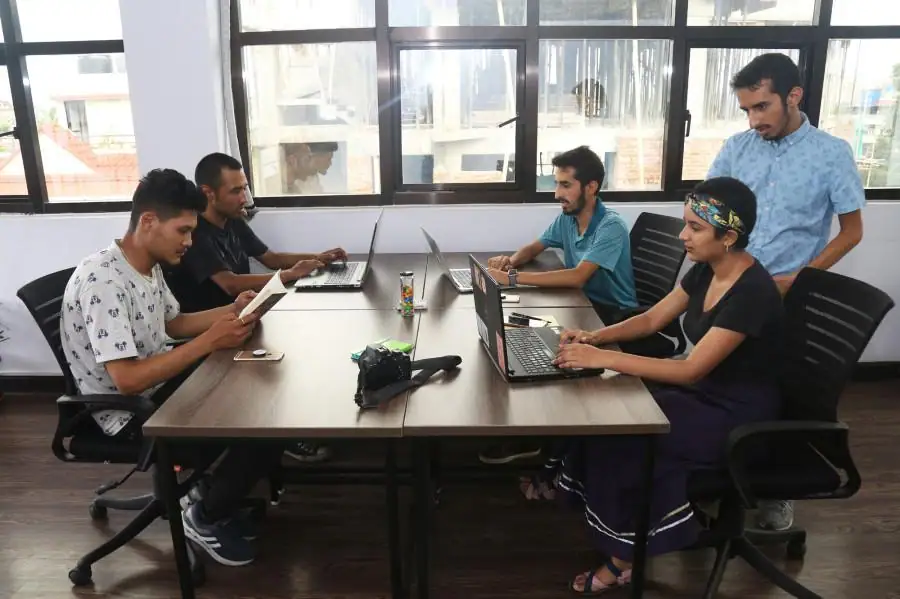
That trade has scaled into real money. Globally, coworking occupancy averaged about 68 percent at the start of 2025 (Deskmag), the United States alone had 8,420 coworking locations as of the third quarter of 2025 with a national median membership around USD 225 a month (CoworkingCafe), and flexible space now accounts for roughly 4 percent of office stock across major Asia-Pacific markets tracked by CBRE. The model is not untested, and it is not fringe.
India shows what the demand curve looks like next door

Nepal’s most useful comparison is not San Francisco but India, where the same demographic pressures arrived a decade earlier. Colliers estimates India had about 0.3 million organized co-living beds in 2025, a penetration rate near 5 percent, and projects the inventory to roughly triple to close to 1 million beds by 2030, lifting penetration above 10 percent. In value terms, the firm’s research puts the market at around INR 40 billion in 2025 with the potential to reach close to INR 200 billion by 2030. The demand base is enormous: Colliers pegs student-living demand at around 12 million beds in 2025 and the co-living demand base among urban migrants aged 20 to 34 at 6.6 million beds.
What made that supply bankable was institutional capital and a rental arbitrage. Leading Indian operators have collectively raised capital on the order of USD 1 billion since 2015, and single-occupancy co-living typically prices 20 to 35 percent below comparable independent rentals, according to Colliers. Operators such as Zolo, Stanza Living, and Colive built national bed counts in the tens of thousands each. The lesson for Nepal is less about the exact numbers and more about the mechanism: a young, mobile, urbanizing population plus patient capital turns informal room-renting into a branded, financed asset class.
Nepal has the tenants
The demand side in Nepal is not a projection, it is already here. The Nepal Chamber of Industries IT Council counts more than 100 firms that export formally and employ over 80,000 people, and the Nepal Association of Software and IT Services estimates IT service exports reached about USD 1 billion in 2025, far above the Rs 22.33 billion the government’s trade report captured, because foreign payments are often recorded as remittance. The May 2026 budget added a 50 percent income-tax exemption on IT export earnings and promised a law to formalize remote work for Nepalis employed by foreign firms (Katmandu Journal). Every one of those workers needs a reliable desk, and many of them are exactly the people co-working serves.
The housing demand is just as concrete. Around 500,000 young Nepalis reach working age each year, Gulf labor approvals have fallen sharply, and the ones who stay gravitate to the Kathmandu Valley for study and work. Those students and young professionals currently find rooms through informal channels: word of mouth, hostels, paying-guest arrangements, and listing sites like Basobaas. That is precisely the fragmented, under-served market that organized co-living consolidated in India. The demand for shared space in Nepal is real; it ties directly to the same remote-work and office trends reshaping Kathmandu’s office market, where IT firms expand while older buildings empty out.
Nepal does not have the buildings
Supply is where the comparison breaks. On the co-working side, Kathmandu has a small but credible scene: directories such as Coworker.com list around 14 spaces, including Work Around in Kalopul, Rem.work in Kamalpokhari, The 100 in Jhamsikhel, Hub108 in Golfutar, Nepal Communitere in Pulchowk, and Karkhana. Indicative pricing from listings and working guides runs from day passes of roughly Rs 250 to Rs 500 up to monthly memberships of about Rs 4,500 to Rs 15,000. These are useful spaces, but they are a handful of converted floors spread across the valley, not glass towers, and none operate at the scale of a financed operator.
On the co-living side, there is essentially nothing organized. Nepal has hostels, paying-guest rooms, and informal rentals, but no branded operator running thousands of professionally managed beds with the amenities, financing, and standardization that define the Indian model. The gap is not a lack of tenants. It is a lack of the three things that built the industry elsewhere: institutional capital willing to fund an operator, a formal rental market that an operator can underwrite, and buildings with floorplates large enough to make per-bed economics work. Nepal’s rental market is overwhelmingly informal, which is a feature for small landlords and an obstacle for anyone trying to build a scaled, bankable business on top of it.
The case for caution, not just the case for optimism
It would be easy to read the demand numbers and declare co-working and co-living an obvious opportunity. The honest version is more mixed. The global reference point for co-working is also a warning: the sector’s best-known operator collapsed under the cost of long leases paid against short memberships, and roughly a third of coworking businesses were not profitable over the prior year even in mature markets (Deskmag). An operator in Kathmandu faces a thinner market than that, and competes against a café table that costs the price of a coffee and an informal room that costs nothing to list.
Nepal’s macro backdrop adds friction. The economy grew just 3.85 percent in 2025-26, financing is expensive, and the banking sector is already heavy with property exposure, as detailed in Nepal’s Rs 689 billion in real estate loans. The realistic near-term path is not a Stanza Living for Nepal but incremental: existing co-working operators adding rooms, student-housing developers adding services, or a mall or office with falling footfall repurposing floors, the kind of retail overbuild documented in Kathmandu’s mall glut. Flexible space abroad grew into whatever buildings were underused, and Nepal has no shortage of those.
The pattern here rhymes with other global property ideas that reached Nepal late and partially. Just as REITs reshaped property investing in dozens of countries before Nepal put them on a clock, co-working and co-living are proven models arriving into a market that has the demand well before it has the capital and the rules. The demographic math favors shared space in Nepal. Whether anyone can build a financed business on it depends less on the tenants, who already exist, and more on whether capital and regulation catch up to them.
Frequently Asked Questions
What is the difference between co-working and co-living?
Co-working rents workspace (a desk, a meeting room, shared amenities) by the day or month instead of a long office lease. Co-living rents furnished housing (a room with shared kitchens, cleaning, and internet) on a monthly basis, mainly to students and young professionals. Both replace a large fixed commitment with a flexible membership, and in both the operator carries the real estate risk.
Are there co-working spaces in Kathmandu?
Yes. Directories such as Coworker.com list around 14 spaces in Kathmandu, including Work Around, Rem.work, The 100, Hub108, Nepal Communitere, and Karkhana. Indicative pricing runs from day passes of about Rs 250 to Rs 500 up to monthly memberships near Rs 4,500 to Rs 15,000. The scene is small but real, used mostly by remote workers, freelancers, and startups.
Does Nepal have organized co-living like India’s Stanza Living or Zolo?
No. Nepal’s shared housing is informal: hostels, paying-guest rooms, and privately rented flats found through word of mouth or listing sites. There is no branded operator running thousands of professionally managed beds, which is what defines the organized co-living sector that Colliers values at around INR 40 billion in India in 2025.
Why has co-living not scaled in Nepal?
Three things are missing rather than tenants: institutional capital willing to fund an operator, a formal rental market an operator can underwrite, and buildings with large enough floorplates to make per-bed economics work. Nepal’s rental market is overwhelmingly informal, financing is costly, and banks are already heavily exposed to property, which together make a scaled, bankable business hard to assemble.
Who is driving demand for shared space in Nepal?
Students and young professionals moving into the Kathmandu Valley, and a growing group of Nepalis who work remotely for foreign firms. With about 500,000 young people reaching working age each year, Gulf migration slowing, and IT service exports estimated near USD 1 billion, the pool of people who need a reliable desk or a furnished room is expanding faster than organized supply.
Is co-working a good investment in Nepal right now?
The demographics favor it, but the risks are real. Co-working’s best-known global operator failed on the mismatch between long leases and short memberships, and even in mature markets a large share of spaces are unprofitable. In Nepal an operator competes with near-free informal alternatives in a thin market and an expensive financing environment. The more realistic near-term play is incremental: adding services to existing spaces or repurposing underused retail and office floors, rather than building at India’s scale.
For more on Nepal’s property market, see our Real Estate coverage.