A salaried worker in Kathmandu with Rs 500,000 saved can buy shares in a commercial bank, a hydropower company, or a life insurer on NEPSE this afternoon. What that same worker cannot buy is a slice of an office tower in Durbar Marg or a share of a shopping complex in Lalitpur. Commercial property in Nepal is sold whole, in plots and buildings, to people who can front crores. That wall between ordinary savers and income-producing real estate is exactly what a Real Estate Investment Trust (REIT) is built to remove, and for the first time Nepal’s regulator has put one on the calendar.
The Securities Board of Nepal (SEBON) unveiled a Capital Market Development Blueprint in July 2026 that lists REITs, exchange-traded funds, and infrastructure investment trusts among its five-year targets, with REITs penciled into the roughly 2028 to 2031 window. The ambition is real. So is the gap between a line in a roadmap and a functioning market. The useful question is not whether REITs are a good idea in the abstract, because 42 countries already run them, but whether Nepal’s market can carry one.
Key Takeaways
- REITs operate in 42 countries and regions, and the global listed REIT market was worth about USD 2.04 trillion at the end of 2024, according to Nareit. The structure was first created in the United States in 1960.
- Nepal has no REIT today. SEBON’s 2026 Capital Market Development Blueprint places REITs, ETFs, and InvITs on a five-year timeline, with REITs grouped into a phase running roughly 2028 to 2031.
- India is the nearest template. It finalized REIT regulations in 2014, listed its first REIT (Embassy Office Parks) in April 2019, and its four listed REITs now hold roughly Rs 1.63 lakh crore in assets across more than 129 million square feet of Grade A space.
- Nepal has the retail plumbing: about 7.77 million demat accounts, 297 listed companies, and a market-capitalization-to-GDP ratio near 74 percent. What it lacks is the legal framework, because the governing Securities Act dates to 2006 and an amendment is still pending.
- The binding constraint is supply, not demand. Nepal has little institutional-grade, rent-paying commercial space, and its dual land-pricing system makes independent, credible valuation hard.
What a REIT actually is

A REIT is a company that owns, operates, or finances income-producing real estate, and whose shares trade on a stock exchange like any other listed firm. Instead of buying a building, an investor buys units in a trust that owns a portfolio of buildings and passes through the rent. The defining rule across most jurisdictions is a high mandatory payout: under the US model that shaped the global template, a REIT must distribute at least 90 percent of its taxable income to unitholders, which is why REITs are treated as income instruments rather than growth bets. The Nareit definition captures the core idea: real estate turned into a liquid, dividend-paying security.
That liquidity is the whole point. Property is normally slow and lumpy to buy and sell. A REIT converts it into something an investor can enter or exit in a single trading session, at a transparent price, with a professional manager handling tenants, maintenance, and leases.
The global track record, and why India is the right mirror
REITs are not an experiment. Since 1960 the model has spread to 42 countries and regions, and listed REITs worldwide carried about USD 2.04 trillion in equity market value at the end of 2024. For Nepal, though, the instructive comparison is not Wall Street. It is India, a neighbor with a similar legal lineage that adopted REITs recently enough that the full arc is visible.
India’s regulator first floated the concept in 2007, finalized its REIT regulations in 2014, and did not see its first listing, Embassy Office Parks, until April 2019. That is a twelve-year path from idea to listing. Today India has four listed REITs: Embassy Office Parks, Mindspace Business Parks, Brookfield India Real Estate Trust, and Nexus Select Trust. Their combined market capitalization crossed Rs 1 lakh crore in July 2025, and the market’s gross assets under management reached about Rs 1.63 lakh crore, spanning more than 129 million square feet of Grade A office and retail space. In the first quarter of FY26 alone, they distributed Rs 1,559 crore to over 2.7 lakh unitholders, and in 2024 India added a framework for smaller Small and Medium REITs to widen the field. The distribution and market-cap data show a product that took years to build and is only now reaching scale.
The lesson Nepal should take from India is sequencing. The regulation came first, the right assets came second, and investor trust came last and slowest. SEBON’s own blueprint acknowledges this by citing the Embassy timeline directly.
Where Nepal stands now
Nepal has no REIT and, as of now, no legal vehicle that lets the public pool money into physical real estate. Mutual funds regulated by SEBON invest in listed shares and bonds, not in buildings. So a Nepali who wants real estate exposure has two options: buy property directly, one plot or flat at a time through listing platforms such as Basobaas, or buy bank and developer stocks on NEPSE and accept that they are not the same thing as owning the underlying property. For a fuller comparison of those paths, see our analysis of real estate versus NEPSE as an investment.
The retail infrastructure a REIT would need already exists. Nepal has 7,766,565 demat accounts and about 6.74 million Mero Share users, 297 listed companies, and a market-capitalization-to-GDP ratio of roughly 74 percent (around Rs 4,656 billion), which is close to the global average. Daily turnover runs near Rs 8 billion. SEBON’s ten-year blueprint wants to push the market-cap ratio above 150 percent and turnover to Rs 30 billion by 2036, and it treats REITs as one of the new instruments that would help get there.
There is also a concentration problem a REIT could help ease. Nepal’s banking system carries enormous exposure to property, as laid out in our look at the Rs 2 trillion of real estate exposure on bank balance sheets. A REIT market would move some real estate financing off bank books and onto public markets, spreading risk across unitholders instead of concentrating it in lenders.
Can Nepal’s market actually support a REIT?

Here is where optimism should slow down. A REIT needs three things Nepal does not yet have in enough supply, and none of them is fixed by writing a regulation.
First, it needs institutional-grade, rent-paying assets. A REIT is only as good as the leases inside it. India’s REITs are built on millions of square feet of Grade A offices rented to multinational tenants on long leases. Nepal’s commercial stock is thinner, more fragmented, and often leased informally. Our reporting on Kathmandu’s office market found that even basic vacancy and rent data are not systematically measured, which is a problem when a REIT must report occupancy and yields to the public every quarter.
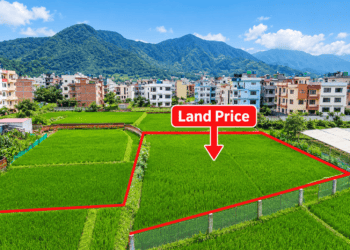
Second, it needs credible, independent valuation. REIT unit prices rise and fall on the appraised value of the properties inside. Nepal’s dual land-pricing system, where the government valuation and the market price diverge sharply, makes honest appraisal difficult and creates room for disputes. A REIT cannot run on two sets of books.
Third, it needs the law. The Securities Act in force dates to 2006 and predates REITs entirely. SEBON has promised an amendment, but until the legal and tax treatment of a trust that owns property and passes through rental income is settled, including how that income is taxed at the trust and the unitholder level, no sponsor can launch one with confidence. Governance is the quiet risk here: a REIT concentrates other people’s money in a manager’s hands, and weak disclosure or related-party dealing can hollow it out fast.
The honest reading is that SEBON’s five-year target is directional, not a delivery date. India took twelve years from concept to first listing with a deeper market and a stronger legal base. If Nepal passes the Securities Act amendment, builds a valuation standard, and gets even one sponsor to assemble a portfolio of genuinely rentable commercial space, a first REIT by the early 2030s is plausible. Skip any of those steps and the line in the blueprint stays a line. For the regulator’s own framing, SEBON publishes its policies and investor resources at the Securities Board of Nepal, and more related coverage sits in our real estate section.
Frequently Asked Questions
What is a REIT in simple terms?
A REIT (Real Estate Investment Trust) is a company that owns income-producing property such as offices, malls, or warehouses, and whose shares trade on a stock exchange. You buy units instead of a building, and the trust passes through most of the rent as dividends. Under the US model, a REIT must distribute at least 90 percent of its taxable income to unitholders.
Does Nepal have REITs right now?
No. Nepal has no listed REIT and no legal vehicle that lets the public pool money into physical real estate. Mutual funds in Nepal invest in listed shares and bonds, not in buildings. SEBON’s 2026 Capital Market Development Blueprint proposes introducing REITs within a five-year window, but the framework does not yet exist.
When could REITs launch in Nepal?
SEBON’s blueprint groups REITs into a phase running roughly 2028 to 2031. That target is directional rather than guaranteed. For comparison, India took twelve years from first floating the idea in 2007 to its first REIT listing in 2019, and Nepal still needs to amend its 2006 Securities Act first.
How large is India’s REIT market?
India has four listed REITs: Embassy Office Parks, Mindspace Business Parks, Brookfield India Real Estate Trust, and Nexus Select Trust. Their combined market capitalization crossed Rs 1 lakh crore in July 2025, and the market’s gross assets under management reached about Rs 1.63 lakh crore across more than 129 million square feet of Grade A space.
What are the main risks of REITs for Nepal?
The three biggest hurdles are a shortage of institutional-grade, rent-paying commercial space, the difficulty of credible valuation under Nepal’s dual land-pricing system, and the absence of an updated legal and tax framework. Governance is an added risk, because a REIT concentrates investors’ money with a manager and depends on strong disclosure.
How is a REIT different from buying property directly?
Buying property directly means owning a specific plot or flat, with high entry cost, slow resale, and hands-on management. A REIT lets you own a small share of a professionally managed portfolio, trade it in a single session at a transparent price, and receive rental income as dividends without maintaining anything yourself.