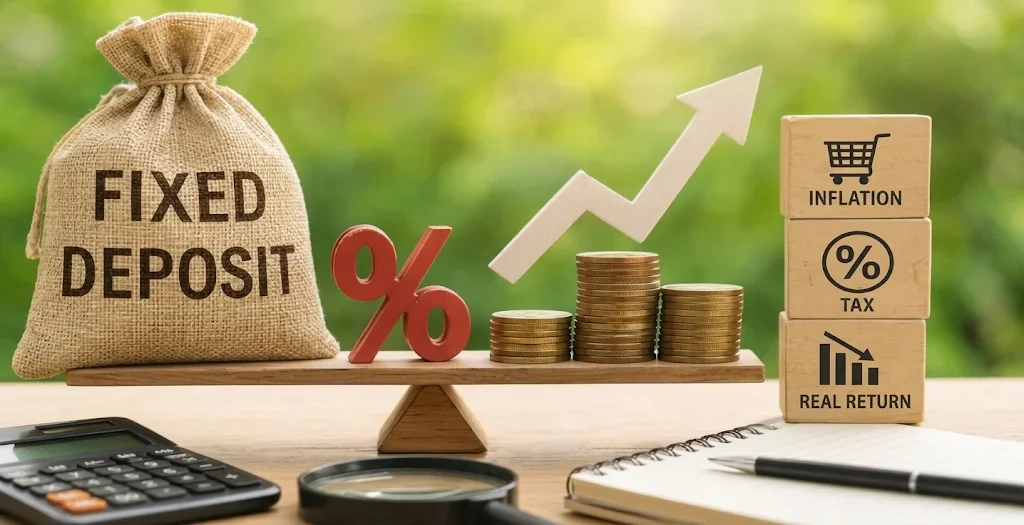
A retired schoolteacher in Bhaktapur moves NPR 10 lakh of her provident fund payout into a one-year fixed deposit. The branch officer quotes the rate, she multiplies it out on a calculator, and she plans her year around that number. A year later the credit is smaller than she expected. Nobody made a mistake. The bank did exactly what the law requires.
That gap is the tax on fixed deposit interest in Nepal, collected as TDS (tax deducted at source) before the interest ever reaches you. It is not hidden, exactly. It is just never in the number anyone quotes. The rate on the branch board, the bank’s website and the rate comparison sites is a pre-tax rate. What you earn is something else.
This piece explains how the deduction works, what it does to a real deposit in late 2026, and why the TDS itself is the smallest of your problems. The bigger story is that the flat tax quietly favors high earners over the small savers who rely on deposits most, and that at today’s rates and inflation, a plain FD is losing purchasing power even before tax.
How tax on fixed deposit interest in Nepal is deducted
The rule sits in the Income Tax Act, 2058. Section 88(3), in its current text as published by NepalLaws, says a resident bank, financial institution, cooperative, debenture issuer or listed company must deduct tax at six percent when it pays interest to a natural person, where the interest has a source in Nepal and is not connected to running a business. That covers your fixed deposit, your savings account interest and the interest on a listed company’s debenture.
The rate used to be 5 percent. According to summaries of the FY 2080/81 budget, the Finance Act 2080 raised it to 6 percent from mid-July 2023, and professional rate cards for FY 2083/84 (which began on July 17, 2026, Shrawan 1, 2083 BS) still list it at 6 percent. Plenty of older blogs, calculators and even some comparison sites still show 5 percent, or confuse it with the 15 percent rate that applies when interest is paid to a company. If you are an individual, 6 percent is the number.
The mechanics are simple. Each time the bank credits interest to you, whether that is quarterly or at maturity depending on the product, it calculates the gross interest, keeps 6 percent, pays that slice to the Inland Revenue Department (IRD) under your PAN or account details, and credits you the remaining 94 percent. Your statement usually shows only the net figure. If you want to see the gross amount and the tax separately, ask the bank for an interest certificate. Most will issue one on request.
“Final” is the word that matters
The second piece of the law is Section 92. It lists payments from which tax is “withheld finally,” and clause (e) covers interest paid by banks, financial institutions, cooperatives and the other payers named in Section 88(3).
Final withholding means two things. The good part: you do not add the FD interest to your annual income, you do not pay slab rates on it, and you do not need to declare it again. The bank’s deduction settles the matter. The less obvious part: you cannot get any of it back. There is no refund if your income is low, and no credit against your other tax. The 6 percent is gone the moment it is withheld.
Compare that with salary TDS, which is an advance against your annual bill and can be adjusted or refunded. FD interest TDS is not an advance. It is the whole tax.
Who pays a different rate
Not every depositor is treated the same.
Companies and other entities face 15 percent withholding on interest, and for them it is not final. It is credited against their corporate tax when they file.
Section 11 of the Act carves out a small exemption: interest of up to NPR 25,000 a year from deposits with certain microfinance institutions, rural development banks, the Postal Savings Bank and qualifying cooperatives is not taxed. It does not apply to an ordinary FD at a commercial bank in Kathmandu, Pokhara or anywhere else. Many people have heard of “the NPR 25,000 exemption” and assume it is theirs. For most bank depositors, it is not.
Non-resident depositors, including many NRNs, sit under different withholding rules, and the rate and treatment depend on residency status and the type of account. If you live abroad, do not assume the 6 percent figure applies to you. Ask the bank how it classifies your account, and see our guide on inflation and the real return on Nepali savings for how the after-tax math compounds over time.
There is no separate rate by age. The withholding rule in Section 88(3) does not distinguish a 25-year-old saver from a 70-year-old pensioner. Some banks pay senior citizens a slightly higher rate, but the tax on that interest is the same 6 percent.
What the deduction does to a real deposit today
Rates have fallen a long way from the double-digit deposit offers of a few years ago. Take Nepal Bank Limited’s published schedule, effective Kartik 1, 2083 (October 18, 2026). It lists an individual fixed deposit of three months to one year at 2.76 percent, one to two years at 3.00 percent, two to five years at 3.30 percent, and five to ten years at 3.75 percent. Its remittance fixed deposit for three months to one year pays 3.76 percent. Private banks quote somewhat different numbers, and some development banks and finance companies pay more, but the order of magnitude is the same: single-digit, and low single-digit at that.
Now run the retired teacher’s NPR 10 lakh through Nepal Bank’s one-year individual rate.
- Gross interest at 2.76 percent: NPR 27,600
- TDS at 6 percent: NPR 1,656
- Net interest credited: NPR 25,944
- Effective after-tax rate: about 2.59 percent
The shortcut is worth memorizing. Your after-tax FD rate is the quoted rate multiplied by 0.94. A 4 percent FD is really 3.76 percent. A 5 percent remittance deposit is really 4.7 percent. When a bank advertises a “special” rate a quarter of a point above a competitor, the tax shaves a little off that advantage too, but the gap between the two banks stays proportionally the same. TDS does not change which deposit is better. It changes how much any of them actually pays.
The tax is not the leak. Inflation is.

Here is where the arithmetic gets uncomfortable. According to Nepal Rastra Bank’s macroeconomic data for the first two months of FY 2083/84, as reported by ShareSansar on October 15, 2026, year-on-year consumer inflation stood at 6.34 percent, up from 5.96 percent in the first month. NRB’s monetary policy for 2083/84 had projected inflation of around 5.5 percent for the year.
Put the teacher’s deposit next to that figure. Her NPR 10 lakh grows to NPR 10,25,944 after tax. To keep the same purchasing power over a year of 6.34 percent inflation, she would need roughly NPR 10,63,400. She is about NPR 37,000 short. Her real, after-tax return is roughly minus 3.5 percent.
Look at where that loss comes from. The TDS cost her NPR 1,656. Inflation cost her about NPR 63,400. The tax that savers complain about, when they notice it, is roughly 3 percent of the damage.
This is the core point most FD explainers miss. They treat the 6 percent deduction as the headline because it is a visible line on a certificate. But at current deposit rates, the tax is a rounding error next to the gap between what banks pay and what prices are doing. A depositor who spends energy trying to avoid 6 percent TDS while leaving money in a 2.76 percent deposit through a 6 percent inflation year has the priorities backwards.
That is a statement about the present, not a permanent law. If inflation eases toward NRB’s projection, as the central bank expects from the fourth quarter of the fiscal year, and if deposit rates rise when liquidity tightens, the real return can turn positive again. Deposit rates in Nepal move with the liquidity cycle, which we explain in our comparison of fixed deposits and stocks in Nepal. But anyone planning around a deposit this year should plan around the real number, not the quoted one.
The flat 6 percent favors the people who need it least
A flat, final tax sounds neutral. It is not.
Under the FY 2083/84 slabs, a resident individual’s first NPR 10 lakh of taxable income is taxed at 1 percent, and the rate climbs through 10, 20 and 27 percent to a top rate of 29 percent above NPR 40 lakh, according to the Finance Bill 2083 slab schedule. Now think about who holds fixed deposits and what they would pay if interest were simply added to their income.
The retired teacher with a modest pension and NPR 10 lakh in the bank sits in the lowest band. If her interest were taxed like the rest of her income, she would pay around 1 percent on it, or less. Instead she pays 6 percent, and because the tax is final, she cannot claim the difference back. In effect, the system over-taxes her interest relative to her income.
A senior executive earning NPR 60 lakh a year sits in the 29 percent band. If his interest were taxed at his marginal rate, he would pay 29 percent on it. Instead he pays 6 percent and is done. In effect, the system under-taxes his interest by more than 20 percentage points.
This is a fact about how the law is built, not a scandal. Final withholding exists because it is cheap to administer: the IRD collects the tax from a few hundred institutions instead of chasing millions of small depositors through returns. Nepal has a narrow filing base, and a flat final tax on interest is a practical way to collect anything at all. That is a reasonable trade-off. But it is still a trade-off, and the people on the losing side of it are small savers with low incomes, many of them retirees, widows and households living on remittances, who keep a larger share of their wealth in deposits than anyone else.
Our opinion: if Nepal ever wanted to make deposit taxation fairer without losing the simplicity of withholding, the obvious tool would be a modest annual exemption on interest for all individuals at regulated banks, not only at microfinance institutions and rural cooperatives. That is a policy suggestion, not a prediction. Nothing in the current Finance Act points to it.
FD interest versus the other income you can earn
The other place the 6 percent matters is when you compare a deposit with something else. Savers often line up gross numbers from different products as if they were taxed the same way. They are not.
As of late 2026, the main rates for individuals look like this. FD and savings interest: 6 percent, final. Cash dividends from a resident company: 5 percent, final, under the Act’s dividend withholding rules. Capital gains on listed shares: 5 percent for shares held 365 days or less and 3.75 percent for shares held longer, under the Ministry of Finance decision published in the Nepal Gazette and reported by ShareSansar on September 22, 2026. Those share rates replaced the 10 and 7.5 percent rates set by the Finance Bill 2083 only a few months earlier. We cover that change in detail in our explainer on Nepal’s new capital gains tax.
So, by rate alone, the safest product on the list (a bank deposit) now carries a higher tax rate on its return than a short-term share trade on NEPSE. That is an odd ordering, and it is the result of piecemeal changes rather than design.
Do not over-read it. A tax rate is not a reason to move money from a deposit into shares. The tax difference between 6 and 5 percent on a few thousand rupees of interest is trivial. The risk difference between a bank deposit and a stock is enormous. A share can fall 30 percent in a quarter. A deposit at a licensed bank cannot, and the Deposit and Credit Guarantee Fund backs individual deposits up to a set limit if a bank fails. What the comparison should change is your expectation. If you are holding money in an FD, you are paying for safety and certainty. Be clear that, right now, the price of that safety includes a negative real return.
How to read your own FD after tax

A few habits make the tax visible and stop it from distorting your planning.
Always convert to the after-tax rate first. Multiply any quoted individual FD rate by 0.94. Do this before comparing banks, before comparing an FD with a debenture, and before comparing anything with inflation.
Compare after-tax return with current inflation, not last year’s. NRB publishes monthly macroeconomic data. If the after-tax FD rate is below the latest year-on-year inflation figure, your deposit is shrinking in real terms. That does not make it the wrong place for your money, but it does mean it is a holding place, not a growth engine.
Get the interest certificate once a year. Check that the bank deducted 6 percent, not 15 percent (a classification error that can happen if your account is coded as an entity) and not the old 5 percent. Banks do make data errors, and because the tax is final, an over-deduction is hard to unwind later.
Know which money belongs in a deposit. An emergency fund, money you need for a known expense in the next year or two, and capital you cannot afford to see fall: these belong in deposits regardless of the real return, because the job is safety. We set out where that money should sit in our guide to where to park your emergency fund in Nepal. Long-term savings you will not touch for a decade are a different question, and leaving them in deposits through high inflation has a cost.
Do not chase higher rates without pricing the risk. Finance companies, some development banks and savings cooperatives advertise higher rates than commercial banks. The TDS rule is the same at all of them. The difference in rate is mostly a difference in risk. A cooperative paying three points more is not a tax trick. It is a riskier borrower paying you for that risk, and Nepal’s recent cooperative failures show what that risk looks like when it materializes.
The verdict
The tax on fixed deposit interest in Nepal is simple: 6 percent, deducted at source, final. You do not need to file anything for it, and you cannot claim any of it back. Memorize the 0.94 multiplier and you will never be surprised by a maturity credit again.
But the tax is not the thing to worry about. At Nepal Bank’s 2.76 percent one-year rate and NRB’s 6.34 percent inflation reading, a deposit is losing about 3.5 percent of its purchasing power a year, and the TDS accounts for only a sliver of that. The flat, final design also means the lowest-income savers pay a higher effective rate on their interest than they would under their own slab, while high earners pay far less than theirs.
None of this makes FDs bad. It makes them what they are: a safe place to hold money you cannot afford to lose, at a known cost. The mistake is not keeping money in a fixed deposit. The mistake is reading the quoted rate as your return.
This is analysis, not financial advice.
Frequently Asked Questions (FAQs)
1. What is the TDS rate on fixed deposit interest in Nepal?
The TDS rate on fixed deposit interest for individuals is 6%. Banks automatically deduct this tax before crediting the interest to your account.
2. Can I claim a refund on TDS deducted from my fixed deposit interest?
No. Fixed deposit interest TDS is a final tax, meaning you cannot claim a refund or adjust it against other income tax liabilities.
3. How do I calculate fixed deposit interest after tax in Nepal?
Multiply the bank’s advertised interest rate by 0.94 to calculate your after-tax interest rate. For example, a 5% FD rate gives you an actual return of 4.7% after TDS.
4. Is fixed deposit interest taxable for senior citizens in Nepal?
Yes. Senior citizens are also subject to 6% TDS on qualifying fixed deposit interest. There is no separate tax rate based on age.
5. Is investing in a fixed deposit profitable when inflation is high?
Not always. If the after-tax FD interest rate is lower than inflation, your money loses purchasing power over time, even though the amount in your bank account increases.