On Wednesday, November 4, 2026, exactly 35 units of Nepal’s only publicly listed green bond changed hands on NEPSE. The last price was NPR 1,072.30 for a bond with a face value of NPR 1,000, according to ShareSansar’s market data for the symbol NIFRAGED. That one quiet line of data tells you more about green bonds in Nepal than most of the launch-day speeches did. The bond pays its coupon. It trades, a little. And the “green” in its name has nothing to do with either fact.
That is the argument of this piece. Green bonds in Nepal are a real and probably useful new instrument for funneling foreign and institutional money into hydropower and clean energy. For an individual investor, though, the green label is marketing. It does not raise your coupon, it does not make your money safer, and nobody can currently force the issuer to keep its green promises. Judge a green bond exactly as you would judge any other debenture: who owes you the money, how sure you are of getting it back, what it really yields, and whether you can get out early. If it passes those tests, the climate angle is a nice bonus. If it fails them, the label should not rescue it.
What a green bond actually is
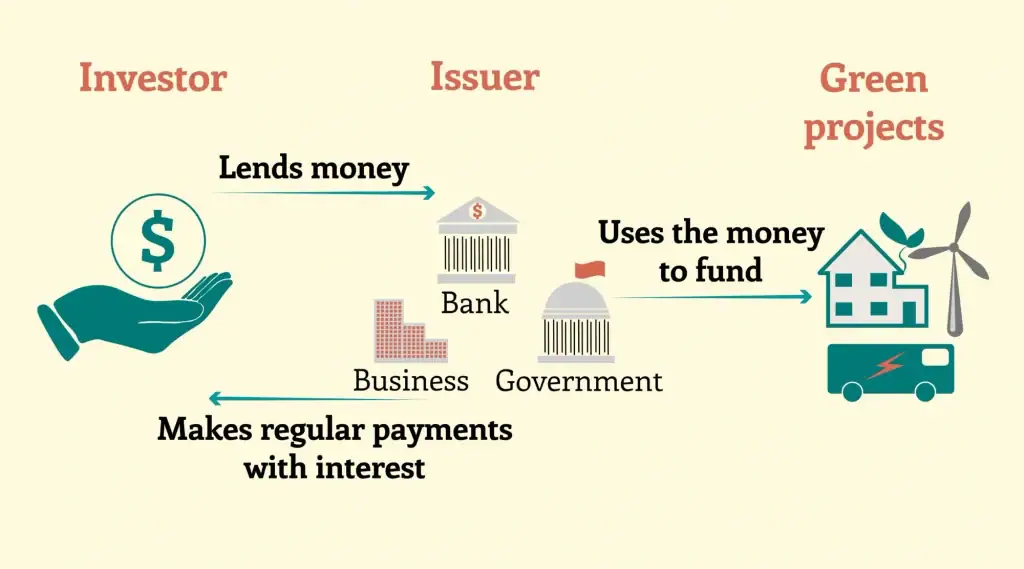
A green bond is an ordinary bond with a promise attached. Like any debenture, it is a loan you make to the issuer. You get a fixed coupon (the annual interest rate) for a fixed term, then your principal back at maturity. The difference is a use-of-proceeds commitment: the issuer says the money it raises will go only to projects with an environmental benefit, such as renewable power, energy efficiency or climate resilience.
Internationally, most credible green bonds follow the Green Bond Principles published by the International Capital Market Association (ICMA). Those principles rest on four pillars: how the proceeds are used, how projects are evaluated and selected, how the money is tracked inside the issuer, and how results are reported to investors. Issuers often add a second-party opinion, an outside reviewer’s assessment of whether the framework is credible.
Notice what is missing from that list. Nothing in the green label changes who repays you. A green bond issued by a bank is backed by that bank’s whole balance sheet, the same as its plain debenture. If the bank gets into trouble, green bondholders do not get a separate pot of clean-energy assets to claim. They stand in the same line as everyone else holding that class of debt. The label describes where the money goes, not where your repayment comes from.
How Nepal got its first green bonds
Nepal’s green bond market is barely a year and a half old, and it has exactly two deals worth knowing.
The first was private. In April 2025, NMB Bank signed Nepal’s first green bond deal with IFC (the World Bank Group’s private-sector arm) as anchor investor, alongside British International Investment and MetLife, a combined investment of USD 60 million, according to IFC’s press release dated April 28, 2025. NEPSE Trading reported the issue at roughly NPR 8 arba. IFC described it as the first thematic bond in Nepal’s capital markets and the first private placement of a local issuer’s bond with international investors. The proceeds are meant to fund lending for solar power, electric vehicles and similar projects. You could not have bought this one. It was privately placed with institutions and is not listed.
The second was public. On May 13, 2025, SEBON announced its first-ever approval of a green bond issue, for NPR 5 arba over seven years, with proceeds to follow NRB’s Nepal Green Finance Taxonomy 2024 and the ICMA principles. The issuer was Nepal Infrastructure Bank (NIFRA), a specialized infrastructure lender set up with government, bank and insurer shareholders. The bond, “6% Nifra Harit Urja Debenture 2088/89,” carries a 6 percent coupon and a seven-year term, according to ShareSansar’s issue notice and a June 2025 release from the Global Green Growth Institute (GGGI), which advised NIFRA on its green bond framework. Sustainable Fitch provided the second-party opinion, according to GGGI.
The structure matters. Of the 50 lakh units at NPR 1,000 each, 30 lakh units (60 percent) went through private placement to institutions, and only 20 lakh units, worth NPR 2 arba, were offered to the public, according to ShareSansar. The issue opened on Jestha 18, 2082 BS (June 1, 2025). The full NPR 5 arba listed on NEPSE as NIFRAGED in July 2025.
The demand story is less flattering than the headlines
Launch coverage called the NIFRA issue a landmark, and as a regulatory first it was. As a test of retail appetite for green investing, it was lukewarm.
The public window was extended twice, first to Jestha 22 and then to Jestha 25, 2082, according to ShareSansar. On the day of the final close, ShareSansar reported CDSC data showing 6,211 applicants had applied for about 15.7 lakh units, worth NPR 1.57 arba, as of the previous evening. That is short of the 20 lakh units on offer. Compare that with the queues for ordinary IPOs, where a popular issue can draw lakhs of applicants. Green, it turned out, was not a reason for most Nepali retail investors to show up.
There is a history here. ICRA Nepal’s December 2024 rating report on NIFRA noted that the bank’s earlier energy bond, issued in FY2023, drew only about 46 percent subscription, partly because its coupon was low against market rates at the time. ICRA flagged subscription of the proposed 6 percent green debenture as something to watch.
So who did want these bonds? Institutions, mostly, and for reasons that have more to do with regulation than climate. ICRA notes that NIFRA’s debentures count toward the infrastructure lending quota that NRB sets for Nepali banks. Pioneer Law Associates, in an August 2025 commentary first published in Business 360, made the same point: banks may subscribe to green energy bonds partly to meet NRB’s sectoral credit mandates. That is a perfectly sensible use of the instrument. But it means the “green demand” in Nepal is largely banks ticking a regulatory box with a bond that happens to carry a green label. It tells you nothing about whether the label is worth anything to you.
Who you are actually lending to
Strip off the label and NIFRAGED is a seven-year claim on Nepal Infrastructure Bank. So the useful question is not “is it green?” but “how good is NIFRA as a borrower?”
ICRA Nepal’s December 2024 surveillance reaffirmed NIFRA’s issuer rating at [ICRANP-IR] BBB, which ICRA defines as a moderate degree of safety and moderate credit risk. That is investment grade, but at the lower end. ICRA’s reasons cut both ways. On the positive side, NIFRA was then funded almost entirely by its own equity, with a capital adequacy ratio of about 87 percent as of mid-October 2024, an enormous cushion by banking standards. It also has the Government of Nepal, Class A banks and life insurers among its shareholders.
On the negative side, ICRA pointed to a limited track record, a lumpy loan book concentrated in large infrastructure projects (about 56 percent in energy as of mid-October 2024), and roughly half its portfolio in projects still under construction, where repayment has not really been tested. Most striking, about 35 percent of NIFRA’s loans were overdue by at least one day as of mid-October 2024, up from about 28 percent a year earlier. Its reported non-performing loans looked tiny, ICRA noted, partly because infrastructure banks get more lenient NPL recognition rules.
None of that makes NIFRA a bad credit. A balance sheet that is mostly equity can absorb a lot of losses before debenture holders feel anything. But it does mean the bond’s risk is the risk of financing Nepali hydropower and infrastructure projects during construction, with all their delays, cost overruns and offtake problems. Being green does not reduce that risk. In Nepal, “green” mostly means hydropower, and hydropower is exactly where the construction and payment risk sits. Before buying any rated debenture, it is worth understanding what those letter grades do and do not tell you, which we cover in our guide to credit rating agencies in Nepal. The ICRA rating cited here is from December 2024, so check for a newer surveillance report before you rely on it.
What it pays, and why the price moved
Here is where the green bond story gets interesting, and it has nothing to do with the environment.
When NIFRA priced its bond at 6 percent in mid-2025, that looked modest. Since then, Nepali interest rates have kept falling as banks sit on excess liquidity. The clearest sign is new bank debenture pricing. On October 28, 2026, ICT Frame reported that Nabil Bank had applied to SEBON for an NPR 4 arba, ten-year debenture with a 5.5 percent coupon. When a top commercial bank is asking investors to accept 5.5 percent for ten years, a 6 percent bond with about six years left looks better than it did at launch.
That is why NIFRAGED trades above its NPR 1,000 face value. Bond prices move opposite to interest rates: when market rates fall, older bonds with higher coupons become worth more. We explain the mechanics in how bond prices react to interest rates in Nepal.
Now the part retail buyers miss. If you buy NIFRAGED today at NPR 1,072.30, you do not earn 6 percent. You earn NPR 60 a year in coupon on a bond you paid NPR 1,072.30 for, which is a current yield of about 5.6 percent. And at maturity you get back only NPR 1,000, so you lose NPR 72.30 per unit over the remaining life. Spread that loss across the years left and, by our estimate, the yield to maturity works out to somewhere around 4.5 to 5 percent a year before tax and trading costs, depending on exactly when coupons fall. That is an estimate, not a quoted figure, and it moves every time the price does.
Put simply: the original subscribers locked in 6 percent and are now sitting on a paper gain. A new buyer is paying for that gain and getting something closer to what a new bank debenture or a long fixed deposit offers. There is no free green bonus in the price.
Interest on debentures is also taxed at source for individuals, at the same final withholding rate that applies to bank deposit interest under the Income Tax Act, so tax does not tilt the comparison toward the bond either.
The liquidity problem is real
Go back to that 35-unit trade. ShareSansar’s data for NIFRAGED shows a 52-week range of NPR 986 to NPR 1,200.20. For a seven-year bond from a single, rated issuer whose coupon never changes, a 20 percent swing between the low and high in a year is not a sign of a lively market. It is a sign of a thin one, where a single eager buyer or a single impatient seller can print a strange price.
That is the same problem every Nepali debenture has, and our explainer on corporate bonds in Nepal covers it in detail. “Listed on NEPSE” does not mean “easy to sell at a fair price.” If you put NPR 10 lakh into NIFRAGED and need it back in two years, you are relying on someone wanting roughly 1,000 units on the day you sell. On many days, nobody does. Plan to hold any green bond to maturity, or do not buy it.
Can anyone enforce the “green” part?

This is the uncomfortable question, and the honest answer for now is: not really.
SEBON approved the NIFRA bond under the Securities Registration and Issuance Regulations, 2073, with the condition that proceeds follow NRB’s taxonomy and the ICMA principles. NRB’s Nepal Green Finance Taxonomy 2024 classifies activities as green, amber or red and calls for disclosure, third-party review and impact reporting. But Pioneer Law’s analysis points out the gaps: the taxonomy is non-binding guidance, SEBON can approve a green bond but lacks clear legal authority to enforce ICMA-style compliance afterward, it has not issued a detailed green bond directive, and there are no specific penalties for misreporting or diverting proceeds.
For a retail investor, this matters less than you might think, and that is the point. Even in markets with strict rules, breaking a green covenant rarely triggers repayment. The usual consequence is reputational. In Nepal, where enforcement is weaker, the label is even more clearly a statement of intent rather than a contractual protection for you. If you care about the environmental impact, read the issuer’s green bond framework and its later allocation reports (NIFRA’s framework is published on its website) and judge them yourself. If the issuer stops reporting, treat that as a governance warning about the borrower, not just the label.
What is coming next

Policy momentum is real, even if issuance has stalled since mid-2025. The government’s Policy and Programs for FY 2083/84 (2026/27), presented in May 2026, commits to developing a Green Bond Framework to attract international concessional finance into hydropower and other green infrastructure, and summaries of the FY 2083/84 budget list green bonds and diaspora bonds among its new financing tools. Treat both as plans, not products. No sovereign green bond had been issued as of this writing.
SEBON’s 2026 ten-year capital market blueprint goes further, targeting green bonds at 15 percent of total bond issuance by 2036 and listing a green bond framework among its two-year instrument goals, according to Nepal News. Separately, SEBON’s draft Debenture Registration and Issuance Regulation, 2026, opened for public comment in August 2026, would explicitly allow green, social and sustainable bonds subject to SEBON’s conditions, make licensed debenture trustees compulsory, require annual credit rating renewal, and require exchanges to build separate trading platforms for publicly issued debentures, as Nepal News reported on August 22, 2026. It would also let non-financial companies with at least NPR 1 arba in paid-up capital issue debentures, though only secured ones.
That last change could matter more for green investors than any label. Today, the green bond menu is two financial institutions. If hydropower developers or solar companies could issue secured green debentures directly, investors would get a real choice of borrowers and a collateral claim on the projects themselves. That would make “green” mean something to your risk, not just your conscience. Our take on whether SEBON can deliver its timetable is in SEBON’s 10-year capital market blueprint. Until the draft rules are final and in force, this is all intention.
The verdict: judge them as bonds first
Green bonds in Nepal are worth understanding, and the next one may be worth buying. Just not because it is green.
Run any green bond through four questions. First, who is the borrower, and what does the latest credit rating report say about its loan book, not just its letter grade? Second, what is the real yield at the price you are paying, not the coupon on the label? Third, can you hold it to maturity without needing the money, because the secondary market will not reliably let you out? Fourth, how does it compare with the plain debenture from a strong commercial bank that is on offer the same month?
If a green bond wins on those four, buy it and enjoy the climate story as a bonus. If it loses on any of them, the label should not change your mind. For the NIFRA bond specifically, original subscribers got a fair 6 percent deal that has aged well as rates fell. Buying it now near NPR 1,070 means accepting a yield closer to new bank debentures, from a BBB-rated infrastructure lender with a concentrated, partly unseasoned loan book. That can still be reasonable for patient money. It is not a bargain, and it is not safer because of the word “Harit.”
The green premium Nepal should care about is not a lower coupon or a feel-good label. It is the day green bonds come from many issuers, with real collateral, independent trustees and a market you can actually sell into. That day has not arrived yet.
This is analysis, not financial advice.
Frequently Asked Questions (FAQs)
1. What is a green bond, and how does it work?
A green bond is a type of debt instrument through which an issuer raises money for environmentally friendly projects such as hydropower, solar energy and clean transportation. Investors receive fixed interest and get their principal back at maturity.
2. What is Nepal’s first publicly issued green bond?
Nepal’s first publicly issued green bond was the 6% NIFRA Harit Urja Debenture 2088/89, issued by Nepal Infrastructure Bank (NIFRA) in 2025. It raised NPR 5 arba, carries a 6% annual interest rate and has a seven-year maturity.
3. Are green bonds safer than regular debentures?
No. The green label does not reduce credit risk or guarantee repayment. The safety of a green bond depends on the financial strength of its issuer, its credit rating and its ability to repay investors.
4. How much return can investors earn from NIFRA’s green bond?
The bond offers a 6% annual coupon on its NPR 1,000 face value. However, investors buying it above face value earn a lower actual return. At a market price of NPR 1,072.30, its estimated yield to maturity is around 4.5% to 5% annually before tax and trading costs.
5. Can investors easily sell green bonds on NEPSE?
Not necessarily. Although NIFRA’s green bond is listed on NEPSE, its trading activity is limited. Investors may struggle to find buyers when they want to sell, so they should be prepared to hold the bond until maturity.