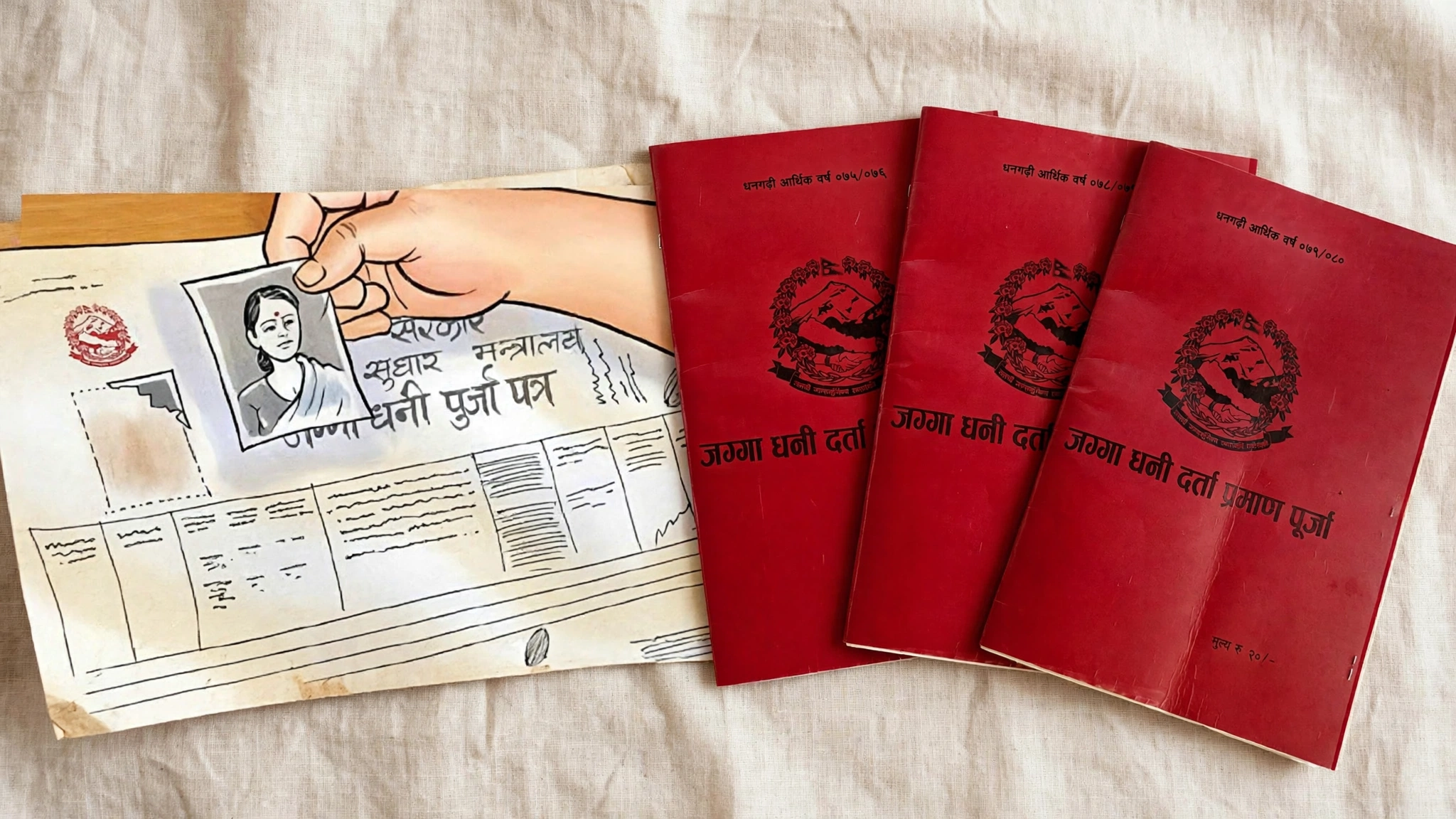
Buying land in Nepal is a major life milestone. It requires your hard-earned savings. However, the real estate market can be tricky. One single document separates legitimate property ownership from a complete financial disaster. That critical document is the official certificate known as LalPurja.
If you want to buy property, you must understand this paper. You cannot rely blindly on verbal promises or middle agents. You need to know exactly what is LalPurja and how to read its complex details. This extensive guide will walk you through the entire document step by step. We will break down the traditional measurement systems, explain the security features, and show you how to verify records at the government offices. Let us dive deep into understanding this foundational real estate document.
What is LalPurja?
The word LalPurja translates literally to “Red Document” in English. Historically, the government printed this official land ownership certificate with a distinct red border or text. Formally, the government of Nepal refers to it as the Jagga Dhani Praman Patra (Landowner Certificate).
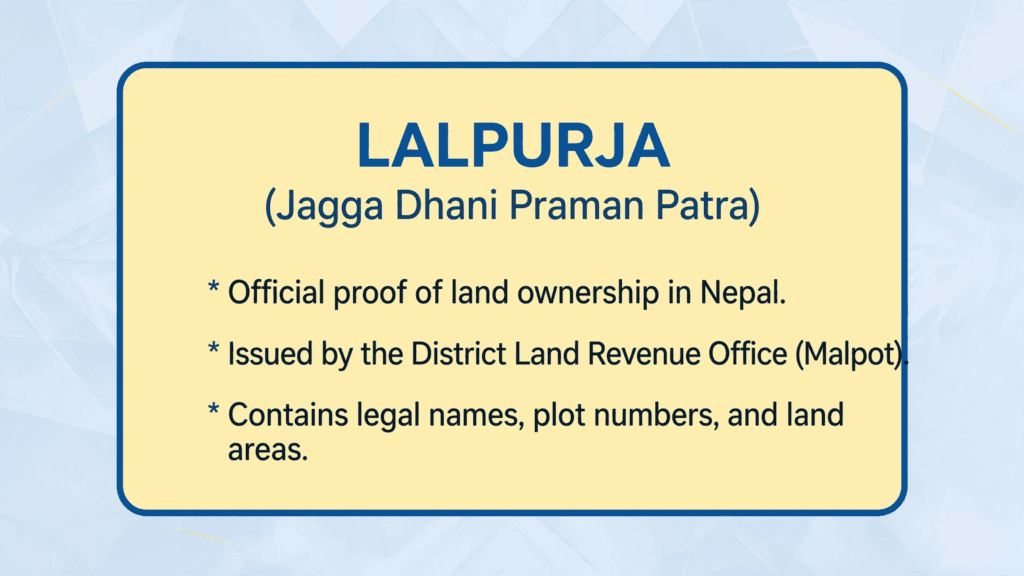
The Land Revenue Office, widely known as the Malpot office, issues this certificate. It serves as the ultimate legal proof that you own a specific parcel of land. Without a valid, original certificate, you do not have legally recognized property rights in Nepal. Whenever land changes hands through a sale, gift, or inheritance, the old document is surrendered. Then, the Malpot office issues a brand-new certificate to the new owner.
Why Understanding This Document Matters
Real estate fraud is a real risk in the fast-growing property market. Dishonest individuals sometimes try to sell the same plot to multiple buyers. Others might show you a beautiful piece of land but give you a certificate for a completely different plot.
When you learn what is LalPurja and how to read its rows and columns, you protect your money. You can match the physical property with the government records yourself. This basic due diligence ensures that your real estate investment remains safe, legal, and free from future court disputes.
The Key Types of Ownership Certificates
Not all property certificates are identical. The state categorizes land under different ownership models. You must identify the type of certificate before signing any purchase agreement.
1. Individual Ownership
This is the most common type of certificate. It lists a single named individual as the absolute owner. The individual has the full legal right to sell or transfer the property at will.
2. Joint Ownership (Amsha Patta or Combined Ownership)
This document lists multiple names. It is highly common in family-inherited lands where the property has not been physically divided yet. Buying joint property requires extreme care. You must get the official, written consent of every single person named on the document. Missing even one signature can legally invalidate the entire transaction.
3. Guthi or Trust Land
This land belongs to religious, cultural, or community trusts. Private individuals cannot easily buy or sell Guthi land. It involves specific legal restrictions and requires special permissions from the Guthi Sansthan.
Decoding the Structure: How to Read the Certificate
A standard land certificate contains several lines of dense text, numbers, and official stamps. The layout might look overwhelming at first glance. However, it follows a logical order. Let us break down the critical sections you need to check.
The Header and Office Details
The top section lists the specific District Land Revenue Office that issued the document. It also displays the official serial number. This unique registration number allows officials to find your file in the master ledger.
Owner Identity Section
This part contains the full legal name of the landowner. It includes their father’s name, grandfather’s name, and permanent address. Crucially, look for the official citizenship number. You must cross-reference this information directly with the seller’s physical citizenship card.
Geographic and Plot Identifiers
This section pinpoints the exact physical location of the land parcel. It records the following indicators:
- District: The administrative region where the land sits.
- Municipality / VDC: The local government zone.
- Ward Number: The specific neighborhood division.
- Kitta Number (Plot Number): This is a highly critical metric. The Survey Department assigning this unique number to your specific plot on the official cadastral map.
Master the Measurements: Hilly vs. Terai Systems
The land area section is where most buyers get confused. Nepal uses two entirely different traditional measurement systems. The system used depends purely on the geography of the district. A 0 in any position acts as a placeholder. It simply means that specific unit has no value. Let us examine both systems in detail.
1. The Hilly and Kathmandu Valley System (Ropani-Aana-Paisa-Daam)
If your property lies in Kathmandu, Lalitpur, Bhaktapur, Pokhara, or any hill district, the document uses this compound system. It is written as four distinct numbers separated by dashes (e.g., 1-2-3-1).
Ropani – Aana – Paisa – Daam
The mathematical relationships between these units are strict:
| Land Unit | Equivalent | Approximate Area (m²) | Approximate Area (sq ft) |
|---|---|---|---|
| 1 Ropani | 16 Aana | 508.96 m² | 5,476 sq ft |
| 1 Aana | 4 Paisa | 31.81 m² | 342 sq ft |
| 1 Paisa | 4 Daam | 7.95 m² | 85.6 sq ft |
| 1 Daam | Smallest traditional unit | 1.99 m² | 21.4 sq ft |
Example of a Hill Notation
If a certificate displays 0-4-2-0, it reads as 0 Ropani, 4 Aana, 2 Paisa, and 0 Daam. To calculate the total area, you convert each part to square feet and add them up:
4*342+ 2*85.6 = 1,368 + 171.2 = 1,539.2sq ft
2. The Terai Plains System (Bigha-Katha-Dhur)
If you are looking at land in southern plains like Chitwan, Jhapa, Morang, or Rupandehi, the document uses a different system. It is written as three numbers separated by dashes (e.g., 0-10-15).
Format: Bigha – Katha – Dhur
The structural conversion rates for the Terai system are:
| Land Unit | Equivalent | Approximate Area (m²) | Approximate Area (sq ft) |
|---|---|---|---|
| 1 Bigha | 20 Katha | 2,000 m² | 21,527 sq ft |
| 1 Katha | 20 Dhur | 100 m² | 1,076 sq ft |
| 1 Dhur | Smallest traditional unit | 5 m² | 53.8 sq ft |
Summary of Land Conversion Metrics
To make comparisons easy, use this clean reference table. It maps the traditional units against modern square meters and square feet.
| Region | Unit Name | Area (Square Meters) | Area (Square Feet) | Key Relationship |
|---|---|---|---|---|
| Hills | 1 Ropani | 508.96 m² | 5,476 sq ft | Equal to 16 Aana |
| Hills | 1 Aana | 31.81 m² | 342 sq ft | Equal to 4 Paisa |
| Hills | 1 Paisa | 7.95 m² | 85.6 sq ft | Equal to 4 Daam |
| Hills | 1 Daam | 1.99 m² | 21.4 sq ft | Smallest hill unit |
| Terai | 1 Bigha | 2,000 m² | 21,527 sq ft | Equal to 20 Katha |
| Terai | 1 Katha | 100 m² | 1,076 sq ft | Equal to 20 Dhur |
| Terai | 1 Dhur | 5 m² | 53.8 sq ft | Smallest Terai unit |
Step-by-Step Guide to Verifying a Certificate
Never buy a piece of property based only on a scanned copy or a photocopy. You must complete a rigorous verification process. Follow these structured steps to ensure your transaction is completely safe.
- Request the Original Document: Initial Check.
Ask the property seller to show you the original physical certificate. Check the physical paper for signs of chemical erasure or handwriting alterations. Ensure the official embossed government seal is clearly visible. - Cross-Match Owner Citizenship: Identity Verification.
Take the seller’s original citizenship card. Compare the legal name, spelling, father’s name, and citizenship number with the details printed in the owner section of the land certificate. They must match perfectly. - Conduct a Malpot Office Search: Official Record Check.
Visit the local District Land Revenue Office where the land is registered. Submit the Kitta number to check the official ledger. This step verifies if the certificate is authentic and matches the government’s current records. - Perform an Encumbrance Search: Check for Hidden Bank Loans.
Ask the Malpot officials to run an encumbrance search on the Kitta number. This check reveals if the land is currently frozen (Rokka) by a bank for a mortgage loan or restricted by a court order over a family dispute. - Verify the Map at the Napi Office: Cadastral Survey Match.
Take the Kitta number to the local Survey Office (Napi Karyalaya). Request the official plot map (Naksha). Verify that the shape, boundaries, and total area on the map match both the certificate and the physical land. - Check the Land Tax Status: Municipal Clearance.
Ask the seller for the latest land tax receipt (Malpot Rasid). Ensure all property taxes are fully paid up to the current fiscal year at the local municipality office. Unpaid taxes will stall the transfer process.
Digitalization of Records: LRIMS and Mero Kitta
The Ministry of Land Management is actively modernizing its operations. The government has introduced the Land Records Information Management System (LRIMS). This digital database stores land details electronically. It reduces manual entry errors and helps eliminate duplicate certificate scams.
Additionally, the Survey Department operates the Mero Kitta online portal. This platform allows landowners and authorized users to view digital cadastral maps. You can check plot boundaries online by uploading a scanned copy of the certificate and the owner’s citizenship card. While these online portals provide excellent preliminary checks, visiting the physical Malpot office remains the gold standard for final legal verification before making payments.
Common Scams and How to Avoid Them
Fraudulent actors use sophisticated methods to deceive innocent property buyers. Being aware of these schemes is your best defense.
The “Clean Copy” Loan Scam
A dishonest seller might hold an older copy of a certificate that looks perfectly clean. However, they may have taken a massive bank loan against the property yesterday. The bank holds the real master record, and the Malpot office places a Rokka restriction on the plot. If you do not perform an official encumbrance search at the Malpot office, you will end up buying a heavily mortgaged piece of property.
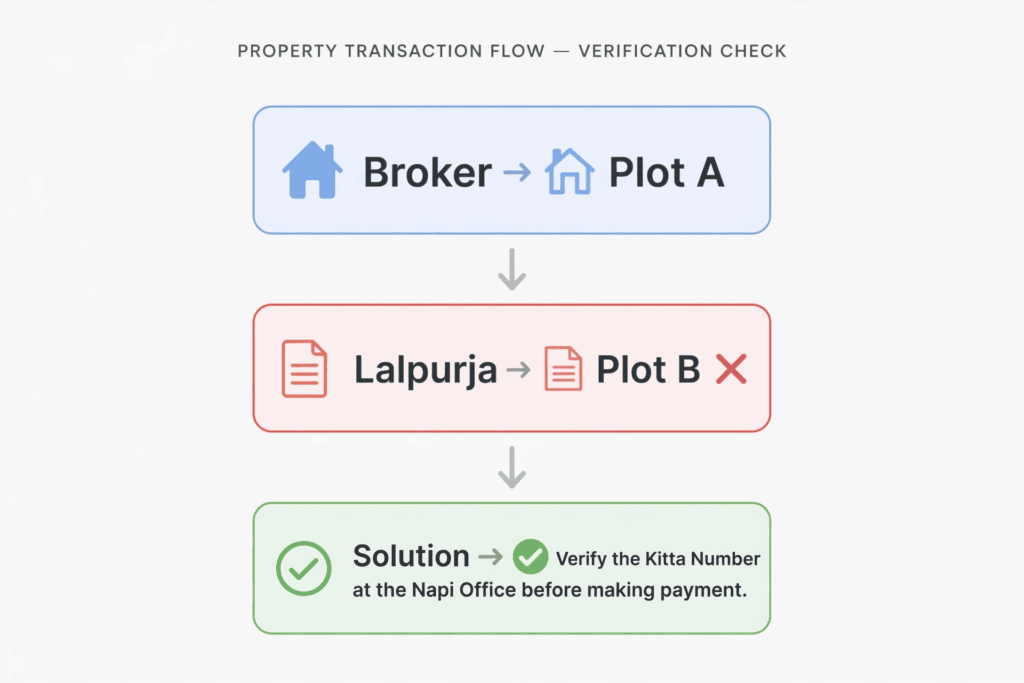
The Wrong Plot Bait-and-Switch
In this scenario, a broker takes you to a beautiful, flat plot right next to a wide pitching road. They show you a valid certificate. You agree to the price. However, the Kitta number on that certificate actually points to a steep, inaccessible cliff two kilometers away. You must always take the Kitta number to the Napi office. Match the map coordinates physically on-site using an official surveyor.
The Missing Co-Owner Trap
If a piece of land belongs to an extended family, the certificate might list multiple brothers or relatives. A single family member might try to sell you the plot urgently, claiming the others agree. Legally, if even one co-owner files a complaint later stating they did not sign the transfer papers, the entire sale can be canceled by a court. Never accept verbal assurances. Every single named owner must sign the papers in front of the Malpot officer.
Conclusion
Acquiring real estate is an excellent way to secure your financial future. However, safety must come first. Understanding what is LalPurja and how to read its terms gives you complete control over your transaction. It transforms you from a vulnerable buyer into a well-informed investor.
Always look closely at the Kitta number. Take time to convert the traditional Ropani or Bigha units into modern square feet. Most importantly, never skip a physical visit to the local Malpot and Napi offices to verify the live database records. If you follow these safety protocols diligently, your real estate investment in Nepal will remain perfectly secure for generations to come.
Frequently Asked Questions (FAQ)
What is LalPurja in Nepal?
It is the official government-issued land ownership certificate. Formally called the Jagga Dhani Praman Patra, it serves as the ultimate legal proof of property ownership across all districts of Nepal.
How can I read land area measurements on a certificate?
The document uses geographic compound notation. Hill districts use the Ropani-Aana-Paisa-Daam system (e.g., 1-2-3-0). The Terai plains use the Bigha-Katha-Dhur system (e.g., 0-10-5). You must convert each unit separately into square feet or square meters to find the total area.
What is a Kitta number on the certificate?
The Kitta number is a unique parcel identification number assigned to a specific plot of land by the Survey Department. It connects your ownership certificate directly to the official government cadastral maps.
Can I verify a land certificate online in Nepal?
You can perform preliminary checks using government systems like the Mero Kitta portal for maps and LRIMS data. However, for a legally binding property transaction, you must visit the physical Malpot office to conduct a comprehensive encumbrance search.
What does it mean if a property is marked as Rokka?
A Rokka status means the property is officially frozen or locked. This happens when the land is under a bank mortgage loan, caught in an active legal dispute, or restricted by a court order. A frozen property cannot be sold or transferred until the restriction is formally lifted.
How do I protect myself from land document forgery?
Always demand to see the original physical document rather than a photocopy. Cross-verify the owner’s details with their physical citizenship card, and independently verify the live registration records directly at the local Land Revenue Office.