
Interest rates get the headlines, but in Nepal the number that decides whether a family can buy a home is the loan-to-value ratio. It fixes how much of a property’s price a bank is allowed to lend, and therefore how much cash the buyer must bring to the table. For most of the last decade that number was a wall. Since July 2025 it has become a door. Nepal Rastra Bank (NRB) now lets a first-time buyer borrow up to 80 percent of a home’s value, the loosest limit the country has ever offered, while loans to buy raw land stay capped at 50 percent. The gap between those two figures is a deliberate policy choice, and tracing how it moved tells you more about Nepal’s property market than any single rate cut.
Key Takeaways
- Since mid-July 2025, first-time residential buyers in Nepal can borrow up to 80 percent of a home’s value, on a ceiling raised to Rs 3 crore (Rs 30 million). Loans against government-approved housing projects go up to 70 percent, and plain real estate (land) loans are capped at 50 percent.
- That 80 percent tier is conditional: the home must be 3,000 square feet or smaller, the borrower must have no prior housing loan from any institution, rental income cannot be counted as a repayment source, and the installment cannot rise even if interest rates do.
- In 2017, NRB moved the other way, cutting the Kathmandu Valley home-loan LTV from 60 percent to 50 percent and the real estate LTV to 40 percent to cool a Valley land boom.
- The caps trace back to 2009 to 2011, when commercial banks’ real estate exposure averaged 32.4 percent of lending and real estate loans carried a 12.4 percent non-performing rate in NRB’s own 2011 study.
- LTV is the lever that moves buyers: at 50 percent a buyer needs half the price in cash, at 80 percent only one-fifth. That swing changes who can buy far more than a half-point rate cut does.
What a loan-to-value ratio actually controls
The loan-to-value ratio is simple arithmetic with large consequences. A 50 percent LTV on a Rs 2 crore house means the bank lends Rs 1 crore and the buyer must produce the other Rs 1 crore in cash. Raise the LTV to 80 percent and the bank lends Rs 1.6 crore, so the buyer needs only Rs 40 lakh. Nothing about the house, the salary, or the interest rate changed. The regulator simply redrew the line, and a purchase that required a lifetime of savings became reachable on a few years of it.
This is why the LTV cap, not the headline lending rate, is the real gatekeeper in a market like Nepal’s. Home ownership here has long been funded mostly by savings, inheritance, and remittance rather than by mortgage debt, which is one reason bank home loans make up a smaller share of the economy than they do in peer countries. When down payments are set at 40 or 50 percent of the price, the barrier is not the monthly cost of a loan. It is the sheer size of the cheque needed to start one. NRB has spent fifteen years adjusting exactly where that cheque sits.
Where the caps came from: the 2009 to 2011 boom
Nepal did not always ration property credit. The caps were a response to a specific scare. In the years around 2009, cheap credit and a flood of remittance money chased a limited supply of urban land, and prices ran. NRB’s July 2011 study, A Report on Real Estate Financing in Nepal, documented the strain in plain numbers: commercial banks had an average of 32.4 percent of their total lending tied to real estate, nearly 60 percent of all bank loans were backed by real estate collateral, and the non-performing rate on real estate loans had reached 12.4 percent in the banks it surveyed. Citing IMF data, the report noted that urban land transactions had almost doubled in 2009 alone compared with the year before.
That concentration is what a credit bubble looks like from the regulator’s chair, and NRB moved to deflate it. Its Monetary Policy for 2010/11 pressed banks to pull real estate and housing lending down to set limits, including a restriction that capped lending for land purchase and plotting at 10 percent of a bank’s portfolio. The loan-to-value cap grew out of that same effort to keep a single asset class from swallowing the banking system. The lesson NRB took from the episode, and has repeated since, is that property lending left unchecked can “generate asset price bubbles” that end in bad loans rather than in homes.
2017: the tightening that drew the Valley line
The sharpest single turn of the screw came in 2017. Through that year’s monetary policy, NRB cut the loan-to-value ratio for a home loan inside the Kathmandu Valley from 60 percent to 50 percent of fair market value, while leaving it unchanged at 60 percent outside the Valley. For loans to purchase real estate, meaning land rather than a house to live in, it set the Valley ratio at 40 percent and held the figure outside the Valley at 50 percent. In the same move it raised the home loan ceiling from Rs 1 crore to Rs 1.5 crore (Rs 10 million to Rs 15 million).
The geography was the point. NRB said openly that it wanted to discourage the expansion of real estate and housing business inside the Valley and push the sector to grow in other parts of the country. A 40 percent LTV on Valley land meant a speculator needed 60 percent of the purchase price in cash, a serious brake on the quick-flip trade that had driven prices up. The cost of that brake fell on ordinary Valley buyers too, who now had to find half a home’s value upfront. For six years, 40 to 60 percent was the band every borrower planned around.
The holding years, with a pandemic nudge
Through the COVID-19 period the caps held, with one easing aimed at genuine owner-occupiers. A circular issued on 27 July 2020 set the LTV ratio at 60 percent for housing projects licensed by the government and extended the same 60 percent to individuals taking a personal residential loan to build their first house. The real estate loan ratios, 40 percent inside the Valley and 50 percent outside, were explicitly kept unchanged. The signal was consistent with everything before it: a modestly friendlier hand for someone building a first home, a firm one for anyone buying land to trade. NRB’s unified rules carried that structure into the following years without loosening the real estate line.
2025: the door swings open
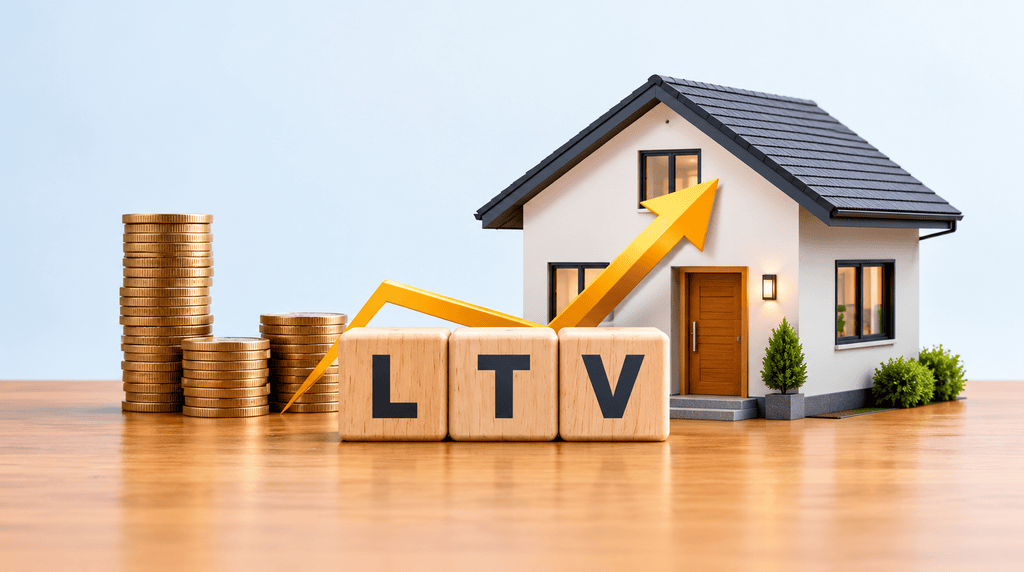
The biggest loosening in the history of these caps arrived with the Monetary Policy for 2082/83, delivered on 11 July 2025, and the revised Unified Directive that followed within days. NRB raised the residential home loan ceiling from Rs 2 crore to Rs 3 crore (Rs 20 million to Rs 30 million) for first-time buyers and lifted the loan-to-value ratio for a first home to up to 80 percent. Government-approved or registered-company housing projects were set at up to 70 percent, and real estate loans were held at a maximum of 50 percent. The same policy cut the policy rate from 5.0 percent to 4.5 percent, the bank rate from 6.5 percent to 6.0 percent, and the deposit collection rate from 3.0 percent to 2.75 percent.
What makes the 80 percent tier notable is how tightly it is fenced. To qualify, the home or apartment must not exceed 3,000 square feet, the borrower must not have taken a housing loan from any institution before, rental income cannot be shown as a source of repayment, and the monthly installment must not increase even if interest rates rise after the loan is signed. Each condition is aimed at the same target: a first, modest, owner-occupied home, not a second property or an investment unit. NRB widened the door and, at the same time, narrowed who is allowed through it.
What the loosening does, and what it risks
On the demand side, the arithmetic is powerful. Cutting the required down payment on a first home from half the price to one-fifth, and lifting the ceiling to Rs 3 crore, pulls a band of salaried buyers who were priced out back into the market in a single stroke. Paired with lower rates, it is the most pro-buyer stance NRB has taken since the caps began. For a market where bank home loans stood at roughly Rs 689 billion and nearly 60 percent of real estate lending is already housing, the policy is clearly meant to deepen owner-occupier demand rather than reignite land speculation, which is why the 50 percent wall on land loans did not move.
The risks are real and worth naming alongside the upside. A higher LTV means a thinner equity cushion, so if prices soften, more borrowers can find themselves owing more than their home is worth, and banks absorb the shortfall. Nepal’s own record is the cautionary note here: the 2009 to 2011 episode ended in elevated real estate non-performing loans, and bad loans across the system have been climbing again, with construction among the strained sectors. There is also a measurement problem beneath the whole exercise. The 80 percent is 80 percent of fair market value, and Nepal famously runs two land prices, a government rate and a far higher market rate visible in everyday property listings, so the valuation the ratio rests on is softer than it looks. Finally, the rule freezing a borrower’s installment even as rates rise shifts interest-rate risk onto the lender, which may make some banks cautious about writing the 80 percent loans at all. The cap has been loosened; whether banks lend to its new limit is a separate question.
What it means for a buyer today

For someone buying a first, modestly sized home to live in, this is the most favorable LTV regime Nepal has offered, and it is worth confirming with a lender exactly which tier a given property and borrower fall into, since the 80 percent, 70 percent, and 50 percent lines turn on the use and the paperwork. For a buyer of land, or a second home, or anything meant to earn rent, little has changed: plan for half the price in cash. The caps are not a technicality buried in a directive. They are the single rule that most decides whether a purchase is possible this year, and after fifteen years of moving mostly in one direction, they have just moved firmly in the other.
Frequently Asked Questions
What is the loan-to-value ratio for a home loan in Nepal right now?
As of mid-July 2025, a first-time residential buyer can borrow up to 80 percent of the home’s fair market value, on a ceiling of Rs 3 crore. Loans against government-approved housing projects go up to 70 percent, and loans to purchase real estate (land) are capped at a maximum of 50 percent. The 80 percent tier comes with conditions on the size of the home and the borrower’s loan history.
How much down payment do I need to buy a home in Nepal?
At the 80 percent first-home LTV, you need about 20 percent of the price in cash. Buyers who do not qualify for that tier, including those buying land or a second property, generally need to put down 30 to 50 percent, because real estate loans are capped at 50 percent and other cases sit below the first-home limit.
What is the maximum home loan in Nepal in 2026?
The ceiling for a first-time residential home loan is Rs 3 crore (Rs 30 million), raised from Rs 2 crore in the Monetary Policy for 2082/83. The amount a borrower actually receives still depends on the applicable loan-to-value ratio and on income and repayment capacity.
Why did Nepal Rastra Bank lower loan-to-value ratios in 2017?
NRB cut the Kathmandu Valley home-loan LTV to 50 percent and the real estate LTV to 40 percent to discourage the expansion of real estate and housing business inside the Valley and to cool a land boom, while pushing the sector to grow in other parts of the country. Ratios outside the Valley were left unchanged.
What conditions apply to the 80 percent first-home loan?
Four main conditions apply: the home or apartment must be 3,000 square feet or smaller, the borrower must not have taken a housing loan from any institution before, rental income cannot be used as a repayment source, and the installment must not increase even if interest rates rise. The tier is designed for a genuine first, owner-occupied home.
Does a higher LTV ratio make the market riskier?
It can. A higher loan-to-value ratio leaves a thinner equity buffer, so a fall in prices puts more borrowers underwater and more risk on banks. Nepal’s 2009 to 2011 experience, when real estate non-performing loans reached double digits, is the reason NRB has kept land loans capped at 50 percent even while easing the first-home limit.
Related reading
- Nepal Raised the Home Loan Ceiling to Rs 3 Crore and Cut Rates: What Buyers Should Check
- Nepal’s Banks Hold Rs 689 Billion in Real Estate Loans. Nearly 60 Percent Are Home Loans.
- Nepal’s Bad Loans Climb to 5.6 Percent, and Construction Is Where the Strain Shows
- More real estate coverage from BiznessVue