Nepal’s IT and outsourcing firms now employ roughly 100,000 people, about 90 percent of them in Kathmandu, and the sector’s service exports crossed an estimated one billion dollars in 2025. That is a lot of workers who need desks. Yet across the same city, “TO-LET” signs multiply on commercial fronts, a 17-storey tower in Radhe Radhe has sat empty for 14 years, and mall units stay dark for months. Kathmandu’s office market is not simply short of space or drowning in it. It is splitting into two markets: one for modern, serviced floors that growing firms will pay for, and one for aging, unplanned buildings that fewer tenants want.
Key Takeaways
- Asking rents for standalone office floors in Kathmandu run roughly Rs 90 to Rs 150 per square foot per month on listing portals, with prime, fully fitted space quoted higher.
- Flexible and serviced offices (for example Regus at Kathmandu Trade Tower and IT Plaza) are listed from about Rs 6,900 per month for a single workstation, a far lower entry point than leasing a whole floor.
- The strongest demand driver is IT and outsourcing: service exports reached an estimated one billion dollars in 2025, the workforce is near 100,000, and about 90 percent of IT employment sits in Kathmandu.
- Older and unplanned buildings face real vacancy. Rising Nepal reported climbing “TO-LET” signage in late 2024, and a 17-storey building at Radhe Radhe has stood empty for 14 years.
- The wider market is recovering: national real estate transactions nearly doubled to Rs 720.86 billion in FY 2025/26, and Kathmandu’s transaction value jumped 217 percent in the fourth quarter alone.
- Nepal has no official office vacancy index or rent benchmark, so every number here comes from listings, news reporting, or central-bank transaction data, not a formal office survey.
What office space actually costs in Kathmandu

There is no published rent-per-square-foot benchmark for Kathmandu offices, so the honest starting point is the asking price on listing portals. Those prices are what landlords want, not always what deals close at, and they skew toward prime locations. On the property portal Gharghaderi, standalone office listings in areas such as Baneshwor, Naxal, Lazimpat, Putalisadak and Gyaneshwor cluster between about Rs 90 and Rs 125 per square foot per month, with a few prime, fully fitted floors quoted as high as Rs 175 to Rs 225. Listings on Basobaas’s office space section price standalone space in a similar band, roughly Rs 80 to Rs 150 per square foot.
Translated into monthly rent, a modest 2,000 square foot office in a mid-tier location is commonly asked at Rs 180,000 to Rs 250,000 a month, while a full commercial floor of 20,000 square feet in Lazimpat has been listed at Rs 3.5 million. For context on how rents move, retail space in prime commercial strips was renting at Rs 40,000 a month or more back in 2023, rising about 10 percent a year, according to the Kathmandu Post. Office rents broadly track that upward drift, which is one reason smaller firms increasingly look past a dedicated floor entirely.
The demand engine: IT, outsourcing and startups

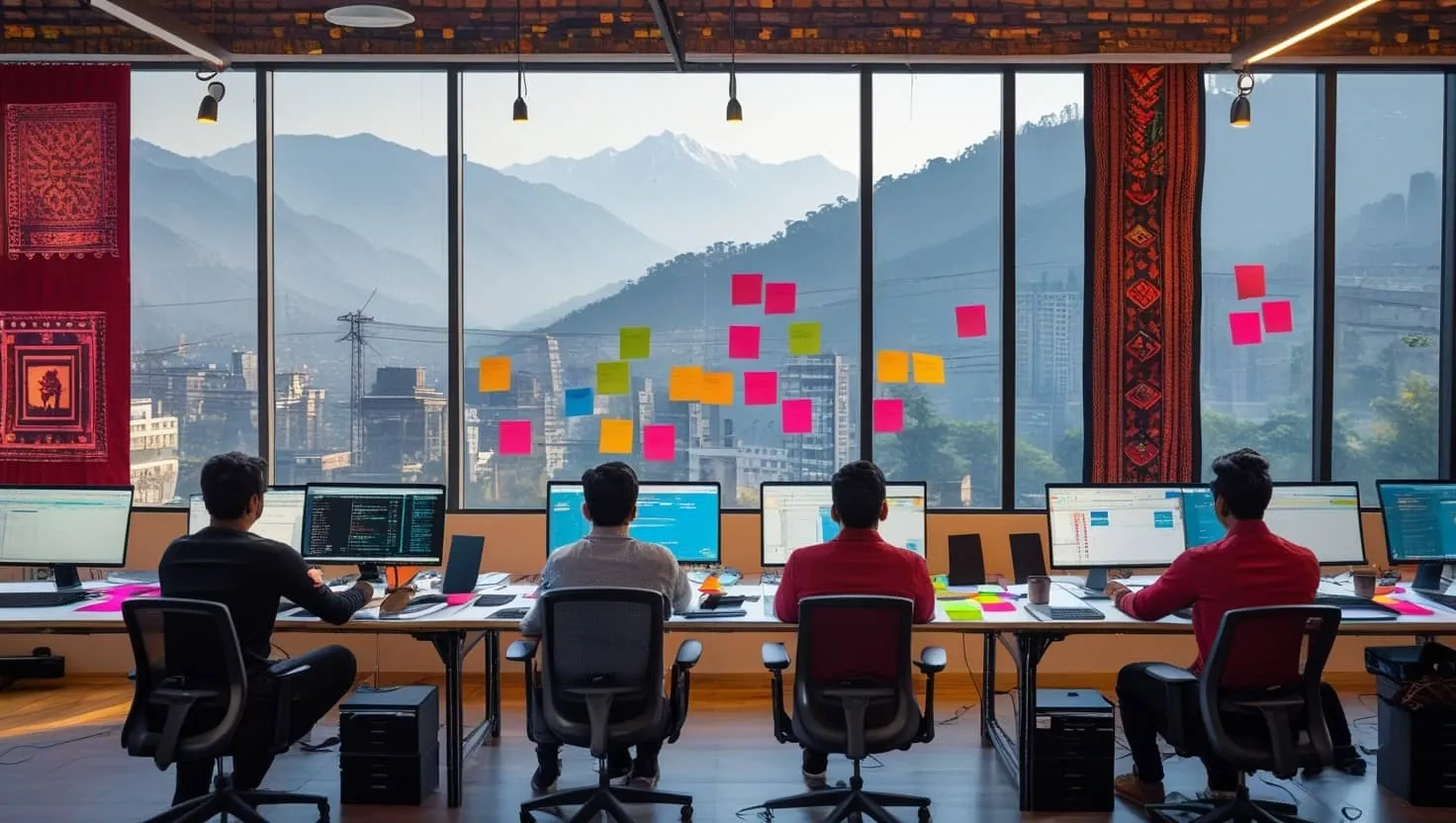
What makes Kathmandu’s office story different from its mall or hotel story is the demand side. Nepal’s technology and outsourcing sector has grown fast enough to move the market. Service exports more than doubled in three years to cross an estimated one billion dollars in 2025, growing at roughly 20 percent a year, the Kathmandu Post reported. Industry leaders put employment near 100,000, up from more than 70,000 counted in a 2022 survey, and about 90 percent of that workforce is in the Kathmandu Valley.
Those are not abstract numbers for a landlord. A BPO firm processing Australian home loans, a software company, or an engineering-services outfit needs reliable power, backup generation, parking, elevators and fast internet, and it needs enough contiguous floor area to seat hundreds of staff. That is a specific product. It is also exactly the product that much of Kathmandu’s older building stock cannot supply, which is where the market’s second half comes in.
The vacancy paradox: empty floors in a growing city
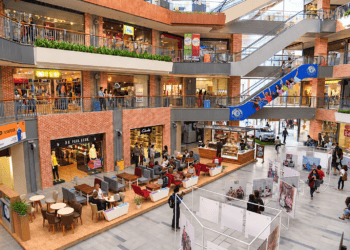
If demand is rising, why the empty buildings? Because supply and demand are not the same product. Much of Kathmandu’s commercial stock went up haphazardly, often as residential-zoned buildings converted to shops and offices, without the parking, power and floor plates that modern tenants require. Rising Nepal documented the result in late 2024: climbing “TO-LET” signage across the city, prime pockets of Thamel and Ratna Park sitting idle, and a 17-storey tower at Radhe Radhe empty for 14 years. Units in malls such as Civil Mall, City Centre and Chhaya Centre stayed vacant for months, in part because monthly rents ran as high as Rs 2.75 lakh.
The same pattern of oversupply at the top end and weak absorption below has shown up elsewhere in Nepal’s commercial property, from shopping malls where half the shutters never open to the hotel sector’s room glut. Add a bruising retail downturn, when the Confederation of Nepalese Industries estimated that around 35 percent of businesses had shut during the 2022-23 liquidity crisis, and you get a city with genuine vacancy sitting alongside genuine unmet demand. The buildings that are empty are often not the buildings that growing firms want to rent.
Co-working and serviced offices fill the gap

Between the dark older buildings and the scarce modern floors sits a third option that has quietly matured: flexible space. International operator Regus runs serviced centers at Kathmandu Trade Tower and IT Plaza, with single workstations listed from about Rs 6,900 a month, which lets a small team get a professional address without signing a multi-year floor lease. Home-grown co-working also took root well before the IT boom. When the Kathmandu Post surveyed the scene in 2019, it found 22 co-working spaces listed for Kathmandu on the global directory Coworker, with Work Around in Kalopul charging about Rs 4,500 a month and Rem.work HQ in Baluwatar pricing a dedicated desk at Rs 6,000 and a six-person private office at Rs 54,000.
Flexible space is not a cure-all. It is more expensive per seat than a bare floor once a team grows, and the companies driving the most demand eventually graduate into their own premises, as several Work Around tenants did. But it absorbs the early-stage demand that a fragmented, informal leasing market handles poorly. Commercial leasing in Nepal still runs heavily on handshake terms and verbal agreements, a gap that fuels recurring disputes, as covered in our look at commercial lease informality in Nepal.
The 2026 backdrop, and what to watch
The office market is riding a broader recovery. After a prolonged slowdown, national real estate transactions nearly doubled in value to Rs 720.86 billion in fiscal year 2025/26, up from Rs 386.15 billion a year earlier, according to Nepal Rastra Bank data reported by the Kathmandu Post. Kathmandu led the rebound, with fourth-quarter transaction value up 217 percent and transaction counts up 156 percent year on year. Bank credit flowing into real estate grew 6.93 percent, and the central bank was sitting on more than Rs 1 trillion in unused lendable funds, which usually means cheaper loans ahead.
Two cautions belong alongside that optimism. First, those figures are land-and-building transactions overall, not an office-specific index, and NRB has noted that about 63.5 percent of all bank credit is secured against land and buildings, which is a concentration risk, not only a sign of health. Second, the office recovery is uneven by design: the modern, serviced product is tight while older stock stays soft, so a rising citywide average can hide empty floors. For tenants, that split is leverage. For developers, it is a signal that the next building has to be the right kind, with parking, power backup and large floor plates, rather than one more generic tower. The demand is real, but it is picky. More context on Nepal’s property market is collected in our real estate section.
Frequently Asked Questions
How much does it cost to rent office space in Kathmandu?
Standalone office floors are asked at roughly Rs 90 to Rs 150 per square foot per month on listing portals, with prime, fully fitted space quoted higher, up to around Rs 175 to Rs 225. A 2,000 square foot office in a mid-tier area is commonly listed at Rs 180,000 to Rs 250,000 a month. Serviced single workstations at operators like Regus start near Rs 6,900 a month. These are asking prices, not an official benchmark.
Which areas of Kathmandu have the most office space?
Office listings concentrate in Baneshwor, Naxal, Lazimpat, Putalisadak, Gyaneshwor, Kamaladi, Panipokhari, Maharajgunj and Dillibazar. Serviced-office centers cluster in landmark commercial towers such as Kathmandu Trade Tower and IT Plaza.
Why are some buildings empty while office demand is rising?
Because supply and demand are different products. Growing IT and outsourcing firms want modern floors with parking, power backup, elevators and large contiguous areas. Much of Kathmandu’s older commercial stock was built haphazardly, often converted from residential buildings, and cannot meet those needs. So vacant older floors and unmet demand for modern space exist side by side.
Are co-working or serviced offices a realistic option in Kathmandu?
Yes. International operator Regus runs serviced centers in Kathmandu, and local co-working spaces such as Work Around and Rem.work have operated for years. A 2019 survey counted 22 co-working spaces listed for the city. Flexible space suits freelancers, startups and small teams that do not want a multi-year floor lease, though it costs more per seat as a team grows.
Is Kathmandu’s office market recovering in 2026?
The broader property market is clearly recovering. National real estate transactions nearly doubled to Rs 720.86 billion in FY 2025/26, and Kathmandu’s fourth-quarter transaction value rose 217 percent year on year. There is no office-specific index, but strong IT-sector demand and falling lending rates point the same way. The recovery is uneven: modern serviced space is tight while older buildings stay soft.
Is there an official office vacancy rate for Kathmandu?
No. Nepal does not publish an office vacancy index or an official office rent benchmark. Estimates come from listing portals, news reporting and Nepal Rastra Bank’s land-and-building transaction data, none of which isolates offices. Treat any single office rent or vacancy figure as indicative, not definitive.