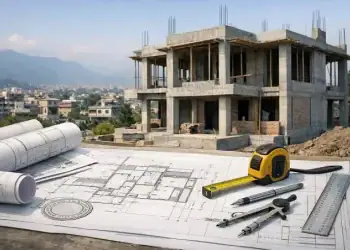
On the stretch of highway where a contractor’s crew walked off the job this year, the unfinished earthwork tells only half the story. The other half sits on a bank’s balance sheet in Kathmandu, where the loan that paid for the excavators is now a line item the lender would rather not discuss. Multiply that stalled site across the country and you get the single number Nepal Rastra Bank now calls its biggest supervisory worry: non-performing loans have climbed to 5.6 percent of all bank credit, and construction is one of the sectors where the strain is easiest to see.
Key Takeaways
- Nepal’s banking system non-performing loan (NPL) ratio reached 4.62 percent at mid-July 2025 (end of FY 2081/82), up from 3.86 percent a year earlier, and rose further to 5.60 percent by the third quarter of FY 2082/83 (early 2026), per Nepal Rastra Bank.
- The rupee value of bad loans grew about 29 percent in a single year, from Rs 199.66 billion to Rs 258.19 billion at mid-July 2025.
- By sector, construction carried an 8.40 percent NPL ratio at mid-July 2025, among the highest in the economy, behind only fishery (9.97 percent) and wholesale and retail trade (8.51 percent).
- Construction and hydropower together accounted for roughly 10.5 percent of all non-performing loans by mid-April 2026, the second-largest block after agriculture and fisheries.
- Nabil Bank CEO Manoj Gyawali told a parliamentary committee in July 2026 that banks have lent nearly Rs 500 billion to the construction sector, much of it exposed to delayed government payments to contractors.
- NRB does not publish a standalone NPL ratio for real estate lending, so construction is the clearest sector-level signal of property-linked loan stress.
The headline number: 4.62 percent, and still rising
For most of the past decade, Nepal’s banks reported bad-loan ratios that looked almost pristine: 1.31 percent at mid-July 2022, a level that would be the envy of lenders in most emerging markets. That era is over. The ratio jumped to 3.02 percent in 2023, 3.86 percent in 2024, and 4.62 percent by mid-July 2025, according to Nepal Rastra Bank’s Financial Stability Report (Issue 17). By the third quarter of the current fiscal year, 2082/83, the figure had reached 5.60 percent. The central bank describes rising NPLs as the single largest challenge facing the system.
The pain is not spread evenly. At mid-July 2025, commercial banks (class A) sat at 4.44 percent, development banks (class B) at 5.03 percent, and finance companies (class C) at 11.05 percent. Microfinance institutions, a separate pressure point, hit 9.95 percent. Individual commercial banks diverge sharply: by the third quarter of 2082/83, NIC Asia (8.85 percent), Prabhu (8.84 percent), Nepal Investment Mega (8.41 percent) and Himalayan (7.68 percent) ran well above the average, while Everest (0.61 percent), Standard Chartered Nepal (1.81 percent) and Nepal SBI (2.53 percent) stayed low. An average, in other words, hides a wide gap between the cleanest and the most stressed books.
Where real estate and construction sit in the data

Here the numbers require care, because NRB classifies property credit in buckets that do not map neatly onto everyday language. At mid-July 2025, outstanding real estate loans (broad property credit, including land and developer lending) stood at Rs 275.96 billion, or 4.94 percent of total bank loans. Separately, residential personal home loans reached Rs 417.61 billion, or 7.47 percent of loans, having grown a brisk 7.91 percent over the year. For a fuller picture of how that exposure built up, see our earlier analysis of how Nepal’s banks came to carry more than Rs 2 trillion in property-linked exposure.
What NRB does not publish is a clean, standalone NPL ratio for real estate. It groups finance, insurance and real estate together, which makes the construction figure the most honest sector read available. And that figure is unflattering: construction’s NPL ratio was 8.40 percent at mid-July 2025, against an economy-wide average of 4.62 percent. By share of the total bad-loan pile, construction and hydropower together made up about 10.5 percent by mid-April 2026, second only to agriculture and fisheries at roughly 23.5 percent. The agriculture concentration reflects years of priority-sector lending targets; the construction concentration reflects something more immediate.
The construction squeeze: Rs 500 billion and an unpaid-bill backlog
The construction strain is not only a story of weak borrowers. A large part of it traces back to the government’s own payment backlog. Nabil Bank chief executive Manoj Gyawali told the House of Representatives Finance Committee on July 5, 2026 that banks have extended close to Rs 500 billion to the construction sector, and warned that if contractors cannot collect what the state owes them, “nearly Rs 500 billion in bank lending is put at risk, making a rise in NPLs inevitable.”
The size of the unpaid backlog is itself disputed. The Federation of Contractors’ Associations of Nepal (FCAN) has put total government dues to contractors at around Rs 45 billion, of which it says only about Rs 15 billion had been paid, leaving roughly Rs 30 billion outstanding. The government’s acknowledged obligation has been lower, around Rs 28.89 billion, with officials saying Rs 22 billion of that was cleared. Whichever figure is closer to the truth, the mechanism is the same: a contractor who is not paid cannot service the loan that financed the project, and a loan parked in the “loss” category for a year can trigger blacklisting, passport suspension and asset-seizure proceedings. That is why NRB and bankers have pressed to separate wilful defaulters from borrowers caught by the slowdown or by delayed state payments.
What is actually inside the bad-loan pile
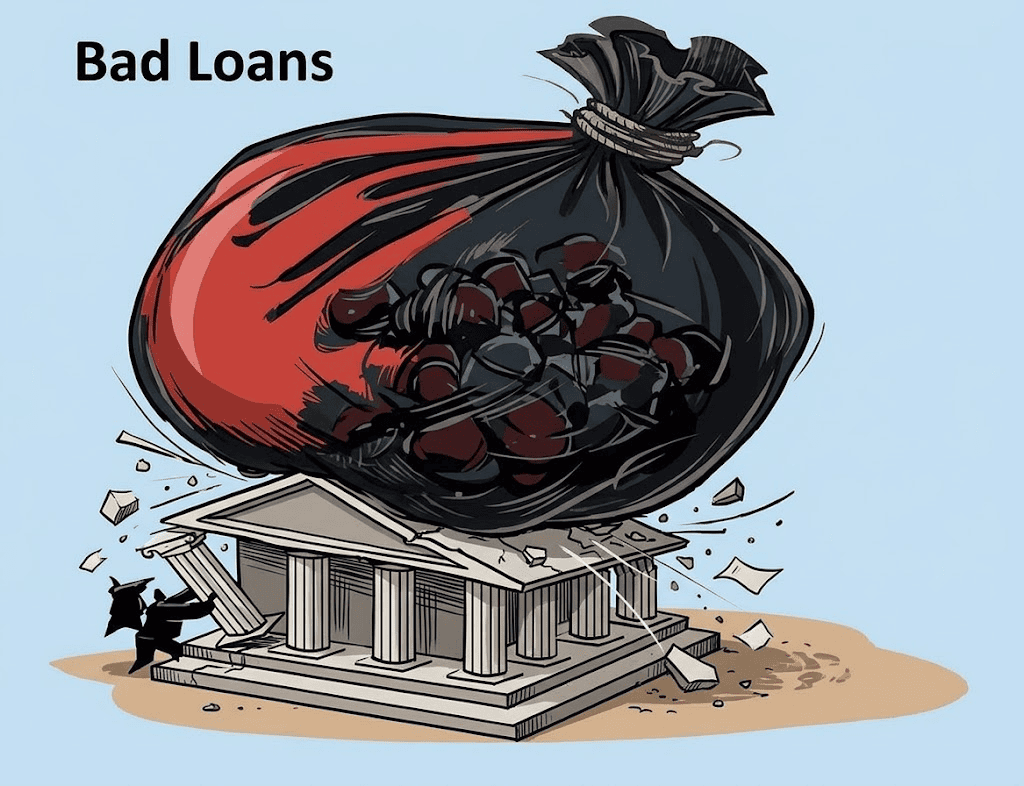
Composition matters as much as the headline ratio, and here the trend is worse than the level alone suggests. Within total NPLs, the “loss” category, the most severe classification, rose from 56.66 percent to 62.30 percent of bad loans over the year to mid-July 2025, while the “doubtful” category climbed from 16.95 percent to 21.06 percent. Restructured and rescheduled loans fell from 24.92 percent to 14.75 percent. In plain terms, a growing share of problem loans is not being nursed back to health; it is being written down as likely unrecoverable.
The borrower data tells the same story. The number of blacklisted borrowers at the Credit Information Bureau rose from 16,987 in FY 2077/78 to 129,974 in FY 2081/82, a roughly sevenfold increase in four years. A property market that has cooled from its boom, documented in softer transaction growth and a capital gains tax that rose to 10 percent in 2026, means collateral is harder to sell at auction, so a defaulted loan takes longer to resolve and recovers less when it does.
The counterweight: how worried should Nepal be?
A 5.6 percent NPL ratio is elevated for Nepal, but it is not, on its own, a crisis number by regional standards; several South Asian banking systems have operated at higher levels. Two things temper the alarm and two things sharpen it. On the reassuring side, a meaningful slice of construction distress is a liquidity problem the government can fix by clearing its arrears, not a structural collapse in demand, and NRB has already eased some lending terms, including a higher residential home-loan ceiling and lower rates, to support borrowers. For households still weighing a purchase, the practical market, from property listings to lending desks, remains open on more favorable terms than a year ago.
On the cautionary side, the shift toward the “loss” category suggests recognition is catching up with reality rather than overstating it, and analysts have questioned whether some banks still delay classifying stressed loans. The ratio that was 1.31 percent in 2022 is now above 5.6 percent, a fourfold move in three years, and the direction has not turned. The honest reading is that Nepal’s banks are absorbing the hangover of a credit and property boom, that construction is where the hangover shows first, and that how fast the ratio stabilizes depends as much on the government paying its contractors as on any move by the central bank. For the full data, readers can consult NRB’s Financial Stability Report and the wider BiznesVue Real Estate coverage.
Frequently Asked Questions
What is Nepal’s current non-performing loan ratio?
Nepal’s banking system NPL ratio was 4.62 percent at mid-July 2025 (end of FY 2081/82), up from 3.86 percent a year earlier, and rose to 5.60 percent by the third quarter of FY 2082/83 in early 2026, according to Nepal Rastra Bank. In rupee terms, bad loans reached Rs 258.19 billion at mid-July 2025.
Why are construction loans in Nepal turning bad?
Construction carried an 8.40 percent NPL ratio at mid-July 2025, well above the 4.62 percent average. A major driver is the government’s backlog of unpaid bills to contractors, estimated at Rs 28.89 billion by the state and around Rs 45 billion by the contractors’ federation. Contractors who are not paid cannot service their bank loans, which pushes those loans into default.
Does Nepal publish a non-performing loan ratio for real estate?
No. Nepal Rastra Bank groups finance, insurance and real estate together and does not report a standalone NPL ratio for real estate lending. Outstanding real estate loans were Rs 275.96 billion (4.94 percent of total loans) and residential home loans Rs 417.61 billion (7.47 percent) at mid-July 2025, but the construction sector’s 8.40 percent ratio is the clearest available signal of property-linked loan stress.
Which banks in Nepal have the highest NPLs?
By the third quarter of FY 2082/83, finance companies as a class had the highest NPLs at 11.05 percent. Among commercial banks, NIC Asia (8.85 percent), Prabhu (8.84 percent), Nepal Investment Mega (8.41 percent) and Himalayan (7.68 percent) were the most stressed, while Everest (0.61 percent), Standard Chartered Nepal (1.81 percent) and Nepal SBI (2.53 percent) had the lowest ratios.
Is Nepal’s rising NPL ratio a banking crisis?
Not yet. A 5.6 percent ratio is elevated for Nepal but not unusually high by South Asian standards. The concern is the trend: the ratio has risen roughly fourfold since 2022, and the share of loans classified as outright “loss” is growing. Much of the construction strain is a liquidity problem tied to delayed government payments, which could ease if the state clears its arrears.