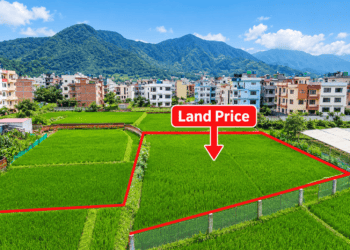
Two buyers agree on a flat 4-aana plot in Kathmandu for Rs 1 crore, shake hands, and both walk away thinking the deal is done. It is not. Before the land actually changes names at the Land Revenue Office, roughly Rs 5.5 lakh more leaves the buyer’s account, and the seller quietly loses close to Rs 3 lakh to tax. The headline price is never the price. In Nepal, the gap between what you agree to pay and what the purchase actually costs runs to several lakh on an ordinary deal, and almost all of it is avoidable only in the sense that you can plan for it, not dodge it.
Key Takeaways
- The registration fee is the single largest closing cost, paid by the buyer. In Kathmandu Valley metropolitan cities it runs about 5.3 percent of the deed value under Bagmati Province’s Finance Act for FY 2083/84.
- Rates fall by local level: roughly 4.8 percent in Valley municipalities, 4.5 to 4.65 percent in cities outside the Valley, and about 3 percent in rural municipalities.
- Registering the deed in a woman’s name earns a 25 percent cut on the fee in Bagmati, rising to 35 percent for single women and for a woman buying in a rural municipality.
- Capital gains tax is the seller’s cost, not the buyer’s: 10 percent on gains if the property was held five years or less, 7.5 percent if held longer, collected at registration.
- On a Rs 1 crore Valley plot, a male buyer pays about Rs 5.5 lakh in total closing costs (around 5.5 percent); a female buyer pays closer to Rs 4.1 lakh.
- Smaller charges (ward letter, lawyer, revenue stamps, boundary report, encumbrance clearance) add Rs 15,000 to Rs 25,000, and a bank loan layers on further processing and valuation fees.
The registration fee: your biggest line item

Nepal does not levy a separate percentage-based stamp duty the way India does. The registration fee does that job. It is charged on the value written into the deed (the rajinama) and, by custom, the buyer pays it. The rate is not national. Each province sets it in its annual Finance Act, and within a province it varies by the type of local government where the land sits.
For Bagmati Province, which contains the Kathmandu Valley, the FY 2083/84 schedule works out roughly as follows:
| Local government type | Approx. registration fee |
|---|---|
| Metropolitan city inside Kathmandu Valley (KMC, Lalitpur) | 5.3% |
| Municipality inside the Valley | 4.8% |
| Metropolitan city outside the Valley | 5.15% |
| Sub-metropolitan city | 4.65% |
| Municipality outside the Valley | 4.5% |
| Rural municipality (gaupalika) | 3% |
On a Rs 1 crore deed in a Valley metropolis, 5.3 percent is Rs 5,30,000. That is the number most first-time buyers forget to set aside, because it is quoted nowhere in the asking price. These fees are not a rounding error for the state either: registration revenue funds roughly a third of provincial budgets, as covered in our report on how land registration fees fund provincial revenue.
The concession worth up to Rs 1.3 lakh
Register the land in a woman’s name and Bagmati’s Finance Act gives a 25 percent discount on the registration fee. On that Rs 5,30,000 bill, the saving is Rs 1,32,500. Single women, and women buying in a rural municipality, get 35 percent off with supporting proof. Senior citizens over 70 and parentless minors qualify for the same 25 percent relief. Only one concession applies per deed, and a joint husband-and-wife deed usually still qualifies for the woman’s rate. This is a legitimate, documented saving, not a loophole, and it is the easiest lakh most buyers leave on the table.
The small charges that are not optional
Beyond the headline fee, a cluster of smaller costs clears the way for registration. Individually they are minor; together they run Rs 15,000 to Rs 25,000 and none of them can be skipped:
- Ward recommendation letter: about Rs 1,000 from the local ward office.
- Lawyer and deed drafting: commonly around Rs 10,000, more for complex or high-value deeds.
- Land tax clearance (tiro rasid): the seller must have paid annual land revenue up to date; the receipt is nominal but mandatory.
- Char killa report: the four-boundary description of the plot, which should match the survey map. Confirming boundaries before you pay is critical, and our guide on how to read a napi naksa walks through it.
- Roka phukuwa (encumbrance release): if the land is frozen or mortgaged, it must be cleared before the deed can transfer. Check this early, because a frozen plot cannot be registered at all.
- Revenue stamps, photocopies, photos and witnesses: a few thousand rupees in total on the day.
Capital gains tax: the seller’s bill that reaches the buyer
Capital gains tax is legally the seller’s cost, and it is collected at the Land Revenue Office at the moment of registration. For individuals, the 2026 Finance Act set the rate at 10 percent of the gain if the property was held five years or less, and 7.5 percent if held longer, applying to gains above Rs 10 lakh. The gain is the sale price minus the documented purchase price and allowable expenses. The full picture is in our breakdown of how capital gains tax rose to 10 percent in 2026, and the framework is set by the Inland Revenue Department.
Why should a buyer care about the seller’s tax? Because it drives the single most common distortion in Nepali deals: under-declaration. A seller facing a 10 percent tax on the gain has every incentive to write a low value into the deed, and some push the buyer to agree. That shaves the buyer’s registration fee too, which is why it is tempting. It is also a trap. A low declared value becomes your official purchase price, so when you eventually sell, your own taxable gain is larger. It also caps the loan a bank will lend against the paper value, and it weakens your position in any future dispute. The few lakh “saved” today can cost more later.
Broker commission and financing: the costs nobody quotes

Most Nepali deals pass through a dalal (broker), and brokerage here is still largely unregulated. There is no fixed statutory rate; commissions are negotiated and often informal, split in ways neither party fully tracks. Formalization has only just begun, with the country’s first government-licensed brokerage appearing in 2026. Until the market standardizes, agree the commission and who pays it in writing before any money moves. The structural reasons this stays murky are covered in our piece on how unlicensed dalals shape land prices.
If you are financing the purchase, add another layer. Banks charge a loan processing or service fee, a credit administration charge, and the cost of an independent valuation, and they will insist the valuation, not your agreed price, sets the loan ceiling. Rates and the maximum loan size shifted in 2026, which we covered when Nepal raised the home loan ceiling to Rs 3 crore. These fees vary by bank, so compare them line by line rather than only comparing interest rates.
A worked example: the real cost of a Rs 1 crore plot
Take a 4-aana plot in a Kathmandu Valley metropolis, declared at Rs 1 crore, bought three years ago by the seller for Rs 70 lakh.
| Item | Who pays | Amount |
|---|---|---|
| Registration fee (5.3%) | Buyer | Rs 5,30,000 |
| Ward letter, lawyer, stamps, boundary report, clearances | Buyer | Rs 15,000 to Rs 25,000 |
| Buyer total | Buyer | ~Rs 5.5 lakh (about 5.5%) |
| Capital gains tax (10% on a ~Rs 30 lakh gain) | Seller | ~Rs 3,00,000 |
Register in a woman’s name and the buyer’s registration fee drops by Rs 1,32,500, pulling the buyer’s total to roughly Rs 4.1 lakh, or about 4.1 percent. If the seller had held the land more than five years, their tax would fall to 7.5 percent. The lesson is simple: the same plot can cost anywhere from about 4 percent to 5.5 percent above the agreed price in closing costs alone, depending on choices made before you sign.
How to budget for it
Set aside 5 to 6 percent of the purchase price for buyer-side costs before you start negotiating, and treat anything less as a bonus. Confirm the exact registration rate at the Land Revenue Office for the specific municipality, not a general figure. Decide early whose name the deed will carry, because that single choice can save over a lakh. Insist on the true value in the deed even when under-declaration is offered, and get every fee, including brokerage, in writing. The buyers who are surprised at the counter are the ones who budgeted only for the sticker price. More market and policy analysis sits in our real estate coverage, and a wider view of total buyer costs is in this Nepal buying-cost guide. For a line-item walkthrough of registration charges, Basobaas has a useful breakdown.
Frequently Asked Questions
How much does it cost to buy property in Nepal beyond the price?
Budget 5 to 6 percent of the purchase price for buyer-side closing costs. The bulk is the registration fee (about 5.3 percent in Kathmandu Valley metros), plus Rs 15,000 to Rs 25,000 in smaller charges, and more if you take a bank loan.
Who pays the registration fee in Nepal, the buyer or the seller?
By custom the buyer pays the registration fee, and the seller pays capital gains tax. Both are negotiable between the parties, but this is the default split and the one most deals follow.
Is there a discount for registering property in a woman’s name?
Yes. In Bagmati Province the registration fee is cut 25 percent when the deed is in a woman’s name, and 35 percent for single women or for a woman buying in a rural municipality, with proof. Only one concession applies per deed.
What is the capital gains tax on selling property in Nepal in 2026?
For individuals, 10 percent of the gain if the property was held five years or less, and 7.5 percent if held longer. It applies to gains above Rs 10 lakh and is collected at the Land Revenue Office at registration.
Is stamp duty charged separately on property in Nepal?
No. Nepal has no separate percentage stamp duty. The registration fee performs that function, and the deed carries only a small fixed-cost revenue stamp.
Why should a buyer avoid under-declaring the property value?
A low declared value cuts today’s registration fee but becomes your official purchase price, inflating your own capital gains tax when you sell. It also caps the loan a bank will give and weakens you in any dispute.