Behind the National Assembly Hall in Kathmandu, on the site of the old city bus park, a concrete frame has stood half-built and empty for roughly a decade. It was meant to be Kathmandu Tower, a multi-storey shopping complex sitting on top of a new bus terminal, built through a public-private partnership with the Kathmandu Metropolitan City. The budget was close to Rs 3.5 billion. The bus park was supposed to be running by about mid-2021. Instead, as of August 2026, the structure is unfinished and abandoned, tangled in a corruption dispute and a court case. It is the most visible warning in the city about a model that looks irresistible on paper: stack shops, offices, parking, cinemas and a hotel into one block and let the land pay for itself several times over.
Key Takeaways
- Chhaya Centre in Thamel is the clearest podium-and-tower project in Kathmandu: a 15-storey block of about 350,000 square feet, built for roughly Rs 5 billion, holding 200-plus shops, three multiplex cinemas, a casino and the 167-room Aloft hotel on its top 10 floors.
- Kathmandu’s building code caps towers at 12 storeys following the 2015 earthquake, so projects planned at 16, 19 or even 29 floors run straight into the rulebook.
- The Kathmandu Tower public-private project at the old bus park, budgeted near Rs 3.5 billion, has sat unfinished for about 10 years amid an irregularities allegation and a High Court fight.
- Civil Trade Centre at Sundhara put 240 shops across its lower four floors and 190 offices on the floors above, an early domestic template for stacking retail under commercial space.
- Nepal’s banks carry around Rs 689 billion in real estate loans, and construction is where bad loans concentrate, so funding a large mixed-use block is harder than the renderings suggest.
What podium-and-tower actually means in Kathmandu
The term is borrowed from dense Asian cities, and it describes a simple stacking logic. The lower floors, the podium, hold the uses that need footfall and large floor plates: retail, a food court, cinemas, parking. The tower above holds the uses that pay rent by the room or the desk: a hotel, offices, or apartments. One plot carries several income streams, and the parking basement serves all of them. In a city where buildable land inside the Ring Road is scarce and expensive, that vertical layering is the whole appeal. Developers are not really betting on retail or hospitality alone. They are betting that combining uses lets a single expensive site clear the returns that any one use could not.
That logic is sound. The execution in Kathmandu has been uneven, and the gap between the two is the real story of the city’s commercial real estate.
The projects that got built

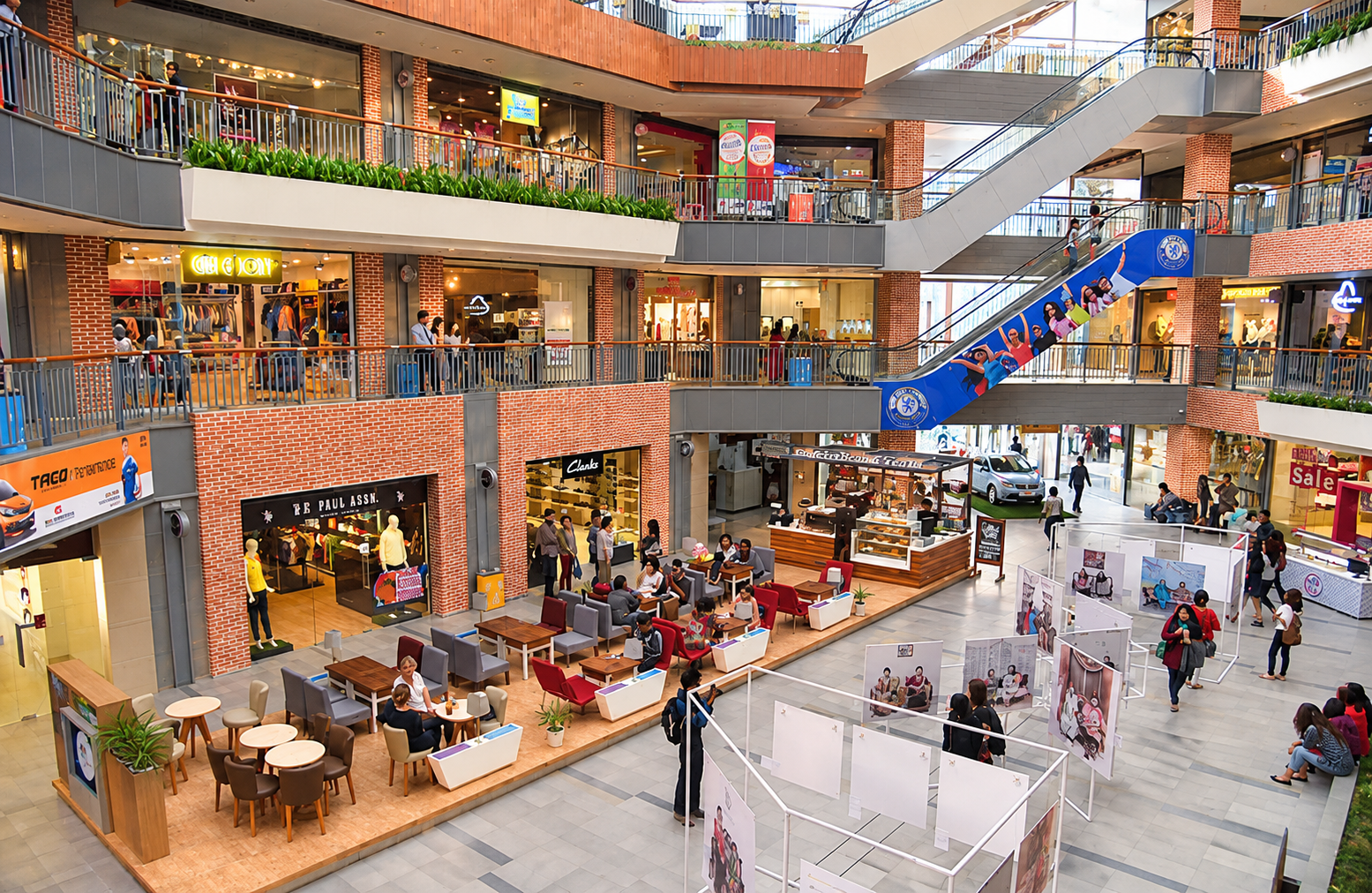
Chhaya Centre in Thamel, opened in December 2018, is the textbook case. Built on a site of about 86,000 square feet with roughly 350,000 square feet of built-up area, it is a 15-storey structure in which the podium runs as a retail and entertainment mall and the hotel takes the top 10 floors. Inside are more than 200 shops, three multiplex cinemas, restaurants and a food court, a casino, and parking for 300 cars and 300 motorbikes in two basement levels. On top sits Aloft Kathmandu Thamel, a 167-room five-star property under the Marriott brand with its own entrance. The chairman, Prithvi Bahadur Pande, put the cost at about Rs 5 billion over five years of construction. The project also drew protest from the local Newar community, who said it destroyed a historic pond, a reminder that even a technically successful development carries community and heritage costs.
The earlier domestic template was Civil Trade Centre, or Civil Mall, at Sundhara, built by the Civil Group for a claimed Rs 2.5 billion. It runs nine storeys on about six ropanis of land, with 240 shops on the lower four floors and 190 offices on the fifth to eighth, two cinema halls near the top, rooftop and revolving restaurants, and a two-level basement parking for 200 cars and 200 motorbikes. At opening it quoted retail rents of roughly Rs 80 to 185 per square foot a month and office rents of roughly Rs 47 to 77. The split is instructive: retail on the floors that draw crowds, offices stacked quietly above, each priced for what it is worth. That is the podium-and-tower idea at a smaller, more conservative scale than Chhaya Centre, and it has filled.
The projects that stalled

For every finished block there is a frame that never topped out. Kathmandu Tower, the bus-park project, is the starkest. Under a 2014 agreement, the developer, Jaleshwor Swachchhanda Bikoi Builders, was to build a 12-storey complex with two basements on about 11,890 square metres, operate it for 25 years on a 30-year lease, then hand it to the metropolitan government. In 2024 the company obtained a permit for a 19-storey building instead. That same year, then-mayor Balen Shah alleged irregularities and said the city stood to lose more than Rs 1 billion, and the metropolitan government ordered construction to stop. The company went to the Patan High Court, which issued an interim order in June 2025 telling the city not to halt work. The standoff has not resolved, and the officials who run the city’s partnership unit say the company has not returned to continue the process. Roughly 10 years and Rs 3.5 billion of ambition sit idle.
Kathmandu View Tower at Purano Bus Park tells a related story about ambition meeting limits. A January 2015 agreement envisioned 29 storeys. After the April 2015 earthquake, the plan was cut back, and the version that advanced was 16 storeys, still four above what the code allows. The pattern repeats: a tall, mixed commercial tower is announced, the numbers shrink, and delivery slips.
The 12-storey ceiling, and the math underneath it
After the magnitude 7.6 earthquake of April 25, 2015, the government tightened the building code for the Kathmandu Valley to restrict construction above 12 storeys. That cap is the hard constraint on the tower half of podium-and-tower. A 29-storey plan becomes 16; a 16-storey plan is already above the line. Height is where the model earns its biggest returns, because each added floor of hotel rooms or offices spreads the land cost thinner, so a ceiling on floors is a direct ceiling on the economics.
Height is not the only rule that bites. Ground coverage, floor area ratio, setbacks and right-of-way requirements all shape how much a developer can actually build on a given plot, and they vary by municipality and road width. Anyone evaluating a mixed-use site has to read those local bylaws before the brochure math means anything, because the buildable envelope, not the land area, sets the ceiling on revenue. (BiznesVue has a full guide to Nepal’s setbacks, coverage and right-of-way rules.)
The demand question nobody wants to answer
A podium-and-tower block only works if all of its parts fill, and that is where Kathmandu’s recent record gets uncomfortable. On the retail side, the city has kept adding mall floor space even as footfall has thinned, leaving some complexes with shutters that never opened. On the office side, there is no reliable public measure of vacancy, which itself tells you how immature the commercial leasing market still is. Residential demand for high-rise apartments softened badly after 2015, with buyers wary of living above the ground floor and some completed towers struggling to find tenants, though surveys suggested demand would return for structurally sound buildings in central locations.
Put those together and the risk in a large mixed-use project is concentration, not diversification. The pitch is that multiple uses spread risk. The reality in a thin market is that a single block can face soft retail, unmeasured office demand and cautious residential buyers at the same time. Tenants and investors looking for commercial or office space in these complexes can at least compare asking terms on property marketplaces such as Basobaas, but the deeper problem is that the market lacks the published occupancy and rent data that would let anyone price the risk properly. For the detail on each leg, BiznesVue has covered Kathmandu’s office market and the city’s mall glut separately.
The financing reality

A Rs 3.5 billion or Rs 5 billion block is a banking event, not just a construction one. Nepal’s banks hold around Rs 689 billion in real estate loans, and the sector is already a focus of regulatory caution, with construction among the areas where non-performing loans have been climbing. Credit is not loose: Nepal Rastra Bank data put total bank lending at about Rs 6,077 billion in October 2026, with private-sector credit growing only in the mid-single digits. For a developer, that means a long, capital-hungry build competing for cautious financing, and for a public-private project it adds the extra fragility that a change of mayor or a court order can freeze the whole thing, as Kathmandu Tower shows.
The bottom line
Podium-and-tower is the right shape for a land-scarce valley, and Chhaya Centre and Civil Mall prove the model can be built and filled. But the city’s record is a split screen. The projects that worked were privately driven, sized to the market, and finished. The ones that stalled were taller, more leveraged on public-private structures, and more exposed to the 12-storey cap and to politics. For investors and developers, the lesson is not that mixed-use fails in Kathmandu. It is that the returns live in disciplined scale, a buildable envelope checked against the bylaws before the land is bought, and tenants lined up before the podium rises, not in the floor count on the rendering. For more, see the full BiznesVue real estate coverage.
Frequently Asked Questions
What is a podium-and-tower mixed-use development?
It is a building that stacks different uses on one plot. The lower floors, the podium, hold retail, a food court, cinemas and parking, which need footfall and large floor plates. The tower above holds a hotel, offices or apartments, which earn rent by the room or desk. The aim is to make one expensive urban site carry several income streams at once.
What is the largest mixed-use complex in Kathmandu?
Chhaya Centre in Thamel is the clearest example. The 15-storey block has about 350,000 square feet of built-up area, more than 200 shops, three multiplex cinemas, a casino and the 167-room Aloft Kathmandu Thamel hotel on its top floors. It cost about Rs 5 billion and opened in December 2018.
How tall can buildings be in Kathmandu?
After the April 2015 earthquake, the building code for the Kathmandu Valley was revised to restrict construction above 12 storeys. Local bylaws on ground coverage, floor area ratio, setbacks and road right-of-way further limit how much can be built on a specific plot, so the buildable envelope is often smaller than the land area suggests.
Why has the Kathmandu Tower project stalled?
The public-private complex at the old bus park, budgeted near Rs 3.5 billion, has been unfinished for about a decade. In 2024 the metropolitan government alleged irregularities and ordered construction to stop; the developer went to the Patan High Court, which issued an interim order in June 2025 against halting work. The dispute remains unresolved, and as of August 2026 the structure is abandoned.
Is commercial mixed-use real estate a sound investment in Kathmandu now?
It can be, but the risks are real. Mall footfall has thinned even as floor space grows, office vacancy is not publicly measured, and high-rise residential demand only partly recovered after 2015. Banks hold about Rs 689 billion in real estate loans and credit is cautious. Returns favor disciplined scale, a buildable envelope checked against local bylaws, and committed tenants, rather than the maximum floor count on a rendering.