
Borrow Rs 75 lakh for a house at 8.5 percent and stretch it over 25 years, and the bank collects about Rs 1.06 crore in interest alone, more than the Rs 75 lakh you borrowed in the first place. The sticker number that buyers obsess over, the interest rate, is rarely what decides that outcome. Tenure does. Before signing anything, it helps to know three things cold: how much a bank will actually lend against your property, what the loan costs once interest compounds across the years, and whether your income clears the bar. Here is the math, with the rules that set it.
Key Takeaways
- Nepal Rastra Bank allows banks to lend up to 80 percent of a first home’s value and 70 percent for any other residential home loan, with the single-household residential credit ceiling raised from Rs 20 million to Rs 30 million in Monetary Policy 2082/83.
- The 80 percent rate is measured against the bank’s valuation, not the price you pay, and banks typically value a property 10 to 20 percent below market, so your real down payment is usually closer to 30 percent than 20.
- Published floating home loan rates in mid-2026 ran roughly 6.5 to 9.5 percent, built as a base rate (around 4.2 to 6.3 percent across banks) plus a premium of about 1 to 2.5 percent.
- On a Rs 50 lakh loan at 8 percent, stretching the term from 15 to 25 years cuts the monthly EMI from about Rs 47,783 to Rs 38,591, but raises total interest from about Rs 36 lakh to Rs 66 lakh.
- For housing loans, total debt servicing cannot exceed 70 percent of gross income under NRB’s unified directive, and most banks size the loan so the EMI leaves you room to live.
How much a bank will actually lend you

The loan-to-value ratio (LTV) is the ceiling. NRB’s Monetary Policy 2082/83 set three bands: 80 percent for a first-time home buyer, 70 percent for any other personal residential home loan, and 50 percent for real estate loans, including land purchase and plotting. The same policy raised the credit limit for building or buying a private residential home from Rs 20 million to Rs 30 million, which widens how large a single-household loan can go.
The catch most first-time buyers miss is the word “value.” The percentage applies to the bank’s own valuation of the pledged property, not the price on the sale deed, and banks routinely value a property 10 to 20 percent below the going market price to protect themselves. Work it through: on a home selling for Rs 1 crore, a bank might value it at Rs 85 lakh, then lend 80 percent of that, or Rs 68 lakh. Your down payment is Rs 32 lakh, which is 32 percent of what you actually pay, not the 20 percent the headline number suggests. Budget for the gap before you commit to a property.
The four conditions behind the 80 percent rate

The 80 percent tier is not automatic. Under NRB’s directives it applies only when four conditions hold together. First, the house or apartment is no larger than 3,000 square feet and is for your own use. Second, you have no existing house or apartment loan from any bank or financial institution, which the lender is required to verify (past ownership without a loan does not disqualify you). Third, rental income from the property cannot be counted toward the income used to size the loan. Fourth, if interest rates rise during the loan, the EMI is not allowed to rise; the bank extends the tenure instead. Miss any one of these and you fall to the 70 percent band, which means a larger down payment on the same house.
What a home loan costs in 2026

Nepali home loans are almost always floating rate, quoted as a base rate plus a premium. The base rate reflects a bank’s own cost of funds and is published monthly; in Shrawan 2083 (mid-2026) base rates across commercial banks ranged from about 4.24 percent at Rastriya Banijya Bank to 6.25 percent at NIC Asia, averaging near 5.1 percent. On top of that sits a premium, commonly 1 to 2.5 percentage points. Add the two and published home loan floating rates in mid-2026 ran from roughly 6.5 percent at the state-owned banks to around 9 to 9.5 percent at the pricier end.
Two things follow. Because the rate floats, your EMI (or tenure) can move when NRB policy shifts the cost of funds. And the premium, not the base rate, is where banks compete, so the spread a bank offers you is worth negotiating. Rates change every month, so confirm the current figure with each bank before you decide rather than trusting any published table.
How EMI is calculated
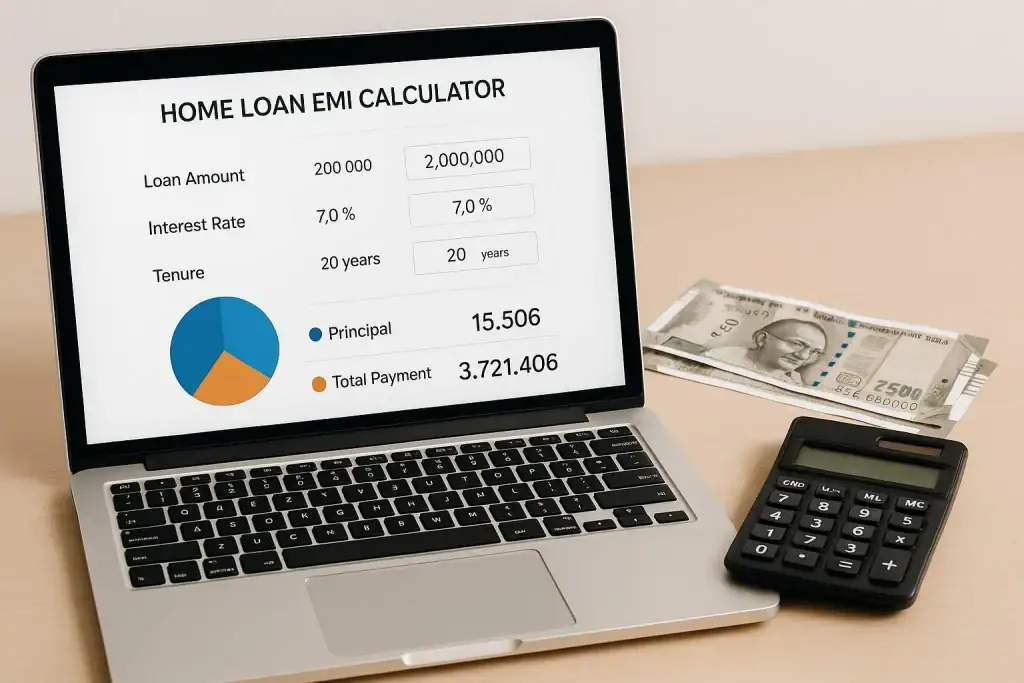
The equated monthly installment (EMI) splits each payment between interest and principal. The formula is EMI = P x r x (1+r)^n / ((1+r)^n – 1), where P is the loan amount, r is the monthly interest rate (the annual rate divided by 12, then by 100), and n is the number of months. Early payments are mostly interest; principal repayment accelerates only in the later years, which is why paying a loan off early saves so much.
The table below shows a Rs 50 lakh and a Rs 1 crore loan at 8 percent across tenures. These are illustrative, computed from the formula above; your bank’s figure will vary slightly with its rounding and fees.
| Loan and tenure | Monthly EMI | Total interest | Total repaid |
|---|---|---|---|
| Rs 50 lakh, 10 years | Rs 60,664 | Rs 22.8 lakh | Rs 72.8 lakh |
| Rs 50 lakh, 15 years | Rs 47,783 | Rs 36.0 lakh | Rs 86.0 lakh |
| Rs 50 lakh, 20 years | Rs 41,822 | Rs 50.4 lakh | Rs 1.00 crore |
| Rs 50 lakh, 25 years | Rs 38,591 | Rs 65.8 lakh | Rs 1.16 crore |
| Rs 1 crore, 15 years | Rs 95,565 | Rs 72.0 lakh | Rs 1.72 crore |
| Rs 1 crore, 20 years | Rs 83,644 | Rs 1.01 crore | Rs 2.01 crore |
| Rs 1 crore, 25 years | Rs 77,182 | Rs 1.32 crore | Rs 2.32 crore |
Why tenure costs more than the rate
A longer tenure feels cheaper because the monthly number shrinks, and that is exactly the trap. On the Rs 50 lakh loan above, moving from 15 to 25 years saves about Rs 9,000 a month but adds roughly Rs 30 lakh in interest over the life of the loan. The rate matters too, but less than most buyers assume. Hold the Rs 50 lakh loan at 20 years and change only the rate: at 7 percent the EMI is about Rs 38,765, at 9 percent about Rs 44,986, a difference of around Rs 6,000 a month. A two-point rate swing moves the EMI less than a ten-year tenure change does. The practical takeaway is to borrow over the shortest term your income can bear, and to treat a longer tenure as a last resort for affordability, not a default.
Will you qualify? Income and the debt-service cap
Eligibility turns on income, not just the property. NRB’s unified directive caps total debt servicing at 70 percent of gross income for housing loans, and in practice banks are more conservative, often sizing the loan so the EMI sits around half of your take-home pay. Run the Rs 50 lakh, 20-year loan at 8 percent, with an EMI near Rs 41,822. At the 70 percent regulatory ceiling you would need gross income of at least about Rs 60,000 a month; at a more livable 50 percent, closer to Rs 84,000. Any other EMIs you carry, a vehicle or personal loan, eat into that same limit. Lenders also look at age, typically expecting the loan to be cleared by retirement, which shortens the maximum tenure for older borrowers. Maximum tenures run to about 25 years, with 30 years available at a few banks.
Before you fix on a property, it is worth working backward from what you can service: pick a comfortable EMI, confirm the tenure your age allows, and let that set your price ceiling. Listing platforms such as Basobaas let you compare asking prices across Kathmandu, Lalitpur and Bhaktapur so your target sits inside that budget rather than outside it. For how NRB’s lending caps shape the wider market, see our breakdown of Nepal’s 80 percent home loan LTV and of how much of the banking system’s loan book is home loans.
The costs beyond the EMI
The loan is not the only bill. Buying a home carries registration and transfer charges at the land revenue office, a loan processing fee (often a fraction of a percent of the loan), property valuation and legal costs, and in many cases mortgage or property insurance the bank requires. If you are buying an apartment rather than land, there are ownership and common-area details that change what you owe over time; our guide to buying an apartment in Nepal covers the certificate, common areas and fees to check first. Fold all of it into your plan before you fix a budget, and compare offers across the full BiznesVue real estate coverage.
Frequently Asked Questions
How much home loan can I get in Nepal?
A bank can lend up to 80 percent of a first home’s value or 70 percent for any other residential home loan, with the single-household residential ceiling now Rs 30 million. The percentage applies to the bank’s valuation, which is usually 10 to 20 percent below market price, so your real down payment is often around 30 percent of the purchase price rather than 20.
What is the home loan interest rate in Nepal in 2026?
Published floating home loan rates in mid-2026 ran roughly 6.5 to 9.5 percent. The rate is a base rate (about 4.2 to 6.3 percent across banks, averaging near 5.1 percent) plus a premium of about 1 to 2.5 percentage points. Because it floats and changes monthly, confirm the current figure with each bank before deciding.
How is EMI calculated on a home loan?
EMI = P x r x (1+r)^n / ((1+r)^n – 1), where P is the loan amount, r is the monthly interest rate, and n is the number of months. For example, a Rs 50 lakh loan at 8 percent over 20 years works out to an EMI of about Rs 41,822, with total interest near Rs 50 lakh over the full term.
What is the maximum home loan tenure in Nepal?
Most banks offer home loans up to 25 years, and a few extend to 30 years. The tenure is also limited by age, since banks generally expect the loan to be repaid by retirement, so an older borrower may be offered a shorter term.
How much income do I need for a Rs 50 lakh home loan?
For a Rs 50 lakh loan at 8 percent over 20 years, the EMI is about Rs 41,822. At NRB’s 70 percent debt-service ceiling you would need gross income of at least roughly Rs 60,000 a month, and at a more comfortable 50 percent, closer to Rs 84,000. Any other loan EMIs reduce the amount you can borrow.
Does a longer tenure actually save money?
No. A longer tenure lowers the monthly EMI but raises total interest. On a Rs 50 lakh loan at 8 percent, moving from 15 to 25 years cuts the EMI by about Rs 9,000 a month but adds roughly Rs 30 lakh in interest over the life of the loan. Borrow over the shortest term your income can comfortably service.