Nepal judges a building by whether it will stand through the next earthquake. Far fewer people ask whether it wastes power and water for the next fifty years. That calculation is starting to change, and the push is coming less from buyers than from the development institutions and banks writing the checks. In June 2024, the International Finance Corporation approved a US$7 million loan for a 186-apartment complex in Maharajgunj, Kathmandu, with the building targeting a green certification almost no Nepali homebuyer has heard of: EDGE.
Key Takeaways
- EDGE, the green building standard run by the IFC (part of the World Bank Group), certifies buildings that cut energy use, water use, and the embodied energy in their materials by at least 20 percent each against a conventional baseline. It now operates in nearly 140 countries.
- Nepal’s visible footprint is small but real: the Soaltee Westend Premier in Nepalgunj is the country’s first US Green Building Council LEED Silver hotel, and a Marriott-operated, 186-unit apartment project in Kathmandu is targeting EDGE certification with IFC financing approved in June 2024.
- Buildings and construction account for 37 percent of global energy- and process-related CO2 emissions and 34 percent of global energy demand (UNEP, 2022 data), which is why multilateral lenders are tying money to certification.
- Adoption is thin. An Institute of Engineering study found only 11 Nepali projects registered for LEED, with none certified at the time of the research, and Nepal still has no green building rating system of its own.
- Green criteria can add roughly 10 to 20 percent to construction cost by older local estimates, so for now the decisive players are the banks and the 2024 Nepal Green Finance Taxonomy, not retail demand.
What green building certification actually certifies
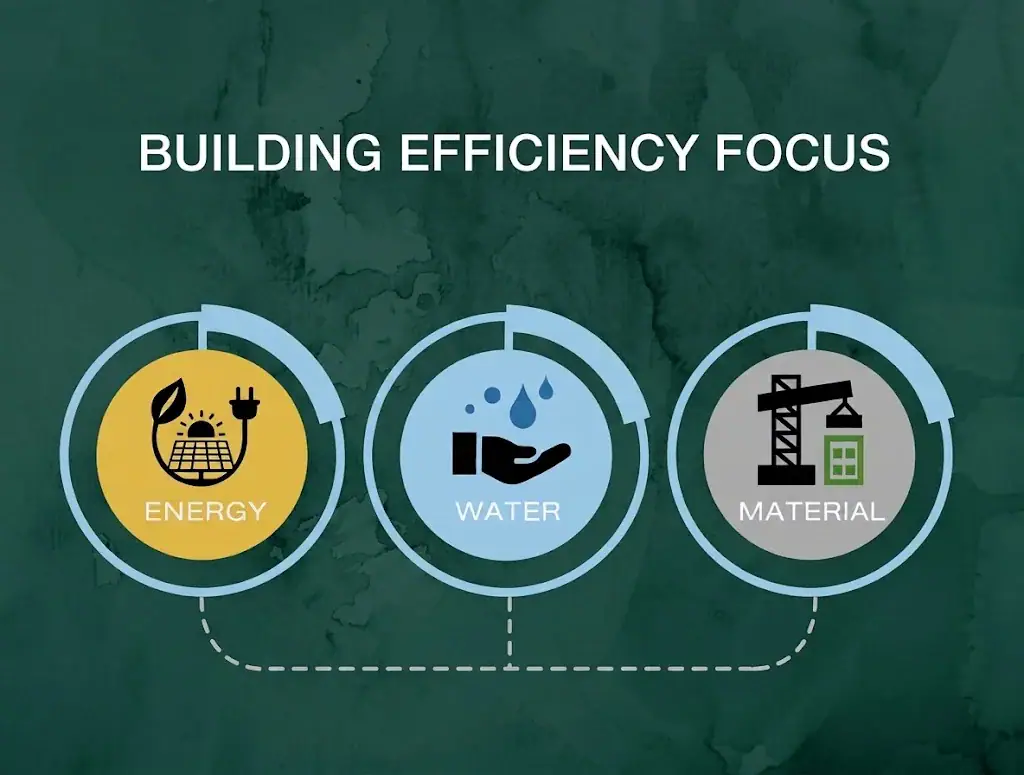
Two systems dominate the conversation globally, and both have now touched Nepal. LEED (Leadership in Energy and Environmental Design), run by the US Green Building Council, scores a building across categories including site sustainability, water efficiency, energy performance, materials, and indoor environmental quality, then awards a level: Certified, Silver, Gold, or Platinum. EDGE (Excellence in Design for Greater Efficiencies), created by the IFC for emerging markets, is deliberately simpler and cheaper. It sets one clear bar: a design must show a projected reduction of at least 20 percent in energy, in water, and in the embodied energy of construction materials, each measured against a conventional local building. You can read the standard directly on the IFC’s green buildings page.
The reason this matters beyond branding is scale. According to the UNEP and GlobalABC Global Status Report for Buildings and Construction, the sector accounted for 37 percent of energy- and process-related carbon emissions and 34 percent of global energy demand in 2022. A standard like EDGE is an attempt to make that footprint financeable: a bank can point to a certificate instead of taking a developer’s word that a building is efficient.
What has actually been built in Nepal
The honest answer is: not much, but the examples are concrete. The clearest LEED case is the Soaltee Westend Premier in Nepalgunj, recognized as Nepal’s first US Green Building Council LEED Silver hotel, with an on-site sewage treatment plant that the company says supplies all of the hotel’s irrigation, flushing, and cooling water. That is a single property, not a trend.
The more telling signal is on the EDGE side. The IFC’s own project disclosure for Good Karma Hospitality Pvt. Ltd. describes a greenfield complex of 186 apartments in Maharajgunj, Kathmandu, where Marriott International will operate 56 serviced apartments and the remaining 130 will be sold to the public. The IFC board approved a US$7 million loan on a 12-year term with a 4-year grace period, signed in June 2024, and the environmental section names the pursuit of EDGE certification. The same document notes the building uses seismic damper walls across the structure, which it calls a first for a residential apartment building in Nepal. That pairing, seismic resilience plus resource efficiency, is exactly the combination Nepali construction has historically split apart.
Step back from the headline projects and the base is still shallow. A 2023 study presented at the Institute of Engineering Graduate Conference counted 11 projects registered for LEED certification in Nepal, among them Central Park Apartment, the Butwal Power Company office, the corporate office of Sipradi, and the Marriott hotel in Thamel, but found none of its rated case studies had obtained a certificate. The study’s blunt conclusion was that Nepal does not currently have a green building rating system in place to assess buildings at all.
The barriers are cost, codes, and the absence of a local system
Why so few? The recurring obstacle is money up front. As far back as 2010, a LEED-accredited professional working on an early Kathmandu project estimated that meeting LEED criteria might raise construction cost by 10 to 20 percent. Certification fees compound that: EDGE charges on a per-square-meter basis with minimums, and LEED runs its own fee schedule, costs that a developer selling into a price-sensitive market struggles to pass on. In a country where many buyers are already weighing setback and ground-coverage rules and the real cost of earthquake-resistant construction before they break ground, a voluntary efficiency premium is a hard sell.
The deeper problem is the absence of a domestic framework. India adapted LEED into LEED-India and built GRIHA as a homegrown system; Nepal has neither a local rating body nor green building bylaws that would reward compliance or penalize waste. Without that scaffolding, certification stays a developer’s marketing choice rather than a market standard, and a buyer browsing apartment listings on a marketplace like Basobaas has no way to filter for an energy rating the way they can filter for price or location. Demand signals cannot form around information that is not collected.
Why the banks will decide this, not buyers
If retail demand is weak, the pressure is arriving from the financing side. In 2024 Nepal Rastra Bank issued the Nepal Green Finance Taxonomy, a classification system, carrying the governor’s foreword, that defines which activities count as green for lending purposes. It contains dedicated construction and real estate categories and grounds its tests in national and international building codes and standards and in energy efficiency. A taxonomy is plumbing, not a mandate, but it is the step that lets a bank label a loan green, report it, and eventually price it differently.
That is the channel to watch. Nepal’s banks already carry heavy exposure to property, with real estate loans in the hundreds of billions of rupees, most of it residential. When a development institution like the IFC attaches EDGE to a loan, and when the central bank’s taxonomy gives commercial lenders a reason to track efficiency, certification stops being a plaque in a hotel lobby and starts being a condition of capital. The risk worth naming is that a taxonomy without verification turns into greenwashing, with labels outrunning any measured savings, which is precisely why third-party certificates like EDGE and LEED matter: they put a number behind the claim.
For now, green building certification in Nepal is a handful of projects and a new rulebook, not a movement. But the ingredients that turned it into a market elsewhere, a verifiable standard, a multilateral lender willing to underwrite it, and a central bank taxonomy, are all now present at once. The question is no longer whether the tools exist. It is whether Nepal’s developers and banks use them before the next building boom locks in another generation of inefficient stock. For related coverage, see our full Real Estate section.
Frequently Asked Questions
What is green building certification?
It is independent verification that a building meets defined resource-efficiency and sustainability standards. The two most common systems are LEED, run by the US Green Building Council, which scores buildings and awards Certified, Silver, Gold, or Platinum levels, and EDGE, run by the IFC, which requires a projected reduction of at least 20 percent in energy, water, and the embodied energy of materials.
Are EDGE or LEED used in Nepal?
Both have reached Nepal, on a small scale. The Soaltee Westend Premier in Nepalgunj is recorded as the country’s first LEED Silver hotel, and a 186-apartment, Marriott-operated project in Maharajgunj, Kathmandu is pursuing EDGE certification with a US$7 million IFC loan approved in June 2024. A 2023 study counted 11 Nepali projects registered for LEED, with none certified at the time.
How much more does a green-certified building cost to build in Nepal?
There is no official Nepal figure, but an early local estimate put the construction premium for meeting LEED criteria at roughly 10 to 20 percent, before certification fees. EDGE charges per square meter with minimum fees, and the extra cost is one reason adoption has been slow in a price-sensitive market.
Does Nepal have its own green building rating system?
No. Unlike India, which created GRIHA and adapted LEED-India, Nepal has no domestic green building rating body and no green building bylaws. Projects that seek certification use foreign systems such as LEED or EDGE directly. The 2024 Nepal Green Finance Taxonomy from Nepal Rastra Bank defines green construction and real estate for lending, but it is a finance classification, not a building rating system.
Why do banks care about green building certification?
Certification gives a lender a verified basis for calling a loan green, which matters as central banks build green finance frameworks. Nepal Rastra Bank’s 2024 taxonomy lets banks classify and report green lending, and development institutions such as the IFC already tie financing to EDGE certification. Because buildings drive a large share of energy use and emissions, lenders see efficiency as both a climate and a long-term credit consideration.
Does green building certification lower utility bills?
That is the intent. EDGE requires designs to project at least a 20 percent cut in energy and water use against a conventional baseline, which should translate into lower running costs over a building’s life. Actual savings depend on how the building is operated, so a certificate signals efficient design, not a guaranteed bill.