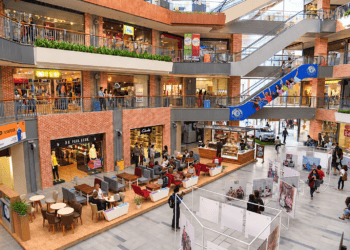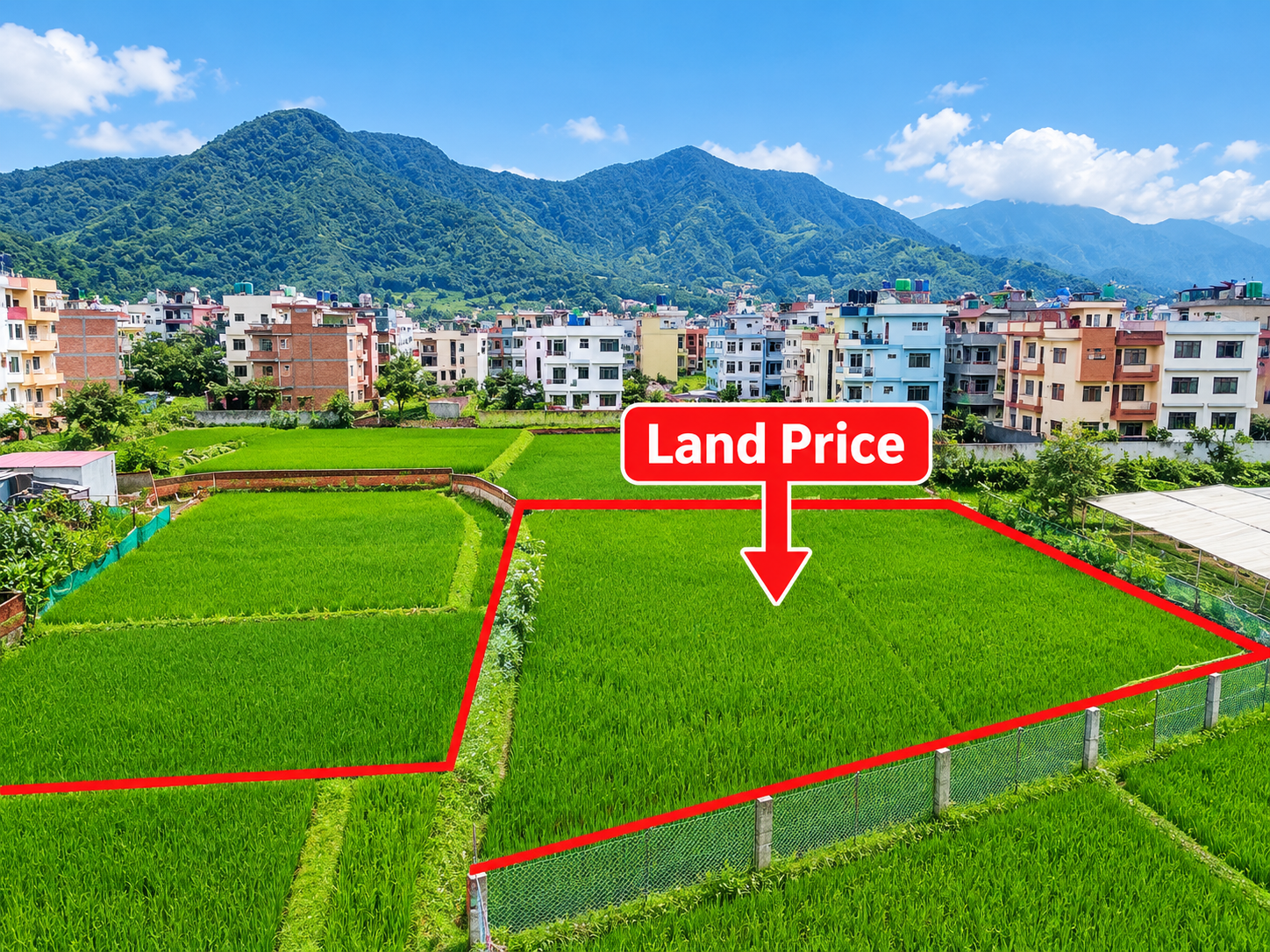
One aana of land, about 342 square feet, carries a government minimum price of roughly Rs 76.20 lakh along New Road and roughly Rs 22 lakh in Manamaiju. Both plots sit inside the same valley, a short drive apart. And the minimum valuation is the floor, not the ceiling: on the open market the gap between the valley’s dearest and cheapest neighborhoods stretches far wider than three to one.
Kathmandu Valley land prices are quoted in a unit most buyers outside Nepal have never heard of, set against a government valuation table that few sellers treat as real, and driven by factors that have little to do with how far a plot sits from the old city core. This is a map of what an aana actually costs across the valley in 2026, where the official numbers come from, and why two plots a few kilometers apart can differ in price by an order of magnitude.
Key Takeaways
- Government minimum valuation (the malpot rate used for registration and tax) for fiscal year 2083/84 runs from about Rs 76.20 lakh per aana in Dillibazar’s commercial core down to about Rs 22 lakh per aana in Manamaiju and Tokha.
- Most Kathmandu land revenue offices raised minimum valuations 5 to 10 percent for 2083/84. Bhaktapur held its rates flat, and Lalitpur had not published new rates as of mid-2026.
- One ropani equals 16 aana, 64 paisa, or 256 daam, which is 5,476 square feet (508.72 square meters). One aana is 342.25 square feet (31.80 square meters). The aana is the valley’s working unit of trade.
- Market prices sit well above the government minimum. Reported estimates reach Rs 2 crore per aana in Baluwatar, Baneshwor and Sanepa, against Rs 20 lakh to Rs 50 lakh per aana in Godawari and Bungamati.
- Price is set mostly by road width and access, nearness to the Ring Road and arterial junctions, and commercial versus residential use, not by distance from the center alone.
- The spread between the official minimum and the real sale price is a structural feature of Nepal’s land market, and it determines how much buyers pay in registration fees and capital gains tax.
First, the unit: how an aana and a ropani work
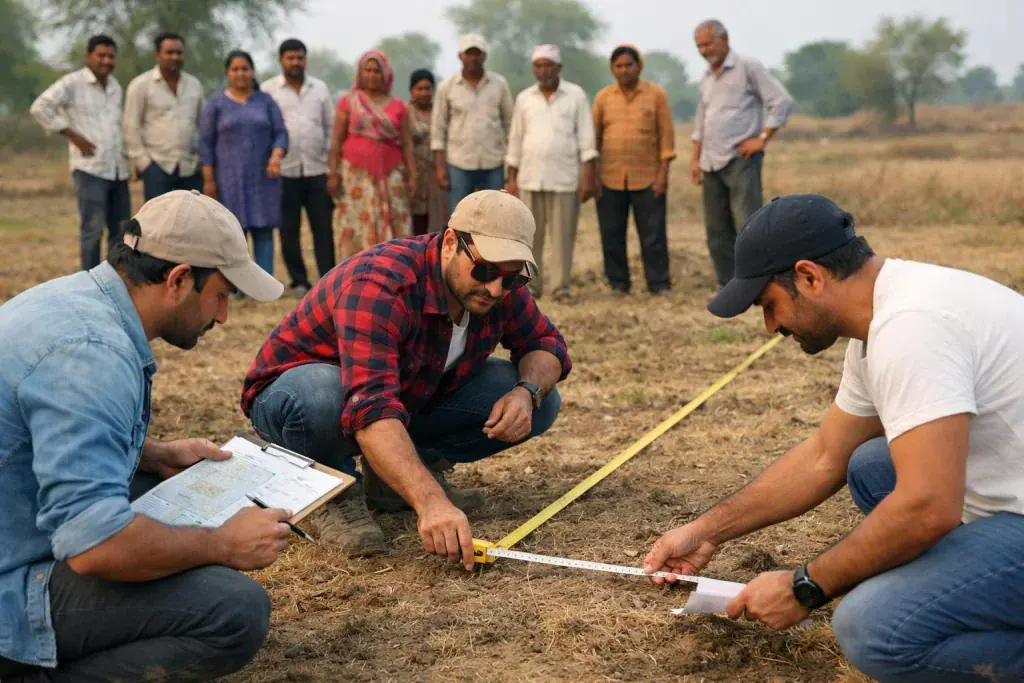
Prices across the Kathmandu Valley, and the hills generally, are quoted per aana. The ropani system divides as follows: one ropani holds 16 aana, each aana holds 4 paisa, and each paisa holds 4 daam. In area terms, one ropani is 5,476 square feet, or 508.72 square meters, and one aana is 342.25 square feet, or 31.80 square meters, according to the standard Nepalese units of measurement.
This matters because the Terai plains use an entirely different system, where land is measured in bigha, kattha and dhur (one bigha is 72,900 square feet). A price quoted per kattha in Chitwan cannot be compared with a price quoted per aana in Kathmandu without converting both to square feet first. Inside the valley, the aana is small enough to be the everyday unit: a modest residential plot is often four to eight aana, and a single aana is the smallest parcel most buyers transact.
What the government says an aana is worth
Every land revenue office in the valley publishes a minimum valuation, area by area, at the start of each fiscal year. This figure is not a market forecast. It is the floor the government uses to calculate registration fees and capital gains tax, and no plot can be registered below it. For fiscal year 2083/84 (2026/27), the Kathmandu offices raised most rates, as reported in July 2026 and corroborated by a separate compilation of the office figures.
| Area (land revenue office) | Prior year | FY 2083/84 | Change |
|---|---|---|---|
| Dillibazar commercial core: New Road, Durbar Marg, Kantipath, Ratnapark | Rs 72.60 lakh | Rs 76.20 lakh | About +5% |
| Putalisadak, Bagbazar, Ratnapark, Sabhagriha | Not stated | Rs 56 lakh | Increased |
| Chabahil: Ring Road, Gaushala to Dhobikhola | Rs 57 lakh | Rs 62.70 lakh | About +10% |
| Boudha Stupa surroundings | Not stated | Rs 48.95 lakh | New figure |
| Kalanki: Ring Road, Balkhu to Banasthali | Rs 47 lakh | Rs 49.35 lakh | About +5% |
| Kalimati, Balkhu, Soalteemode, Kalanki Chowk | Not stated | Rs 43 lakh | Set for the year |
| Tokha: pitched road toward Narayansthan | Rs 21.17 lakh | Rs 22.25 lakh (Rs 70,000 per sq m) | About +5% |
| Manamaiju: area roads | Rs 20 lakh | Rs 22 lakh | About +10% |
Two points stand out. First, the official spread within the valley is already steep: the commercial core is valued at more than three times the rate of the northern fringe, before any market premium is added. Second, the increases are modest, clustered at 5 to 10 percent, which keeps the official floor well below real transaction prices. Bhaktapur’s decision to leave its valuation unchanged, and Lalitpur’s delay in publishing, mean the valley does not even raise its floor uniformly.
What the market actually charges
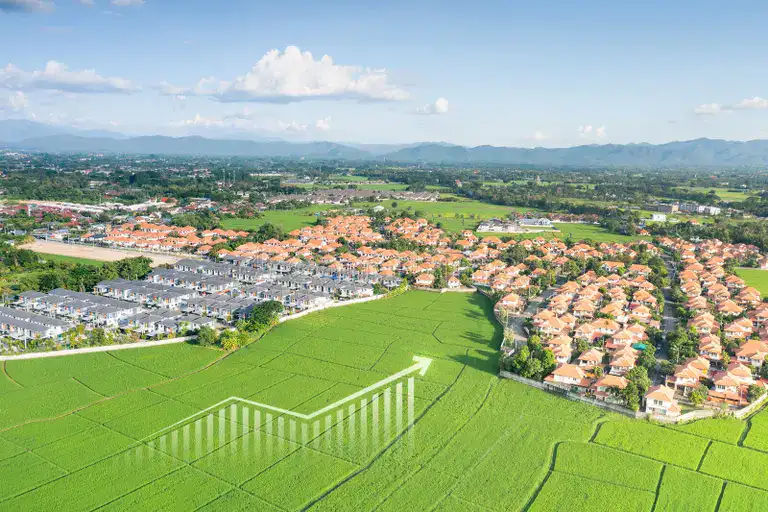
Market prices are harder to pin down than government rates, because Nepal has no central registry of transacted prices and most deals pass through informal brokers. The figures below are published estimates from the listings platform Basobaas for 2026, and they should be read as ranges rather than fixed quotes. Within each area, the actual price swings sharply with road width, plot shape and the exact location of the parcel.
| Area | Estimated market price per aana |
|---|---|
| Baluwatar, Naxal, Lazimpat | Rs 65 lakh to Rs 2 crore |
| Baneshwor, Maitighar | Rs 70 lakh to Rs 2 crore |
| Sanepa, Jhamsikhel (Lalitpur) | Rs 80 lakh to Rs 2 crore |
| Bhaisepati, Imadol | Rs 40 lakh to Rs 1 crore |
| Kapan, Budhanilkantha | Rs 35 lakh to Rs 85 lakh |
| Tokha | Rs 30 lakh to Rs 80 lakh |
| Godawari, Bungamati | Rs 20 lakh to Rs 50 lakh |
| Peri-urban (Lubhu, Lamatar road) | Rs 20 lakh to Rs 45 lakh |
Set the two tables side by side and the pattern is clear. In Tokha, the government minimum is about Rs 22 lakh per aana while the market range runs to Rs 80 lakh, roughly three to four times higher at the top end. In the commercial core, the official Rs 76.20 lakh sits below market quotes that reach Rs 2 crore. The ratio is not constant, which is part of why the valuation system is so contested.
Why the official and market prices diverge
The gap is deliberate on both sides. A low government valuation reduces the registration fee and the capital gains tax a seller owes, so buyers and sellers have a shared incentive to register near the floor and settle the balance privately. The government, for its part, raises the floor slowly to avoid pricing ordinary families out of registration. The result is a two-tier price for the same plot, a pattern BiznesVue has covered in detail in the valuation duplication trap. That gap is not harmless: it narrows the state’s tax base and it makes the real market opaque, because the only official record of a sale understates what changed hands.
It also feeds directly into transaction costs. Registration fees and the 10 percent capital gains tax both calculate off the declared value, which is why the valuation floor matters to every buyer. Land registration fees now fund roughly a third of provincial revenue, as covered in our analysis of the FY 2082/83 record, which gives provinces a strong reason to keep nudging the floor upward.
What actually sets the price of a plot
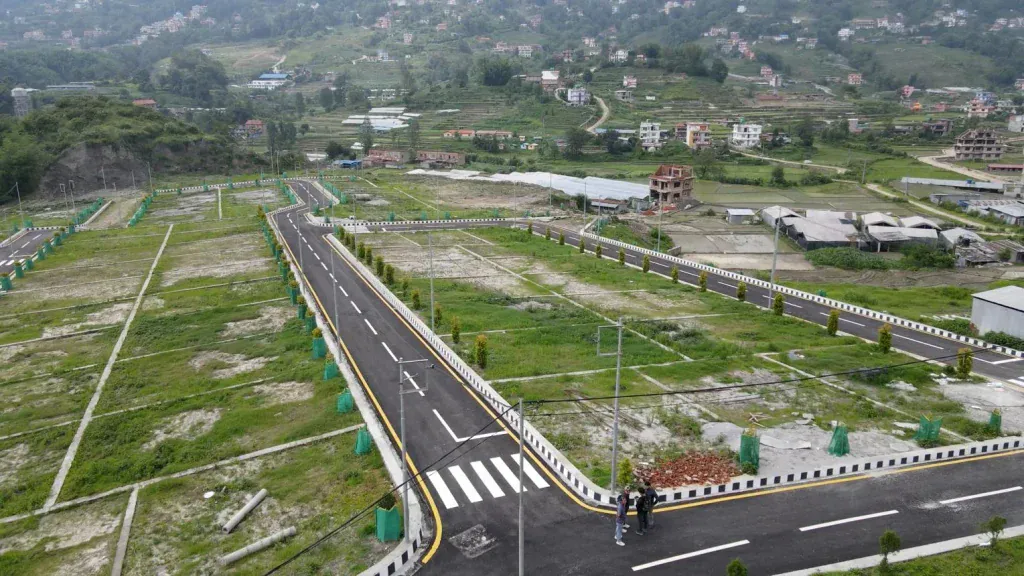
Distance from the city center is a weak predictor of price in the valley. The stronger drivers are specific and physical.
Road width and access. The single largest swing within any area is the width of the road a plot fronts. A parcel on a motorable arterial can cost several times a parcel of identical size on a narrow lane 100 meters behind it. This is why price ranges within one neighborhood are so wide: a Baluwatar quote of Rs 65 lakh and one of Rs 2 crore can describe plots in the same locality on different roads.
Proximity to the Ring Road and junctions. Land along the Ring Road and at points where arterials meet carries a premium for commercial potential. Baneshwor’s pricing reflects its position where the Ring Road meets several radial routes, which supports both resale value and rental income. That premium is also why the proposed northern outer ring road extension is watched so closely in the Kapan, Tokha and Budhanilkantha corridor.
Use and buyer type. Sanepa and Jhamsikhel draw professional and expatriate demand; Baluwatar is a diplomatic enclave; Bhaisepati attracts family buyers with planned layouts, schools and a cooler microclimate. Each pocket of demand supports a different price, independent of how central the area is.
The flip side is speculation. Fringe areas with a rumored road or infrastructure project can see prices run ahead of any real change in access, then stall when the project slips. BiznesVue has traced one such cycle in the outer ring road speculation pattern, where land booms priced in a highway that took years to arrive.
What a buyer should take from the numbers
Treat the government valuation as a cost input, not a price guide. It tells you the minimum you can register at and therefore your tax and fee base, nothing more. For an actual purchase, the market range is the starting point, and the real figure depends on the specific road and plot, which no table can capture. Verify the per-aana rate at the relevant land revenue office directly, because the published compilations carry translation and transcription errors, and the Mitrapark figures in the 2083/84 round, for instance, were reported inconsistently across sources.
Buyers should also price in the cost of the two-tier system itself. Registering near the floor lowers today’s tax bill but sets a low acquisition cost on record, which can raise the capital gains tax when the plot is sold later. The Inland Revenue Department administers that tax, and its published directives on capital gains from land and house transfers are the authoritative reference. On the financing side, Nepal Rastra Bank’s loan-to-value caps, laid out in its monetary policy, limit how much of a valley purchase a bank will fund, which keeps a hard cash floor under every deal.
For more on the mechanics behind these prices, see the full BiznesVue real estate coverage.
Frequently Asked Questions
How much does one aana of land cost in Kathmandu Valley?
It depends heavily on the area. The government minimum valuation for FY 2083/84 ranges from about Rs 22 lakh per aana on the northern fringe (Manamaiju, Tokha) to about Rs 76.20 lakh per aana in the Dillibazar commercial core. Market prices run higher, with 2026 estimates reaching Rs 2 crore per aana in prime areas like Baluwatar, Baneshwor and Sanepa, and Rs 20 lakh to Rs 50 lakh in outer areas like Godawari and Bungamati.
How many square feet is one aana and one ropani?
One aana is 342.25 square feet, or 31.80 square meters. One ropani is 16 aana, which equals 5,476 square feet, or 508.72 square meters. A ropani also divides into 64 paisa and 256 daam.
What is the difference between government valuation and market price?
The government minimum valuation (malpot rate) is the floor used to calculate registration fees and capital gains tax; a plot cannot be registered below it. The market price is what buyers and sellers actually agree to, and it is typically several times higher. The gap exists partly because registering near the floor lowers transaction taxes, which is why the official record often understates real sale values.
Did land valuations rise in fiscal year 2083/84?
Most Kathmandu land revenue offices raised minimum valuations by 5 to 10 percent for FY 2083/84 (2026/27). For example, the Chabahil Ring Road rate rose from Rs 57 lakh to Rs 62.70 lakh per aana, and Dillibazar’s commercial core from Rs 72.60 lakh to Rs 76.20 lakh. Bhaktapur kept its rates unchanged, and Lalitpur had not published new rates as of mid-2026.
Why is land near the Ring Road so expensive?
Ring Road frontage and arterial junctions carry a commercial premium because they allow shopfronts, offices and higher rental income. Road width and access are the strongest drivers of price within any area, which is why a plot on a wide motorable road can cost several times an identical plot on a narrow lane nearby.
Which areas of the valley are cheapest?
The outer and peri-urban areas are cheapest. In 2026, estimated market prices in Godawari, Bungamati and the Lubhu-Lamatar corridor ran about Rs 20 lakh to Rs 50 lakh per aana, against Rs 2 crore in the prime central and Lalitpur pockets. Prices in these fringe areas are also more sensitive to speculation around planned roads and infrastructure.