Nepal’s seven provinces raise only a fraction of what they spend, and most of what they do raise on their own comes from a charge buyers tend to resent: the fee to register a land or house deed. In the fiscal year that ended in mid-July 2026, that resented line item had a record run. Land registration fees in Nepal, collected alongside capital gains tax at the local land revenue office, drove government real estate revenue to roughly Rs 61.5 billion for the year, and they now fund close to a third of all the money the provinces collect themselves.
Key Takeaways
- Land and house registration fees made up 30.56 percent of Nepal’s provinces’ total internal revenue of Rs 35.89 billion, the single largest own-source line for provincial governments.
- Government real estate revenue reached about Rs 61.5 billion in FY 2082/83, with Rs 21.95 billion collected in just the first six months, already above each of the three previous full years (Rs 18.24 billion, Rs 18.27 billion, and Rs 20.83 billion).
- Total transaction value nearly doubled to Rs 720.86 billion from Rs 386.15 billion a year earlier, per Nepal Rastra Bank, while fourth-quarter real estate revenue rose 48.26 percent and capital gains tax collection jumped 63.22 percent.
- The boom was lopsided: Bagmati Province transaction value grew 175.33 percent, while Madhesh managed 31.98 percent and saw its registered deed count fall 3.44 percent.
- Registration fees run from about 5 percent in Kathmandu Valley metros down to about 3 percent in rural municipalities, with a roughly 25 to 35 percent concession when a woman’s name is on the deed.
- The revenue figures flatter activity: they include mortgage registrations, not just sales, and are charged on below-market government valuations, which both inflates and understates the true picture.
Who collects the money, and where it goes
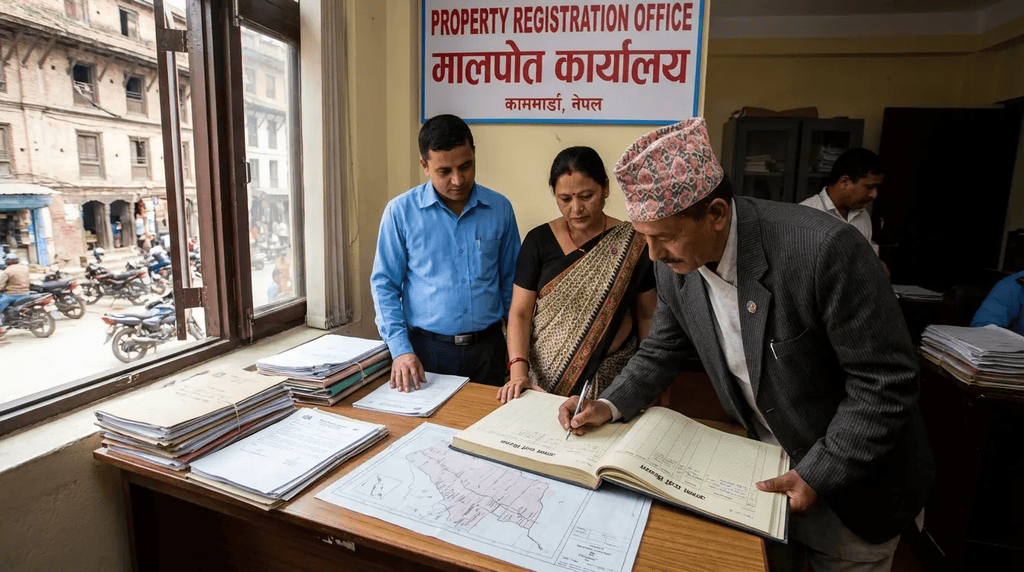
Every deed in Nepal passes through a Land Revenue Office, the malpot, run under the federal Department of Land Management and Archives (DOLMA). The office collects several things at once: the registration fee itself, capital gains tax on the seller’s profit, service and administrative charges, and penalty or delay fees. DOLMA reported that these combined collections hit Rs 21.95 billion in the first half of FY 2082/83, more than the agency took in across any of the three preceding full years. Kantipur put the full-year total at about Rs 61.5 billion.
What makes registration fees matter beyond the treasury is where the money lands. Registration fees are a shared revenue source, and they are the backbone of provincial own-source income. According to analysis of provincial finances, house and land registration fees alone accounted for 30.56 percent of the Rs 35.89 billion that Nepal’s provinces raised internally. No other single provincial tax comes close. That dependence cuts both ways, which is the part worth watching.
What the rates actually are

The registration fee is a percentage of the valuation, and the percentage depends on where the property sits. In Kathmandu Valley metropolitan areas the fee is around 5 percent. It falls to roughly 4.5 percent in municipalities outside the valley and to about 3 percent in rural municipalities (gaupalika). Putting a woman’s name on the deed typically cuts the fee by 25 to 35 percent, a concession designed to push property ownership toward women. Because rates and valuation tables vary by municipality, buyers should confirm the exact figure for their location; Basobaas maintains a current breakdown of registration charges by area.
Sitting next to the registration fee at the same counter is capital gains tax, withheld by the malpot before a transfer completes. Since Shrawan 1, 2083 (July 17, 2026), the rate rose to 10 percent of the gain on property held five years or less, and 7.5 percent on property held longer, applied to transactions above Rs 10 lakh. That increase is itself part of why the FY 2082/83 revenue numbers climbed, a point covered in detail in our report on the capital gains tax increase and what sellers now owe. Current rates and filing rules are published by the Inland Revenue Department.
FY 2082/83: a record year, and a rebound

The revenue record sat on top of a sharp recovery in the market itself. Nepal Rastra Bank‘s real estate report showed total transaction value reaching Rs 720.86 billion in FY 2082/83, nearly double the Rs 386.15 billion of the prior year. The momentum built through the year: fourth-quarter transactions rose 12.25 percent, registered deed transactions 12.28 percent, and rajinama (sale deed) transactions 22.88 percent. Real estate revenue in that final quarter grew 48.26 percent year on year, and capital gains tax collection alone surged 63.22 percent, as the pre-hike rush pulled deals forward. The two-year context is laid out in our analysis of NRB’s real estate data and the banking system’s property exposure.
The boom was lopsided by province
A national average hides how uneven the recovery was. By transaction value, Bagmati Province grew 175.33 percent, dwarfing the gains elsewhere, while Madhesh Province rose 31.98 percent and actually saw its fourth-quarter registered deed count shrink by 3.44 percent, the only province to decline. Bagmati’s rajinama transactions grew 69.38 percent, the highest of any province. The concentration is even starker at the metro level: fourth-quarter transactions rose 155.74 percent in Kathmandu, 136.92 percent in Lalitpur, and 108.71 percent in Pokhara.
Office-level data shows how the collection splits in practice. The Land Revenue Office in Nepalgunj took in Rs 74.86 crore (about Rs 748.6 million) in FY 2082/83, operating from rented quarters after an arson attack destroyed its premises and records in September 2025. Of that, capital gains tax was the largest piece at Rs 37.40 crore, with registration fees close behind at Rs 36.90 crore. The near-even split between the two is typical, and it is why a change to either rate moves the whole revenue line.
Why the headline numbers flatter the picture
The revenue totals deserve a few asterisks. First, they are gross of mortgage activity. When collection at the valley’s five land revenue offices jumped 80.5 percent year on year in one first quarter, reaching Rs 622.86 million, the Nepal Land and Housing Developers’ Association noted that actual property transactions grew closer to 20 percent, because the government figures also capture mortgage registrations and re-registrations, not only genuine sales. Revenue growth and sales growth are not the same number.
Second, the fee is charged on the government valuation, which sits below the real market price in most of the country. That gap understates the true value flowing through the market and leaves room for under-declaration, the mechanics of which we cover in the valuation duplication trap. It is the same structural weakness that drives property tax collection leakage at the local level. A record revenue year, in other words, is still collecting on a discounted base.
Third, and most consequential for public finance, is the cyclicality. A revenue source that can nearly double in value in a single year can also halve. Provinces that lean on registration fees for roughly a third of their own income are, in effect, betting their budgets on the property cycle. FY 2082/83 was the up-leg. The discipline will be in the years that are not.
Frequently Asked Questions
What is the land registration fee in Nepal?
It is a charge, paid at the Land Revenue Office (malpot) when a property deed is registered, calculated as a percentage of the property’s valuation. The rate is around 5 percent in Kathmandu Valley metropolitan areas, about 4.5 percent in municipalities, and about 3 percent in rural municipalities.
How much revenue did land registration generate in Nepal in FY 2082/83?
Government real estate revenue reached roughly Rs 61.5 billion for the full year, with Rs 21.95 billion collected in the first six months alone, more than the agency’s total in any of the previous three full years.
Who gets the money from registration fees?
Registration fees are a shared revenue source and the largest own-source line for Nepal’s provincial governments, accounting for 30.56 percent of the provinces’ total internal revenue. The federal Department of Land Management and Archives collects it through the Land Revenue Offices.
Is the registration fee cheaper if a woman is the buyer?
Yes. Registering a deed in a woman’s name typically cuts the fee by 25 to 35 percent, depending on the province and municipality. Joint husband-and-wife deeds usually still qualify for the woman’s concession.
Why did registration revenue rise so much in 2082/83?
Three forces combined: a market rebound that nearly doubled transaction value to Rs 720.86 billion, a capital gains tax increase effective Shrawan 1, 2083 that pulled deals forward, and mortgage registrations that are counted in the revenue figures alongside genuine sales.
Which province saw the biggest real estate growth?
Bagmati Province, by a wide margin. Its transaction value grew 175.33 percent year on year and its sale deed transactions rose 69.38 percent, while Madhesh Province lagged with a 31.98 percent value gain and a small decline in deed count.
Read more of our coverage in the BiznesVue Real Estate section.