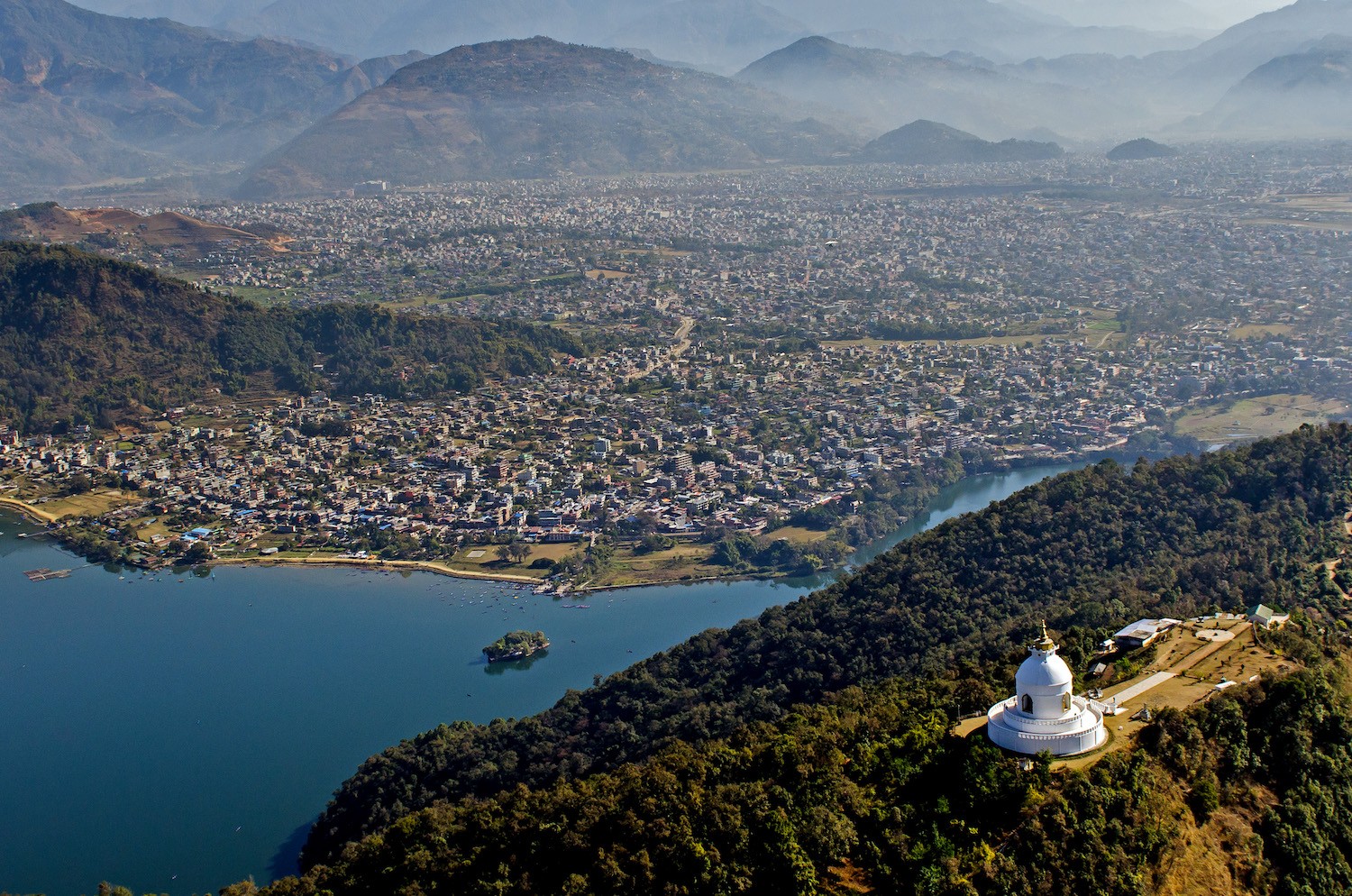
On September 23, 2026, a flydubai Boeing 737 MAX landed in Pokhara carrying 133 passengers, fewer than its 166-seat capacity. Nearly four years after Pokhara International Airport opened, the arrival marked the start of the city’s first daily scheduled international flight. During those years, Pokhara’s tourism and real estate sectors had expanded around the promise of international arrivals that never fully materialised.
Now, a new daily Dubai connection raises a crucial question: Will international air connectivity finally justify Pokhara’s massive tourism and real estate investment, or is the city still betting on demand that has yet to arrive?
Key Takeaways
- The $215.96 million Pokhara Regional International Airport opened on January 1, 2023, but did not receive a single daily scheduled international flight until flydubai’s Pokhara to Dubai service began on September 23, 2026.
- Pokhara now holds roughly 1,200 hotels, more than 700 of them tourist-standard, with member capacity for about 40,000 guests a night, according to the Hotel Association Pokhara.
- Tourism industry leaders estimate close to Rs 600 billion is invested in Pokhara tourism, with around Rs 500 billion of it in hotels alone.
- Annual hotel occupancy runs near 35 to 45 percent, even as peak festival weeks touch 90 percent on the strength of Indian and domestic visitors.
- The airport was financed mainly by a China EXIM Bank concessional loan of about 1.38 billion yuan (25 percent interest-free, the rest at 2 percent, a 20-year term and a 7-year grace period). Nepal has repeatedly asked Beijing to convert it to a grant.
- India has not granted the direct air routes Pokhara needs, so the airport still leans on one daily Gulf flight plus occasional charters rather than a full international schedule.
An international airport with almost no international flights
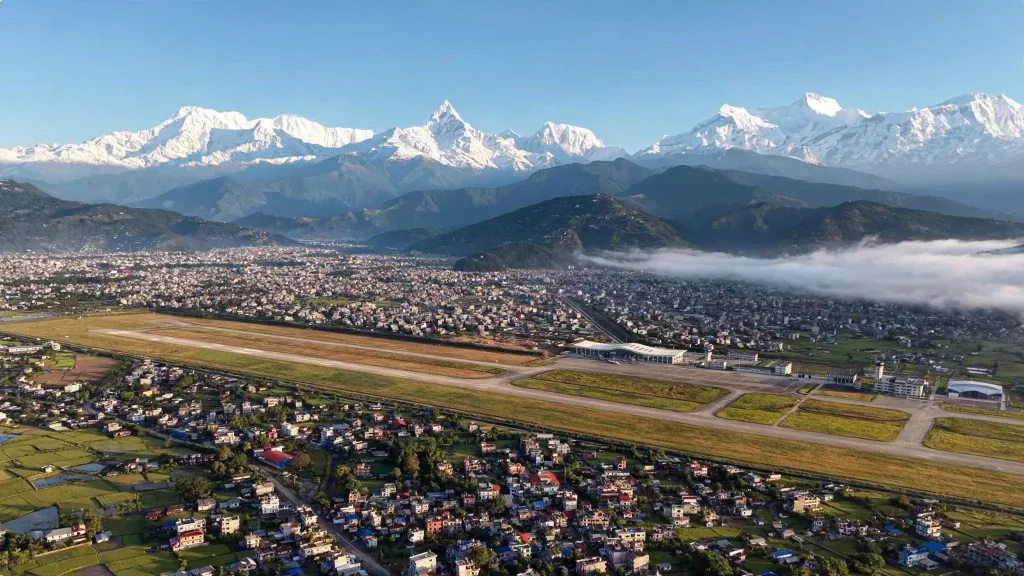
Pokhara Regional International Airport was inaugurated on January 1, 2023, built by China CAMC Engineering under a contract signed back in 2013. The facility was designed to move up to one million passengers a year, with an international terminal of about 10,000 square meters and a 2,500 meter runway. For most of its first four years, that capacity sat largely idle for international traffic. The first international flight was a China-funded Sichuan Airlines charter in June 2023. A weekly Himalaya Airlines service to Lhasa, launched on March 31, 2025, became the airport’s first scheduled international route, then stopped within months because too few passengers booked it. Across one recent year, the airport counted just seven international charter flights, according to the Pokhara Tourism Council.
The flydubai launch changed that picture, at least on paper. The Kathmandu Post reported that the opening flights ran well under capacity: 133 arrived and 152 departed on the first day, 135 arrived and 146 departed on the second. Departures running fuller than arrivals is a familiar pattern for a route carrying outbound workers and students rather than inbound tourists. One daily flight to a single Gulf hub is a real connection, but it is not the international gateway the region’s real estate was built to serve.
What Pokhara built while it waited
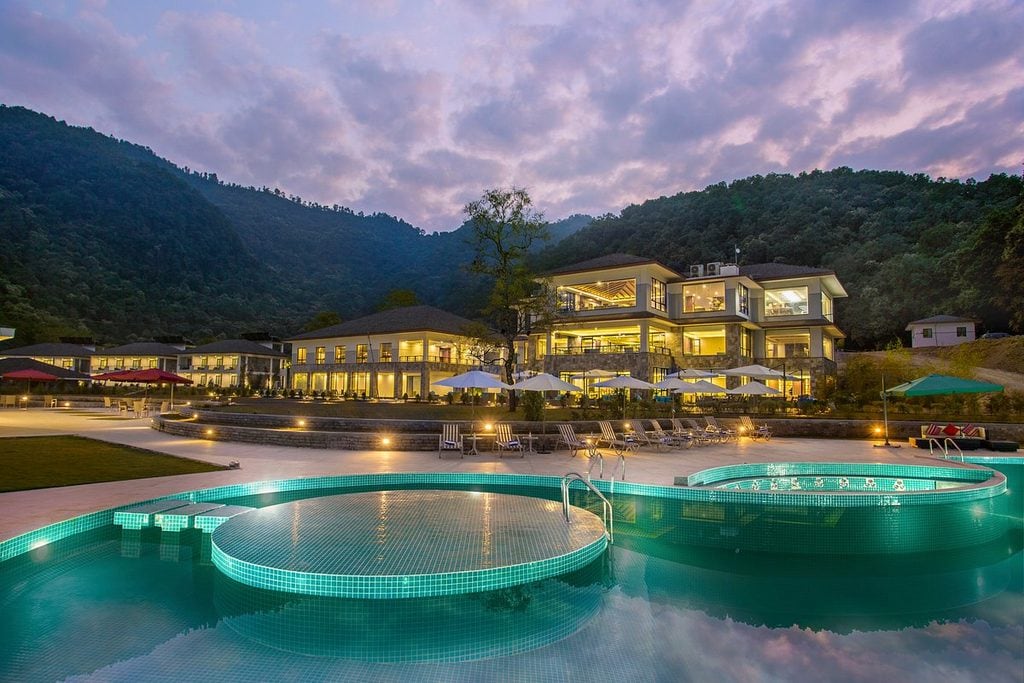
The supply side did not wait for the flights. Pokhara today has about 1,200 hotels, with more than 700 classed as tourist-standard, and the Hotel Association Pokhara alone counts 425 affiliated properties that can house roughly 40,000 guests a night. The hotel sector employs around 15,000 people. Pom Narayan Shrestha of the Pokhara Tourism Council has put total tourism investment in the city near Rs 600 billion, with about Rs 500 billion of that in hotels. The Kathmandu Post has reported that roughly Rs 100 billion in additional investment followed the airport’s construction.
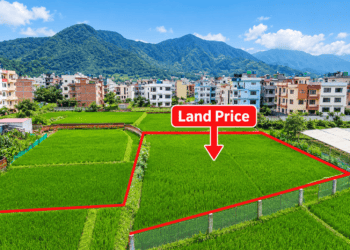
The building has not stopped. In one recent six-month stretch, the Hotel Association Pokhara estimated at least Rs 4 billion of fresh investment, about half in land and half in construction, as eight new hotels opened and roughly 400 rooms came online. Among them, the Temple Bell Boutique Hotel absorbed around Rs 1.25 billion for 55 rooms on about 2.5 ropanis of Lakeside land, while the Peninsula expanded from 30 rooms toward 77. Those land costs explain why much of the capital in Pokhara tourism real estate is tied up in location rather than in the buildings themselves. Buyers comparing plots and commercial space around Lakeside can scan asking prices on marketplaces such as Basobaas, though headline list prices rarely reflect the discounts that appear when rooms sit empty.
The occupancy problem: supply ran past verified demand
The headline occupancy figures out of Pokhara can mislead. During festival weeks and the April new-year surge, hotels have reported occupancy near 90 percent, driven heavily by Indian visitors escaping the summer heat and by domestic travelers. Phewa Lake has carried more than 5,000 boaters a day at those peaks. Average annual occupancy is a different story, sitting closer to 35 to 45 percent, with domestic tourists supplying about 30 percent of the beds filled over a full year. A city with capacity for 40,000 guests a night and an average occupancy in the low 40s has built well ahead of the demand it can currently prove.
The national arrivals data underlines how thin the international base still is. Nepal welcomed 1,158,459 foreign tourists in 2025, and India was the largest source market at 292,438 arrivals, or 25.2 percent, according to immigration and Nepal Tourism Board data. Local operators estimate about 400,000 foreign tourists reach Pokhara in a year, and most of that traffic still arrives overland from India or by connecting flights through Kathmandu. Pokhara’s tourism real estate was underwritten on the assumption that direct international flights would convert far more of Asia’s travelers into Pokhara guests. That conversion has not yet shown up in the numbers. For a national view of how hotel capacity has outrun arrivals, see our analysis of Nepal’s Rs 650 billion hotel bet and the broader pattern of five-star rooms sitting one-third full.
The debt under the runway
The airport that was supposed to fill those rooms carries its own balance-sheet problem. The $215.96 million project was financed largely by a concessional loan from China’s Export-Import Bank of roughly 1.38 billion yuan. About a quarter of the loan is interest-free, the remainder carries 2 percent annual interest, and the whole is repayable over 20 years after a 7-year grace period. Nepal’s Finance Ministry then on-lent the money to the Civil Aviation Authority of Nepal at 5 percent, which means the operator has to service a debt on an asset that is not yet generating international-scale revenue. With the grace period now behind it, the government has repeatedly asked China to convert the loan into a grant, including a formal request in August 2024, and has floated restructuring the debt. Beijing has not agreed.
The project also sits under a cloud of governance questions. The Commission for the Investigation of Abuse of Authority has filed corruption cases tied to the airport, including a December 2025 case naming 55 individuals and a March 2026 case against 21 people, among them two China CAMC Engineering officials, over alleged embezzlement of Rs 461.5 million. None of that changes the physical asset, but it does shape the political cost of pouring more public money into making the airport work.
What the Dubai flight fixes, and what it does not
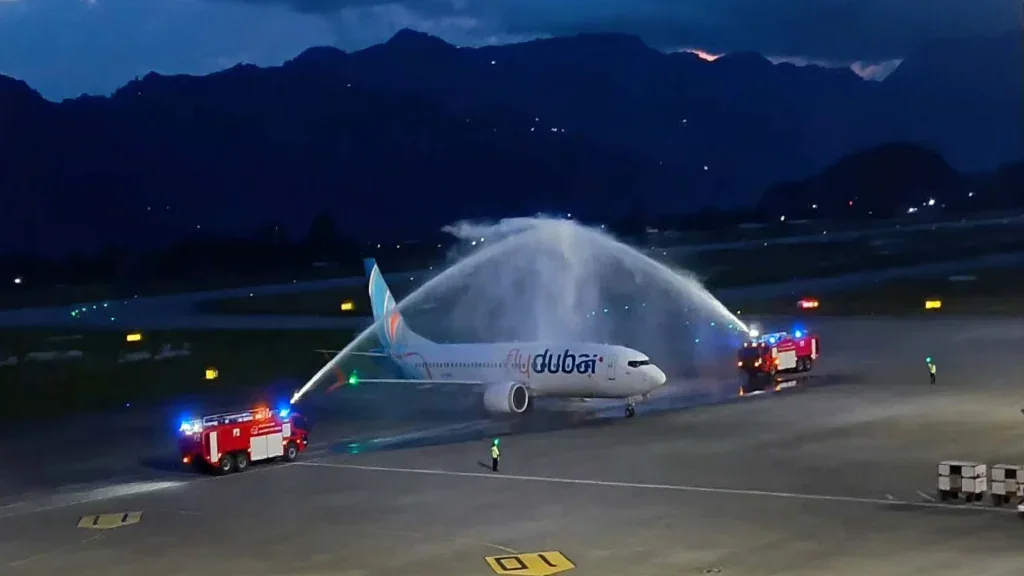
The flydubai route is a genuine improvement, and it did not happen by accident. The government waived landing, parking, navigation and ground-handling charges for carriers and offered discounts at both Pokhara and Bhairahawa to coax airlines in.
A daily wide-reach Gulf connection gives Pokhara a direct link to a global transfer hub and to the large Nepali workforce in the Emirates. If a second daily flight follows, as flydubai has said is possible on stronger demand, the route could begin to move the occupancy average rather than just the peak weeks.
The limits are just as clear. One route to one city cannot substitute for the regional air access Pokhara actually needs, and the biggest missing piece is India. Nepal has sought additional cross-border air routes and entry points from New Delhi since at least 2014, and India, citing security, has not granted them. Without those routes, flights between Pokhara and the Indian cities that send the most tourists remain inefficient or impossible, which keeps Pokhara’s single largest international market arriving mostly by road.
A daily Dubai flight running at 80 percent of capacity is encouraging. It is not the structural demand shift that justifies Rs 500 billion of hotel investment on its own.
What it means for buyers and developers
For anyone weighing Pokhara tourism real estate in late 2026, the evidence points to caution rather than either boom-time optimism or blanket pessimism. The upside is real: Pokhara remains Nepal’s premier leisure destination, Indian arrivals have hit multi-decade highs, and the city finally has a daily international flight with room to grow.
The risks are equally concrete. Supply has run ahead of proven demand, so a new hotel competes against thousands of existing rooms for an occupancy rate still stuck in the 40s. Returns depend on air connectivity that is politically contingent, above all the India routes. And the anchor asset, the airport, is carrying debt the operator cannot yet cover from its own revenue.
The practical read is that land in prime Lakeside and lakefront locations retains value because it is scarce, while undifferentiated mid-market hotel rooms face a long absorption period. Developers underwriting new projects on peak-week occupancy are using the wrong number; the annual average is what services a loan. Investors should treat the Dubai flight as a data point to watch, tracking whether load factors hold and whether a second daily service or a new route appears, rather than as a signal that the demand gap has closed. Pokhara’s commercial real estate thesis is not broken, but it is still waiting on the connectivity it was built to assume. For comparison, the same supply-ahead-of-demand dynamic is visible in Kathmandu’s office market, and you can follow the rest of our coverage on the BiznesVue real estate page.
Primary sources worth watching directly include the Civil Aviation Authority of Nepal for flight movement data and the Nepal Tourism Board for monthly arrival statistics, which together will show whether the airport effect is finally reaching Pokhara’s hotels.
Frequently Asked Questions
When did Pokhara airport get its first daily international flight?
flydubai began a daily Pokhara to Dubai service on September 23, 2026, using a Boeing 737 MAX with 166 seats. It was the first daily scheduled international flight at Pokhara Regional International Airport, which had opened on January 1, 2023. Before it, the airport had only a short-lived weekly Lhasa service and a handful of charters.
How much did Pokhara International Airport cost and who paid for it?
The airport cost about $215.96 million. It was financed mainly by a concessional loan of roughly 1.38 billion yuan from China’s Export-Import Bank. About 25 percent of the loan is interest-free and the rest carries 2 percent annual interest, repayable over 20 years with a 7-year grace period. Nepal has repeatedly asked China to convert the loan into a grant.
How many hotels does Pokhara have?
Pokhara has roughly 1,200 hotels, more than 700 of them tourist-standard. The Hotel Association Pokhara counts 425 affiliated properties with capacity for about 40,000 guests a night, and the hotel sector employs around 15,000 people. New supply is still being added, with about 400 rooms opening in one recent six-month period.
What is hotel occupancy like in Pokhara?
Occupancy swings sharply by season. Festival weeks and the April new-year surge have pushed hotels near 90 percent, led by Indian and domestic visitors, but the annual average sits closer to 35 to 45 percent. Domestic tourists account for roughly 30 percent of beds filled over a full year, which means international demand is still the missing piece.
Is Pokhara tourism real estate a good investment in 2026?
It is a mixed picture. Scarce prime Lakeside land holds its value, and record Indian arrivals plus the new Dubai flight are genuine positives. But supply has outrun proven demand, average occupancy remains in the 40s, and returns depend heavily on air connectivity that is not yet secured, especially direct routes to India. Underwriting a project on peak-week occupancy rather than the annual average is the most common mistake.
Why doesn’t Pokhara have more international flights?
Two reasons dominate. Airlines have been slow to commit because inbound demand is unproven, and India has not granted the additional cross-border air routes and entry points Nepal has requested since 2014, citing security concerns. Those routes are essential for efficient flights between Pokhara and the Indian cities that send the most tourists, so their absence keeps the airport dependent on a single Gulf route and charters.