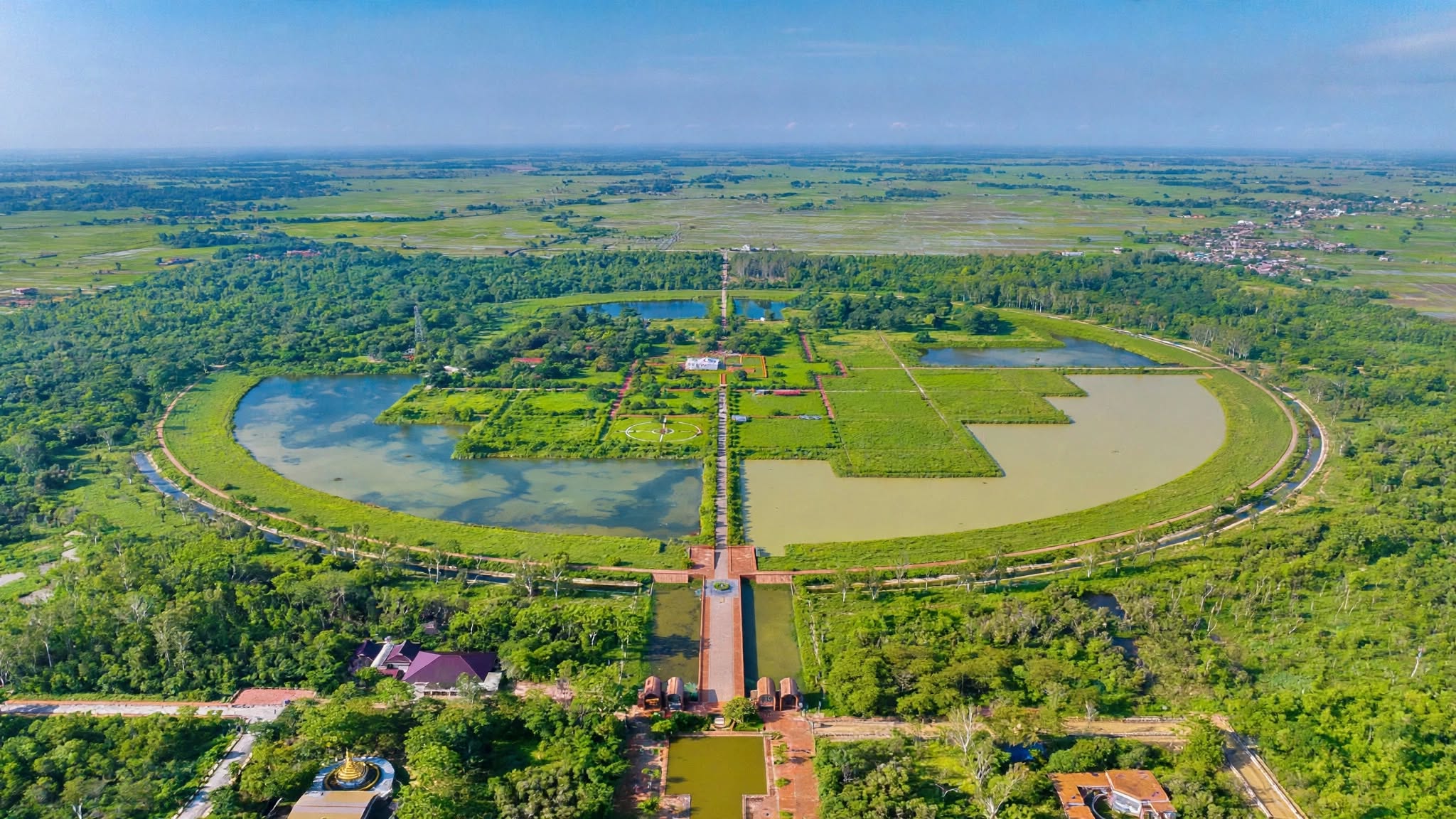
For more than six months in 2026, the newest international gateway to the birthplace of the Buddha handled no international flights at all. Gautam Buddha International Airport at Bhairahawa, built for about Rs 36 billion and opened in May 2022, saw its last scheduled foreign arrival on March 24, 2026, a Thai AirAsia service from Bangkok that landed with 14 passengers and left with 106. Around that silent terminal sits one of Nepal’s largest concentrations of new hospitality money: a Marriott-branded resort on the way, a cluster of five-star and deluxe hotels, and roughly Rs 80 billion that local entrepreneurs have poured into airport-linked businesses. The investment arrived first. The traffic it was built for has not followed.
Lumbini is Nepal’s clearest test of whether religious tourism can carry commercial real estate. The demand is real and, among foreign pilgrims, growing. But the economics of the corridor now rest on two assumptions that 2026 has called into question: that the airport will deliver international visitors directly, and that those visitors will stay long enough to fill hotel rooms. Neither is holding as planned.
Key Takeaways
- Lumbini recorded 1,114,266 visitors in 2025, down 4.95 percent from 1,172,282 in 2024, as Nepali arrivals fell 7.5 percent and Indian arrivals fell 10.1 percent from a record high.
- Foreign arrivals other than Indian rose 26.5 percent to 140,969, from 106 countries, led by Sri Lanka (32,287), Thailand (19,891) and Myanmar (18,528). That segment has grown from just 1,197 in 2021.
- Gautam Buddha International Airport, built for about Rs 36 billion, ran no scheduled international flights for more than six months in 2026 and has moved only 69,377 passengers in total since opening in 2022.
- Local entrepreneurs have invested an estimated Rs 80 billion in hotels, restaurants and real estate across Bhairahawa, Tilottama, Lumbini and Butwal, most of it bank-financed.
- The corridor’s core weakness is the day-tripper problem: many visitors see Lumbini and leave the same day, so added rooms chase a thin pool of overnight demand.
The money arrived ahead of the visitors

The scale of the bet is easier to grasp from the ground than from any single project. Netra Prasad Acharya, president of the Siddhartha Chamber of Industry and Commerce, has estimated that local entrepreneurs put about Rs 80 billion into businesses tied to the airport, spanning hotels and restaurants in Bhairahawa, Tilottama, Lumbini and Butwal, plus real estate. Most of it came from bank loans, and by his account some borrowers are already struggling with repayments. That is the central risk in one sentence: a region financed its hospitality buildout on debt, against demand the airport was supposed to generate.
The branded pipeline is what makes the story more than a local overbuild. In January 2026, Lumbini Palace Resort Limited signed a hotel management agreement with Marriott International to operate as the Lumbini Marriott Resort & Spa in Siyari, Rupandehi. For Marriott, it is the group’s first hotel presence in Nepal outside the Kathmandu Valley, a signal that a global operator sees enough forward demand to attach its name. The resort, running since 2018, has also begun preparing an initial public offering. Other properties already operating in the corridor include Hyatt Palace, Tiger Palace, Vilasa and Lumbini Heritage, and industry figures report interest from Hyatt, Marriott, Holiday Inn and Crowne Plaza. Tiger Palace Resort at Kotihawa, backed by Hong Kong’s Silver Heritage Group at a reported Rs 5.2 billion, remains the corridor’s largest single integrated-resort investment.
Beyond hotels, the same expectation has pulled money into commercial and office space along the Bhairahawa-Butwal axis, where a widened highway and an under-construction international conference center have been pitched as reasons to build now. The pattern rhymes with what BiznesVue has documented at the national level, where Nepal’s roughly Rs 650 billion hotel buildout created capacity for about four million tourists against arrivals near 1.2 million. Lumbini is that national mismatch in miniature, with one extra dependency bolted on: a dedicated airport.
The demand is real, and it is also shrinking
Both halves of that sentence are true, which is why the investment case is genuinely contested rather than simply wrong. According to data compiled by the Lumbini Development Trust, the sacred site drew 1,114,266 visitors in 2025, down 58,016 from the previous year. The decline came from the two largest groups: Nepali visitors fell to 702,910 from 759,990, and Indian visitors fell to 270,387 from a record 300,889 in 2024. For a region banking on volume, a down year in its two biggest markets is not a detail.
The brighter line is the foreign segment. Visitors holding passports other than Indian rose 26.5 percent to 140,969, arriving from 106 countries. That cohort has climbed from 1,197 in 2021 to 23,992 in 2022, 76,210 in 2023, 111,403 in 2024 and 140,969 in 2025, a rebound steep enough to explain why operators keep committing capital. The 2025 leaders were Sri Lanka with 32,287, Thailand with 19,891, Myanmar with 18,528, China with 10,789 and Vietnam with 8,615, a roster that maps almost exactly onto the Buddhist pilgrimage circuit. These are precisely the guests who, in theory, stay overnight and spend.
In practice, length of stay is the problem the hotels cannot solve by building more of themselves. Tourism operators in Rupandehi describe a persistent pattern of visitors touring Lumbini and returning the same day, which caps the overnight demand that hotel revenue depends on. More rooms do not lengthen a stay. Attractions, events and reasons to linger do, and most of those lie outside any single hotel’s control. It is the same supply-versus-use gap that BiznesVue traced in Kathmandu’s mall glut, where floor space rose while footfall did not.
The airport is the load-bearing assumption

Every optimistic projection for the corridor runs through Gautam Buddha International Airport, and that is exactly where the case is weakest. The airport opened on May 16, 2022, at a cost of about Rs 36 billion, with land acquisition for roughly 500 bighas accounting for some Rs 22 billion in compensation, partly funded by an Asian Development Bank concessional loan the government is still servicing. Since opening, it has recorded 1,222 flight movements and 69,377 passengers in total. For context, that cumulative figure over more than four years is smaller than the number of foreign pilgrims Lumbini received by road in 2025 alone.
The international service has been intermittent and, lately, absent. Five carriers (Jazeera Airways, Fly Dubai, Thai AirAsia, Qatar Airways and Nepal Airlines) operated between September and November 2024, then withdrew for the following summer schedule because they did not apply for slots. By 2026 the terminal had gone more than six months without a scheduled international flight. The airport’s running costs do not pause when the aircraft do: operating and administrative expenses exceed Rs 80 million a year against negligible aeronautical revenue, a structural loss documented since the airport’s first full year of operation. Civil aviation officials have pointed to expected charter flights rather than confirmed scheduled routes, which is not the same thing for a hotel trying to forecast occupancy.
The business community has grown blunt about the consequence. Thakur Kumar Shrestha, who heads the FNCCI’s Lumbini Province chapter, put it this way in October 2026: “Forget earning returns. Even the money already invested is now at risk.” That is the voice of the same Rs 80 billion, now waiting on flights that have not been scheduled. For a credible investor, the airport should be treated as optionality rather than as a base case until a carrier commits to a repeating schedule.
What has to go right, and who is exposed if it does not
A fair reading is that Lumbini’s upside is real but back-loaded and conditional. For the hospitality bet to pay off, three things need to line up: a carrier has to restore and sustain international flights so foreign pilgrims can arrive directly; the day-trip pattern has to shift toward overnight stays, which depends on attractions and itineraries more than on room count; and the foreign-arrival growth curve has to keep bending upward fast enough to offset softness in the Nepali and Indian markets. Each is plausible. None is guaranteed, and they are correlated, because the airport is also one of the main levers for lengthening stays and widening the source-country mix.
The exposure is not evenly shared. A global operator entering on a management contract carries brand and fee risk, not the building; the owners who financed the concrete and the local entrepreneurs who borrowed against expected traffic carry the balance-sheet risk. That asymmetry is worth naming plainly, because a Marriott flag is a signal of confidence but not a transfer of downside. The planning backdrop does not help the timeline either: the Lumbini master plan prepared by Japanese architect Kenzo Tange, approved in 1978, remains unfinished 48 years later, and the site has seen visitor-facing disruption from shutdowns by employees, contractors and traders. A region that cannot reliably complete its anchor plan or keep its gates calm is a harder place to underwrite a ten-year hotel loan.
The honest conclusion is neither boosterish nor dismissive. Lumbini has a durable draw, a verifiably growing foreign pilgrim base and credible operators willing to commit, which is more than most Nepali secondary markets can claim. It also has an idle airport, a day-tripper economy and a debt-financed supply pool that got ahead of its demand. The corridor is investable, but it is a demand story, not a supply story, and the next real signal will not be another hotel. It will be an airline schedule that holds. For investors weighing commercial space in the corridor against the broader market, the same discipline applies as in Kathmandu’s office market: underwrite the use, not the building.
Frequently Asked Questions
How many tourists visited Lumbini in 2025?
Lumbini recorded 1,114,266 visitors in 2025, according to Lumbini Development Trust data, down 4.95 percent from 1,172,282 in 2024. Nepali visitors fell to 702,910 and Indian visitors to 270,387, while foreign arrivals other than Indian rose to 140,969.
Why is Gautam Buddha International Airport a problem for Lumbini’s hotels?
Much of the roughly Rs 80 billion invested in the corridor assumed the airport would bring foreign pilgrims directly to Bhairahawa. For more than six months in 2026 the airport ran no scheduled international flights, so hotels built for international arrivals face occupancy risk and debt-repayment strain until carriers return on a reliable schedule.
Which hotel brands are investing in Lumbini?
Marriott International signed a management agreement in January 2026 to run the Lumbini Marriott Resort & Spa in Rupandehi, its first property in Nepal outside the Kathmandu Valley. Other operating hotels include Hyatt Palace, Tiger Palace, Vilasa and Lumbini Heritage, and operators report further interest from Hyatt, Holiday Inn and Crowne Plaza.
Is foreign tourism to Lumbini actually growing?
Yes. Foreign arrivals other than Indian rose 26.5 percent to 140,969 in 2025, from 106 countries, up from just 1,197 in 2021. The 2025 leaders were Sri Lanka, Thailand, Myanmar, China and Vietnam, which track the Buddhist pilgrimage circuit. The weakness is in the Nepali and Indian segments, which both declined.
Is it a good time to invest in Lumbini commercial real estate?
The draw is durable and foreign demand is rising, but the corridor is oversupplied relative to current overnight demand and dependent on an airport that is not yet delivering reliable international flights. This is general information, not investment advice. Any investment should be underwritten on actual overnight demand and a confirmed flight schedule rather than on projected traffic.
Sources: Lumbini Development Trust; The Kathmandu Post; The Kathmandu Post (airport and investment); The Kathmandu Post (Marriott); Gautam Buddha International Airport; Ekantipur. Figures are as reported by these sources. This article is general information, not investment advice.