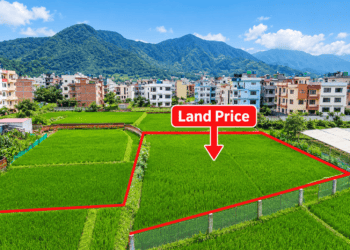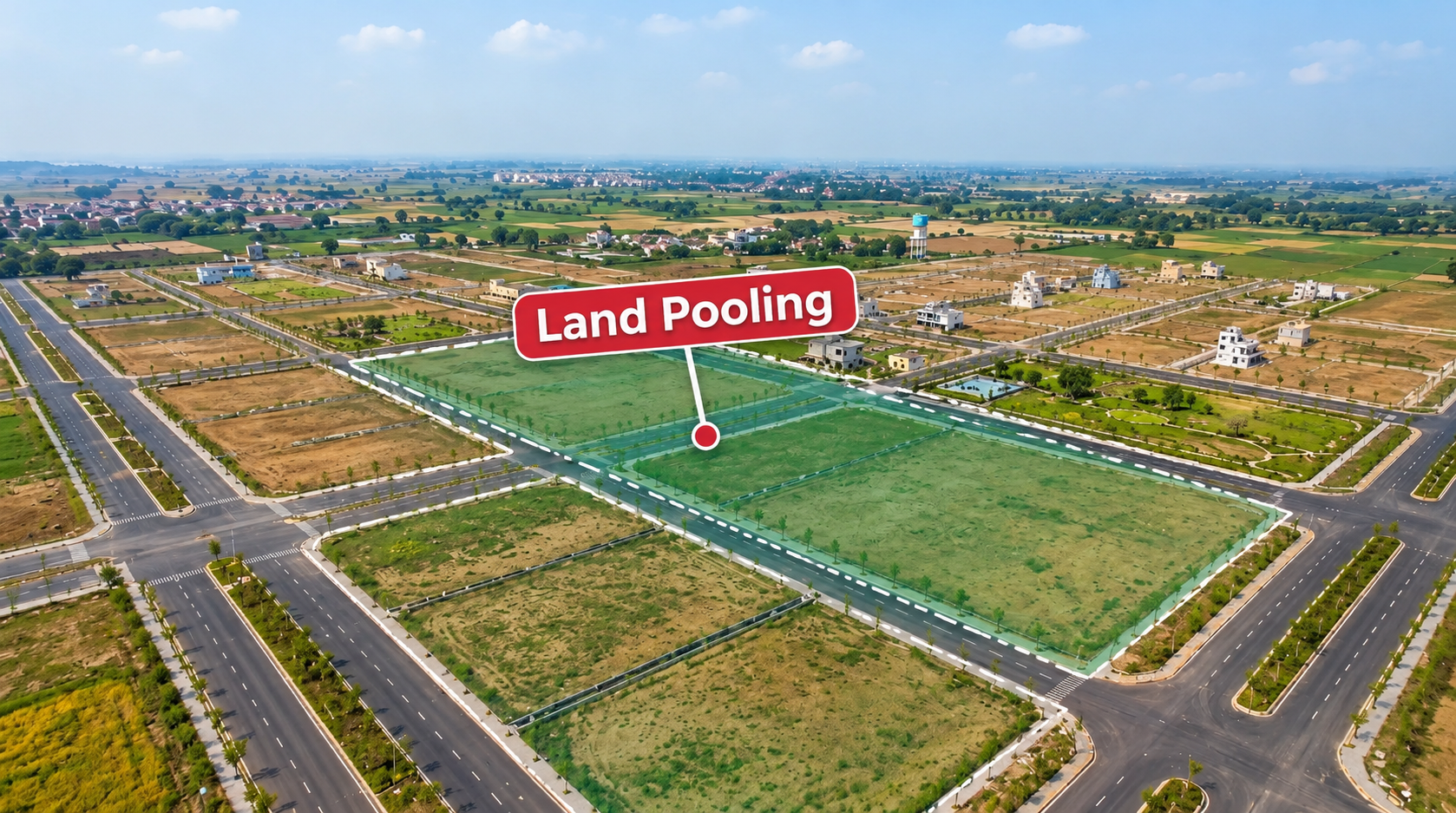
Land pooling is the rare government program that asks you to hand over part of your land and then expects you to come out ahead. You give up a slice of your plot, often a quarter to two-fifths of it. In exchange a public agency lays roads, drainage and water lines, redraws the boundaries, and returns a smaller parcel that is supposed to be worth far more than the larger, serviceless one you started with. Done well, it has turned raw farmland on the edge of Kathmandu into gridded neighborhoods. Done slowly, it has frozen owners’ land for a decade or more while they waited for a title they could finally sell.
For a landowner in the Kathmandu Valley, the pitch arrives when a project is proposed on your block. Before you sign a consent form, it helps to know exactly what you are agreeing to: how much land leaves your name, when it comes back, and what can go wrong in between.
Key Takeaways
- Land pooling (land readjustment, or jagga akikaran) consolidates fragmented plots, installs infrastructure, and returns a smaller serviced parcel to each original owner. Part of the pooled land becomes roads and open space; part is sold to pay for the works.
- Owners typically surrender between a quarter and 40 percent of their land. Across completed Valley projects the figure has ranged from about 12 percent to more than 50 percent, depending on the plot. Dallu, for example, took roughly 40 percent.
- Since a 2007 legal amendment, a project needs the consent of just 51 percent of affected landowners to proceed, down from 75 percent.
- Thirteen completed Valley projects have delivered close to 16,000 serviced plots across roughly 350 hectares, according to the Asian Development Bank.
- Projects are meant to finish in five years. Only 4 of 21 studied actually did. Most took 7 to 12 years, and several ongoing schemes have run 12 to 17 years.
- The upside is real where it works: at Kamerotar, serviced plots later auctioned for over USD 4 million per hectare, land that had sold undeveloped for about USD 300,000 per hectare five years earlier.
What land pooling actually does to your plot
Most of Nepal’s urban land reaches the market already broken into odd, narrow strips through inheritance and informal sale, the process BiznesVue has covered as kitta kat fragmentation. Land pooling runs that process in reverse. An implementing agency draws a boundary around a cluster of plots, pools them on paper, and treats the whole block as one canvas. It carves out a road grid, reserves space for drainage and parks, sets aside a block of plots to sell, and then hands each owner back a parcel inside the same locality.
The parcel you get back is smaller than what you put in. That reduction is the price of the roads, utilities and open space the project builds, plus the land it sells to cover its own costs. The bet is that a 60-square-meter plot on a paved lane with a drainage line and clear title is worth more than the 100-square-meter field behind someone else’s house that you held before. Where demand is strong, it usually is.
The contribution ratio: what you give up
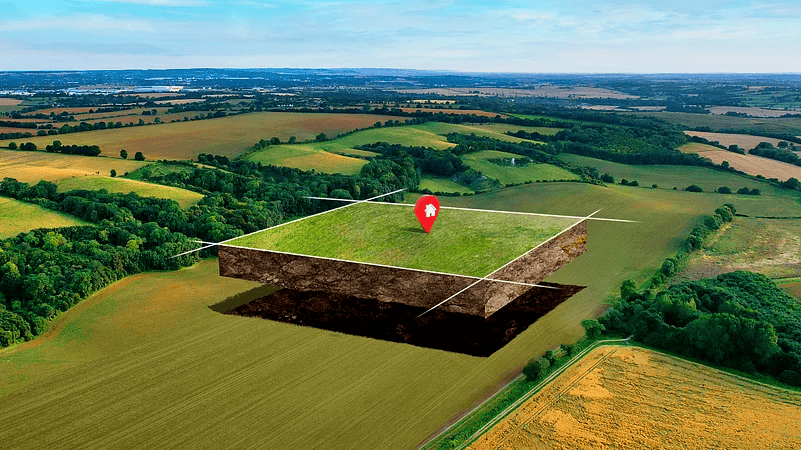
The single number that decides whether pooling is worth it to you is the contribution ratio, the share of your land the project keeps. It is set as an average for the scheme, then adjusted plot by plot during redistribution based on frontage, depth and location. Corner plots and those facing wider roads tend to give up more, because they gain more.
Across Kathmandu Valley projects the averages have clustered around 30 to 40 percent, with individual plots falling anywhere from roughly 12 percent to over half. The minimum parcel the project will return is 80 square meters with at least 6 meters of road frontage. If pooling would leave you below that floor, you are either combined with a neighbor or paid cash compensation at a fixed project price, which matters if you were counting on keeping a buildable plot rather than a check.
Before you accept a ratio, it is worth checking what serviced plots in comparable pooled neighborhoods actually trade for today. Current land listings on Basobaas give a rough read on per-aana prices in areas like Dallu, Naya Bazar and Sinamangal, which helps you judge whether the smaller plot you are promised clears the value of the larger one you are giving up.
What you get back, and what it has been worth
The returns, where projects finish, can be large. The Asian Development Bank’s 2020 review of Nepali land pooling documented the clearest example at Kamerotar, where about 2.5 hectares of undeveloped land sold to Nepal Telecom in 2005 for roughly USD 300,000 per hectare. Five years later, serviced plots with road access in the same project auctioned for over USD 4 million per hectare. Naya Bazar, one of the Valley’s largest schemes at nearly 43 hectares and around 2,300 plots, returned a financial internal rate of return of 15.5 percent on its strongest component.
Those gains ride on a rising market as much as on the pooling itself. Kathmandu land prices climbed roughly 300 percent after 2003 by the Nepal Land and Housing Developers’ Association’s count, so a plot held for a decade inside a slow project may still have appreciated even as it sat frozen. The appreciation and the servicing are two different things, and a buyer should not credit pooling with gains the whole market delivered. The value is also not evenly built: at Naya Bazar, a municipal engineer called the planning “sub-standard,” and a users committee member estimated that 80 to 90 percent of buildings in the area breached bylaws.
The process, and the wait
A project moves through feasibility study, a consent drive, formation of a users committee of roughly 15 to 20 landowners, a public notice and moratorium, cadastral survey, block-plan approval, infrastructure construction financed by selling reserved plots, redistribution, and finally title transfer. The Ministry of Urban Development approves the detailed project report. Inside the Valley the Kathmandu Valley Development Authority implements; outside it, the Department of Urban Development and Building Construction or a municipality does.
The timeline is where expectations and reality part. Schemes are designed to close in five years. In the ADB’s sample, only 4 of 21 projects hit that target. Most completed ones took 7 to 12 years; several still running had been open 12 to 17 years. Chamati had run 16 years and was about 60 percent complete as of 2015. The reasons are familiar: grievance resolution, court cases, financing gaps, and the long stretch from 2002 to 2017 when the Valley’s municipalities had no elected officials to push projects along. For a household, the practical cost of that delay is a plot that cannot easily be sold, mortgaged or built on until the project legalizes the new titles.
The moratorium and other obligations
Once a project is notified, a moratorium freezes the land: no subdivision, no sale carving, no construction, usually for three years in the Valley, and it can be extended through gazette notices. During that window your land is effectively illiquid, which can complicate a loan secured against it or a sale you were planning. You are also bound to accept the finalized block plan and your assigned plot, and to work through the users committee for grievances. These are not small commitments, and they are the part owners most often underestimate when they sign a consent form expecting a quick upgrade.
The risks worth weighing before you consent
The structural weakness of Nepali land pooling is that it does not use eminent domain. A single determined objector can stall an entire scheme, and the ADB recorded one case that had been in court for more than seven years. That cuts both ways: it protects you if you refuse, but it exposes you to open-ended delay if a neighbor refuses. At Ichangu Narayan, opposition from a large share of owners dragged the project out.
Financing is the second fault line. Most projects pay for roads and drainage by selling reserved plots, sometimes before those plots are even serviced and sometimes below market value, which shrinks the pot available for the infrastructure you were promised. When plot sales slow, the works slow with them. Survey errors in the cadastral maps are a third hazard, since a mismeasured area can quietly understate what you are owed. None of this means pooling is a bad deal, but it means the quality of the specific implementing agency and users committee matters more than the concept. The same tension between planned ambition and delivery runs through Nepal’s wider smart city announcements and the long-stalled land assembly for the Outer Ring Road.
A short checklist before you sign
- Get the proposed contribution ratio in writing and model what plot size you would get back, not just the percentage.
- Confirm the returned plot clears the 80-square-meter, 6-meter-frontage minimum, or understand the cash-compensation alternative.
- Ask how infrastructure will be financed and how many reserved plots must sell for the works to complete.
- Check the implementing agency’s track record on nearby projects: did they finish, and in how many years?
- Plan for the moratorium: assume the land is illiquid for at least three years and do not pledge it against a loan you cannot otherwise service.
- Compare the promised serviced-plot value against real market prices in similar pooled areas before accepting the ratio.
The legal footing
Nepal runs all of this without a dedicated land pooling law. Projects rest on the Town Development Act of 1988 and the Kathmandu Valley Development Authority Act of the same year, with the Department of Urban Development and Building Construction’s Land Pooling Manual of 2061 (2004) serving as guidance rather than binding rule. The first scheme, a 13.5-hectare project in Pokhara’s Chipledhunga, dates to 1976. Nearly half a century on, the tool still delivers serviced land where other mechanisms cannot, but it does so on a timeline and with a level of owner risk that no consent form fully spells out. For more on how Nepal’s land market works, see BiznesVue’s ongoing real estate coverage.
Frequently Asked Questions
1. How much land do you lose in a land pooling project in Nepal?
Owners typically give up between a quarter and 40 percent of their land, though across completed Kathmandu Valley projects individual plots have contributed anywhere from about 12 percent to more than 50 percent. The exact share, called the contribution ratio, is set as a scheme average and then adjusted for each plot by frontage, depth and location. The land you give up pays for roads, drainage, open space and the plots the project sells to fund itself.
2. How long does a land pooling project take to complete?
Projects are designed to finish in five years, but very few do. In the Asian Development Bank’s review, only 4 of 21 projects met the five-year target. Most completed schemes took 7 to 12 years, and several ongoing ones had been running 12 to 17 years. Chamati, for instance, was about 60 percent complete after 16 years. Owners should assume their land will be tied up for the better part of a decade.
3. Can a land pooling project go ahead without my consent?
A scheme needs the consent of at least 51 percent of affected landowners to proceed, a threshold lowered from 75 percent by a 2007 amendment. Because Nepal does not use eminent domain for pooling, a non-consenting owner cannot simply be forced in; the boundary may be redrawn to exclude you, or the dispute may head to court. This protects individual owners but also means one objector can delay an entire project, sometimes for years.
4. Can I sell or build on my land during a land pooling project?
No. Once a project is notified, a moratorium freezes the land, usually for three years in the Valley and extendable by gazette notice. During that time you cannot subdivide, carve off a portion to sell, or construct. The land is also difficult to mortgage. You regain full rights only after redistribution and title transfer, which is why the timeline matters so much to households relying on the plot’s liquidity.
5. Is land pooling a good investment for a landowner?
It can be, where a project finishes and the market is rising. Serviced plots at Kamerotar later auctioned for over USD 4 million per hectare, against about USD 300,000 per hectare for the undeveloped land five years earlier. But much of that gain reflected a citywide property boom, not the pooling alone, and the benefit depends on the project completing on a reasonable timeline. The risk is a scheme that stalls for 10 to 15 years, leaving your land frozen and your return deferred.