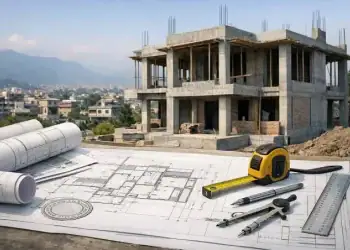
A man in Baneshwor sells four aana of land his father bought in 2010 for NPR 20 lakh, and it fetches him more than NPR 3 crore. He tells everyone at the tea shop that land is the only real investment in Nepal, that shares are gambling, and that anyone who put money in NEPSE instead was a fool. He is not wrong about his own plot. He is wrong about almost everything else, and the gap between those two things is what the debate over real estate vs stocks in Nepal is really about.
Land is the sacred cow of Nepali finance. It is what remittance turns into, what dowries are measured in, what a family means when it says it has “made it.” NEPSE, by contrast, is treated as a place where clever people and lucky people take money from patient people. This piece compares the two honestly, on the things that actually decide whether an investment was good: real after-cost returns, liquidity, taxes, income, and the size of the check you need to write to play at all. The short verdict, which the rest of the article earns, is that land has been an excellent store of wealth for the people who already owned it and is a deeply awkward investment for almost everyone buying in today.
What land actually returned, and the number that lies
Start with the story land tells about itself, because it is genuinely impressive. A plot in Baneshwor that sold for around NPR 20 lakh per aana in 2010 was selling for NPR 80 lakh to NPR 90 lakh per aana by 2025, per reporting by Nepali Times and Kathmandu real estate trackers. That is roughly four to five times in fifteen years, or something like 10% to 11% a year compounded, before you count anything land might earn along the way. Nepal Rastra Bank’s own real estate work has at times cited Kathmandu Valley property values rising far faster than that, with one figure of about 27.7% a year floating through the market commentary, which would double a plot’s price every three and a half years.
Treat that 27.7% figure with suspicion. It describes a specific, frothy stretch, not a law of nature, and the market has since done exactly what overheated markets do. Land is measured here in the hill-district units most readers know: one ropani is 16 aana, and one aana is about 342 square feet, per standard Nepali land conversions. The Terai runs on bigha and kattha instead. The unit does not change the lesson. The headline appreciation number for Kathmandu land is real, it is large, and it is almost entirely a story about one valley during one credit-fueled boom.
Here is the part the tea-shop version leaves out. The man in Baneshwor did not earn 10% a year in any usable sense for most of those fifteen years. His land paid him nothing while he held it. It threw off no rent he collected, no dividend, no cash at all, until the single day he sold it. Until that day it was, in accounting terms, dead capital that happened to be rising in price. That is fine if you can wait fifteen years and never need the money. It is close to useless if you are trying to build wealth you can actually live on.
What NEPSE returned over the same kind of window
Now the asset everyone distrusts. The NEPSE index started at a base value of 100 on February 12, 1994, so the index level today tells you, almost literally, how many times the listed market has grown in price since then. As of August 8, 2026, NEPSE closed near 2,650 points, per Kathmandu Post and Nepal News market reports. From 100 to about 2,650 over roughly thirty-two years works out to a little over 10% a year, and that is before dividends.
That “before dividends” clause matters more for shares than the equivalent clause matters for land, and in the opposite direction. The NEPSE index is a price index. It tracks share prices and ignores the cash dividends and bonus shares that Nepali banks, insurers and hydropower companies hand out year after year. A real shareholder who took those payouts, or reinvested them, earned meaningfully more than the index shows. Land’s headline number, by contrast, already flatters land, because it ignores the costs of owning it. So the fair fight is land’s price gain, minus its heavy costs and with no income, against NEPSE’s price gain, plus dividends, minus lighter costs. Framed that way, the two are far closer than the tea shop believes.
The catch with NEPSE is the ride. The index ran to an all-time high above 3,000 points in 2021, then fell by roughly half over the next two years before recovering toward current levels. Anyone who bought at the top, and a whole generation of first-time investors did exactly that, spent years underwater. Land in the same window drifted and cooled but did not visibly halve, mostly because there is no daily price ticking on your plot to frighten you. That invisibility is not the same as safety. It is just the absence of a screen.
Liquidity is where the comparison stops being close
This is the section the daily market sites will not write, and it is the one that should change how you think. On returns, land and shares are roughly comparable over long, honestly chosen windows. On liquidity, they are not remotely comparable, and liquidity is what most families discover they needed at the worst possible time.
You cannot sell a corner of your plot to pay a hospital bill. Land trades in whole parcels, and finding a buyer, agreeing a price, verifying the lalpurja, clearing the loan against it, and completing registration at the malpot office can take weeks or months in a good market and simply not happen in a bad one. Nepal is in a bad one right now. Real estate transactions fell sharply from the 2021 peak, with one widely reported estimate putting the decline around 25%, per Fiscal Nepal, even as banks eased lending. Nepal Rastra Bank tightened the rules that had fueled the boom: loans above NPR 50 lakh against real estate must now keep a loan-to-value ratio of 50%, down from the looser limits that let buyers borrow far more against a plot. When credit dries up, land does not fall politely in price. It just stops selling, and a plot you cannot sell at the price you have in your head is worth exactly nothing on the day you need cash.
A NEPSE share is the opposite. You can sell one share or ten thousand, on any trading day, at a price you can see before you commit, and the money reaches your bank account within days. You can raise NPR 50,000 without touching the other NPR 5 lakh in your portfolio. For anyone who might need part of their money back before they are old, that divisibility is not a minor convenience. It is the whole difference between an asset and a trap. If you are just starting and wondering how small you can start, our guide on how much money you need to start investing in NEPSE shows the entry ticket is a few thousand rupees, not a few lakh.
The costs nobody puts in the return
Both assets look better in the headline than in the bank statement, but land looks a lot better, because its costs are large, upfront, and conveniently forgotten.
When you buy land, the buyer pays a registration fee at the malpot office. The rate runs about 5% of value in a metropolitan city, 4.5% in a sub-metropolitan city, 4% in a municipality and 2% in a rural municipality, applied to the higher of the declared price or the government valuation, per current land-revenue schedules (women buyers get a concession, and Kathmandu Valley purchases carry an extra Bagmati levy on top). That is money gone the moment you sign. When you sell at a profit, the seller pays capital gains tax, withheld at source by the malpot before the transfer completes. Under the Finance Act for 2083, property gains are taxed at 7.5% if the land was held more than five years and 10% if held five years or less, rates that rose from 5% and 7.5% with effect from mid-July 2026. On a NPR 3 crore sale with a NPR 2.8 crore gain, that is a real seven-figure deduction, plus registration the buyer paid, plus any agent commission, plus the interest on any loan carried for years.
Shares carry costs too, and they are not zero: broker commission, SEBON and CDSC fees, the DP charge, and capital gains tax on profits. For an individual on NEPSE, that gain is taxed at 7.5% if held long term and 10% if short term under the Finance Bill provisions for 2083/84, and we walk through the weighted-average cost math in our explainer on capital gains tax on NEPSE shares. Notice the symmetry in the tax rates and the asymmetry in everything else. Share costs are small, transparent, deducted automatically, and only bite when you actually book a gain. Land’s biggest costs are large, paid upfront, and mostly invisible to the owner celebrating the sale price.
The income problem
An investment ideally pays you while you hold it. This is where land in Nepal is genuinely weak, and where the sacred-cow story is most misleading.
Rental yields in Kathmandu are low. Numbeo’s price-to-rent data puts the gross residential yield at roughly 2.1% in the city center and about 1.8% outside it. Realtors selling apartments will quote you 5% to 8%, but those are marketing figures for specific new-build units, usually gross of maintenance, management, vacancy and the tax on rental income, and they are not what a typical plot or house returns. Call the realistic gross yield on ordinary Kathmandu residential property somewhere around 2% to 4%, and the net yield lower still. That means the person holding land is betting almost entirely on price appreciation, because the income barely covers property upkeep, let alone the interest on a loan used to buy it.
NEPSE’s income side is stronger than most non-investors realize. Commercial banks, insurers and hydropower firms routinely pay cash dividends and issue bonus shares, and in good years the cash dividend yield on a decent bank stock has rivaled or beaten Kathmandu rental yields, with none of the tenant hassle. That income is not guaranteed, it falls when profits fall, and chasing it blindly is its own mistake. But an asset that can pay you 4% to 6% in cash while you hold it, and that you can sell in an afternoon, is doing two jobs that land does neither of.
The entry ticket, and who each asset is really for
There is a blunt practical fact underneath the whole debate. A single aana of Kathmandu land now costs tens of lakhs, and a usable plot costs a crore or more. That is not an investment most Nepali savers can make. It is a thing you inherit, or a thing you buy once in a lifetime with a mortgage, remittance savings, and family money pooled together. You cannot dip a toe. You are all in on one undiversified, illiquid asset in one city, financed with debt, or you are out.
NEPSE lets you start with a few thousand rupees, add a little each month, spread across banks, hydropower and insurance, and sell any slice at any time. For a beginner, that difference is decisive. The right first step is rarely a plot and often a small, diversified position, or a mutual fund that builds one for you, as we lay out in building your first NEPSE portfolio without overconcentrating.
The verdict
Land and NEPSE shares have delivered broadly similar long-run price appreciation in rupee terms, somewhere around 10% a year over long windows, and the belief that land is obviously superior is mostly a story told by people who already owned the plot before the boom. Once you add NEPSE’s dividends and subtract land’s heavy registration, capital gains and financing costs, the return gap narrows to almost nothing, and land’s remaining edge is emotional, not financial.
Where they genuinely differ, land loses on the things that matter to ordinary savers. It is illiquid, especially now, in a market where transactions have slumped and NRB has tightened the credit that inflated it. It pays almost no income. It demands a crore-sized, undiversified, debt-financed bet on a single parcel. NEPSE is liquid, divisible, income-producing and open to anyone with a few thousand rupees, at the price of a volatile ride you must be able to stomach.
So the honest answer to real estate vs stocks in Nepal is not a winner. It is a matching problem. Land suits the family with a long horizon, cash it will never need back in a hurry, and a specific use for the property, to live in, to build on, to pass down. Shares suit the saver building wealth in installments who values being able to get out. Most Nepali households are wildly overweight the first and own none of the second, and they call that prudence. It is really just habit. The same logic applies to gold, the other asset Nepalis trust on faith, which we test in gold vs NEPSE shares. Test the sacred cow. Do not just inherit it.
This is analysis, not financial advice.