Nepal Rastra Bank runs two housing markets at once, and it treats them nothing alike. A first-time buyer who has never held a home loan can now borrow up to 80 percent of a property’s value. Someone buying land to hold and resell inside the Kathmandu Valley is capped at 40 percent, the same ceiling the central bank set back in 2017. Same regulator, same collateral class, less than half the leverage.
That gap is not an accident. The loan-to-value ratio, the share of a property’s appraised value a bank is allowed to finance, is the most direct lever NRB holds over housing credit, and the dial has swung hard over the past decade: tightened in 2017 to cool a Valley land boom, held through the 2022 liquidity crunch, then loosened in 2025 to coax buyers back. Reading that history explains more about who can buy what in Nepal today than any single interest rate does.
Key takeaways
- NRB’s FY 2082/83 (2025/26) monetary policy raised the first-time home buyer loan-to-value ratio to up to 80 percent and lifted the residential home loan ceiling from Rs 20 million to Rs 30 million (Rs 3 crore).
- Loans to purchase land or real estate stay capped at 40 percent LTV inside Kathmandu Valley and 50 percent outside it, the levels set by a 2017 NRB directive and left untouched by the 2025 easing.
- General, non-first-time individual home loans remain at 50 percent LTV; licensed developers and government-approved housing projects can reach 70 percent.
- When credit tightened and liquidity dried up, quarterly real estate registration revenue fell from a Rs 23.7 billion peak in the first quarter of 2021/22 to Rs 8.2 billion a year later, a drop of about 65 percent.
- Even after the 2025 loosening, land and house deeds in Ashoj 2082 (mid-September to mid-October 2025) fell about 23.5 percent year on year to 23,353, a reminder that LTV is only one lever among several.
Two loan-to-value dials, one central bank

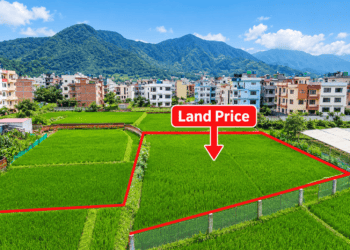
NRB does not set a single LTV for property. It sets different ratios for different purposes, and the distinction is where most confusion starts. A “home loan” (also called a residential or housing loan) finances a house you intend to live in. A “real estate loan” finances land or property bought as a business or an investment, the kind of purchase that feeds plotting, flipping, and speculation. The central bank wants to encourage the first and restrain the second, so it prices the leverage differently.
The result is a tiered system. A first-time home buyer sits at the top with up to 80 percent financing. A general home buyer who already owns a home sits at 50 percent. A licensed developer or an approved housing project can access up to 70 percent. And anyone borrowing to buy land as real estate sits at the bottom, 40 percent in the Valley and 50 percent elsewhere. The lower the ratio, the more cash a buyer must bring, and the harder it is to turn a small deposit into a large leveraged bet.
From the 2017 clampdown to the 2025 thaw
The current map was drawn in August 2017. Responding to a surge in Valley land prices, NRB lowered the LTV on residential home loans inside Kathmandu Valley from 60 percent to 50 percent, and cut the ratio for real estate purchases in the Valley from 60 percent to 40 percent. Outside the Valley, the ceilings stayed at 60 percent for houses and 50 percent for real estate. The stated aim, per the central bank, was to discourage the concentration of real estate and housing business in the Valley so activity could spread to the rest of the country.
Those real estate caps proved durable. NRB’s monetary policy for 2021/22 explicitly kept the 40 percent Valley and 50 percent outside-Valley real estate ratios unchanged, while setting a 60 percent LTV for government-licensed housing projects and for individuals building a first home (Nepal Rastra Bank, Monetary Policy 2021/22). That stance held through a punishing stretch for the sector, when a balance-of-payments squeeze, import restrictions, and a deposit shortage pushed interest rates into the mid-teens and froze transactions.
The thaw came in 2025. NRB’s monetary policy for FY 2082/83, in paragraph 74, raised the credit limit for building or buying a private residential house from Rs 20 million to Rs 30 million, set the LTV at up to 80 percent for a first home, and allowed up to 70 percent in other cases (Nepal Rastra Bank, Monetary Policy 2025/26). Crucially, the easing was aimed at households, not land traders: the real estate purchase ratios were not loosened.
What the 2082/83 policy actually changed

When NRB revised its Unified Directive in July 2025 to implement the policy, the fine print clarified who benefits. The 80 percent ratio applies to first-time homebuyers only, for loans up to Rs 30 million, on a property no larger than 3,000 square feet, and only if the borrower can prove they have never taken a home loan from any bank or financial institution. Rental income cannot be used to calculate repayment capacity. Licensed real estate developers and government-approved residential housing projects can access up to 70 percent. The LTV cap for ordinary individual residential housing loans stayed at 50 percent (Fiscal Nepal).
In plain terms, the headline “80 percent” is a narrow door, not a general loosening. It rewards the specific buyer NRB wants to help, a household purchasing a modest first home, while leaving repeat buyers, large homes, and land investors on tighter terms. The same policy cycle that lifted the ceiling also cut lending rates, which is covered in more detail in our breakdown of Nepal’s higher home loan ceiling and what buyers should check. Buyers weighing how far an 80 percent loan actually stretches can compare current asking prices and model repayments against listings and the EMI calculator on portals such as Basobaas.
The market effect: credit moved, transactions followed
LTV rules bite because property in Nepal runs heavily on credit, and the data shows demand tracking the flow of financing. Quarterly government revenue from real estate registration peaked at Rs 23.7 billion in the first quarter of 2021/22, then collapsed to Rs 8.2 billion in the first quarter of 2022/23 as the liquidity crunch took hold, a fall of roughly 65 percent. Volumes have since staged only a modest recovery, with quarterly registration revenue running in the Rs 10 billion to Rs 15 billion range and transactions peaking at about 0.456 million deeds in the fourth quarter of 2024/25.
The lending side tells the other half of the story. Between 2020/21 and 2024/25, real estate loans grew 72.41 percent and residential loans grew 61.55 percent, outpacing the recovery in transaction volumes. NRB’s own officials frame the link directly, noting a positive relationship between real estate financing and transaction activity. For the scale of the exposure that lending has built, see our analysis of the Rs 2 trillion in property exposure sitting on bank balance sheets.
The risks and the limits of the LTV lever

Looser LTV is not a guaranteed revival, and the early evidence is mixed. In Ashoj 2082 (mid-September to mid-October 2025), registered land and house deeds fell to 23,353 nationwide, down about 23.5 percent from the same month a year earlier, with monthly transaction revenue of Rs 2.73 billion and deeds falling for three straight months (Fiscal Nepal). A higher borrowing ceiling does not help if prices, incomes, and confidence are not aligned, and it does nothing for buyers who already own a home.
There is a tradeoff on the other side too. Every percentage point of extra leverage raises the stakes if prices fall, because thin equity cushions turn into negative equity faster. Nepal’s banking system is already carrying the strain of past property lending, with rising bad loans concentrated in construction, as detailed in our coverage of Nepal’s climbing non-performing loans. That is the balance NRB is trying to strike: enough leverage to let genuine homebuyers in, not so much that the system repeats the boom-and-bust it spent the last decade trying to contain. Keeping the real estate purchase ratio pinned at 40 percent while opening the first-home door to 80 percent is how it is trying to have both. More market and data analysis is collected on our Real Estate page.
Frequently asked questions
What is the loan-to-value (LTV) ratio in Nepal?
The loan-to-value ratio is the maximum share of a property’s appraised value that a bank or financial institution in Nepal is allowed to lend. A 70 percent LTV means the lender finances up to 70 percent of the value and the buyer must cover the remaining 30 percent as a down payment. Nepal Rastra Bank sets these ceilings and varies them by loan purpose.
What is the maximum home loan LTV in Nepal in 2026?
Under the FY 2082/83 (2025/26) monetary policy, a first-time homebuyer can borrow up to 80 percent of a property’s value, subject to conditions. Government-approved housing projects and licensed developers can access up to 70 percent, while ordinary individual home loans for repeat buyers remain capped at 50 percent. The residential home loan ceiling is Rs 30 million (Rs 3 crore).
Why is the real estate loan LTV only 40 percent in Kathmandu Valley?
NRB lowered the LTV on real estate purchase loans in the Kathmandu Valley to 40 percent in a 2017 directive aimed at cooling land speculation and spreading real estate activity to the rest of the country. The cap has been retained through subsequent policy cycles, including the 2025 easing, which loosened home loans but left the real estate ratio in place. Outside the Valley, the real estate ratio is 50 percent.
What conditions apply to the 80 percent first-time buyer LTV?
The 80 percent ratio applies only to first-time homebuyers, for loans up to Rs 30 million, on a property no larger than 3,000 square feet. The borrower must prove they have never taken a home loan from any bank or financial institution, and rental income cannot be counted toward repayment capacity.
Did looser LTV revive Nepal’s property market?
Not yet, at least not clearly. Despite the 2025 loosening, registered deeds in Ashoj 2082 (mid-September to mid-October 2025) fell about 23.5 percent year on year to 23,353, with transactions declining for three consecutive months. LTV is one lever among several, and prices, interest rates, incomes, and buyer confidence all shape demand alongside it.
What is the difference between a home loan and a real estate loan at NRB?
A home loan finances a residential property the borrower intends to occupy and carries higher permitted leverage, up to 80 percent for a qualifying first-time buyer. A real estate loan finances land or property bought as an investment or business and carries a much lower ceiling, 40 percent inside Kathmandu Valley and 50 percent outside it, because NRB uses the tighter ratio to restrain speculation.