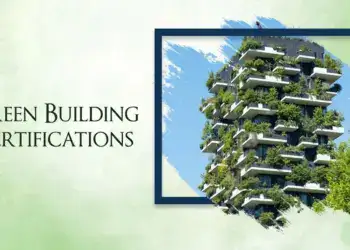
A green building label has quietly become a financing and leasing credential across more than 130 countries. Lenders cite it, corporate tenants demand it, and developers advertise it. Nepal, fifteen years after its first building registered for one, has issued only a scattering of them. The gap is not about appetite for better buildings. It is about standards, cost perception, and a market that has never had to compete on energy performance.
Key Takeaways
- EDGE, the certification created by the International Finance Corporation, labels a building once it is projected to use at least 20% less energy, 20% less water, and 20% less embodied energy in its materials than a standard local building. It now operates in more than 130 countries.
- Nepal’s buildings are energy-heavy. The residential sector alone consumed 60.59% of national energy in 2022, and the residential and commercial building sector together accounts for roughly 70% of total energy use.
- Certification is almost absent. A 2016 engineering study found only 11 Nepali projects had ever registered for LEED since 2009, and several rated buildings never finished certification.
- The nearest market shows the scale of the gap. India certified 370 LEED projects covering 8.5 million square meters in 2024 alone, the third-highest total in the world.
- Certified buildings carry a measurable premium abroad: commercial sale premiums up to 31% and occupancy up to 23% higher. A 2007 global survey found builders overestimate the cost, guessing about 17% when the real premium is closer to 5%.
- Nepal has no green building bylaw or enforcement mechanism. The Department of Urban Development and Construction has issued voluntary Green Building Technology guidelines, and the IFC pegs the green building investment opportunity at about $3.4 billion.
What a green building certification actually certifies
A green building certification is a third-party verification that a building performs better than a conventional one on measurable resource use. Two systems dominate the conversation in South Asia. LEED, run by the U.S. Green Building Council, scores a building on credits across energy, water, materials, indoor quality, and site. EDGE, built by the International Finance Corporation, the World Bank Group’s private-sector arm, takes a simpler and cheaper route designed for emerging markets.
EDGE sets one clear bar. A project earns the base certificate when software projects at least a 20% reduction in energy use, a 20% reduction in water use, and a 20% reduction in the embodied energy of its materials, each benchmarked against a standard local building. Two higher tiers exist: EDGE Advanced requires at least 40% on-site energy savings, and EDGE Zero Carbon requires a building to reach 100% renewable energy or offset the balance. The appeal in a market like Nepal is the low entry cost and the fact that the 20% threshold can often be met with orientation, better glazing, insulation, efficient fixtures, and local materials rather than imported systems.
The global trend Nepal is standing outside of

Green certification has moved from a marketing badge to a market structure. The IFC estimates the green buildings opportunity across emerging-market cities at $24.7 trillion by 2030, with $15.7 trillion of that in residential, and it notes that buildings generate 28% of energy-related greenhouse gas emissions. That is the lever. Where incentives and awareness exist, penetration climbs fast: EDGE now covers about 8% of new building growth in Colombia, a similar share of the addressable market in Vietnam with no subsidy, and nearly 5% of Peru’s residential market within a few years, according to the IFC’s own business case.
India is the most relevant comparison, because its climate, construction methods, and supply chains overlap heavily with Nepal’s. In 2024, India ranked third in the world for LEED, with 370 projects certified across 8.5 million gross square meters, the equivalent of about 91.5 million square feet, in a single year. Nepal’s cumulative total, across every system and every year, does not approach a fraction of that. The point is not that Nepal should mimic India’s volume. It is that a working certification market exists next door, running on the same contractors and materials Nepali developers already use.
Why certification matters more in Nepal than the quiet market suggests
Nepal’s buildings are not light energy users, and that is the case for paying attention. A SWITCH Asia baseline study of operational energy found the residential sector alone accounted for 60.59% of national energy consumption in 2022, and it cited national data putting the residential and commercial building sector at roughly 70% of total energy use. Much of that is heating and cooking, and in colder zones it is still burned biomass: the same survey found firewood used by 88.7% of surveyed households in the cold climate zone. A building standard that cuts energy and water by a fifth is not a luxury overlay in that context. It is a direct hit on the largest slice of national energy demand.
The economics follow. Nepal faces a severe trade imbalance driven partly by imported fuel and electricity demand, and buildings that use less of both reduce operating costs for owners and tenants. Abroad, the premium is documented. The IFC’s business case reports commercial green buildings achieving sale premiums up to 31% higher, occupancy rates up to 23% higher, and residential green homes commanding rents about 8% higher, with sale prices 4% to 10% above comparable conventional stock. Those are foreign figures and should be read as a ceiling, not a promise for Kathmandu. But they describe where committed capital is already flowing, and they explain why certification abroad has become a financing credential rather than a plaque.
Nepal’s thin certification record
The on-the-ground record is sparse and honest about why. An Institute of Engineering study presented at IOE’s graduate conference examined green building rating in Nepal and found that only 11 projects had ever registered for LEED between 2009 and 2016. The list included the Butwal Power Company office building, Central Park Apartment, Crystal Palace, Hama Iron and Steel’s corporate building, Sipradi’s corporate office, the Marriott Hotel in Thamel, and a handful of others. Several buildings the researchers rated against LEED criteria never completed certification at all, failing on cost, mid-project design changes, shifting client requirements, and a shortage of confident HVAC teams.
Those failure points matter because they are structural, not accidental. The study identified the same barriers that keep appearing in Nepal’s construction sector: the upfront cost of implementation, the scarcity of green materials and technologies in a nascent market, low awareness among investors and government, and, crucially, the absence of any bylaw, standard, or enforcement mechanism requiring sustainable performance. A certification that is entirely voluntary, in a market where buyers cannot even filter listings for energy efficiency on platforms like Basobaas, has little to push it forward.
The cost question, and where the perception is wrong
The single biggest objection in Nepal is that green building costs too much. The evidence is more nuanced. A 2007 World Business Council for Sustainable Development survey of 1,400 professionals worldwide found they estimated green construction cost about 17% more than conventional work, when the measured difference was closer to 5%, and even LEED Platinum projects topped out around a 10% premium. The perception gap, in other words, was roughly three times the real one. EDGE was designed precisely around this problem: its 20% thresholds are set low enough that many buildings can clear them through design choices and local materials rather than expensive imported equipment.
That does not make certification free. Documentation, modeling, and verification carry fees, and Nepal’s thin pool of accredited professionals adds cost and time. The fair conclusion is that the premium is real but smaller than the industry assumes, and that it is weighed against operating savings over a building’s life. For a commercial landlord watching the vacancy and rent pressures described in our look at Kathmandu’s office market, a credential that attracts corporate tenants and lenders can shift from cost to competitive edge.
What would have to change
Certification markets rarely grow on virtue. They grow on rules, finance, and materials. Nepal has the beginnings of the first: the Department of Urban Development and Construction has formulated voluntary Guidelines for Green Building Technology, and the country’s climate commitments reference green homes. But voluntary guidance is not an enforced standard, and Nepal’s building regulation still centers on safety and setback and coverage bylaws rather than energy performance. The same gap shows up in earthquake-resistant construction, where the code exists but enforcement is uneven.
Finance is the faster lever. If banks priced green-certified projects at a modest rate advantage, as lenders in India and Southeast Asia increasingly do, developers would have a reason to certify beyond goodwill. The IFC already frames Nepal’s green building investment opportunity at about $3.4 billion, tied to the roughly one million additional homes the country needs over the coming decade and to post-earthquake reconstruction. Materials are the slowest constraint, since efficient glazing, insulation, and fixtures still largely arrive by import. None of these is solved by a certification label alone. But the label is the measuring stick that makes the other three legible to lenders and buyers, which is exactly why it travels ahead of the market everywhere it has taken hold. For more on Nepal’s property market, see our Real Estate coverage.
Frequently Asked Questions
1. What is green building certification?
It is a third-party verification that a building uses measurably fewer resources than a conventional one. The two systems most relevant to Nepal are LEED, run by the U.S. Green Building Council, and EDGE, created by the International Finance Corporation. EDGE certifies a building when it is projected to use at least 20% less energy, 20% less water, and 20% less embodied energy in its materials than a standard local building.
2. How many green-certified buildings does Nepal have?
Very few. A 2016 Institute of Engineering study found only 11 projects had ever registered for LEED in Nepal since 2009, and several rated buildings never completed certification. Nepal’s cumulative total across all systems remains a tiny fraction of what neighboring India certifies in a single year.
3. Does green building really cost much more in Nepal?
The premium is real but smaller than the industry assumes. A 2007 global survey found professionals estimated a 17% cost increase when the measured difference was about 5%. EDGE is designed so its 20% thresholds can often be met through orientation, insulation, efficient fixtures, and local materials rather than costly imported systems, and operating savings offset part of the upfront cost over time.
4. Why does building energy efficiency matter so much in Nepal?
Because buildings dominate national energy use. A SWITCH Asia baseline study found the residential sector alone consumed 60.59% of national energy in 2022, with residential and commercial buildings together near 70%. A standard that cuts energy and water use by a fifth therefore targets the largest slice of the country’s energy demand.
5. What is stopping green certification from growing in Nepal?
Three things: the absence of any enforced green building bylaw or standard, limited green financing incentives from banks, and the scarcity of efficient materials, most of which are imported. Nepal has voluntary Green Building Technology guidelines from the Department of Urban Development and Construction, but voluntary guidance is not the same as an enforced requirement or a price signal from lenders.
6. Is there a business case for certifying a building in Nepal?
Internationally, yes. The IFC reports commercial green buildings achieving sale premiums up to 31% and occupancy up to 23% higher, with green homes renting about 8% above comparable stock. Those are foreign figures and should be treated as an upper bound rather than a guarantee for Nepal, but they explain why certification abroad functions as a financing and leasing credential, not just a plaque.