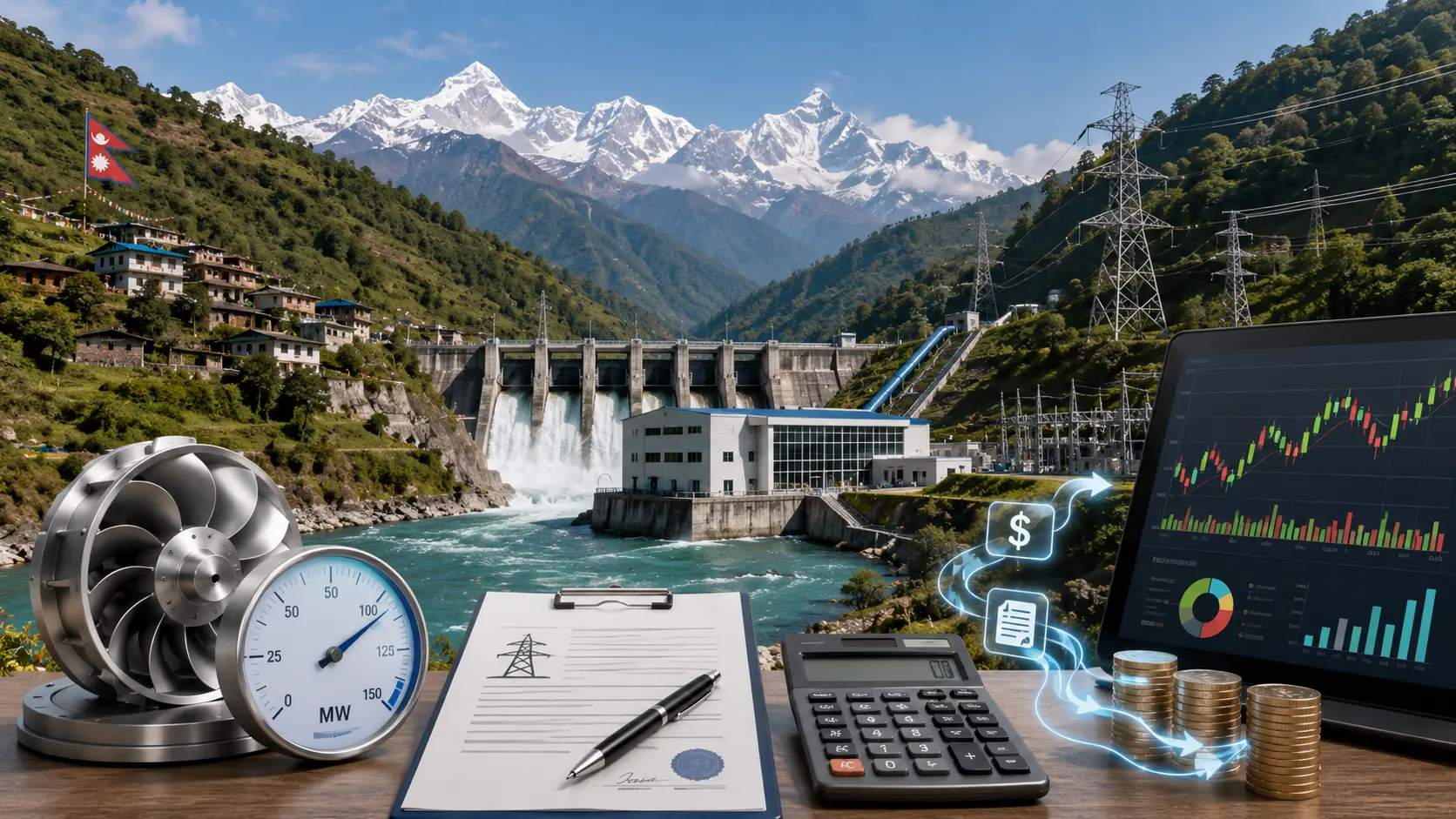
On Wednesday, August 26, 2026, a flood came down the Bhotekoshi and Trishuli rivers in Rasuwa and Nuwakot. By the close of trading that day, Rasuwagadhi Hydropower was down 15 percent, Mailung Khola down 14.99 percent, Sanjen Jalvidyut down 11.18 percent and Chilime Hydropower down 10.12 percent, according to the Kathmandu Post’s tally of NEPSE movers. The hydropower sub-index fell 2.84 percent in a session the benchmark barely noticed.
Two months earlier, the same monsoon was being treated as good news. River flows were rising, plants were running near capacity, and the strong first-quarter numbers were already being priced in. That is the trap at the heart of monsoon hydropower earnings in Nepal. Investors treat the rainy season as the upside quarter. It is actually the quarter where the upside is capped and the downside is not.
That is the argument of this piece. The monsoon does set the year’s earnings for a run-of-river hydro company. But the wet season pays the lowest tariff of the year, it is the season when the grid most often refuses your power, and it is the only season that can physically destroy the plant. If you read a strong monsoon quarter as a sign of earning power, you are reading it backwards.
The monsoon is where the year is earned
Start with the part everyone gets right. Nepal’s rivers are fed by the monsoon, which the Department of Hydrology and Meteorology (DHM) treats as running from a normal onset around June 13 to a normal withdrawal around October 2, according to DHM meteorologists quoted by OnlineKhabar. This year the withdrawal started late, with DHM’s first withdrawal bulletin issued on October 3, 2026 for Sudurpaschim and Karnali, as reported by Radio Nepal and Spotlight Nepal.
A run-of-river plant has no reservoir. It generates from whatever water passes its intake. So during these months it runs flat out, and for the rest of the year it runs on a fraction of that. NEA’s own dry-season plan, reported by Khabarhub on September 28, 2026, assumes only about 30 percent of installed capacity will be available in the coming winter. That is why NEA expects to import 1,154 MW across the dry months even as it exports in the wet ones.
Nepal’s fiscal year starts mid-July. That means the first quarter (Shrawan to Ashoj) sits almost entirely inside the monsoon, and the fourth quarter (Baisakh to Asar) catches its start. For most run-of-river companies on NEPSE, those two quarters carry the year. We covered the other side of this cycle, why winter quarters look ugly by design, in our piece on hydropower seasonality and earnings. This piece is about the wet side, and why it is less generous than it looks.
Why the wet season pays the lowest price
Here is the part most retail investors skip. Volume peaks in the monsoon, but price bottoms.
Most run-of-river projects sell to the Nepal Electricity Authority (NEA) under a power purchase agreement (PPA), a long-term contract that fixes the price per unit. The standard run-of-river structure, set out in the Energy Ministry’s 2017 PPA guideline as reported by The Himalayan Times, pays NPR 8.40 per unit in the dry season and NPR 4.80 per unit in the wet season, with a 3 percent annual escalation for a fixed number of years. The wet rate is roughly 43 percent below the dry rate.
That gap is deliberate. NEA has more power than it can use in the monsoon and too little in winter, so it pays more for scarce winter units. For the developer, it means the monsoon quarter is a volume story at a discount price. If you want the contract mechanics in detail, our explainer on how hydropower PPAs work walks through it.
Now look at who captures the monsoon surplus. NEA earned NPR 2,932 crore from electricity exports to India and Bangladesh in FY 2082/83, up 67.96 percent, selling 3.88 billion units at an average of NPR 7.56 per unit, according to NEA figures reported by Ratopati and ShareSansar on July 23, 2026. Most of those exports happen in the wet season, when Nepal has power to spare.
Compare NPR 7.56 with a base wet-season PPA rate of NPR 4.80. The listed developer sells to NEA at the PPA rate. NEA sells the surplus across the border at the market rate. Whatever the gap is after NEA’s transmission costs, losses and trading charges, it belongs to NEA, not to you as a shareholder in a private hydro company. The headlines about “record power exports” are real. They are just not your earnings.
This is the first reason the monsoon upside is capped. Your company’s wet-season revenue is volume multiplied by a fixed, low price. A wetter-than-average monsoon can add some units at the margin. It cannot reprice them.
Curtailment: when the grid says no
The second cap is the grid itself.
On July 1, 2026, the Kathmandu Post reported that NEA’s Load Dispatch Centre had again begun ordering hydropower projects to cut output because generation was exceeding what the system could absorb. NEA’s acting managing director, Dirghayu Kumar Shrestha, put monsoon-hour generation at around 4,100 MW against roughly 3,200 MW of domestic consumption plus exports. IPPAN president Mohan Dangi estimated that nearly 900 MW may not be absorbed at certain times.
The first projects to be cut are those NEA classifies as “contingency,” meaning plants that are built and ready but cannot be fully evacuated because of transmission limits. IPPAN told the Post that more than 30 projects sit in this category. One developer described being told to run four to five hours on some days, eight on others, and fully on a few. Plants outside contingency get cut too when lines are congested.
Why does this matter for a shareholder? Because the PPA type decides who eats the loss. Under a “take-or-pay” arrangement, NEA pays for a minimum agreed quantity whether or not it takes the power. Under “take-and-pay,” NEA pays only for what it actually takes. Developers told the Post that contingency projects are often pushed into take-and-pay conditions, and that NEA’s 5 percent compensation for transmission delays does not even cover their bank interest.
So the same monsoon that fills the river can leave a take-and-pay project spilling water it is not allowed to sell. NEA rejects the word “wastage.” From a shareholder’s seat, unsold units are unsold units.
The practical lesson: before you judge a hydro company’s monsoon quarter, find out whether its PPA is take-or-pay or take-and-pay, and whether it has ever been in contingency. That information sits in the prospectus, the annual report and NEA’s project lists. Most investors never look.
Floods: the downside nobody models
The third reason is the one August 26 made impossible to ignore. The monsoon is the only season that can take the plant offline for months.
By the Kathmandu Post’s count on August 30, 2026, at least 13 operating and under-construction projects in Rasuwa and Nuwakot were damaged. NEA’s spokesperson said the Rasuwagadhi project had been “completely washed away” and Chilime “buried.” Damage to the Upper Trishuli 3B 220 kV hub left 430 MW of generation out of the system, with NEA and its subsidiaries alone facing preliminary losses of around NPR 74 arba, according to NEA figures reported by Khabarhub. IPPAN put sector losses at NPR 25 to 30 arba, while NEA’s spokesperson said they could run into hundreds of billions. Nobody has a final number yet.
Then it happened again. Rain from late September knocked out plants across the Seti, Madi, Marsyangdi and Kaligandaki corridors, though NEA said many had resumed by September 28. On October 11, 2026, a flash flood on the Budhi Gandaki affected four projects with a combined 412.09 MW of installed capacity, according to IPPAN as reported by Ekantipur, including the camp of the 341 MW Budhi Gandaki project still under construction.
None of this is new. In late September 2024, floods halted 15 projects with a combined 1,177 MW, according to IPPAN figures reported by ShareSansar.
What does the market do with this? Mostly, it forgets between events. The August flood was priced in two sessions as a sector-wide shock: the hydropower index fell 104.33 points on Wednesday and another 19.48 points on Thursday, according to the Post. Meanwhile Upper Hewakhola, a plant nowhere near Rasuwa, rose 10.43 percent on the first day and fell 9.45 percent on the second. That is a crowd trading a sector label.
Insurance cushions the asset, not necessarily the earnings
The standard response is “they are insured.” Partly true. IPPAN’s president told the Kathmandu Post that all private-sector hydropower projects carry insurance, and the Nepal Insurance Authority’s executive director said under-construction projects are generally covered while he could not yet confirm that every operating plant was.
Two caveats matter for a shareholder. First, a property policy pays to rebuild the structure. Whether it also pays for the months of lost generation (business interruption cover) depends on the specific policy, and that is rarely disclosed in a way retail investors can check. Reporting by Beinsure and others noted that insurers were still assessing business interruption exposure weeks after the flood. Second, claims take time. Surveyors cannot assess a site they cannot reach, and a plant that misses most of a monsoon misses the season that pays for its winter.
There is also a second-order effect. When hydro plants are insured, the loss shifts onto non-life insurers. The non-life insurance index fell 3.90 percent on August 26, according to the Post, as investors priced in claims. If you hold both hydro and non-life insurance stocks, you may be less diversified than you think. The same flood can hit both lines of your portfolio in the same week.
A worked example: how much of the monsoon quarter is really “upside”
To make the asymmetry concrete, take an illustrative 20 MW run-of-river plant. These numbers are not a real company. They use the base PPA rates above and ignore escalation to keep the arithmetic clean.
At full output, 20 MW running 24 hours makes 480,000 units a day. Across a 92-day first quarter at an 85 percent plant factor (the share of maximum possible output actually generated), that is about 37.5 million units. At NPR 4.80 per unit, revenue comes to roughly NPR 18 crore.
Now the upside case. Say the monsoon is unusually strong and the plant hits a 95 percent plant factor instead. Output rises to about 42 million units, and revenue to roughly NPR 20.1 crore. That is about NPR 2.1 crore of extra revenue, a gain of roughly 12 percent. A plant cannot run above its rated capacity, so this is close to the ceiling.
Now the curtailment case. Say the plant is in contingency and gets cut to 8 hours a day for 20 days of the quarter. It loses about 5.4 million units, or roughly NPR 2.6 crore of revenue. That alone is larger than the best-case monsoon bonus.
Now the flood case. Say the plant is knocked offline on August 26, about 41 days into the quarter, and stays down through mid-October. It loses roughly 52 days of generation, about 21 million units, or about NPR 10.2 crore. That is more than half the quarter’s revenue, before a single rupee of repair cost and before you count the winter months it might also miss.
Because most of a hydro company’s costs (loan interest, depreciation, staff) do not fall when output falls, every one of those revenue swings lands almost fully on profit. The upside is a few crore. The downside is most of the year. That is what “capped upside, uncapped downside” looks like in rupees.
How to read monsoon hydropower earnings on NEPSE this season
The first-quarter results for FY 2083/84, covering roughly mid-July to mid-October 2026, will start arriving in the weeks after the quarter closes. Listed companies are required to file unaudited quarterly reports with SEBON within 30 days of quarter end, according to ShareSansar’s reporting on the rule. Here is how to read them without being fooled in either direction.
Do not annualize the monsoon quarter. A strong Q1 is the best quarter of the year by design. Multiplying it by four, or reading its earnings per share as the run rate, overstates earning power. If you have done this before, our explainer on why annualized quarterly EPS misleads shows the math.
Compare Q1 with last year’s Q1, not with last quarter. Same season, same tariff structure. If generation is down on a comparable monsoon, ask why. The answers this year will often be curtailment or flood damage, and they deserve different responses.
Separate the flood-hit from the merely nervous. A plant in Rasuwa whose headworks were buried is a different investment from a plant in the east whose share price fell in sympathy. Check where the project physically sits, which corridor and substation it evacuates through, and whether the company has filed a disclosure with NEPSE about damage or outages.
Look for the insurance line. When flood-hit companies report, check whether they recognize an insurance receivable, an impairment of the damaged asset, or neither yet. An impairment with no matching receivable tells you something about how confident management is in the claim.
Check the PPA terms. Take-or-pay versus take-and-pay, contingency history, and the dry-season share of contracted energy. These decide how much of the monsoon’s volume actually turns into revenue. Our guide to plant load factor and capacity shows how to test whether a company’s generation numbers hold up.
Fact, estimate and opinion, separated
Fact: The wet-season PPA rate is lower than the dry-season rate under the standard run-of-river structure. NEA curtailed output from contingency and other projects during the 2026 monsoon. The August 26, 2026 flood damaged at least 13 projects in Rasuwa and Nuwakot and the hydropower sub-index fell 2.84 percent that day. NEA’s export earnings rose to NPR 2,932 crore in FY 2082/83 at an average of NPR 7.56 per unit.
Estimate: Total flood losses, the share of those losses covered by insurance, and the amount of energy lost to curtailment in 2026 are not yet published as final figures. The 20 MW worked example is illustrative.
Opinion: The monsoon quarter is the most overrated quarter in a hydro company’s year. Its upside is limited by a low tariff and a congested grid, while its downside includes losing the plant.
The verdict
The rains do set hydropower earnings on NEPSE. That part of the conventional wisdom is right. What it gets wrong is the shape of the bet.
A monsoon can make a good year a little better. It cannot make a contingency project’s power saleable, it cannot raise a fixed wet-season tariff, and it does not hand you NEA’s export margin. What it can do is wash out a headworks, bury a powerhouse and take a substation offline for the season that pays the bills. The upside is measured in a few percent of revenue. The downside is measured in years.
So price hydro stocks like an investor who has seen August 2026, not like one who has only seen a good first quarter. Favor projects with take-or-pay terms, clean evacuation, underground or well-protected structures, and a geography you understand. Treat a strong monsoon quarter as the plant doing its job, not as a reason to pay more. And treat every flood-day selloff as a question to answer project by project, not a sector to dump or a dip to buy blindly.
This is analysis, not financial advice.