In early 2025, 492,577 rights shares of Life Insurance Corporation (Nepal) went unclaimed. The shareholders who owned that entitlement could have bought each share at NPR 100. They did not. So the company auctioned them, and according to ShareSansar’s report on the result, bidders paid up to NPR 1,100, with the cut-off landing at NPR 1,022 per share. The gap between those two numbers, roughly NPR 922 a share, was value that belonged to existing owners and walked out the door because nobody acted.
That is the real question behind every rights share subscribe or sell Nepal decision. It is not “is this a good company?” It is “what does each of my three choices actually cost me?” Most coverage stops at the ratio, the book closure date and the opening day. This piece does the math on all three options (subscribe, sell before book closure, or skip) and gives you a short framework for choosing.
Our position, stated up front: on a stock trading well above NPR 100, letting a rights entitlement lapse is almost never the right answer. You either want more of the company or you do not. If you do, subscribe. If you do not, sell before book closure. Doing nothing is the one option that reliably loses money.
First, what makes rights different in Nepal
If you need the basics of how a rights issue differs from an IPO or FPO, start with our explainer on the IPO, FPO and rights share difference. The short version: a rights issue offers new shares only to existing shareholders, in proportion to what they hold, usually at the par value of NPR 100. Eligibility is fixed by the book closure date. In Nepal Insurance’s 2025 issue, for example, Beema Post reported that shareholders on the register by the end of trading the day before the one-day book closure were eligible to apply.
Two features of the Nepali system shape everything that follows.
The first is that, in practice, you cannot sell the entitlement itself. In India, a rights entitlement is credited to your demat account and trades on the exchange during the issue, so a shareholder who does not want to pay can sell the right to someone who does. NEPSE has discussed something similar for years. ShareSansar reported that NEPSE submitted a rights renunciation bylaw to SEBON in 2008 that “did not take off,” and revived the idea in 2014. We could find no evidence that a retail renunciation market operates today. For an ordinary investor, the entitlement has no separate price you can capture.
The second is what happens to unclaimed shares. Under Clause 21 of the Securities Registration and Issuance Regulations, 2073, and Clause 15 of the Securities Issuance and Allotment Guidelines, 2074 (the provisions LICN cited for its auction), unsubscribed rights shares are sold by sealed-bid auction to the public. The minimum bid is typically NPR 100. Sun Nepal Life Insurance’s July 2025 auction, for instance, set a NPR 100 floor and a 100-unit minimum for ordinary shares, according to ShareSansar.
Put those together and you get the core asymmetry of the Nepali rights market. The value of your right does not come back to you if you ignore it. It goes to the company (as share premium or, in some cases, income) and to whoever wins the auction. When Citizen Investment Trust auctioned unsold rights in 2021, ShareSansar reported the sale could add more than NPR 1.38 arba to the company’s books. That money came, in effect, from shareholders who let their rights lapse.
The dilution math NEPSE applies

When a rights issue opens, NEPSE adjusts the share price downward to reflect the new, cheaper shares. Back-solving from NEPSE’s published adjustments, the formula works out to the standard theoretical ex-rights price:
Adjusted price = (Market price + Rights ratio × NPR 100) ÷ (1 + Rights ratio)
Two real cases confirm it. Beema Post reported that NEPSE adjusted Sun Nepal Life Insurance after a 27% rights issue from a closing price of NPR 629.16 to NPR 516.66. Plug the numbers in: (629.16 + 0.27 × 100) ÷ 1.27 = 516.66. For Nepal Insurance’s 34.78% rights issue in June 2025, NEPSE took the last traded price of NPR 782.87 and set the adjusted price at NPR 606.65. Again, (782.87 + 0.3478 × 100) ÷ 1.3478 = 606.65.
The adjustment is not a loss. It is a redistribution. Value moves from the old shares to the new ones. Whether you end up whole depends entirely on whether you claim the new ones.
The three choices, worked through with real numbers
Take an illustrative investor. You hold 500 shares of a company trading at NPR 600. Your stake is worth NPR 3 lakh. The company announces a 50% rights issue (1:0.5) at NPR 100. These numbers are an example, not a specific stock.
The adjusted price would be (600 + 0.5 × 100) ÷ 1.5 = NPR 433.33.
Option 1: Subscribe
You are entitled to 250 new shares. You pay 250 × NPR 100 = NPR 25,000 through Meroshare’s ASBA facility. You now own 750 shares at NPR 433.33, worth NPR 3.25 lakh.
Subtract the NPR 25,000 you put in and you are at NPR 3 lakh. Exactly where you started. Your percentage ownership of the company is unchanged. Subscribing is value-neutral. It is not a bargain, despite the “NPR 100 shares” headline. You are simply buying the slice that would otherwise be taken from you.
Option 2: Sell before book closure
You sell all 500 shares at NPR 600 before the eligibility cut-off. You receive NPR 3 lakh, less broker commission, SEBON fee, DP charges and any capital gains tax. The buyer gets the right to subscribe. You have exited cleanly at full value, with no new cash required.
Notice that this produces the same pre-tax value as subscribing and then selling everything after the adjustment (750 × NPR 433.33 = NPR 3.25 lakh, minus the NPR 25,000 paid). The difference is not in the value. It is in the friction and timing, which we come to below.
Option 3: Skip (let it lapse)
You do nothing. You still hold 500 shares, now marked at NPR 433.33. Your stake is worth about NPR 2.17 lakh. You have lost NPR 83,333, or about 28% of your holding, without a single trade.
The 250 shares you declined go to auction. Whatever premium the auction raises lands in the company’s equity, and you still own a sliver of that company. But your sliver is tiny. If you hold 500 shares out of several crore, your share of the recovered premium is a rounding error. The loss is real and almost entirely yours.
This is why we say skipping is not a neutral choice. On NEPSE, “I’ll pass” is a trade, and usually a bad one.
When skipping is actually fine
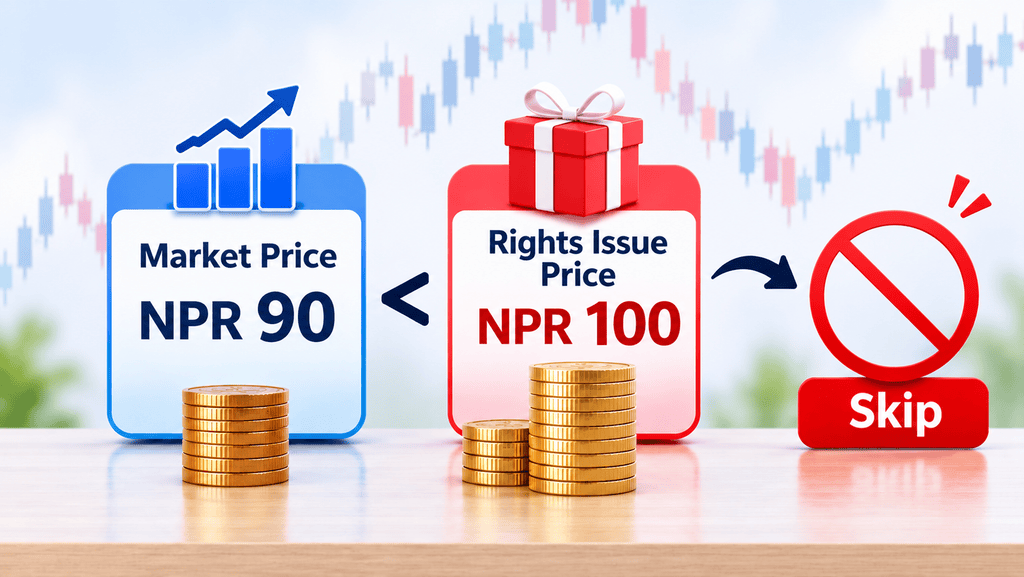
There is one honest exception. The cost of skipping depends on the gap between the market price and NPR 100. If a stock trades at NPR 110 and announces a 1:1 rights issue, the adjusted price is (110 + 100) ÷ 2 = NPR 105. Skip, and you lose NPR 5 a share. On 100 shares, that is NPR 500. It may not be worth the effort of blocking funds, and it is definitely not worth borrowing for.
When the market price is at or below par, the right is worthless and nobody rational will subscribe at NPR 100 when they can buy on the floor for less. You will see this with weaker microfinance, finance company or hydropower stocks in a downturn, and it is usually a signal about the company rather than about the rights issue.
So the rule of thumb is simple. The further above NPR 100 the stock trades, the more expensive it is to skip.
Subscribe or sell: the framework
Once you accept that skipping a high-priced right is a loss, the real decision is between subscribing and selling. That turns on four questions.
1. Would you buy this stock today at the adjusted price?
This is the question most people skip. Subscribing is economically the same as buying more of the company at the theoretical ex-rights price. If you would not put fresh money into the stock at NPR 433 on the open market, the fact that the ticket says “NPR 100” should not change your mind. The low headline price is an accounting artifact of the ratio, not a discount.
2. Why is the company raising money?
This is where your edge as a reader of annual reports comes in. Nepali companies issue rights for broadly three reasons, and they are not equally good for you.
The first is regulatory capital. Banks, insurers and other financial institutions periodically have to lift paid-up capital to meet minimums set by Nepal Rastra Bank or the Nepal Insurance Authority. The money is raised because the regulator demands it, not because management has a high-return project waiting. More capital chasing the same business usually means lower return on equity and diluted earnings per share for a while. That is not a reason to skip (skipping still costs you), but it is a reason to ask whether you want a bigger position.
The second is funding growth with a visible return, such as a hydropower developer financing construction of a project with a signed power purchase agreement. Here the question is whether the project will earn more than the company’s existing return. If it will, the new capital adds value. If construction is delayed, the shares you paid for sit idle.
The third is plugging a hole: covering losses or rebuilding capital after bad loans or claims. Be most skeptical here. The company is asking you to put more money into something that has already been losing it.
The rights prospectus and the board’s stated purpose tell you which of these you are dealing with. Read them before you decide.
3. Can you fund it without selling something else or borrowing?
Rights issues arrive on the company’s schedule, not yours. A 1:1 issue on a large holding is a serious cash call. If funding it means breaking a fixed deposit early, selling another stock you like at a bad time, or drawing on a margin loan, the “cost” of subscribing goes up. Borrowing at double-digit interest to buy a value-neutral entitlement is a poor trade. In that situation, selling before book closure is often the better choice. You keep the full value and avoid leverage.
4. What does subscribing do to your position size?
Subscribing increases your exposure to one company. In our example, your investment in the stock rises from NPR 3 lakh to NPR 3.25 lakh, and if the company is already your largest holding, that matters. We cover the limits in our guide to position sizing on NEPSE. A partial subscription is also allowed (you can apply for fewer shares than your entitlement), but partial subscription means partial dilution on the remainder. Better, in most cases, to sell part of your holding before book closure and subscribe in full on what you keep.
The friction nobody prices in
On paper, subscribing and selling before book closure give the same result. In practice, they differ in four ways.
Time and liquidity. When you subscribe, the NPR 25,000 is blocked in your bank account through ASBA during the issue, and the new shares only become tradable after allotment and listing, which takes weeks. During that window you hold an asset you cannot sell. If the stock falls, you cannot exit the new shares. Selling before book closure avoids this entirely.
Price drift. The adjusted price is a theoretical starting point. The market moves after that. A stock adjusted to NPR 433 can trade at NPR 400 or NPR 470 by the time your rights shares list. You bear that risk on the larger position if you subscribe.
Transaction costs. Selling 500 shares before book closure costs commission and fees on NPR 3 lakh. Subscribing and holding costs only the application. If you would end up holding the stock anyway, subscribing is the cheaper path.
Tax. Selling triggers capital gains tax on any gain over your weighted average cost. According to the Ministry of Finance notice published in the Nepal Gazette and reported by ShareSansar on September 22, 2026, resident individuals now pay 5% on gains from listed shares held 365 days or less and 3.75% on shares held longer. (Those rates replaced the higher 10% and 7.5% set in the FY2026/27 budget.) If your existing shares are long-held, selling before book closure may cost you little. If you bought recently, the short-term rate applies. Subscribing defers the question. The new shares enter Meroshare’s weighted average cost calculation at NPR 100, which lowers your average cost per share and, eventually, raises your taxable gain when you sell. Our guide to weighted average cost on NEPSE explains how that average is built. Check the holding-period date Meroshare assigns to your rights shares before you sell them.
The “buy before book closure for cheap shares” trap
Every rights season, the same idea circulates in Telegram groups: buy the stock before book closure so you can get NPR 100 shares. The math above shows why this does not work as an arbitrage. Whatever you “gain” on the cheap new shares, you give back on the adjustment of the shares you bought to qualify. Buy at NPR 600, get adjusted to NPR 433, subscribe at NPR 100, and your average cost is exactly the adjusted price. You have earned nothing except a larger position and a few weeks of illiquidity.
If the price runs up into book closure because of this crowd, the trade gets worse: you pay a pre-closure premium and still receive the same mechanical adjustment. Buying for a rights issue only makes sense if you wanted to own more of the company anyway.
A quick decision checklist

When a rights issue is announced on a stock you hold, work through this in order.
- Compare the market price to NPR 100. If it is close to par, the decision barely matters. If it is well above, skipping is expensive.
- Calculate the adjusted price with the formula above and ask whether you would buy the stock at that price.
- Read the stated purpose of the issue in the prospectus: regulatory capital, growth project, or loss recovery.
- Check whether you can fund the full entitlement from cash, without selling something you want to keep or borrowing.
- Check your position size after subscription.
- If any answer is no, sell some or all of your shares before the eligibility cut-off rather than letting rights lapse.
- If you subscribe, apply through Meroshare’s ASBA section before the issue closes, and keep the bank balance in place until allotment.
Verdict
The rights share subscribe or sell Nepal decision looks complicated because the headlines frame it as an opportunity: shares at NPR 100 when the market price is NPR 600. It is not an opportunity. It is a capital call with a penalty attached for ignoring it. NEPSE’s price adjustment makes subscription value-neutral, and the auction system makes inaction a transfer of your money to the company and to auction bidders, as LICN’s NPR 1,022 cut-off showed.
So treat every rights issue as a fresh buy-or-sell decision on the stock at its adjusted price. If you want more of the company and can pay from cash, subscribe in full. If you do not, sell before book closure and let someone else pay for the right. The only answer we would argue against, on any stock trading well above par, is the one most retail investors default to: doing nothing.
This is analysis, not financial advice.
Frequently Asked Questions
1. What are rights shares in Nepal?
Rights shares are additional shares offered by a company to its existing shareholders in proportion to their current holdings, usually at NPR 100 per share.
2. Should I subscribe to rights shares or sell my existing shares?5
Subscribe if you want to increase your investment and can afford it. Sell before the eligibility cut-off if you do not want additional exposure to the company.
3. What happens if I do not apply for rights shares?
Your entitlement may lapse, and the unsubscribed shares may be auctioned to other investors. You may also lose value because of the market price adjustment.
4. Why should investors read a company’s rights issue prospectus?
The prospectus explains why the company is raising money, whether for regulatory capital, a growth project, or recovering losses. Understanding the purpose helps investors decide whether they want to increase their investment in the company.
5. Is buying shares before book closure to get rights shares profitable?
Not automatically. NEPSE adjusts the share price to account for the new shares, so buying before book closure only to qualify does not guarantee a profit.