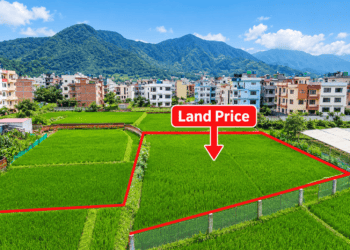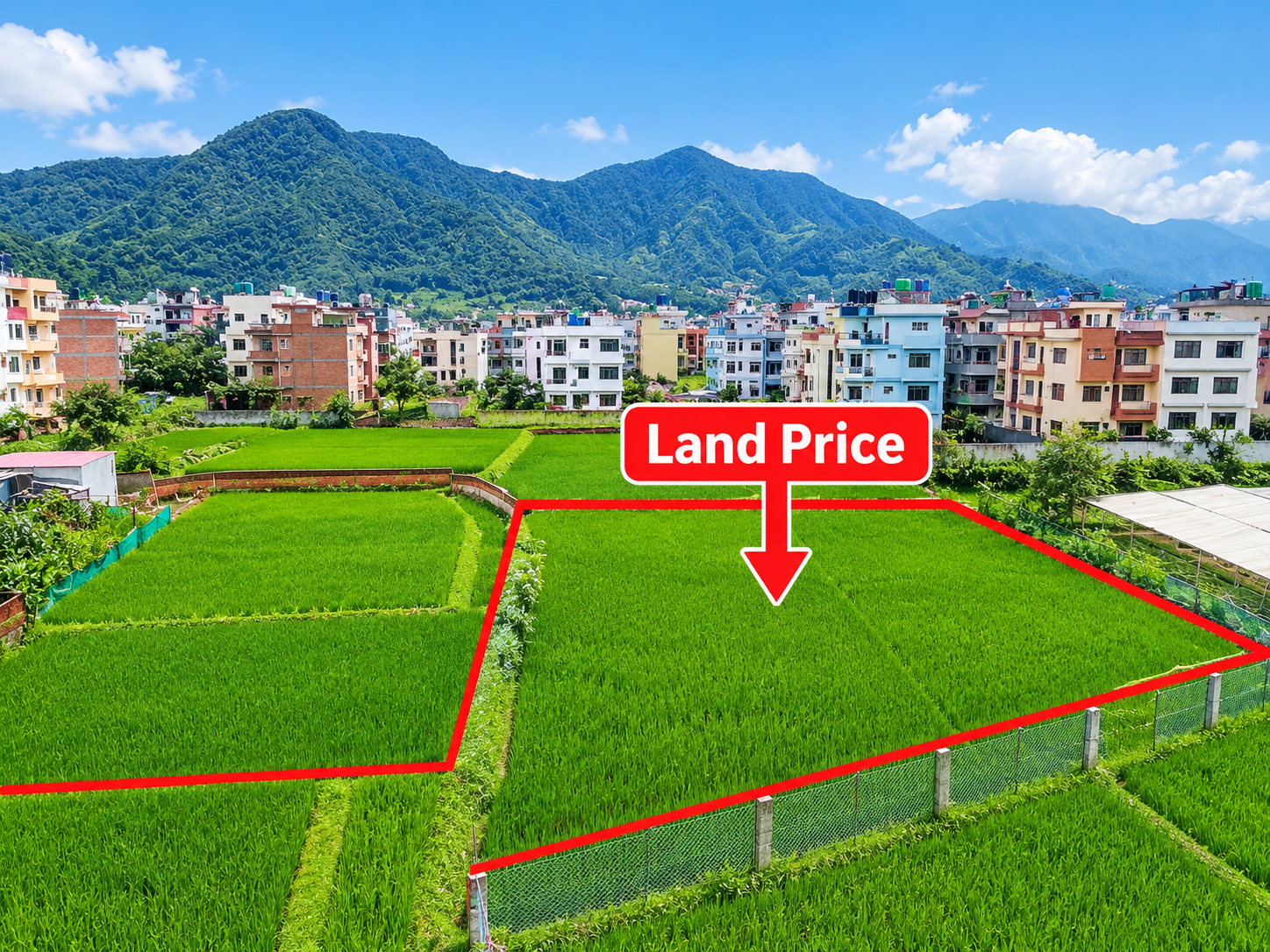
Two plots sit a 25-minute drive apart. One aana in a prime residential pocket of Baluwatar can ask north of Rs 2 crore. One aana on a roadside stretch of Manamaiju carries a government valuation of Rs 22 lakh, and trades not far above it. Same valley, same unit of land, a price gap of nearly tenfold. For buyers, sellers, and anyone trying to read the Kathmandu Valley market, the first problem is that “land price” means at least two different numbers, and they rarely agree.
Key Takeaways
- In 2026, reported market land prices across the Kathmandu Valley run from roughly Rs 20 lakh per aana on the peri-urban fringe to over Rs 2 crore per aana in prime inner-city residential pockets such as Baluwatar, Naxal, and Jhamsikhel.
- The measurement that matters is the aana: 1 ropani = 16 aana = 5,476 sq ft, and 1 aana = 342.25 sq ft (about 31.8 square meters).
- The official government valuation sits well below the market. For FY 2083/84, the Kathmandu land revenue offices set minimum rates from about Rs 22 lakh per aana (Tokha, Manamaiju) up to Rs 76.2 lakh per aana in the Dillibazar commercial core.
- Those official rates rose roughly 5 to 10 percent for 2083/84 across most Kathmandu offices. Bhaktapur held its rates flat, and Lalitpur had not published new rates as of mid-July 2026.
- Road access is the single biggest price driver. Under the Kathmandu Metropolitan City valuation schedule, a main-road frontage was valued at up to Rs 50 lakh per aana while a landlocked plot fell to as little as Rs 4 lakh, a swing of more than tenfold within the same city.
- The government minimum valuation exists to set registration fees and capital gains tax, not to reflect trading value. Buyers should treat it as a floor, not a price.
First, the unit: what a ropani and an aana actually are
Kathmandu Valley land is priced in the hill-region system, not the Terai system. The base unit is the ropani, which divides into aana, paisa, and daam. In practice, almost every valley transaction is quoted per aana, because a full ropani in a built-up area is a large and expensive parcel. The conversions are fixed:6
| Unit | Equals | Square feet | Square meters |
|---|---|---|---|
| 1 Ropani | 16 aana / 64 paisa / 256 daam | 5,476 | 508.72 |
| 1 Aana | 4 paisa / 16 daam | 342.25 | 31.80 |
| 1 Paisa | 4 daam | 85.56 | 7.95 |
| 1 Daam | – | 21.39 | 1.99 |
For context, land in the Terai plains uses the bigha system, where 1 bigha equals 20 kattha and about 72,900 sq ft. A valley buyer rarely needs it, but it explains why a “ropani” price in Kathmandu and a “kattha” price in Chitwan are not remotely comparable. One crore, throughout this piece, means Rs 10 million, and one lakh means Rs 100,000.
What land actually costs by area in 2026
Market prices are the harder number, because no single agency publishes them. The ranges below are reported asking prices compiled in a 2026 Kathmandu land price guide from the property platform Basobaas. Treat them as a map of relative value, not a quote: within any area, the final price turns on road width, plot shape, and exact position.
| Area | Reported market range (per aana) |
|---|---|
| Sanepa, Jhamsikhel (Lalitpur) | Rs 80 lakh to Rs 2 crore |
| Baneshwor, Maitighar | Rs 70 lakh to Rs 2 crore |
| Baluwatar, Naxal, Lazimpat | Rs 65 lakh to Rs 2 crore |
| Bhaisepati, Imadol | Rs 40 lakh to Rs 1 crore |
| Kapan, Budhanilkantha | Rs 35 lakh to Rs 85 lakh |
| Tokha | Rs 30 lakh to Rs 80 lakh |
| Godawari, Bungamati | Rs 20 lakh to Rs 50 lakh |
| Peri-urban (Lubhu, Lamatar belt) | Rs 20 lakh to Rs 45 lakh |
The wide bands inside each row are the real signal. Baluwatar does not have one price. A tight gali plot and a plot on a wide motorable road a block apart can differ by two or three times. That is why a single headline “Kathmandu land price” is close to meaningless, and why appreciation claims, such as the 12 to 15 percent annual gains sometimes cited for pockets of Bhaisepati, should be read as area-specific and unverified rather than valley-wide.
The official floor: government minimum valuation for 2083/84

Running underneath the market is a second, lower set of numbers: the minimum valuation that the land revenue (malpot) offices publish each fiscal year. This is the figure used to calculate registration charges and capital gains tax, so it is deliberately conservative. For FY 2083/84 (2026/27), Kathmandu offices raised most rates by roughly 5 to 10 percent, as reported when the new schedule took effect from Shrawan 2083.
| Area (land revenue office) | Minimum valuation, per aana | Change |
|---|---|---|
| Dillibazar commercial core (New Road, Durbar Marg, Kantipath, Putalisadak) | Rs 76.2 lakh | +5% |
| Chabahil, Ring Road (Gaushala to Dhobikhola) | Rs 62.7 lakh | +10% |
| Putalisadak, Bagbazar, Ratnapark, Sabhagriha | Rs 56 lakh | – |
| Mitrapark, Kalopul, Gaushala, Ratopul, Jorpati (main roads) | Rs 55.66 lakh | +10% |
| Kalanki, Ring Road (Balkhu to Banasthali) | Rs 49.35 lakh | +5% |
| Boudha Stupa vicinity | Rs 48.95 lakh | – |
| Kalimati, Balkhu, Soaltimode, Kalanki Chowk | Rs 43 lakh | – |
| Tokha (pitched road toward Narayansthan) | Rs 22.25 lakh | +5% |
| Manamaiju (main roads) | Rs 22 lakh | +10% |
The pattern is the same shape as the market table, compressed downward. The priciest official rate, Dillibazar’s commercial frontage at Rs 76.2 lakh, is more than three times the cheapest, Manamaiju’s roadside land at Rs 22 lakh. In most residential areas, though, the official valuation lands well below what plots actually change hands for, which is exactly why the gap between the two numbers is a recurring feature of Nepali property. BiznesVue has written before about why Nepal’s land carries two prices at once, and the same mechanics show up every time a plot is registered.
Why the same area carries wildly different prices
Five factors do most of the work, and they compound.
Road access comes first, by a distance. It is the clearest single driver, and the government’s own schedule proves it. In Kathmandu Metropolitan City’s valuation, a main-road frontage was set at up to Rs 50 lakh per aana while land with no road access fell to as little as Rs 4 lakh, a spread of more than tenfold inside one city, as documented in the metropolis rate list. A plot you can drive a car and a construction truck up to is worth multiples of an identical plot reachable only on foot.
Road width then grades it. A 4-meter gali, an 8-meter road, and a highway frontage are three different prices on the same street. Width also decides what you can build, because setback and coverage limits key off the road in front, which feeds directly back into land value.
Commercial versus residential use explains why the official core rates (Dillibazar, New Road) sit far above leafy residential zones. Frontage that can host a shop or showroom is priced on rental yield, not on where a family wants to live.
Proximity to the Ring Road and arterial corridors sets the floor for an area’s trajectory. Stretches that opened up along and beyond the Ring Road have run through full boom-and-bust cycles, a pattern BiznesVue traced in its look at the outer ring road speculation cycle.
Plot shape, size, and services finish the job. A square, south-facing ghderi with clean access, water, and a clear title commands a premium over an irregular strip, even at the same address. Demand itself has a well-known fuel source: remittance income, though its link to land prices is weaker than the popular story suggests, as covered in BiznesVue’s analysis of how much land remittances actually buy.
What the two-number gap means when you transact
The practical consequence of the official-versus-market gap lands at registration. Registration charges and capital gains tax are computed on the government minimum valuation or the stated transaction price, whichever is higher, which is why the malpot rate is a floor you cannot register below. A buyer should price a plot off real comparable sales in the same lane, then check the official valuation separately to estimate registration cost. The two numbers answer different questions: one is what you pay the seller, the other is what you pay the state. Readers weighing the tax side can see BiznesVue’s breakdown of how land registration fees are set and collected, and the wider real estate coverage for area-by-area context.
None of this makes Kathmandu land cheap or safe. Prime-area asking prices of Rs 2 crore per aana are not supported by rental yields in any ordinary sense, the market is thinly traded, and valuations in fringe areas can stall for years. The point is narrower and more useful: there is no single Kathmandu land price. There is a market number that moves with road access and use, and an official number that moves slowly and sets your tax. Buy on the first, budget for the second, and never confuse one for the other.
Frequently Asked Questions
1. How much does one aana of land cost in Kathmandu in 2026?
Reported 2026 market prices range from about Rs 20 lakh per aana on the peri-urban fringe (the Lubhu and Lamatar belt, Godawari, Bungamati) to over Rs 2 crore per aana in prime inner-city residential pockets such as Baluwatar, Naxal, and Jhamsikhel. Mid-tier areas like Bhaisepati, Kapan, and Tokha commonly fall between Rs 30 lakh and Rs 1 crore. Within any area, road access and plot shape can move the price by two to three times.6
2. How many square feet is one ropani and one aana?
One ropani equals 5,476 square feet, or about 508.72 square meters, and divides into 16 aana. One aana equals 342.25 square feet, or about 31.8 square meters. An aana further divides into 4 paisa, and a paisa into 4 daam. Valley land is almost always quoted per aana.
3. What is the government minimum valuation, and how is it different from market price?
The minimum valuation is a per-area rate published each fiscal year by the land revenue (malpot) offices. It is used to calculate registration fees and capital gains tax, and a plot cannot be registered below it. It is deliberately set under true market value, so it serves as a tax floor rather than a price. The actual sale price is negotiated between buyer and seller based on comparable transactions.
4. Which areas of the Kathmandu Valley are most expensive?
By market price, prime residential pockets of Baluwatar, Naxal, Lazimpat, Sanepa, and Jhamsikhel sit at the top, with asking prices reaching Rs 2 crore per aana. By official valuation, the commercial core around Dillibazar, New Road, Durbar Marg, and Kantipath is highest, set at Rs 76.2 lakh per aana for FY 2083/84.
5. Why does land in the same area have such different prices?
Road access is the dominant factor. The government’s own schedule valued a main-road frontage at up to Rs 50 lakh per aana and a landlocked plot at as little as Rs 4 lakh, more than a tenfold gap within one city. Road width, commercial versus residential use, proximity to the Ring Road, plot shape, and services then layer on top, so two plots a block apart can carry very different prices.
6. Did Kathmandu land valuations go up in 2026?
Yes. For FY 2083/84 (2026/27), Kathmandu land revenue offices raised most minimum valuations by roughly 5 to 10 percent. Bhaktapur kept its rates unchanged, and Lalitpur had not published new rates as of mid-July 2026. These are official valuation changes for tax purposes and do not necessarily track actual market movement.