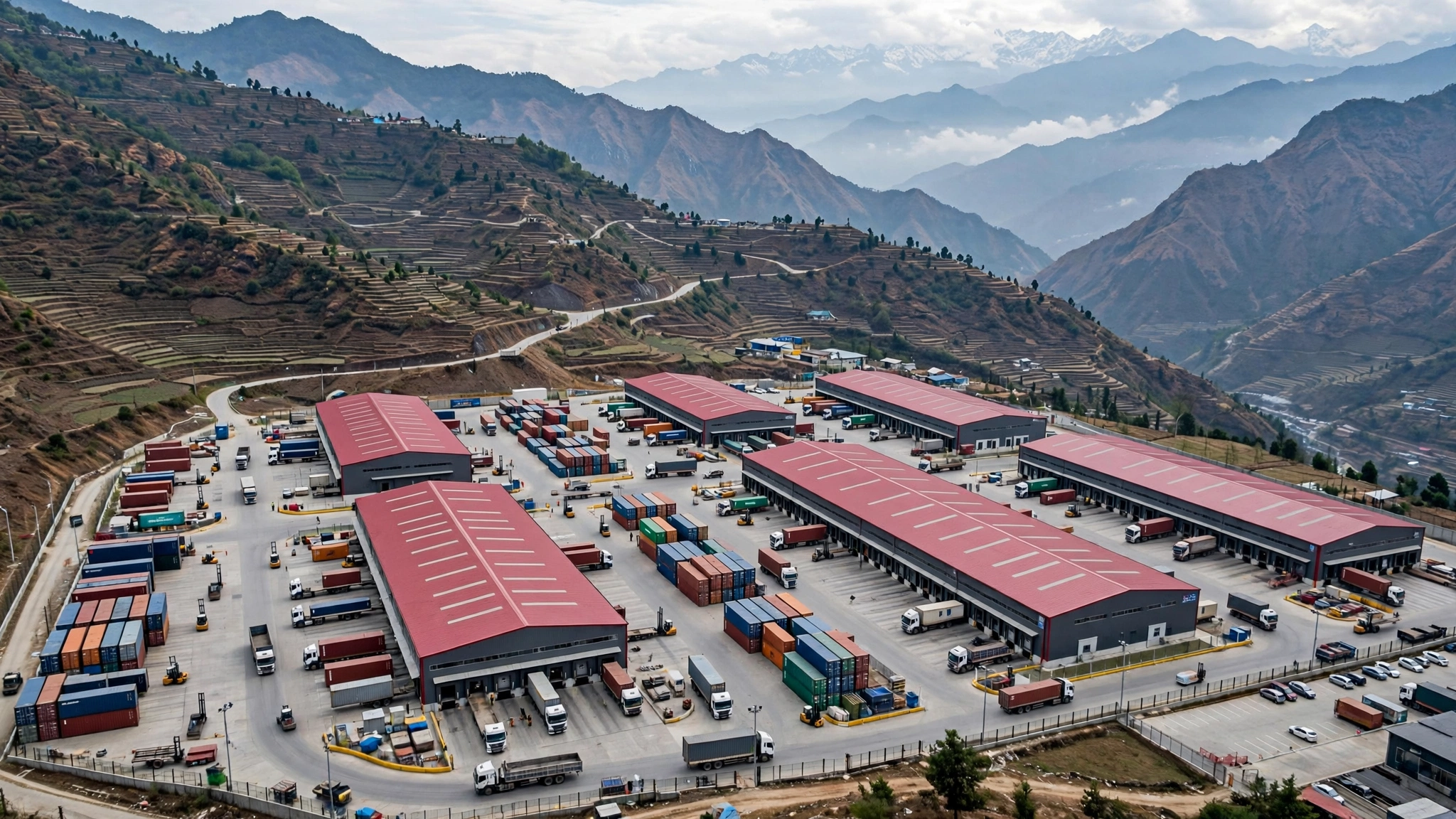
Trucks queue for days outside Nepal’s busiest dry port. Not because customs is slow, but because there’s simply nowhere to store the goods once they arrive.
Warehousing and logistics land in Nepal has become a genuine bottleneck. As trade volumes grow and e-commerce expands, demand for structured, large-acreage storage hubs near dry ports and distribution routes keeps climbing. Supply, unfortunately, hasn’t kept pace.
This isn’t a hypothetical concern. It’s visible right now, at Nepal’s border crossings, industrial zones, and along its most important trade corridors. Understanding this gap matters for businesses, investors, and policymakers alike.
In this article, we’ll explore what’s driving demand for logistics land in Nepal, where the biggest bottlenecks sit, and what recent developments suggest about the road ahead.
Why Dry Ports Anchor Nepal’s Logistics Land Demand
Nepal’s landlocked geography makes dry ports the country’s essential trade infrastructure. According to the Digital Logistics Capacity Assessment, Nepal relies on Kolkata Port in India for handling practically all of its sea freight imports, making inland clearance depots the critical link between that port and Nepal’s domestic markets.
Currently, five ICDs operate across Nepal’s borders. According to the same source, Birgunj, Bhairahawa, and Kakarvitta ICDs sit along the India border, Tatopani ICD operates at the China border, and Chovar ICD serves Kathmandu directly. A sixth facility, Rasuwagadhi ICD at the Nepal-China border, was under construction and expected to complete by 2026.
Four of these facilities carry special international recognition. According to the Intergovernmental Agreement on Dry Ports, Bhairahawa, Birgunj, Kakarbhitta, and Tatopani ICDs are all formally registered as “dry ports of international importance.” This designation reflects their role within a broader Asian intermodal transport and logistics network, not just domestic Nepali trade infrastructure.
Birgunj: Nepal’s Largest, and Most Congested, Dry Port
Understanding the scale of demand starts with Nepal’s single most important logistics facility.
According to field research published by CUTS International and the Nepal Economic Forum, Birgunj ICD was constructed on 38 hectares, roughly 94 acres, with storage capacity for 1,568 twenty-foot equivalent container units. The facility handles more than 20,000 TEU containers and breakbulk cargo annually, connected by six full-rake railway sidings.
Despite this scale, capacity constraints remain a persistent problem. The same research found that congestion due to inadequate warehousing facilities has led to significant delays, increasing cargo clearance times considerably. The facility’s two main warehouses, a 7,000 square meter container freight station shed and a 10,000 square meter goods shed, simply weren’t built for today’s trade volumes.
Land assembly problems compound this shortage. According to the same field study, the government had planned to merge the ICD and its adjacent Integrated Check Point by expanding infrastructure, but has been unable to acquire the 16 hectares of land needed between the two properties. This single land acquisition bottleneck illustrates just how difficult expanding structured logistics land remains, even at Nepal’s most strategically important trade facility.
Trade volume data confirms why this congestion matters so much nationally. According to the Digital Logistics Capacity Assessment, Birgunj alone accounted for 32.82% of Nepal’s total import value by trade point during a recent full fiscal year, making it by far the country’s most consequential land border crossing.
Bhairahawa: The Second Bottleneck
Nepal’s second-largest dry port faces remarkably similar constraints, reinforcing that this isn’t an isolated Birgunj problem.
According to the Digital Logistics Capacity Assessment, Bhairahawa ICD ranks second in overall trade volume after Birgunj, accounting for 15.19% of import value. Yet, the same assessment describes the facility as “busy and congested due to a lack of parking area,” with the problem intensifying during the rainy season when available warehouse and parking space becomes insufficient.
Waiting times reflect this strain directly. According to the same source, the average waiting time between vehicle arrival and berthing at Bhairahawa runs one to two days. Perhaps most notably for perishable goods trade, the facility lacks cold storage facilities entirely, despite handling agricultural imports like vegetables alongside petroleum products and construction materials.
Simara SEZ: Where Demand Is Translating Into Real Investment
While dry ports themselves struggle with capacity, nearby industrial zones are showing genuinely encouraging signs of logistics-driven investment growth.
According to Kathmandu Post’s May 2026 reporting, investment at the Simara Special Economic Zone has surged sharply after the federal government reduced land rent this year, from Rs 20 per square meter down to just Rs 5. This single policy change triggered nearly a dozen new industrial projects within the zone.
The zone’s strategic value comes directly from its logistics positioning. According to solar manufacturing site-selection research, Simara’s key advantage is its proximity to the Birgunj Inland Container Depot, making it particularly attractive for manufacturers importing raw materials or machinery through sea freight via Indian ports.
The scale here is genuinely significant. According to Kathmandu Post, the Simara SEZ spans 833 bigha, approximately 564 hectares, divided into five blocks. Block A alone covers 343 bigha, about 232 hectares, of which 165 bigha, roughly 112 hectares, is already occupied by operating or under-construction industries. A total of 21 industries have now registered in the zone, with seven already operational, employing around 700 workers directly.
Notably, more than half of these new projects involve Indian and Chinese investors, according to the same report, ranging from a Rs 5 billion tile and sanitary ware joint venture to a South Korean-backed cosmetics manufacturing facility. SEZ site engineer Pappu Giri confirmed that the previously high rent had genuinely slowed industrial growth in the zone, making this rent reduction a directly measurable policy lever behind the recent investment surge.
Nepal’s Broader Warehousing Sector Remains Modest
Despite this pocket of strong growth around Simara, Nepal’s overall structured warehousing sector remains relatively small in absolute terms.
According to Tracxn’s January 2026 market analysis, Nepal’s warehousing sector includes 91 founded companies. While this reflects genuine sector activity, it’s a modest base compared to the scale of demand growth trade and e-commerce expansion are generating, suggesting significant room remains for structured, professionally managed warehousing capacity to develop further.
Infrastructure Delays Are Compounding the Land Supply Problem
Perhaps the most significant constraint on expanding logistics land access isn’t land availability itself, but the transport infrastructure meant to connect that land to markets.
According to recent district-level government commitment tracking, Nepal’s critical Kathmandu-Terai Fast Track highway, which would dramatically improve connectivity between the capital and Terai-based logistics hubs, sat at just 45.16% progress as of recent reporting, with Rs 83 billion spent of a planned Rs 212 billion, against an April 2027 deadline. A land dispute at Khokana has specifically blocked progress at the project’s starting point.
Rail infrastructure tells an even more sobering story. According to the same tracking, the broader railway project connecting Nepal’s logistics corridors has progressed at just 5% since work began back in 2008. More specifically, the Bardibas-Simara railway section, directly relevant to logistics land near Simara’s growing SEZ, has seen only about 50 kilometers of track bedding completed out of a planned 70-kilometer section, with Rs 11.22 billion spent so far against roughly Rs 4 billion in annual allocation.
Budget execution problems compound these delays further. According to the same district-level tracking, a recent fiscal year budget of Rs 67.08 billion allocated toward these infrastructure priorities saw only 15.49%, roughly Rs 10.39 billion, actually spent within the first six months. Notably, allocations for the Nijgadh airport project specifically recorded zero spending during this period, despite Nijgadh’s emergence as a speculative land investment hotspot precisely because of its logistics corridor potential.
Why This Gap Between Demand and Supply Matters
This combination of rising demand and constrained supply creates real economic consequences worth understanding clearly.
First, dry port congestion directly raises trade costs. Every extra day a truck waits for berthing, every delayed cargo clearance caused by inadequate warehousing, translates into higher costs for importers and exporters, costs that ultimately pass through to consumer prices across Nepal’s economy.
Second, the gap creates genuine investment opportunity, precisely where the Simara SEZ example demonstrates real demand exists. When land costs align with market conditions, as the rent reduction there showed clearly, investment responds quickly and substantially.
Third, infrastructure delays specifically threaten to undermine logistics land value even where that land exists. A warehouse hub near Simara matters far less if the Fast Track highway and rail connections meant to move goods to and from Kathmandu remain years behind schedule.
What Would Help Close This Gap
Given these compounding pressures, several concrete steps could help expand Nepal’s structured logistics land capacity more effectively.
First, resolving land acquisition bottlenecks at existing dry ports, like the stalled 16-hectare acquisition blocking Birgunj’s ICD-ICP merger, would unlock capacity at facilities that already have proven trade volume and infrastructure investment behind them.
Second, extending the Simara SEZ rent reduction model to other strategically positioned industrial zones near dry ports could replicate this demonstrated investment response elsewhere along Nepal’s trade corridors.
Third, prioritizing completion of connecting infrastructure, particularly the Fast Track highway and Bardibas-Simara railway section, would ensure that logistics land investment actually translates into functional, connected supply chains, rather than isolated storage capacity disconnected from Nepal’s broader trade network.
Finally, addressing specific capacity gaps like cold storage, notably absent at Bhairahawa despite significant agricultural import volume, would help Nepal’s logistics infrastructure serve a broader range of goods, not just the non-perishable cargo current facilities handle most easily.
Why This Trend Deserves Long-Term Tracking
Warehousing and logistics land demand in Nepal deserves sustained attention as a structural indicator of trade infrastructure health.
First, tracking dry port congestion metrics, like average berthing wait times, reveals whether capacity investments are keeping pace with genuinely growing trade volumes, or whether bottlenecks continue worsening.
Second, monitoring investment response to policy changes, following the Simara SEZ rent reduction as a clear case study, would help identify which specific levers most effectively unlock logistics land development elsewhere.
Third, tracking connecting infrastructure progress, particularly the Fast Track highway and rail corridor completion, matters enormously, since logistics land value depends fundamentally on the transport connections linking it to actual markets.
Conclusion
Warehousing and logistics land in Nepal sits at a genuinely important inflection point. Demand is clearly rising, evident in Birgunj’s persistent congestion, Bhairahawa’s parking shortages, and the sharp investment surge that followed Simara SEZ’s land rent reduction. Yet, supply constraints, from unresolved land acquisition disputes to years-delayed connecting infrastructure, continue holding this sector back from matching that demand.
The Simara example offers real encouragement. When policy conditions align, investment responds quickly and substantially. However, without resolving the deeper infrastructure bottlenecks, particularly around the Fast Track highway and rail connectivity, even successful logistics land development risks remaining disconnected from the broader trade network it needs to serve.
Closing this gap will require sustained attention to land acquisition, infrastructure completion, and targeted capacity investment, precisely the kind of long-term commitment Nepal’s trade growth increasingly demands.
FAQ: Warehousing and Logistics Land in Nepal
How many dry ports does Nepal currently operate?
Nepal operates five inland clearance depots, at Birgunj, Bhairahawa, Kakarvitta, Tatopani, and Chovar, with a sixth at Rasuwagadhi under construction.
Why is Birgunj ICD so important to Nepal’s trade?
Birgunj accounts for 32.82% of Nepal’s total import value, making it the country’s largest and most significant dry port and logistics hub.
What triggered the recent investment surge at Simara SEZ?
The government reduced land rent from Rs 20 to Rs 5 per square meter, directly triggering nearly a dozen new industrial projects in the zone.
Does Nepal have cold storage facilities at its dry ports?
Not consistently. Bhairahawa ICD, Nepal’s second-largest dry port, currently lacks cold storage facilities despite handling significant agricultural imports.
What infrastructure is limiting logistics land development in Nepal?
The Kathmandu-Terai Fast Track highway and Bardibas-Simara railway section remain significantly behind schedule, limiting connectivity to logistics land near dry ports.
How large is Nepal’s structured warehousing sector?
Nepal’s warehousing sector includes 91 founded companies as of early 2026, a relatively modest base given growing trade and e-commerce demand.