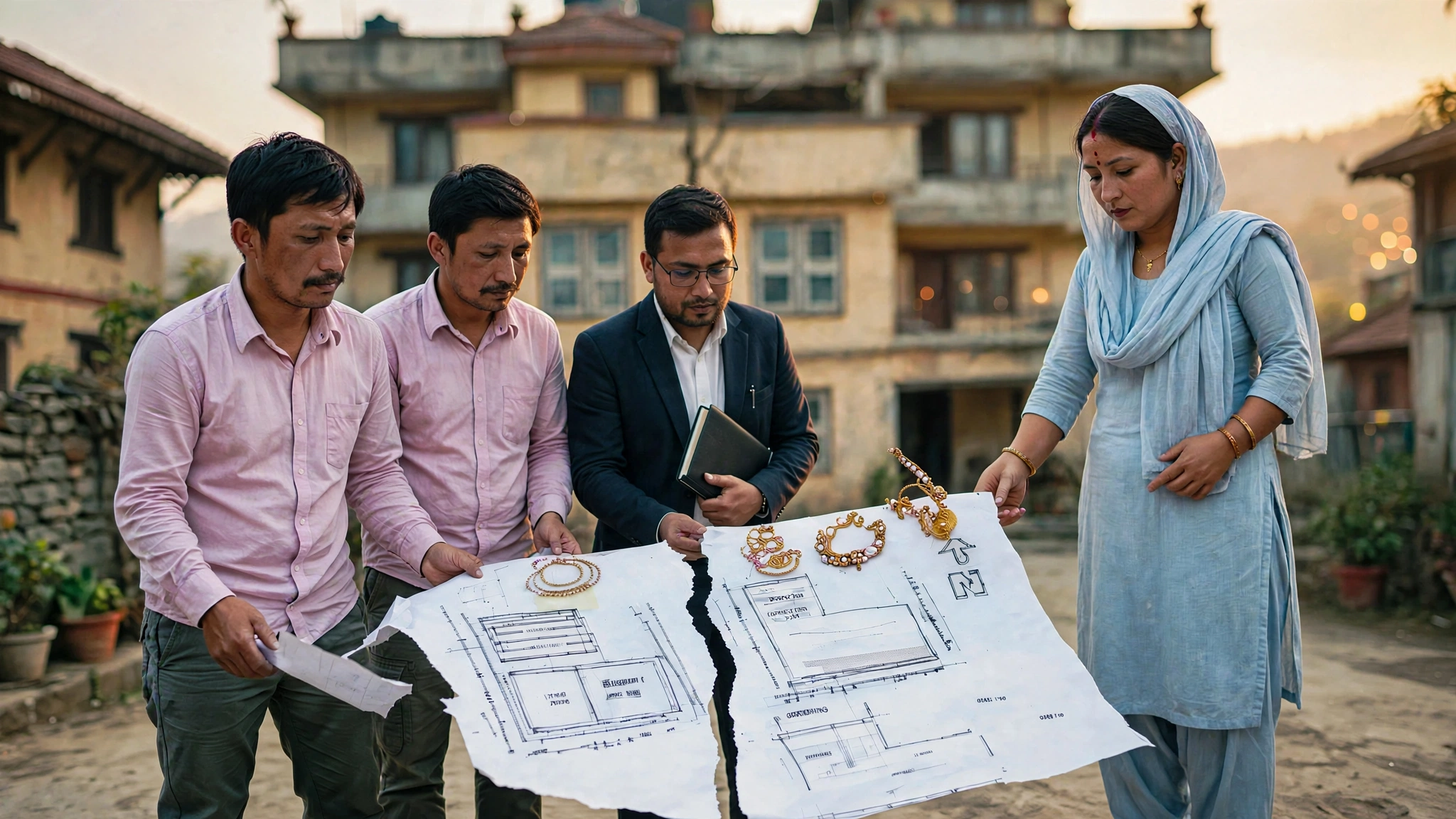
Every generation, the same plot of Nepali farmland gets divided again. And again. What started as one contiguous field, large enough to genuinely support a family, eventually becomes a scattering of narrow strips, each too small to farm efficiently on its own.
Amsabanda land partition in Nepal, the legal right guaranteeing equal property division among heirs, sits at the heart of this pattern. It’s a genuinely important legal principle, rooted in fairness and, since 2017, gender equality. Yet, its cumulative economic effect has been to steadily shatter Nepal’s agricultural land into ever-smaller, less productive fragments, generation after generation.
Understanding how this legal right actually works, and how directly it connects to Nepal’s well-documented land fragmentation problem, reveals a genuine tension between individual property justice and collective agricultural productivity.
In this article, we’ll examine how Amsabanda functions legally, what the data shows about its fragmentation effect, and why a landmark 2017 equality reform may have unintentionally accelerated the problem.
What Amsabanda Actually Guarantees
Amsabanda, also written as Ansha Banda or Ansabanda, is the legal process of dividing family property, including parental and ancestral property, among family members known as coparceners, according to Court Marriage in Nepal’s 2026 legal guide. Any coparcener can claim partition of family property at any time, a right that exists independently of whether other family members agree to the division.
According to Mero Adalat’s 2026 legal guide, this process is governed by the Muluki Civil Code, 2074, specifically Articles 205 through 236. Under Nepali law, the wife, husband, father, mother, son, and daughter are all considered coparceners, and crucially, every coparcener has equal property rights. This isn’t a discretionary allocation left to a household head’s preference. It’s a legally guaranteed, equal entitlement by birth.
According to Law Firm Nepal’s guide, one particularly important distinction shapes how this right applies in practice: parents can exclude children from self-acquired property, property they personally earned or purchased, but cannot exclude them from ancestral property. This distinction matters enormously for understanding why fragmentation specifically concentrates in inherited agricultural land rather than newly acquired property.
The 2017 Reform That Changed Everything
Nepal’s current partition framework represents a genuinely significant legal transformation, one explicitly designed to correct a longstanding gender injustice.
According to Notary Nepal’s 2026 legal guide, the Muluki Civil Code, 2074 came into force on 1 Bhadra 2075 (August 17, 2018), replacing the older Muluki Ain, 2020. Before this reform, daughters faced significantly restricted inheritance rights compared to sons. According to Nepal Legal Firm’s 2025 guide, the new code was a landmark, giving daughters equal rights to ancestral property for the first time, regardless of marital status.
This reform’s scope extends further than many might assume. According to Common Law’s 2026 guide, a wife is considered an equal coparcener from the date of marriage, and if a son dies, his widow inherits his share directly. Married daughters, previously excluded or restricted under the old law, gained retroactive claim rights too. According to Nepal Legal Firm, married daughters can now file for shares if partition wasn’t completed before their marriage, a change that has led to what the guide describes as “a surge in Ansabanda cases from married daughters reclaiming their inheritance.”
Why Fair Inheritance and Fragmented Land Are Connected
Here’s where Amsabanda’s legal fairness and Nepal’s agricultural productivity challenges intersect directly, and academic research confirms this connection isn’t incidental.
According to research on land fragmentation in Nepal’s mountain regions, published in an agricultural economics journal, analysis revealed an increasing trend in the number of land parcels and a decreasing trend in parcel size, primarily due to the heredity tradition of equal division of land among the inheritors. This isn’t a minor contributing factor among many. The research identifies inheritance practice as the primary driver of this specific fragmentation pattern.
The Nepal Economic Forum’s own analysis reaches the identical conclusion. According to their assessment of impediments in Nepal’s agriculture sector, reduced arable plot sizes are a direct result of inheritance laws that make landholdings small and limiting to profitable agricultural practices, with population growth directly compounding the effect, since each new generation multiplies the number of equal claimants dividing the same original land base.
The Numbers Behind the Fragmentation
The scale of this fragmentation, and its measurable economic cost, has been documented in specific regional case studies across Nepal.
According to research examining land fragmentation in Chitwan district, agricultural production decreased by approximately 33% over 15 years specifically due to increasing land fragmentation, with average parcel sizes dropping from 0.38 hectares to just 0.26 hectares during that period. This represents a direct, quantified link between fragmentation and lost agricultural output within a single documented case.
The national trend tells a similarly stark story. According to agricultural land use research published by Agriculture and Forestry University, the average landholding per family in Nepal stood at less than 0.68 hectares as of 2013, a figure that has been gradually decreasing for the preceding three decades. The same research explicitly names inheritance, alongside land markets and cultural norms, as the core causes behind both fallow land and fragmentation across Nepal.
A separate case study focused on Nawalparasi district reaches the same structural conclusion. According to this research, policy implications include addressing structural causes of land fragmentation, specifically naming the law of inheritance and the broader political economy of agrarian structure as the root issues requiring attention, rather than simply treating fragmentation as an inevitable, unaddressable natural process.
Why the 2017 Reform May Have Accelerated the Problem
This is where Amsabanda’s story becomes genuinely nuanced, and worth discussing carefully. The Muluki Civil Code 2074’s landmark extension of full, equal inheritance rights to daughters represents a genuine, important correction to decades of gender-based property injustice. At the same time, this same reform mathematically expanded the pool of equal claimants dividing any given piece of ancestral land.
Consider the arithmetic directly. Under the older system, a family’s ancestral land might have been divided primarily among sons. Under the current code, that same plot must now be divided equally among sons and daughters alike, and according to Nepal Legal Firm’s guide, this expansion applies retroactively too, allowing married daughters from earlier, undivided family holdings to file new partition claims decades after their marriage. Each of these genuinely just legal entitlements adds another coparcener to the division calculation, another cut into what was often already a shrinking plot.
This isn’t an argument against the reform’s fairness. It’s a recognition that genuine gender equality in inheritance rights and land fragmentation pressure are, mathematically, connected outcomes of the same underlying legal structure, one that guarantees equal shares by birth rather than allowing land to pass undivided to a single heir or be consolidated through alternative mechanisms.
Regional Variation: Terai, Hills, and Mountains
Nepal’s fragmentation pattern doesn’t play out identically across its different geographic regions, reflecting how inheritance pressure interacts with local land use patterns.
According to agricultural land use research, the Terai region, occupying 23% of Nepal’s total land, functions as the country’s grain basket and faces regular fragmentation, particularly as inheritance divisions compound with increasing land market pressure in this more fertile, accessible region. The Hill region, covering 42% of total land, faces a related but distinct challenge: absentee landlordism, where fragmented parcels increasingly belong to owners who have migrated elsewhere, whether to urban centers or abroad for foreign employment, leaving inherited land underutilized or entirely fallow rather than actively farmed.
The Productivity Paradox Within Fragmentation
Interestingly, not all research on Nepal’s land fragmentation reaches uniformly negative productivity conclusions, adding genuine complexity to this picture.
According to research on land fragmentation’s impact on input use and crop yield in Nepal’s mountain regions, yield analysis actually revealed that small parcels are more productive than large parcels in certain contexts, specifically because smaller plots often receive higher, more intensive applications of labor and inputs per unit of land. However, the same research found that as farm size increased, maize yield also increased, while other efficiency measures showed mixed results depending on the specific crop and farming system involved.
This nuance matters for understanding fragmentation’s true economic cost. It’s not simply that smaller is always worse for per-hectare output. Rather, fragmentation’s core problem lies in the compounding transaction costs, managing multiple scattered parcels, the loss of economies of scale in labor and equipment use, and the practical difficulty of investing in irrigation or mechanization across disconnected, ever-shrinking plots, exactly the pattern the Chitwan study’s 33% production decline over 15 years illustrates concretely.
What Legal Reform Alone Cannot Fix
Understanding Amsabanda’s fragmentation effect clearly requires recognizing that this isn’t primarily a legal drafting problem the courts or legislature could easily correct. It’s a structural consequence of guaranteeing equal, birth-right property claims within a country where population has grown substantially while total agricultural land has remained essentially fixed.
According to the Nepal Economic Forum’s analysis, people seek land ownership not purely for agricultural production, but for investment purposes, enhancing personal prestige and status, and securing their family’s future, motivations that persist regardless of whether a given parcel remains genuinely viable for farming after each successive division. This means even policy interventions specifically targeting agricultural efficiency may struggle against the deeper cultural and economic motivations driving continued land partition, generation after generation.
What Could Genuinely Help
Given how deeply Amsabanda’s fragmentation effect connects to fundamental inheritance rights Nepal has rightly enshrined in law, addressing the resulting agricultural productivity challenge requires approaches that work alongside these rights, rather than against them.
First, land consolidation programs, allowing fragmented heirs to voluntarily pool or exchange scattered parcels into more contiguous, jointly or cooperatively managed farming units, could help address the transaction cost and scale problems fragmentation creates, without requiring anyone to surrender their underlying legal ownership share.
Second, expanding cooperative farming models specifically designed for multiple small-parcel owners could allow families to maintain their individual Amsabanda-guaranteed ownership shares while pooling actual cultivation and equipment use, capturing some of the economies of scale that individual fragmented plots cannot achieve alone.
Third, addressing absentee landlordism directly, particularly in Hill regions where migration has left increasing amounts of inherited land fallow, through leasing frameworks or land-banking programs, could help ensure fragmented ancestral plots remain productively used even when original heirs have moved elsewhere.
Finally, continued research into region-specific fragmentation patterns, distinguishing Terai’s market-driven pressure from Hill absentee landlordism from Mountain-region input-intensity dynamics, would help policymakers design targeted interventions rather than assuming a single national approach could address what are genuinely distinct regional manifestations of the same underlying inheritance-driven process.
Why This Trend Deserves Long-Term Tracking
Amsabanda’s fragmentation effect deserves sustained attention as a structural indicator connecting property law, gender equity, and agricultural productivity simultaneously.
First, tracking average landholding size over time, already documented declining from under 0.68 hectares in 2013 through more recent estimates around 0.4 hectares, would reveal whether this fragmentation trend continues accelerating or begins stabilizing as Nepal’s rural population growth patterns shift.
Second, monitoring the volume of retroactive Ansabanda claims from married daughters specifically, the surge Nepal Legal Firm identified following the 2017 reform, would help quantify how much of Nepal’s ongoing fragmentation reflects this particular legal change versus longer-standing generational division patterns.
Third, tracking land consolidation and cooperative farming program adoption rates would show whether Nepal is developing genuine alternative pathways to address fragmentation’s productivity cost, without requiring any rollback of the equal inheritance rights the 2017 reform rightly established.
Conclusion
Amsabanda land partition in Nepal represents a genuine legal achievement, particularly following the Muluki Civil Code 2074’s landmark extension of full, equal inheritance rights to daughters. Yet, this same guarantee of equal division among an expanding pool of heirs has measurably accelerated Nepal’s agricultural land fragmentation, with documented cases like Chitwan’s 33% production decline over 15 years illustrating the real economic cost this process carries.
This isn’t a case of good law producing bad outcomes. It’s a case of genuinely important individual property rights generating collective agricultural productivity challenges that require their own distinct solutions, land consolidation, cooperative farming, and targeted regional interventions, rather than any reconsideration of the equality principle itself.
As Nepal’s rural land continues dividing across generations, closing the gap between fair inheritance and productive farmland will require exactly this kind of nuanced, multi-pronged approach, one that protects what Amsabanda rightly guarantees while building genuine alternatives to the fragmentation that guarantee has, quite predictably, produced.
FAQ: Amsabanda Land Partition in Nepal
What is Amsabanda in Nepali property law?
Amsabanda, or Ansha Banda, is the legal process of dividing ancestral and joint family property equally among coparceners, governed by the Muluki Civil Code 2074.
Who is entitled to an equal share under Amsabanda?
Sons, daughters, wives, and in certain cases parents and daughters-in-law, are all considered coparceners with equal birth-right entitlement to ancestral property.
How did the 2017 Muluki Civil Code change inheritance rights?
It gave daughters full, equal inheritance rights regardless of marital status for the first time, including retroactive claims for married daughters whose family land hadn’t yet been partitioned.
How is Amsabanda connected to land fragmentation in Nepal?
Academic research directly identifies equal inheritance division as the primary driver of shrinking, increasingly fragmented agricultural parcels across Nepal.
How much has land fragmentation affected agricultural productivity?
A Chitwan district study found agricultural production fell approximately 33% over 15 years as average parcel sizes dropped from 0.38 to 0.26 hectares.
Can land fragmentation be addressed without changing inheritance law?
Yes. Land consolidation programs and cooperative farming models can help address fragmentation’s productivity cost while preserving individual ownership rights.