Walk through any Nepali city and think about where the money actually moves. The grocery you shop at, the noodle brand in your kitchen, the private hospital you go to, the school you pay fees to, the trekking company your cousin runs, the construction firm building the road outside. Now open your NEPSE app and try to buy shares in any of them. You cannot. Almost none of the businesses that make up Nepal’s real economy are listed. What you can buy, over and over, is a bank, an insurer, or a hydropower company. That gap between the economy you live in and the market you invest in is the single most important thing to understand about NEPSE, and hardly anyone spells it out.
The NEPSE sector composition is not a neutral snapshot of Nepal Inc. It is a lopsided market where financial firms and hydropower crowd out nearly everything else. Here is the position this piece takes. When you buy “the market” in Nepal, you are not buying a diversified claim on the country’s growth. You are buying a leveraged bet on interest rates and river flows, with a thin garnish of everything else. Treating the NEPSE index as a proxy for the Nepali economy is a category error, and it quietly warps how people build portfolios, read the index, and think about risk.
What NEPSE sector composition actually looks like
Start with the raw shape of the market, because the numbers are blunt.
NEPSE lists somewhere in the region of 286 companies, up from around 268 a year earlier, according to market data reported by ICTFrame in 2026. Sort those companies by sector and the concentration jumps out. The banking, financial and insurance group accounts for roughly 133 of the listed companies, the single largest block by name count, as reported in that same 2026 market data. Hydropower is the other giant. Around 91 hydropower companies are now listed, making it the biggest single sector by sheer number of firms.
Company counts tell one story. Market capitalization, the total rupee value of all shares, tells a sharper one. The banking, financial and insurance sector commands about 52.2 percent of NEPSE’s total market capitalization, according to sector data reported by NEPSE Trading in 2026. Hydropower sits second at roughly 15.9 percent. Put those together and you get the headline that should reframe how you see the whole market. More than two-thirds of NEPSE’s value is finance plus hydropower. Everything else, every factory, hotel, trading house, and investment company listed in Nepal, splits the remaining third.
Now the other side of the ledger, the part the sector tables never show. The manufacturing and processing sector, the closest thing NEPSE has to Nepal’s industrial base, groups only about 34 companies, according to sector listings on Hamroshare. The trading sector is smaller still, a handful of old names like Bishal Bazar and Salt Trading Corporation. Hotels and tourism, in a country that sells itself to the world on Everest and Lumbini, is represented by a short list led by Soaltee and Taragaon. There is no listed agriculture to speak of, in an economy where farming still employs the largest share of people. There is no listed IT services company of scale, no listed private hospital chain, no listed education group, no listed FMCG champion beyond a couple of foreign-parented exceptions.
The index is not the economy
This is the core argument, so let me put it plainly. The NEPSE index measures the price of a narrow, financialized slice of Nepal, not the health of the Nepali economy.
Consider what actually drives Nepal’s GDP. Remittance-fueled household consumption. Agriculture. Trade and retail. Tourism. A large informal and services sector. Construction. Now consider what drives NEPSE. Bank earnings, which turn on interest rate spreads and loan growth. Hydropower project completions and monsoon-dependent generation. That is not the same economy. It is a specific, interest-rate-sensitive, monsoon-sensitive corner of it, dressed up as the whole.
The practical consequence shows up every time someone treats a rising index as proof the economy is booming, or a falling one as proof it is sick. NEPSE can rally hard while manufacturing stagnates, because a rate cut lifted bank valuations. It can slump while remittances and consumption hum along, because tight liquidity squeezed the financial sector that dominates the index. The index and the economy are correlated at the edges and disconnected at the core. If you want to understand what the NEPSE number is really telling you, our explainer on how the NEPSE index is built and weighted walks through why market-cap weighting hands the steering wheel to the biggest sectors.
Why the real sector stayed private
None of this is an accident. Three forces pushed financials and hydropower onto the exchange and kept the rest of the economy off it.
The first is regulation. Banks, insurers, and microfinance institutions are required by their regulators to be public companies with dispersed ownership. Nepal Rastra Bank and the Nepal Insurance Authority effectively mandate listing and minimum public float for the institutions they supervise. Financial firms did not choose NEPSE because they love public markets. They were pushed there by rule. That single regulatory fact explains why 133 of the market’s companies are financial. It is compliance, not enthusiasm.
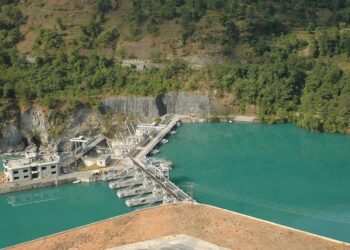
The second is hydropower’s specific funding need. A hydropower project is a large, upfront, capital-hungry build with a long payback. Nepal’s government and regulators have actively used the stock market to finance it, requiring or encouraging developers to sell shares to the public, often reserving a slice for locals in the project district. For a promoter who needs to raise crores for a run-of-river plant, a public issue is a cheap and politically favored way to do it. So hydropower flooded the exchange, 91 companies deep, for reasons that have nothing to do with any other sector’s behavior.
The third force is the one that keeps everyone else away. For a profitable family manufacturer, trading house, or private hospital, listing on NEPSE offers little and costs plenty. Nepal’s par-value IPO system has historically forced companies to sell shares at NPR 100 regardless of what they are worth, handing a windfall to applicants and leaving money on the table for the owner. Add public disclosure, regulatory scrutiny, tax visibility, and the loss of family control, and the math is obvious. Why would a comfortable, cash-generating private business invite all that to raise capital it can get from a bank loan or retained earnings? It would not, and it mostly does not. The businesses that list are the ones compelled to. The businesses that can stay private, do.
What this does to your portfolio
Here is where the structural critique stops being academic and starts costing you money, or at least mispricing your risk.
Most Nepali retail investors believe they are diversified because they hold eight or ten different scrips. Look closely at a typical portfolio and you often find a commercial bank, a development bank, a couple of microfinance companies, a life insurer, a non-life insurer, and two or three hydropower stocks. That is not ten bets. That is essentially two bets, finance and hydropower, cloned across ten names. When interest rates move, the whole financial block moves together. When the monsoon and project pipeline shift, the hydropower block moves together. The diversification is cosmetic.
This matters because the two dominant sectors carry very specific, correlated risks. The financial block is a leveraged play on the credit cycle, and Nepal’s banks are currently working through a visible rise in bad loans, which pressures the earnings that justify their valuations. If you are heavy in bank and finance stocks, you are exposed to that in a concentrated way, and it is worth reading those companies the way a credit analyst would, using the health checks in our guide to reading a bank’s key ratios: NPL, CD and CAR. The hydropower block, meanwhile, is a bet on rivers, monsoons, project execution, and power purchase agreements, a different risk entirely and one that is easy to misprice if you buy on installed-capacity hype. Our teardown on how to value a hydropower stock on NEPSE explains why the headline megawatt figure is often the least useful number.
The deeper problem is what you cannot hold. You cannot use NEPSE to bet on Nepal’s consumption story, its tourism recovery, its services growth, or its manufacturing base, because those companies are not there to buy. An investor in India or the US can build a portfolio that mirrors the economy across FMCG, IT, pharma, autos, and consumer goods. A Nepali investor cannot. The menu is finance, hydropower, and scraps. Any claim that a NEPSE portfolio gives you broad exposure to Nepal’s growth runs straight into that missing menu. For how to build the most balanced portfolio the available menu actually allows, see our walkthrough on building a first NEPSE portfolio without overconcentrating.
The manufacturing exceptions prove the rule
It is worth pausing on the few real-sector names that did list, because they show what the market is missing rather than contradicting it.
The manufacturing and processing sector’s most valuable members are a short, telling list. Unilever Nepal, a subsidiary of a global multinational. Bottlers Nepal, the local Coca-Cola franchise, again foreign-linked. A few cement makers like Shivam. A distillery or two. What these have in common is instructive. Several are foreign-parented companies that listed to meet local ownership norms, not homegrown industrials that chose the market. And they trade at some of the highest prices and richest valuations on the exchange, precisely because they are scarce. When genuinely profitable non-financial businesses are this rare, the few that exist get bid up simply for being different. That scarcity premium is a symptom of the disease, not a sign of health. A market with a deep manufacturing bench would not pay a novelty premium for a soap company.
The same scarcity logic applies to the trading sector, where a couple of legacy names carry a whole category, and to hotels, where a handful of properties stand in for an entire tourism industry. These are not sectors on NEPSE. They are tokens.
Will the mix ever change?
There is a case for optimism, and it deserves a fair hearing before I temper it.
The Securities Board of Nepal has made attracting real-sector companies an explicit goal. Its book building framework was designed to let profitable firms list at fair value instead of being forced to sell at par, removing one of the biggest disincentives for a private owner. Its 2026 capital market roadmap talks about broadening the market beyond financials. If premium pricing becomes normal, a family manufacturer or a large services business has a real reason to consider listing that it never had before. That is a genuine structural lever, and it points the right way.
Now the temper. Nepal has talked about diversifying the exchange for years, and the mix has barely moved. Book building has been legally available since 2017 and only a tiny number of companies have used it. Regulation still compels financials to list and still gives comfortable private firms every reason to stay out. Changing the NEPSE sector composition is not a matter of one rule or one good year. It requires enough profitable real-sector companies to decide, one by one, that the benefits of listing beat the costs, and that calculation still mostly favors staying private. Treat the diversification story as a plausible direction, not a near-term fact. The exchange you can buy today is still finance and hydropower with a thin edge of everything else, and it will be for a while yet.
The verdict
NEPSE is a financial-sector index with a large hydropower annex, and calling it “the Nepali stock market” oversells what it actually is. That is not a reason to avoid it. It is a reason to hold it with clear eyes. Know that when you buy the market, you are concentrated in two correlated bets, not spread across the economy. Know that the index will tell you about the credit cycle and the hydropower pipeline long before it tells you anything about Nepal’s consumers, farmers, or factories. And know that the real economy you participate in every day is, for now, something you can work in and spend in but cannot invest in.
The useful move is to stop mistaking the map for the territory. Build your NEPSE holdings deliberately, aware that “ten stocks” may really be two, and hunt hard for the rare non-financial names that give you any genuine spread. Do not assume the index reflects the country. It reflects a narrow, regulated, capital-hungry slice of it, and that slice has its own weather. The investors who do best on NEPSE are the ones who never confuse the exchange with the economy, and size their bets to the market that actually exists rather than the one they wish were listed.
This is analysis, not financial advice.