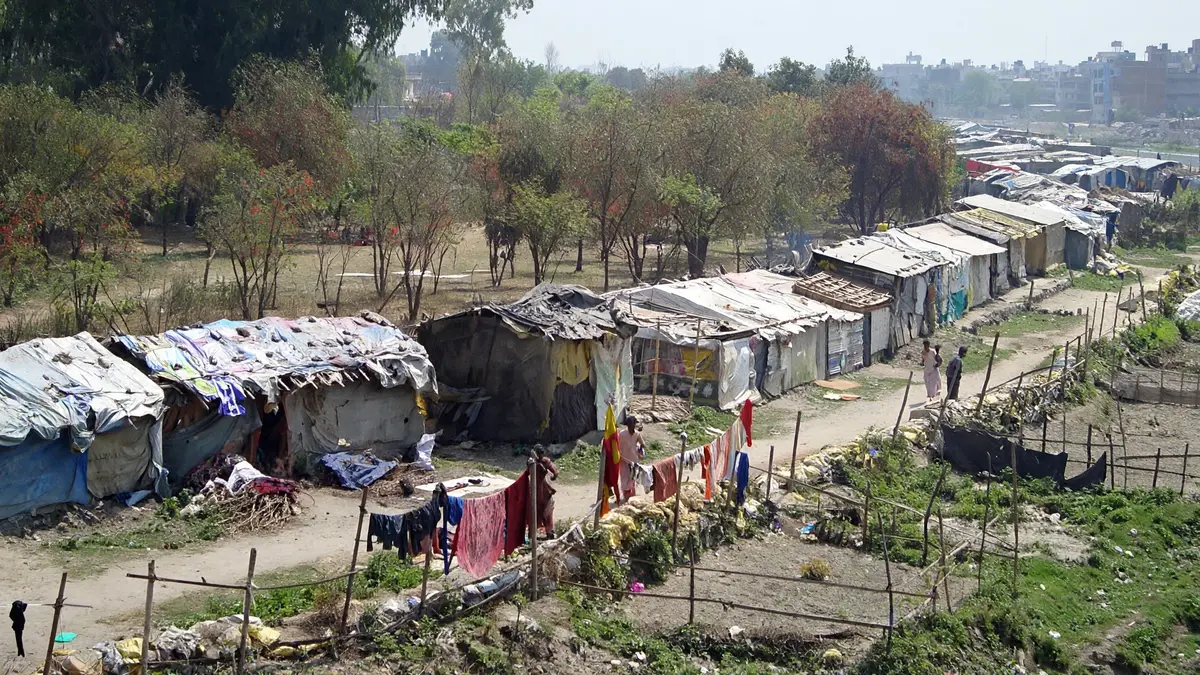
Nepal’s Riverbank Settlements, the Sukumbasi economy isn’t just a housing crisis. It’s a functioning, if brutal, system with its own labor markets, land pricing, political currency, and survival logic. Along Kathmandu’s Bagmati riverbanks, tens of thousands of families have built an entire informal world, one the state periodically bulldozes and just as consistently fails to replace.
In this article, we’ll examine how the Sukumbasi economy actually works, who profits from it, and why seven decades of government intervention haven’t dismantled it.
What the Sukumbasi Economy Actually Is
Let’s start with definitions, because they matter enormously here. Sukumbasi literally means one who has no house for shelter, no private land to cultivate, and no other reliable livelihood. Under Nepal’s 1964 Land Act, a genuine sukumbasi is someone whose family hasn’t owned land for generations and cannot purchase any through family income. By that narrow legal standard, only around 20 percent of people living in Kathmandu’s riverbank settlements actually qualify.
The other 80 percent fall into a messier category officials call unorganized settlers, people who may own land elsewhere but can’t return to it, or whose landlessness is real but whose paperwork doesn’t fit the official box. This ambiguity isn’t accidental. It’s structural, and it’s precisely what allows the Sukumbasi economy to function the way it does, denying, deferring, and diluting claims while the state gestures toward concern.
The Economics of Illegal Occupation
Here’s where the Sukumbasi economy becomes genuinely economic, rather than purely a welfare story. Riverbank land in Kathmandu is public land, technically under the jurisdiction of the High-Powered Committee for Integrated Development of Bagmati Civilization.
Yet it functions as a de facto informal real estate market. Land rights advocates describe organized encroachment networks, often called land mafias, operating with political protection.
These networks sell “rights” to occupy specific plots of government land to desperate, often rural migrant families, families who hand over life savings for a piece of paper with no legal standing whatsoever. When bulldozers eventually arrive, security forces rarely distinguish between a family that occupied land out of genuine desperation and one that purchased fraudulent rights from a broker. Everyone gets treated as an encroacher, while the land mafia that profited from the transaction faces little consequence. This dynamic means the Sukumbasi economy generates real cash flow, just not for the people who end up living, and eventually losing everything, on the riverbank.
From 2,000 to 35,000: The Growth of a Parallel Economy
The scale here tells its own story. Around 1985, Kathmandu had an estimated 2,000 squatters. By 1992, that number had grown to between 8,000 and 10,000. The Maoist insurgency, beginning in 1996, accelerated things dramatically, as conflict-displaced families poured into the capital and occupied land along river corridors. By 2003, the city counted 63 documented settlements. By 2022, an estimated 35,000 families lived along the Bagmati riverbank alone.
The 2015 earthquake added another layer to the crisis. It severely affected an estimated 900,000 households across the hill districts, leaving many families without secure legal tenure over the land where they had built their homes. Doubly dispossessed, many migrated to Kathmandu in the years that followed, feeding directly into the riverbank settlement population. Each shock, conflict, disaster, drought, has functioned as an input into this parallel urban economy, pushing more people toward the only land in the city nobody else wanted.
Labor, Community, and the Informal Value These Settlements Create
It’s worth being precise about what actually exists inside these settlements, because the Sukumbasi economy isn’t just about illegal occupation. It’s also a functioning labor ecosystem. Residents of Thapathali, one of the most prominent Bagmati settlements, work predominantly as daily-wage laborers, construction workers, and domestic help, precisely the informal labor that keeps Kathmandu’s formal economy running.
The settlements themselves developed internal infrastructure over decades: schools children could walk to, employers who knew exactly where to find their workers, water sources, however unreliable, and dense community networks that functioned as informal social security. This is why the Ichangu Narayan resettlement colony, built in 2012 at a cost of Rs 230 million, remained empty. Not a single displaced family moved in. The site lacked public transport, reliable water, and access to employment. Authorities also designed it without any community input.
Families evicted from Thapathali scattered rather than relocate to a place that severed them from the informal economy sustaining them. That single failure, and its Rs 230 million price tag, illustrates just how real and how undervalued the economic infrastructure of these settlements actually is.
The Political Economy Behind Seven Decades of Failure
Since 1952, Nepal has formed 22 separate commissions, committees, and land reform bodies specifically tasked with resolving landlessness. Fourteen focused specifically on squatters. Together, they’ve distributed roughly 46,600 bighas of government land to around 150,000 families since 2013, a real number, but nowhere near sufficient against the actual scale of need.
The pattern across all 22 bodies is remarkably consistent. Each new government dissolves the existing commission and forms a new one, staffed with party loyalists. A dedicated software system built by one commission to cross-check applications against national land records was simply abandoned by its successor. The 22nd commission registered over a million applications and identified roughly 81,300 landless Dalits, 156,800 landless squatters, and over 783,000 unorganized settler families before its term expired in September 2024, without completing distribution.
This isn’t policy failure in the ordinary sense. Land rights advocates describe it more precisely: the sukumbasi problem has proven more politically useful as a permanent grievance than it would be as a resolved issue. Every major party, Nepali Congress, CPN-UML, and Maoist incarnations, has promised squatters land and resettlement while campaigning, then abandoned those promises in office. Squatter communities have repeatedly been mobilized as reliable vote banks, their loyalty maintained through promises rather than delivery.
April 2026: The Crisis That Made the Pattern Visible
The clearest recent illustration of how the Sukumbasi economy collides with state power came in April 2026. On the evening of April 23, security forces entered Thapathali’s riverbank settlement with loudspeakers. They warned residents that they had to leave the area by 6 a.m. the following Saturday. The sudden eviction order left families with little time to prepare or find alternative shelter.
The operation carried the direct authority of Prime Minister Balendra Shah, who as Kathmandu’s mayor in 2022 had attempted a similar eviction that collapsed disastrously, with 18 police officers injured after squatters resisted with stones and bricks.
This time, Shah wielded federal authority he hadn’t previously held. By early May 2026, government data showed 19 settlements across Kathmandu cleared, 2,686 huts and shelters demolished by bulldozers, and 15,316 people relocated. Yet the pattern of political theater around enforcement repeated itself almost exactly. CCTV cameras appeared on utility poles near the settlement the same evening loudspeakers issued warnings. The acting chairman of the Sukumbasi Morcha, the settlers’ federation, was arrested on the eve of the planned eviction. Authorities officially linked the arrest to an unrelated banking investigation. At the same time, the government denied making any formal Council of Ministers decision to evict the settlers.
Residents and Gen Z activists filed a Supreme Court writ petition seeking to halt the evictions. Amnesty International urged the government to suspend the plan, warning it reflected “a dangerous erosion of the rule of law.” The Supreme Court had already ruled, back in July 2024, that government must provide proper housing to genuinely landless families before clearing settlements, assigning joint responsibility to the Ministry of Urban Development and the HPCIDBC. The April 2026 operation proceeded largely without that sequence being honored.
Why the Sukumbasi Economy Keeps Refilling Itself
Clearing a settlement doesn’t address what filled it in the first place. This is the core mechanical flaw at the heart of the entire system. Nepal’s land distribution remains extraordinarily unequal at the national level, the top 5 percent of the population has historically controlled 37 percent of all arable land, while Dalit communities collectively own roughly 1 percent of land despite comprising more than 13 percent of the population. Over 2.1 million people nationally live without formal land rights in some form.
Layered onto this are Nepal’s historic bonded labor systems. The Kamaiya system, hereditary bonded labor in western Nepal, was formally abolished in 2000, freeing over 30,000 families. As of 2024, 2,375 of the original 27,570 registered Kamaiya families still had no land at all, and many who did receive plots got unproductive, flood-prone parcels, ending up on riverbanks anyway. The Haliya system, abolished in 2008, saw rehabilitation reach less than 5 percent of the roughly 20,000 freed families. Every one of these unresolved threads eventually feeds the same urban riverbank economy, because Kathmandu remains the only place with enough informal daily-wage work to survive on.
What an Actual Resolution Would Require
Given this history, what would it actually take to dismantle the Sukumbasi economy rather than periodically demolish its physical footprint? Land rights advocates and legal rulings point toward several concrete requirements. First, a single national database of verified landless individuals, coordinated across federal, provincial, and local government tiers, rather than repeatedly abandoned commission software.
Second, differentiated policy responses based on actual geography and community type, since a riverbank settler in Kathmandu, a freed Kamaiya family in Bardiya, and a Haliya household in the far-western hills face genuinely different structural problems requiring different solutions. Third, treating constitutional compliance, specifically Article 37’s housing guarantee and Article 40’s Dalit land provisions, as a non-negotiable procedural floor rather than an aspiration.
Fourth, legally binding timelines with independent monitoring, so commissions can’t simply expire without completing distribution. Fifth, statutory protection insulating land commissions from being dissolved every time a new government takes power. And sixth, genuine engagement with Nepal’s underlying land concentration, since redistributing riverbank huts while 5 percent of the population controls over a third of arable land treats a symptom while leaving the root condition entirely intact.
Final Thoughts on the Sukumbasi Economy
The Sukumbasi economy persists not because Nepal lacks laws, commissions, or constitutional promises, but because dismantling it would require political courage that has been in short supply for seven decades. Riverbank settlements generate real economic activity, informal labor, illicit land transactions, community-based survival networks, even as they expose residents to flood risk, demolition, and legal precarity.
Every bulldozer operation clears the visible symptom while leaving the underlying machinery, land inequality, unresolved bonded labor legacies, and political incentives to keep the crisis alive, fully intact. Until a government treats resettlement as a genuine procedural obligation rather than a photo opportunity, Nepal’s rivers will keep collecting the same settlements they’ve been clearing since 1952.
Frequently Asked Questions About the Sukumbasi Economy in Nepal
What does Sukumbasi mean in Nepal?
Sukumbasi refers to someone without a house for shelter, private land to cultivate, or reliable livelihood. Legally, it applies to families that haven’t owned land for generations, though usage has broadened to cover various landless groups.
How many people actually qualify as genuine Sukumbasi under Nepali law?
Roughly 20 percent of residents in Kathmandu’s riverbank settlements meet the strict 1964 Land Act definition. The remaining 80 percent are classified as unorganized settlers with more complicated landlessness claims.
Why do land mafias operate within Sukumbasi settlements?
Organized networks sell fraudulent occupation rights to public riverbank land to desperate migrant families, generating illegal profit while leaving buyers with no legal protection when eviction eventually occurs.
How many settlements has Nepal cleared in recent eviction drives?
By early May 2026, government data showed 19 settlements cleared in Kathmandu, with 2,686 huts and shelters demolished and 15,316 people relocated during that operation.
Why did Nepal’s 2012 resettlement colony at Ichangu Narayan fail completely?
Despite costing Rs 230 million, the site lacked public transport, water access, and employment opportunities, and was built without community input, so not a single displaced family moved in.
What would actually resolve Nepal’s Sukumbasi crisis?
Experts point to a unified national landless database, constitutionally mandated housing before eviction, legally binding commission timelines, and addressing Nepal’s underlying land concentration among a small elite.