
Suppose you paid NPR 251.90 for one share of Hydroelectricity Investment and Development Company (HIDCL) on November 6, 2026. You probably think you bought a slice of Nepal’s hydropower build-out. Here is what the company’s own fourth-quarter report says sits behind that share: roughly NPR 55 in fixed deposits at commercial banks, about NPR 34 in loans to power projects, and under NPR 18 in equity stakes in those projects. Its net worth per share is NPR 112.65. You paid more than double that.
That gap is the whole story of investment companies on NEPSE. Abroad, holding companies and closed-end funds usually trade at a discount to what they own. The textbook calls it the “holdco discount.” On NEPSE, the listed investment companies do the reverse. They trade at two to eleven times book value, while the closed-end mutual funds next to them on the same exchange, holding similar assets, sit below their net asset value.
This piece explains what these companies actually hold, why the market prices them the way it does, and why the premium, not the portfolio, is the main thing you are betting on.
What counts as an investment company on NEPSE
NEPSE groups seven companies in its Investment sub-index, a count NEPSE Trading confirms in its sector tally. They are a mixed bag, and the label hides more than it reveals.
Citizen Investment Trust (CIT) is a government-backed trust that runs retirement and savings schemes for employees and also invests in shares and bonds. HIDCL was set up by the government to lend to and take stakes in hydropower projects. Nepal Infrastructure Bank (NIFRA) is a bank licensed to finance large infrastructure, which earns most of its income from interest. NRN Infrastructure and Development (NRN) and CEDB Holdings (CHDC) are private holding companies that own stakes in other businesses, mostly hydropower and infrastructure. Hathway Investment Nepal (HATHY) and Emerging Nepal (ENL) are smaller investment firms that put capital into a mix of listed and unlisted companies.
So “investment company” covers a government trust, a development lender, an infrastructure bank and four holding companies. A balance sheet is the only way to tell them apart.
The sector is also lopsided. On NEPSE Trading’s figures for early November 2026, the seven companies have a combined market capitalization of about NPR 290 arba. CIT alone accounts for NPR 116.60 arba, roughly 40 percent of the group. CIT, HIDCL and NIFRA together make up about 80 percent. When the Investment sub-index moves, it is mostly those three moving.
The premium nobody explains
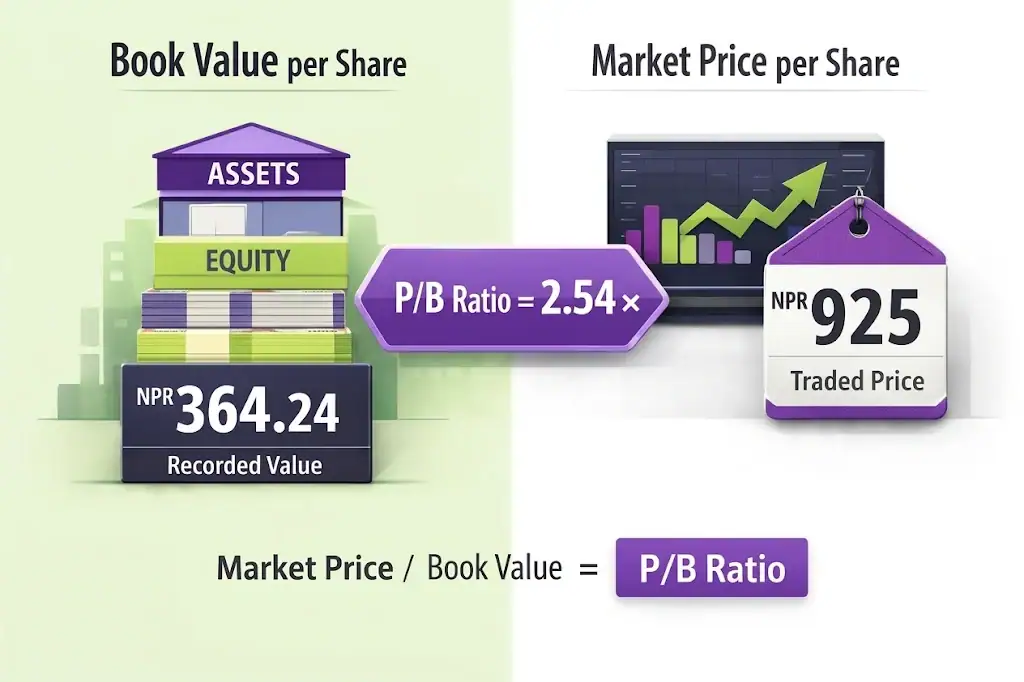
Here is how the group was priced at the start of November 2026, using NEPSE Trading’s tearsheets, which divide the latest closing price by book value (net worth) per share from each company’s most recent filed quarterly statement:
| Company | Price (NPR) | Book value per share (NPR) | Price-to-book |
|---|---|---|---|
| CIT | 1,713.20 | 152.47 | 11.24x |
| CHDC | 2,288.00 | 268.77 | 8.51x |
| NRN | 1,381.00 | 169.23 | 8.16x |
| HIDCL | 251.90 | 112.65 | 2.24x |
| NIFRA | 246.00 | 117.22 | 2.10x |
HATHY and ENL did not have book value per share on the tearsheet. Using HATHY’s reported paid-up capital (NPR 1.59 arba) plus reserves (NPR 16.91 crore) over 1.59 crore shares gives a rough book value near NPR 110 per share. That is our estimate, not a filed figure. At NPR 405, it implies about 3.7 times book, and that is after the stock lost 57 percent in a year.
Now compare that with the closed-end mutual funds. ShareSansar counted 46 closed-end schemes listed on NEPSE as of September 1, 2026, and noted that many trade at a discount to their reported NAV. A closed-end fund’s NAV is marked to market every month, so its “book” is close to what the holdings would fetch if sold. (If the difference between fund types is new to you, our explainer on closed-end vs open-end mutual funds in Nepal covers it.)
Put plainly: a NEPSE investor can buy a diversified basket of listed shares through a closed-end fund for less than it is worth, or buy a holding company that owns a less diversified basket, plus a lot of bank deposits, for several times what it is worth on paper. The market is consistently choosing the second.
What you actually own, company by company
Price-to-book only means something if you know what the “book” is made of. This is where investment companies on NEPSE differ most from each other.
HIDCL: mostly a deposit account with a hydropower label
HIDCL’s fourth-quarter report for fiscal year 2082/83, as summarized by ShareSansar on August 18, 2026, is unusually clear. The company had NPR 13.76 arba in deposits with banks, NPR 8.45 arba in net loans to power projects, and NPR 4.46 arba invested in equity. Its paid-up capital is NPR 24.93 arba and reserves are NPR 3.15 arba, so net worth is about NPR 28.08 arba.
Run the division. Bank deposits are roughly half of HIDCL’s net worth. Equity stakes, the part that actually behaves like “investing in hydropower,” are about 16 percent. Finance income, mostly interest, fell 28.96 percent to NPR 99.10 crore as deposit rates dropped, and net profit fell 27.29 percent to NPR 67.93 crore.
That is the honest description of HIDCL today: a large, government-backed pool of cash waiting to be lent, whose earnings rise and fall with bank interest rates. At 2.24 times book, you are paying NPR 2.24 for every rupee of mostly deposits and loans. Annualized EPS is NPR 2.73, which puts the P/E above 90 at the November 6 price. A fixed deposit would give you the interest without the premium.
CIT: you are buying a fund manager’s balance sheet
CIT has the highest price-to-book in the group at 11.24 times. Its return on equity is a respectable 13.01 percent, but its return on assets is just 0.36 percent, according to NEPSE Trading. Divide one by the other and assets come out at roughly 36 times equity. That is the profile of an institution whose balance sheet carries the savings schemes it manages for other people, not a lean holding company. Its own capital is small relative to the money passing through it.
That is not a criticism of CIT’s business. Managing retirement money is steady and fee-like. But it means book value tells you little about what CIT is “worth,” and the price tells you even less, because only 20 percent of the shares are in public hands. Average daily volume over the past month was about 3,600 shares on NEPSE Trading’s data. A small float and thin trading can hold a price far above any fundamental anchor for years. Our explainer on free float on NEPSE shows how that works.
CHDC: the one where earnings back the price
CEDB Holdings is the most defensible of the group on the numbers. It reported net profit of NPR 63.21 crore for fiscal year 2082/83, up from NPR 57.35 crore a year earlier, on ShareSansar’s summary of its filing. NEPSE Trading lists annualized EPS of NPR 61.12, return on equity of 22.74 percent and a P/E of 37.43. Book value per share climbed from NPR 147 to NPR 268.77 over eight quarters.
A 22 percent ROE can justify paying above book. Whether 8.5 times book is fair depends on whether that return is repeatable. CHDC’s net profit margin of about 97 percent tells you nearly all of its income is investment income from the companies it owns, not operating revenue of its own. When the holdings do well, CHDC does well. When they stop paying, CHDC has nothing else.
NRN: lumpy profits, steady price
NRN shows why a holding company’s income statement can mislead. It earned NPR 67.09 crore in fiscal year 2081/82, but NPR 60.17 crore of that came in the fourth quarter alone, on NEPSE Trading’s quarterly figures. In 2082/83 it swung to a net loss of NPR 7.77 crore. Holding companies book big gains when they sell or revalue a stake, then go quiet. Annualizing a good quarter is how retail investors overpay for them.
NRN then issued a 40 percent bonus share from that one strong year (plus 2.11 percent cash), which moved reserves into paid-up capital. Book value per share dropped from NPR 250.15 to NPR 169.23. The price, at NPR 1,381, still sits above 8 times that book value, against a loss-making year.
HATHY and ENL: what premium compression looks like
The two smallest names show what happens when the premium starts to unwind. In August 2025, NEPSE Trading reported HATHY’s book value at NPR 75.38 per share against a market price of NPR 1,220.14, more than 16 times book, with a P/E above 500. By November 6, 2026, the stock was at NPR 405, down 57.14 percent in a year. ENL fell 46.78 percent over the same period, from a 52-week high of NPR 995 to NPR 480. Its full-year profit for 2082/83 was NPR 1.50 crore against a market cap of NPR 2.67 arba, a P/E near 178 on our arithmetic.
Neither company’s underlying holdings collapsed by half. The price fell because the premium fell. That is the risk you carry when you buy an investment company far above book: even if the portfolio does fine, you can lose most of your money while the market simply changes its mind about how much extra to pay.
Why NEPSE prices holding companies backwards

Several forces push investment companies on NEPSE toward a premium instead of a discount. Some are facts, some are our reading of the market.
Scarcity of float (fact). HATHY’s public float is 12.5 percent, CIT’s and HIDCL’s are 20 percent, and NIFRA’s is 40 percent, per NEPSE Trading. When most shares are locked with promoters, a small amount of retail demand moves the price a long way.
The bonus-share habit (fact and opinion). NRN, CHDC and HATHY have all paid most of their recent dividends as bonus shares rather than cash, according to NEPSE Trading’s dividend records. NEPSE retail investors have long treated bonus shares as free money, even though the price adjusts. Companies that issue them regularly tend to attract a following that is not doing NAV arithmetic. (Our guide to the price-to-book ratio on NEPSE explains why book value matters more for these companies than EPS headlines.)
The story premium (opinion). “Hydropower investment” and “infrastructure” are easy narratives to sell in a market where hydro has been the largest group of listings. A holding company with that label gets bought as a theme, not as a balance sheet.
No arbitrage (fact). In deeper markets, a big discount or premium invites activists or arbitrageurs who buy the cheap side and short the expensive side. NEPSE has no live short selling (SEBON’s 10-year blueprint lists it as a planned reform), so nothing forces the premium closed except time and sentiment.
The fair counterargument
Book value is not a perfect measure of what a holding company owns. Under Nepal Financial Reporting Standards, listed shares are generally carried near market value, but unlisted stakes and subsidiaries can sit on the books at cost or at conservative valuations. If CHDC or NRN own a hydropower project that has since been commissioned and is earning well, the “true” NAV may be well above reported book. That hidden value is a legitimate reason to pay some premium.
There is also the CIT case, where the business is managing money, and a fee-earning manager deserves to be valued on earnings, not assets.
Both points are fair. Neither explains a price-to-book of 8 to 11 times across most of the group, or HIDCL trading above twice book when half its net worth is bank deposits that are worth exactly their face value. Hidden value is a reason to pay a bit more. It is not a reason to stop asking what you are paying for.
How to look at an investment company before you buy

If you trade investment companies on NEPSE, the work is simpler than for a bank or an insurer, because the question is narrower: what does it hold, and how much extra am I paying for it?
- Break the balance sheet into buckets. Bank deposits, loans, listed shares, unlisted stakes. Deposits and loans are worth roughly their face value. Listed shares are worth their market price. Only the unlisted part can plausibly be worth more than book.
- Compute the premium in rupees, not ratios. Price minus book value per share. For HIDCL on November 6, 2026, that was about NPR 139 per share. Ask what that NPR 139 is buying.
- Check where profit came from. One big quarter from selling a stake (NRN in 2081/82) is not an earnings run rate. Look at four quarters together.
- Look at the free float and volume. A 12.5 or 20 percent float can hold a price up and then let it fall fast, as HATHY and ENL showed.
- Compare with a closed-end fund. If a fund holding similar sectors trades below NAV, you need a specific reason to pay several times book for a holding company instead.
Costs matter at the margin too. Gains on listed shares sold by resident individuals are now taxed at 5 percent for holdings of 365 days or less and 3.75 percent for longer holdings, under a Ministry of Finance notice published in the Nepal Gazette and reported by ShareSansar on September 22, 2026. Our capital gains tax explainer covers how the holding period is counted. With lumpy, low-cash-dividend stocks like these, your return depends almost entirely on selling to someone else at a premium, so the tax and broker commission come straight out of that premium.
The verdict
Investment and holding companies on NEPSE are not a cheap back door into a diversified portfolio. Right now they are the opposite: an expensive front door. With the exception of CHDC, whose earnings growth gives the premium some support, the group is priced on float scarcity, bonus-share habits and sector stories rather than on what the companies hold.
That does not mean the prices must fall tomorrow. Thin floats can keep premiums alive for a long time. It means the main risk in these stocks is not the hydropower project or the loan book. It is the multiple. The portfolio underneath HIDCL is boring and safe. The NPR 139 per share you pay on top of it is neither.
Value an investment company at what it owns, then make it earn every rupee of premium. If it cannot, a closed-end fund or the holdings themselves will usually give you the same exposure for less.
This is analysis, not financial advice.
Frequently Asked Questions (FAQs)
1. What are investment companies on NEPSE?
Investment companies are businesses that invest money in other companies, projects, shares, loans or financial assets. Examples on NEPSE include CIT, HIDCL, NIFRA, NRN, CHDC, HATHY and ENL.
2. What does price-to-book (P/B) ratio mean?
The price-to-book ratio compares a company’s market share price with its book value per share. A higher ratio means investors are paying more than the company’s recorded net worth for each share.
3. Why do investment companies on NEPSE trade above their book value?
Limited public share availability, bonus-share expectations, investor interest in hydropower and infrastructure, and market speculation can push share prices above their actual book value.
4. Why is HIDCL’s share price higher than its book value?
HIDCL’s share price was NPR 251.90 against a book value of NPR 112.65 on November 6, 2026. Investors are paying a premium partly because of its government backing and hydropower investment story.
5. What should investors check before buying investment company shares on NEPSE?
Investors should examine the company’s assets, bank deposits, loans, investments, earnings consistency, book value, price-to-book ratio, public share availability and trading volume before investing.