On November 6, 2026, the last trading day before Tihar, 340 shares of Unilever Nepal changed hands. That counts as a busy day for UNL. Over the previous month, according to NEPSE Trading’s tearsheet, the stock averaged 75 shares a day. At NPR 48,500 a share, that is roughly NPR 36 lakh of daily turnover for a company the market values at NPR 44.65 arba. A mid-sized hydropower stock can trade more than that before lunch.
That one detail tells you most of what you need to know about manufacturing stocks on NEPSE. They are few. They are tightly held. They trade rarely. And because investors keep hearing that Nepal needs more “real sector” listings, the handful that exist get treated as precious by default.
They should not be. This piece looks at what the manufacturing stocks NEPSE actually lists, why there are so few of them, and how to value one without paying a scarcity premium for a business that does not deserve it.
How few manufacturing stocks NEPSE really has
ShareSansar’s two-decade review of NEPSE listings, published on May 3, 2026, gives the clearest history. In 2007 the Manufacturing and Processing group had 21 companies. By 2009 it had shrunk to 18. Then, in ShareSansar’s words, no company was interested or dared to list for a decade, until 2019. One new name arrived in 2020. By mid-March 2026 the sub-index had 27 members, a rise driven by a recent wave of cement, distillery, pharmaceutical and food-processing IPOs.
Compare that with hydropower. The same ShareSansar review counts three listed hydropower companies in 2007 and 97 by 2026. Manufacturing went from 21 to 27 over the same 19 years. One sector grew more than thirtyfold. The other barely moved.
(Counts differ by source. NEPSE Trading’s own tally for fiscal year 2081/82 put the group at 22 companies out of 271 listed. The difference comes down to timing and how new listings are classified. The direction is the same either way: manufacturing is a small corner of the exchange.)
Two very different kinds of company share one label
The “Manufacturing and Processing” tag hides the most important split in the sector. There are really two groups, and they behave nothing alike.
The old guard: subsidiaries with tiny floats
Unilever Nepal (UNL), Bottlers Nepal (Balaju) (BNL) and Bottlers Nepal (Terai) (BNT) are local arms of multinational groups that have been listed for decades. Their parents own most of the shares. NEPSE Trading lists UNL’s promoter holding at 85 percent and BNT’s at 75 percent.
These companies have very few shares outstanding, which is why their prices look absurd. UNL has about 9.21 lakh shares, BNT about 12.10 lakh. A single UNL share cost NPR 48,500 on November 6, 2026, and a BNT share cost NPR 12,000. That price is not a sign of quality. It is arithmetic: a small number of shares divided into a large, profitable business.
UNL is the clearest case of what this group offers. According to NEPSE Trading’s summary of its filed fourth-quarter statement for fiscal year 2082/83, its return on equity (profit as a share of shareholders’ funds) was 30.92 percent and its net profit margin 19.93 percent. For fiscal year 2081/82 it paid a 1,842 percent cash dividend. Since dividends in Nepal are declared as a percentage of the NPR 100 face value, that works out to NPR 1,842 per share. NEPSE Trading puts the yield at 3.80 percent of the current price.
That is a real business returning real cash. But look at the trend. UNL’s full-year net profit fell from NPR 1.96 arba in fiscal year 2081/82 to NPR 1.58 arba in fiscal year 2082/83, on the same tearsheet. That is a drop of about 19 percent. A company paying out most of what it earns has less room to keep that dividend flat when profit slides.
BNT is the warning on the other side. It posted a net loss of NPR 60.76 crore for fiscal year 2081/82, then swung to a NPR 65.93 crore profit in 2082/83, according to NEPSE Trading’s eight-quarter table. Its net margin was 7.60 percent. A bottler’s earnings depend on sugar and packaging costs, excise duties and a hot summer. They swing. The share price, held steady by a thin float, does not always reflect that.
The new wave: post-2019 IPOs
The second group listed in the last several years: Shivam Cements (SHIVM), Ghorahi Cement (GCIL), Himalayan Distillery (HDL, an older listing that behaves like this group), Sagar Distillery (SAGAR), Om Megashree Pharmaceuticals (OMPL) and others. These trade far more actively. They are owned by Nepali business groups rather than foreign parents. And they are where most retail money in the sector goes.
Their numbers are much less comfortable.
The valuation table nobody wants to read
Here is how a cross-section of the sector was priced at the start of November 2026, using NEPSE Trading’s tearsheets. P/E is the share price divided by annualized earnings per share. P/B is price divided by book value (net worth) per share. Both use each company’s latest filed quarterly statement, the fourth quarter of fiscal year 2082/83.
| Company | Price (NPR) | P/E | P/B | ROE | Promoter holding |
|---|---|---|---|---|---|
| UNL | 48,500 | 28.32 | 8.76 | 30.92% | 85% |
| HDL | 1,299 | 39.71 | 9.18 | 23.13% | 58% |
| BNT | 12,000 | 22.02 | 3.46 | 15.70% | 75% |
| SHIVM | 685 | 48.82 | 3.63 | 7.43% | 88% |
| GCIL | 380 | loss | 2.29 | 0% | 80% |
| OMPL | 803.10 | loss | 8.19 | 0% | 70% |
NEPSE Trading puts the sector’s average P/E at 34.54 and its average P/B at 5.08, against an average return on equity of just 10.89 percent.
That last pairing is the one to sit with. If a company earns 11 percent on its book value and you pay five times book value for it, your earnings yield (profit you are buying per rupee you pay) is roughly 11 divided by 5, or about 2.2 percent. That is our arithmetic, not a filed figure, but it is the honest way to read the sector average. You are paying for growth, or for scarcity, or for both. You are not paying for current earnings.
Some of these companies earn their multiple. UNL’s 30.92 percent return on equity and HDL’s 23.13 percent are strong by any standard. A high-return business can deserve a high P/B. (Our explainer on price-to-book ratio on NEPSE walks through why book value matters more for some sectors than others.)
Others do not. Shivam Cements earned NPR 78.45 crore in fiscal year 2082/83, slightly less than the NPR 79.41 crore it earned the year before, according to NEPSE Trading’s table. Flat profit, a 7.43 percent return on equity, and a P/E of 48.82, the highest in the sector on NEPSE Trading’s peer comparison. Nothing in those numbers explains why SHIVM should trade at nearly 50 times earnings. Only a belief that cement demand is about to surge, and that Shivam will capture it, does.
Om Megashree Pharmaceuticals is starker. It lost money in every quarter of fiscal year 2082/83, its reserves have turned negative, and its book value per share is NPR 98.04, below the NPR 100 face value. It still traded at 8.19 times book on November 2, 2026. That is after the price fell 36.61 percent year to date.
Cement shows what “real sector” actually means
Investors often say they want “real economy” exposure, as if factories were safer than banks. Ghorahi Cement is a useful corrective.
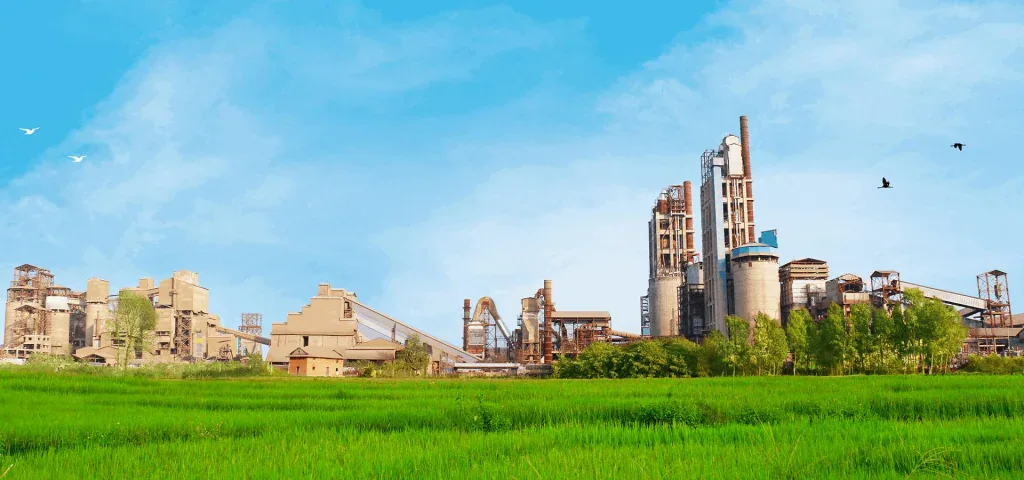
GCIL’s book value per share fell from NPR 196.63 to NPR 165.73 over the eight quarters shown on NEPSE Trading’s tearsheet, a decline of about 16 percent. Its reserves dropped from NPR 1.68 arba to NPR 64.39 crore over the same period, partly because reserves were capitalized into bonus shares (paid-up capital rose from NPR 4.57 arba to NPR 5.02 arba) and partly because the business lost money. NEPSE Trading reported in May 2025 that GCIL had posted a NPR 55.43 crore loss for the first three quarters of fiscal year 2081/82, the worst result in the group at the time. The company still distributed a 10 percent bonus share for that year.
That is what a capital-heavy, cyclical manufacturer looks like when demand softens. Cement plants carry large fixed costs, heavy debt and depreciation. When construction slows, utilization falls and losses arrive fast. When construction recovers, profits can jump just as fast. NEPSE Trading reported Sarbottam Cement’s profit rising 399 percent in the first three quarters of fiscal year 2081/82, for example.
So “real sector” does not mean “stable.” It means earnings tied to actual demand for actual goods, which can be far more volatile than a bank’s interest margin. That is fine, as long as you price the volatility in. Most of the sector’s multiples do not.
Why so few manufacturers list

The scarcity is not an accident, and it is worth understanding because it shapes the stocks that do list.
The first reason is ownership. Most large Nepali manufacturers are owned by family business groups that already have easy access to bank credit. Borrowing costs them nothing in disclosure. Listing means quarterly reports, audited accounts, annual general meetings and minority shareholders asking questions. For a group used to running companies privately, that is a cost, not a benefit.
The second is that hydropower got there first. For more than a decade, project developers learned to use IPOs (often with local-community quotas) as a standard funding tool. Factory owners did not build the same habit. We covered the wider structural reasons in why NEPSE has so few real-sector companies.
The third reason is the one investors should worry about. When a company does decide to list, the timing is its choice. Promoters sell to the public when they think the price is good, which usually means when the business, or the sector’s sentiment, is near a high. The post-2019 wave of manufacturing IPOs arrived during and after a long run of retail enthusiasm. That does not make every listing a bad deal. It does mean the sector’s newer names were not picked at random. They came to market when selling was attractive for the seller.
The float problem
Almost every manufacturing stock on NEPSE has a small public float, meaning the share of stock that ordinary investors can actually buy and sell. On NEPSE Trading’s figures, the public holds 12 percent of Shivam Cements, 15 percent of UNL, 20 percent of GCIL and SAGAR, and 25 percent of BNT. Himalayan Distillery, at 42 percent, is the exception.
A small float does two things. It makes the price easy to move, because a modest amount of buying runs into very few sellers. And it means the market price may say little about what the whole company is worth, since most shares never trade. If you want the mechanics, our piece on free float on NEPSE explains why it matters for price discovery.
Promoter lock-in adds a second risk. Once promoter shares become eligible for sale, supply can rise sharply. ShareSansar reported in the run-up to 2022 that 90 percent of Shivam’s shares would become tradable that year and tied the earlier price run to short supply. Before you buy any new-wave manufacturer, check when its promoter lock-in ends.
Sagar Distillery shows how violent thin trading can be. Its 52-week range on NEPSE Trading runs from NPR 319.50 to NPR 2,439, and on October 28, 2026 it closed at NPR 1,526, 37 percent below that high. The aggregator showed no filed quarterly statements for it, which means anyone trading SAGAR on that page was trading on price alone.
How to value a manufacturing stock on NEPSE

Most NEPSE valuation habits were built for banks: P/B, dividend history, capital adequacy. Manufacturers need a different checklist. Here is the one we would use.
Start with return on equity, then look at price. A P/B of 9 is defensible for a business earning 25 to 30 percent on equity year after year, like UNL. It is not defensible for one earning 7 percent. Divide ROE by P/B to get a rough earnings yield and compare it with what a fixed deposit pays you today. If the stock yields less than a bank deposit, you need a specific reason to expect growth.
Read margins over several years, not one quarter. Bottlers, distilleries and cement makers have cyclical margins. BNT went from a loss to a profit in one year. Sarbottam’s profit rose almost fivefold in another. A single good quarter, annualized, can make any P/E look cheap. Look at the full eight quarters NEPSE Trading or the company’s own reports provide.
Check whether bonus shares are real. A bonus share moves reserves into paid-up capital. It creates no new value. When a company is losing money and still issuing bonus shares, as GCIL did, ask why management wants a higher share count rather than a stronger balance sheet.
Look at the balance sheet, not just the profit line. For cement and other heavy industry, debt and interest cost decide who survives a slow year. The tearsheet summaries do not show this. The company’s annual report does.
Know who you are buying alongside. For UNL and the bottlers, you are a small partner to a multinational parent that sets dividend policy for its own reasons. For the new-wave names, you are a minority investor in a family-controlled company. Neither is wrong. But they carry different risks, and the second carries more.
Factor in liquidity. If a stock trades 75 shares a day, you may not be able to sell when you want to. That should push the price you are willing to pay down, not up.
One tax note for completeness. From September 22, 2026, capital gains tax on listed shares for resident individuals is 5 percent for holdings of 365 days or less and 3.75 percent for longer holdings, under the Ministry of Finance notice published in the Nepal Gazette and reported by ShareSansar the same day. Manufacturing stocks are taxed the same as any other listed share. Our capital gains tax guide covers how it is withheld.
Our verdict
The rarity of manufacturing stocks on NEPSE is a real problem for the market. It is not a reason to buy them.
The old guard (UNL in particular) is the best-quality business in the sector. High returns on equity and a long dividend record are genuine. But you are paying close to nine times book for a company whose profit fell about 19 percent last year, in a stock you may struggle to sell. Treat it as a slow dividend holding, not a growth story.
The new wave is where caution matters most. SHIVM at 48.82 times flat earnings, OMPL at 8.19 times a shrinking book, and GCIL issuing bonus shares while its reserves erode do not show a sector being priced on fundamentals. They show a sector priced on the idea that “real sector” stocks are scarce, and scarcity is worth paying for.
Scarcity can keep prices high for a long time. It cannot turn a mediocre business into a good investment. If you want exposure to Nepal’s factories, pick the one or two companies whose returns justify their price, check the float and the lock-in, and size the position for a stock you might not be able to exit quickly. Everything else in the sector should earn its multiple before you pay it.
This is analysis, not financial advice.
Frequently Asked Questions (FAQs)
1. How many manufacturing companies are listed on NEPSE?
By mid-March 2026, NEPSE’s Manufacturing and Processing sub-index had 27 companies, according to ShareSansar. However, NEPSE Trading reported 22 companies for FY 2081/82, with the difference mainly due to reporting dates and classification.
2. Why are there so few manufacturing companies on NEPSE?
Many Nepali manufacturers are family-owned businesses that rely on bank loans instead of raising money through the stock market. Listing also requires greater financial disclosure, regular reporting and accountability to public shareholders.
3. Which manufacturing stocks are listed on NEPSE?
Some notable manufacturing and processing stocks include Unilever Nepal (UNL), Bottlers Nepal (Balaju) (BNL), Bottlers Nepal (Terai) (BNT), Shivam Cement (SHIVM), Ghorahi Cement (GCIL), Himalayan Distillery (HDL), Sagar Distillery (SAGAR) and Om Megashree Pharmaceuticals (OMPL).
4. What should investors check before buying manufacturing stocks on NEPSE?
Investors should examine return on equity (ROE), profit margins, P/E and P/B ratios, company debt, balance sheets, promoter ownership, public shareholding and daily trading volume. They should also review financial performance over several quarters rather than relying on a single profitable period.
5. Are manufacturing stocks on NEPSE good investments?
Not necessarily. Some companies, such as Unilever Nepal and Himalayan Distillery, have relatively strong returns on equity, while others have faced losses or declining financial performance. Investors should evaluate each company’s profitability, valuation, financial health and liquidity instead of buying simply because manufacturing stocks are rare on NEPSE.