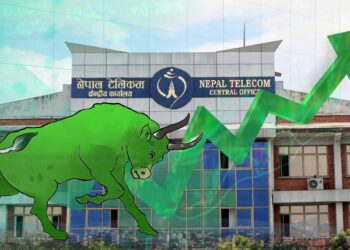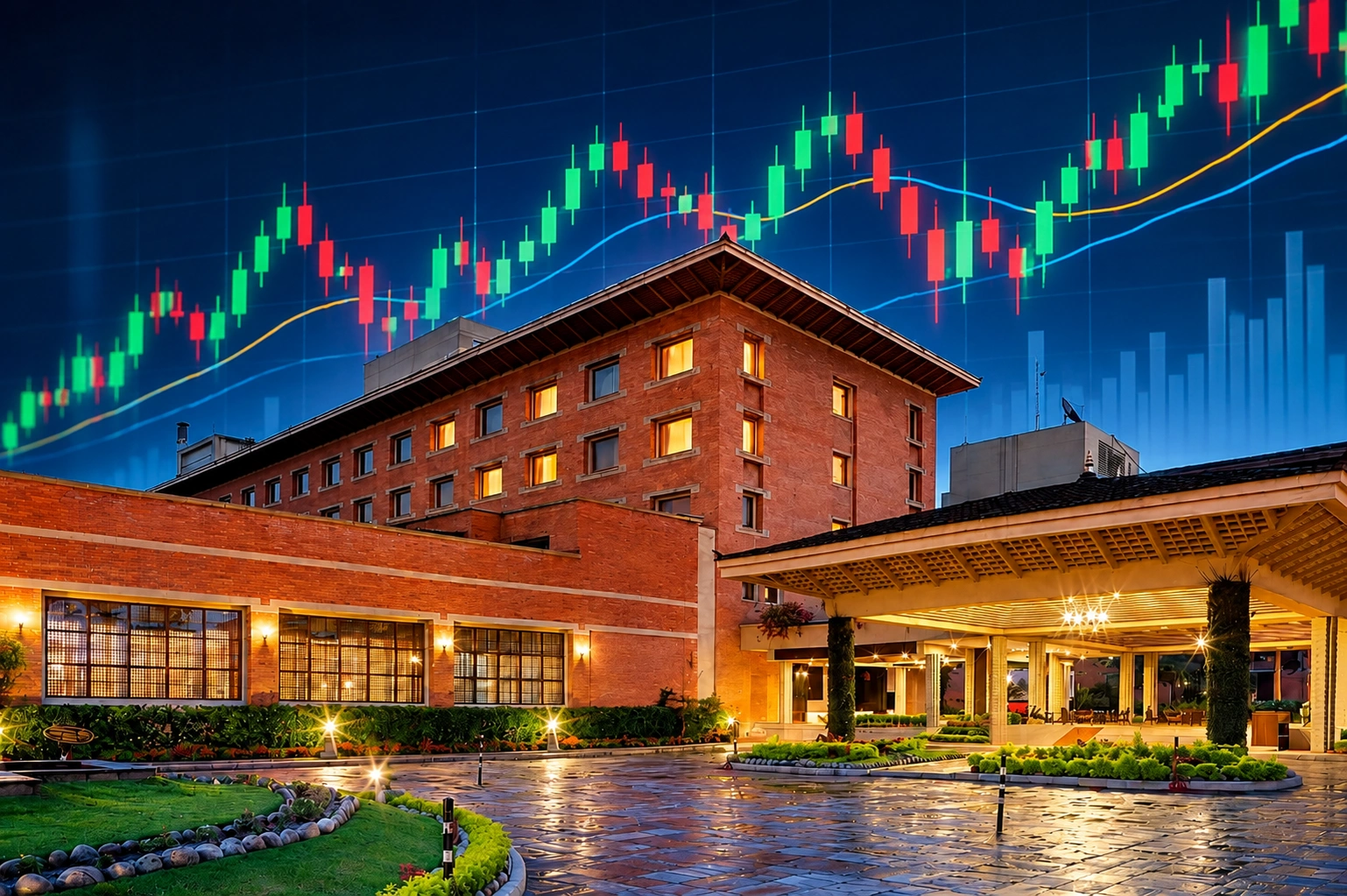
Here is a fact that should bother anyone who buys hotel tourism stocks on NEPSE because “tourism is recovering.” Taragaon Regency Hotels, the company that owns Hyatt Regency Kathmandu, closed fiscal year 2082/83 with a net loss of NPR 70.58 crore. A year earlier it had earned a profit of NPR 51.54 crore. Its flagship and only hotel has been shut for reconstruction since protesters looted and set fire to it in September 2025. And yet, over the twelve months to October 30, 2026, its share price rose about 13 percent, to NPR 816.70, according to NEPSE Trading’s compilation of the company’s filed statements and exchange prices.
A loss-making company with its main asset closed, and the stock goes up. That is not how a cyclical sector is supposed to behave.
That is the argument of this piece. NEPSE’s hotel and tourism group is usually described as a bet on the tourism cycle. In practice, it is priced less on the cycle than on scarcity. There are very few listed names, the free float in the biggest ones is tiny, and prices drift away from earnings for long stretches. To trade this sector, you need a framework that covers both the real swings in the business and the market quirks that override them.
What is actually in the hotel and tourism group
The sector is small enough to list in one paragraph. For most of NEPSE’s history, there were only three hotel companies: Soaltee Hotel (SHL), which runs the Crowne Plaza Kathmandu-Soaltee; Oriental Hotels (OHL), which operates the Radisson; and Taragaon Regency Hotels (TRH), which owns the Hyatt Regency. Since then, Chandragiri Hills (CGH), the IME Group-backed cable car and resort company, Kalinchowk Darshan (KDL), City Hotel (CITY, which runs a Hyatt Centric) and, in the current fiscal year, Bandipur Cable Car and Tourism (BANDIPUR) and Hotel Forest Inn (HFIN) have joined. NEPSE Trading counted eight listed companies in the tourism group in March 2026, with sixteen more in the IPO pipeline, including several airlines, helicopter operators, cable cars and five-star hotels.
So when you read that the “Hotels and Tourism sub-index” rose or fell on a given day, keep the arithmetic in mind. On NEPSE Trading’s figures, Soaltee alone carries a market capitalization of about NPR 64.28 arba (roughly NPR 6,428 crore). TRH, CGH, CITY and OHL combined come to about NPR 44.7 arba. One company is worth more than the next four put together. In practice, the sub-index is mostly a Soaltee chart with some noise from the others. (If you are new to how NEPSE’s indices are built and weighted, our explainer on how the NEPSE index works covers it.)
That concentration matters because the eight companies are very different businesses. A five-star city hotel earns from rooms, banquets and events. A cable car earns from ticket sales. A new hotel just out of construction earns little and carries heavy depreciation and interest. Calling them all “tourism stocks” hides more than it reveals.
Why hotel tourism stocks on NEPSE are cyclical (the real part)
The cyclical story is not wrong. It is just incomplete. Three cycles run through these businesses at the same time.
The season inside the fiscal year
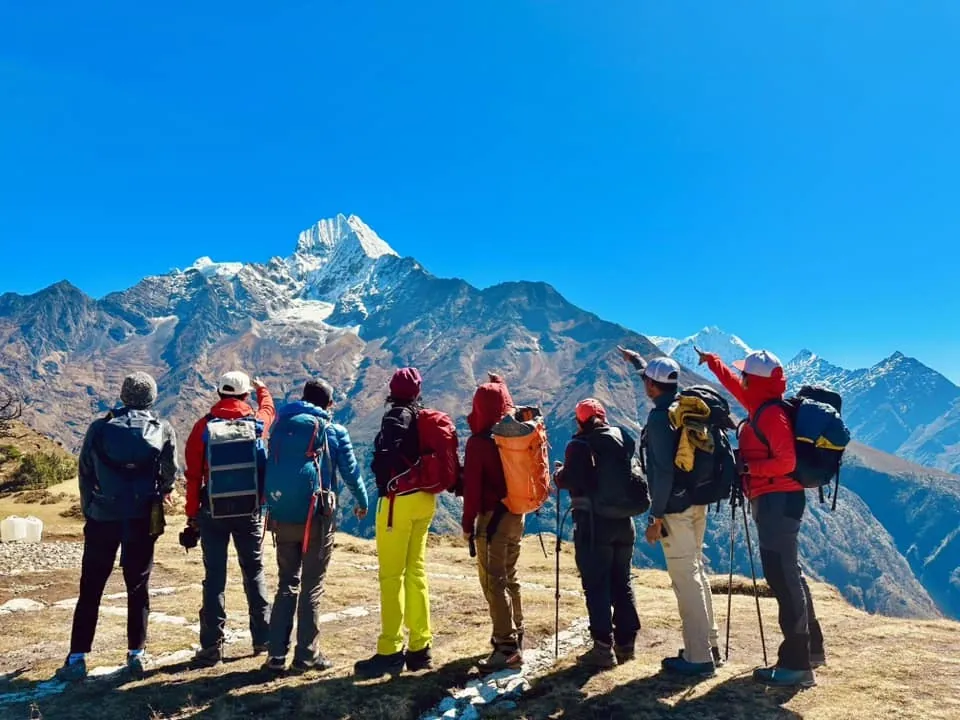
Nepal’s fiscal year runs from mid-July (Shrawan) to mid-July (Ashadh). That means a company’s first quarter covers mid-July to mid-October, which is mostly monsoon, the weakest stretch for foreign arrivals. The second quarter, mid-October to mid-January, captures the autumn trekking peak and the wedding and festival season. The pattern shows up clearly in arrivals. The Nepal Tourism Board (NTB) recorded 88,248 foreign visitors in September 2026 and 132,814 in October 2026, the highest monthly figure of the year so far, as reported by ShareSansar and NEPSE Trading.
It also shows up in company accounts. Soaltee reported a first-quarter net profit of NPR 12.36 crore for FY 2082/83, against a full-year profit of NPR 76.11 crore, on NEPSE Trading’s compilation of its filings. The first quarter delivered only about 16 percent of the year’s profit, well under the 25 percent you would expect if earnings were spread evenly.
This is where retail traders get misled. Data portals show an “annualized EPS,” which scales year-to-date earnings to twelve months. Soaltee’s annualized EPS after the first quarter of FY 2082/83 was NPR 4.84. Its actual full-year EPS came in at NPR 6.48. If you had valued the stock on that first-quarter number, it would have looked about a third more expensive than it really was. The reverse trap is worse: a strong second quarter, annualized, makes a hotel look far cheaper than its full year will justify. Chandragiri Hills was loss-making on a year-to-date basis after the first, second and third quarters of FY 2082/83, then finished the year with a profit of NPR 8.25 crore, according to the same compilation. Quarterly numbers in this sector are only comparable with the same quarter last year, never with each other.
The multi-year tourism cycle
Above the seasons sits the slower cycle of foreign arrivals. Nepal received 1,158,459 foreign tourists in 2025, up about 1 percent from 2024 but still about 3.2 percent below 2019, according to NTB data based on Department of Immigration figures, as reported by Himal Press. In the first ten months of 2026, arrivals reached 1,008,616, NTB data shows, as reported by NEPSE Trading on November 3, 2026. That is steady, not explosive. Six years after the pandemic, the country has still not convincingly beaten its 2019 numbers.
The mix is also shifting. In October 2026, visitors from the United States (17,437) outnumbered those from India (12,097), and Indian arrivals were down sharply from 17,298 a year earlier, ShareSansar reported citing NTB. India was still Nepal’s largest source market for 2025 as a whole, with 292,438 visitors, though that was itself down 8 percent from 2024, according to NTB figures reported by Himal Press. A shrinking largest market is not neutral for listed hotels, even when total arrivals rise, because the mix of who comes shapes how long they stay and what they spend.
The shock cycle
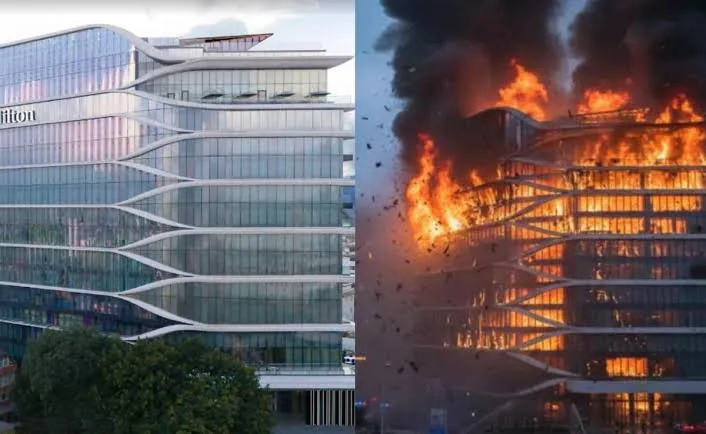
The third cycle is the one no spreadsheet captures: shocks. The 2015 earthquake, the 2020 to 2021 pandemic, and the September 2025 Gen Z protests each hit this sector harder than almost any other on NEPSE. The Hotel Association Nepal (HAN) estimated losses of around NPR 25 arba across roughly two dozen hotels damaged or burned during the protests on September 9 and 10, 2025. Chandragiri Cable Car’s bottom station was destroyed on September 10, 2025, and the service stayed closed for about two months. Hyatt Regency, which has 280 rooms according to its management as quoted by the Kathmandu Post, has been closed since.
A bank stock can absorb a bad quarter in one branch. A single-hotel company cannot. That is the core risk of this sector, and it is why the second-quarter results for FY 2082/83 were so lopsided. By mid-January 2026, five of the seven companies then reporting were in loss, and only Soaltee and Kalinchowk Darshan were profitable, NEPSE Trading reported on February 19, 2026. Taragaon’s revenue for the half-year fell 75.26 percent.
Why the prices do not follow the cycle (the market part)
If hotel stocks tracked the business cycle, the last year would have been simple. Earnings across most of the group collapsed or stayed negative. Prices should have fallen. Some did. City Hotel, still loss-making with a full-year net loss of NPR 17.31 crore for FY 2082/83, fell about 39 percent over the year to NPR 322, on NEPSE Trading’s figures. Oriental Hotels slipped about 6 percent and Chandragiri Hills about 15 percent.
But Soaltee rose about 16 percent and Taragaon about 13 percent. Two explanations stand out, and both are about the market, not about tourism.
Thin free float creates a scarcity premium
Soaltee’s promoters hold 85 percent of the company; the public holds 15 percent, according to NEPSE Trading. City Hotel’s public share is listed at 10 percent and Oriental’s at 30 percent. When only a small slice of a company trades, it takes very little money to move the price, and holders who believe in the long-term story rarely sell. That pushes valuations to levels you would not accept elsewhere. Soaltee traded at about 84 times its FY 2082/83 earnings and about 19 times book value as of November 4, 2026. (For context on why a high P/E is not automatically a sell signal, and when it is, see our guide to reading the P/E ratio on NEPSE.)
To be fair to Soaltee, it is the one company in the group that earns its keep. Its return on equity was about 22.7 percent on NEPSE Trading’s figures, and it paid 16.58 percent in cash and 15 percent in bonus shares for FY 2081/82. But even a well-run, profitable hotel at 84 times earnings is priced for years of uninterrupted growth in a sector that, as we have just seen, is interrupted every few years.
Free float is the single most underrated number in this sector. We explain how to find and interpret it in our piece on free float on NEPSE.
Asset value and recovery hope
Taragaon’s rise needs a different explanation. With the hotel closed and a full-year loss, the P/E ratio is meaningless. What buyers are paying for is the eventual reopening and the land and building underneath it. The company’s operators aimed to finish reconstruction and resume operations by December 2026, according to Onlinekhabar’s September 10, 2026 report. The market is pricing that future, not the present. At NPR 816.70, the stock traded at about 6.9 times its book value per share of NPR 118.71 as of October 30, 2026, on NEPSE Trading’s figures, and that book value itself has shrunk from NPR 161.65 a year earlier because of the losses.
Our opinion: paying a recovery premium before the reopening works only if three things go right together. The hotel opens close to schedule, insurance money arrives (a Hilton source told Onlinekhabar in September 2026 that its claim was still unpaid), and room demand returns quickly. If any one slips, the recovery story becomes a delay story, and the current price leaves little room for that.
Oriental Hotels is the mirror image. It traded at about 2 times book value (NPR 649.40 against NPR 326.64 per share) as of October 29, 2026, after a small full-year loss of NPR 4.74 crore. The market gives it almost no premium. Bargain or value trap depends on whether management can turn a large balance sheet into consistent profit, which recent years have not shown.
A five-question framework before you buy

Instead of asking “is tourism recovering,” ask these five questions of any hotel or tourism stock on NEPSE.
1. How many assets does the company depend on? A company with one hotel or one cable car is a concentrated bet on one location, one license and one stretch of road. Taragaon and Chandragiri both showed in 2025 what a single event can do. Diversified earnings deserve a lower risk discount. Single-asset companies deserve a higher one.
2. Which quarter am I looking at? Compare first quarter with first quarter, second with second. Never extrapolate a monsoon quarter or a peak quarter to the full year. If a portal shows annualized EPS, find the year-to-date net profit and the same figure for last year and do your own comparison.
3. What is the free float, and when do lock-ins end? A small public float can push prices up, but it also means that when promoter lock-ins expire, a large block of supply can hit the market. NEPSE Trading noted in March 2026 that lock-in periods for Kalinchowk Darshan and City Hotel were ending. Check the promoter lock-in schedule on CDSC or your broker’s portal before you buy any recently listed tourism company.
4. Is the business earning above its cost of capital, or just holding assets? Look at return on equity across a full year, not one quarter. In FY 2082/83, on NEPSE Trading’s sector comparison, only Soaltee posted a double-digit ROE; most of the group posted zero or negative returns. A hotel that does not earn more than a fixed deposit on its equity is a real estate holding with operating risk attached.
5. How much supply is coming? Sixteen tourism-related companies were in the IPO pipeline as of March 2026, according to NEPSE Trading. Every new listing dilutes the scarcity premium that props up existing names. It also adds capacity to an industry that HAN says can already accommodate more than four million tourists a year, against roughly 1.2 million who actually arrive, as HAN’s president told Onlinekhabar in September 2026. More rooms chasing the same visitors means pressure on room rates.
A worked example: buying on the wrong quarter
Imagine you buy 500 shares of a hypothetical hotel company at NPR 600 each in late Kartik, right after it announces a strong second quarter. The cost is NPR 3 lakh before brokerage. The company’s second-quarter EPS, annualized, is NPR 20, so the stock looks like it trades at 30 times earnings. That seems reasonable for a “recovery” story.
Then the third and fourth quarters arrive. Spring is decent but the monsoon months are weak, depreciation and interest stay fixed, and the full-year EPS lands at NPR 10. The same NPR 600 price is now 60 times earnings. Nothing went wrong with the business. You simply priced the peak season as if it lasted all year. If the market re-rates the stock to 40 times earnings, the price falls to NPR 400, and your NPR 3 lakh becomes NPR 2 lakh.
If you do sell at a profit at some point, remember the tax side. Since September 22, 2026, resident individuals pay capital gains tax of 5 percent on listed shares held for 365 days or less and 3.75 percent on shares held longer, under the Ministry of Finance notice published in the Nepal Gazette, as reported by ShareSansar. For a seasonal trader flipping hotel stocks within the year, the short-term rate applies. Our full guide to capital gains tax on NEPSE explains how the holding period is counted.
What to watch over the next twelve months
Four things matter more than the rest. First, the Hyatt Regency reopening: whether it happens around December 2026 or slips into 2027 will move TRH more than any tourism statistic. Second, second-quarter results for FY 2083/84, due early in 2027. That is the first peak-season quarter since the protests with most damaged properties back in operation, so compare it with the same quarter of FY 2081/82, the last undisturbed year, not just with the depressed FY 2082/83. Third, monthly NTB arrivals by country, not just the total. Fourth, the IPO pipeline, because every new tourism listing SEBON approves adds supply.
The verdict
Hotel and tourism stocks on NEPSE are cyclical businesses wrapped in a market structure that often ignores the cycle. That combination is dangerous for anyone who treats “tourism is recovering” as a reason to buy.
Our view, and it is a view, not a fact: the only listed company in the group with a demonstrated record of earning strong returns through the cycle is Soaltee, and its current price already assumes that record continues indefinitely. The rest of the group is a mix of recovery bets, new projects without an earnings history, and asset-heavy companies that the market has given up on. None of that makes them untouchable. It does mean you should buy them for a specific, checkable reason (a reopening date, a season, a valuation gap against book value) rather than for a general belief in Nepal’s tourism potential. Belief in the potential has been cheap for twenty years. Profits have been scarce.
If you trade this sector, trade the calendar and the float, not the slogan. Compare like quarters, watch lock-ins, and price in the next shock, because history says one will come.
This is analysis, not financial advice.
Frequently Asked Questions
1. Why are hotel and tourism stocks on NEPSE considered cyclical?
These stocks are cyclical because their earnings depend on seasonal tourist arrivals, long-term tourism trends and unexpected events such as earthquakes, pandemics and political unrest.
2. Which companies are included in NEPSE’s hotel and tourism sector?
The sector includes Soaltee Hotel, Oriental Hotels, Taragaon Regency Hotels, Chandragiri Hills, Kalinchowk Darshan, City Hotel, Bandipur Cable Car and Tourism, and Hotel Forest Inn.
3. Why do some hotel stocks rise even when companies report losses?
Share prices can rise because of limited public share availability, expectations of future recovery, and the value of company assets. Therefore, stock prices do not always reflect current earnings.
4. What should investors check before buying hotel and tourism stocks?
Investors should examine the company’s assets, quarterly earnings, public shareholding (free float), promoter lock-in periods, return on equity and upcoming IPO supply.
5. Why should investors compare the same quarters when analysing hotel stocks?
Hotel businesses earn differently across seasons. Monsoon months generally have fewer tourists, while autumn and festival seasons bring higher demand. Comparing the same quarters across different years gives a more accurate picture of business performance.