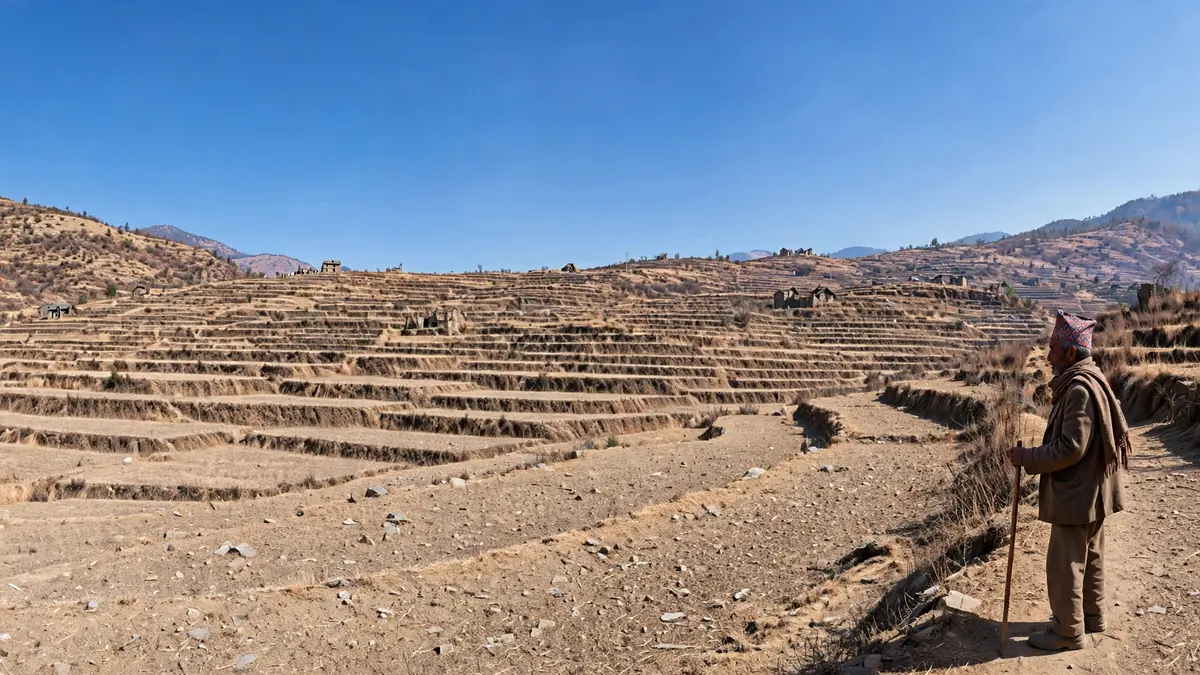
Drive through Nepal’s hill districts today, and you’ll notice something odd. Terraced fields that once fed entire villages now sit empty, overgrown, and untouched.
This is agricultural land fallowing, and it’s spreading fast. Roughly a third of Nepal’s cultivated land now lies unused, even as the country imports more food than ever before.
The root cause isn’t drought or soil exhaustion. It’s people. Specifically, it’s the mass departure of young Nepalis seeking work abroad, leaving farms without hands to work them.
In this article, we’ll look at how widespread agricultural land fallowing has become, what’s driving it, and why it’s costing Nepal far more than empty fields alone.
How Widespread Is Agricultural Land Fallowing in Nepal?
The numbers here are genuinely striking. According to New Spotlight Magazine’s 2025 reporting, approximately 32% of Nepal’s cultivated land is now left fallow. A separate 2026 analysis from MMI Lans reached a similar conclusion, describing this exodus as creating “a cruel irony where a sector struggling with low productivity simultaneously cannot fully utilize its existing arable land.”
Regional studies paint an even starker local picture. Research focused on Khotang district found that 30% to 40% of cultivated land remained fallow, driven by population deficit, labor shortages, migration, and wildlife encroachment. Meanwhile, a household survey in Kaski district found that roughly 40% of surveyed households had kept at least one farm plot uncultivated for more than two consecutive years. Altogether, about 28% of all farm plots owned by these households sat fallow.
This isn’t a new trend, but it has accelerated. Earlier data from Nepal’s Ministry of Land Management, Cooperatives and Poverty Alleviation found that of 5.49 million hectares under cultivation, roughly 1.03 million hectares had already gone fallow. That earlier figure represented a smaller share than today’s estimates, suggesting the problem has genuinely worsened over time.
The Daily Exodus Driving the Trend
Why is so much farmland going unused? The answer traces directly back to migration patterns.
According to MMI Lans’s 2026 analysis, an estimated 2,000 to 2,500 agricultural workers leave Nepal daily to seek employment abroad. This daily outflow reflects higher wages and limited domestic opportunities, pulling working-age adults away from farming communities at a remarkable pace.
This pattern connects to Nepal’s broader labor migration story. According to Nepal News’s coverage of the country’s Economic Survey for fiscal year 2025/26, approximately 839,000 Nepali workers received labor permits to go abroad in fiscal year 2024/25 alone. By mid-March 2026, over 557,000 had already received permits in the current fiscal year. Over the preceding decade, this annual outflow grew at an average rate of 28.6% per year.
Crucially, the Economic Survey itself acknowledges the direct link to agriculture. It notes that continuous departure of working-age people “hollows out the agricultural and construction workforce, suppresses domestic wages,” and weakens incentives for productivity improvements. Households increasingly see little reason to invest in domestic farming enterprises when foreign wages offer more reliable returns.
Why Farmers Choose to Leave Land Idle
It’s tempting to assume fallowing simply happens by accident, once workers leave. However, research suggests farmers often make this choice deliberately, weighing real economic trade-offs.
According to a study on farmer decision-making in Kaski district, published on ResearchGate, farmers keep land fallow even amid food scarcity because remittance income frequently outperforms farming returns. Traditional farming on widely scattered small parcels simply isn’t attractive when a family member abroad sends home steady, reliable income instead.
This dynamic is particularly pronounced in Nepal’s hill regions. According to horticultural research published by Horticulture Nepal, difficult terrain makes farming more physically demanding in hilly areas, adding another disincentive on top of the wage gap. Meanwhile, fertile lowland areas in the Terai and valleys face a different but related problem: fertile land increasingly gets converted into settlements and non-agricultural use, rather than staying fallow outright.
Land fragmentation compounds the issue further. Research published by Kathmandu University’s Agriculture and Forestry University notes that inheritance patterns, land market dynamics, and cultural norms all contribute to fragmentation, which in turn reduces irrigation feasibility and discourages sustained cultivation.
The Shrinking Role of Agriculture in Nepal’s Economy
This land abandonment shows up clearly in Nepal’s national economic data, not just local surveys.
According to Nepal News’s Economic Survey coverage, agriculture now contributes just 24.03% of Nepal’s GDP, down sharply from 33.45% a decade earlier in fiscal year 2010/11. That’s a substantial structural shift for a country still widely described, officially, as agriculture-based.
Recent weather shocks have compounded the underlying labor shortage. Floods in October 2025 destroyed significant crop output, and paddy production fell by an estimated 4.16% as a result, according to the same Economic Survey coverage. Some recovery came from gains in legumes and cereals, but this only partially offset the overall decline.
The World Bank’s April 2026 Nepal Development Update reinforces this picture, noting that agricultural growth remains only “broadly resilient,” tempered specifically by lower paddy production in Madhesh Province due to drought conditions and reduced planting.
The Food Import Bill: Paying the Price of Fallow Land
Perhaps the clearest economic signal of agricultural land fallowing shows up in Nepal’s food import bill, which keeps climbing year after year.
According to the Kathmandu Post’s August 2025 reporting, Nepal’s food and agricultural import bill reached Rs 360 billion in the last fiscal year, driven mainly by edible oil and cereal imports. Nepal imported 958,901 tonnes of crude palm, sunflower, and soybean oil alone, worth Rs 144.79 billion.
Cereal imports specifically told a similar story. Nepal imported paddy and rice worth Rs 43.42 billion, including Rs 20.35 billion in paddy, Rs 10.55 billion in basmati rice, and Rs 12.50 billion in other rice varieties. Separately, the cereal import bill overall reached Rs 44.52 billion, up from Rs 40.14 billion the previous year.
Looking ahead, the situation isn’t improving quickly. According to MMI Lans’s 2026 analysis, cereal import requirements for the 2025/26 marketing year are forecast at 1.7 million tonnes, approximately 20% above the average. This comes even as paddy production is projected at 5.4 million tonnes, below average levels due to rainfall deficits in key producing regions.
Why Low Productivity Compounds the Problem
Agricultural land fallowing doesn’t happen in isolation. It interacts with, and worsens, Nepal’s already low farm productivity.
According to MMI Lans, Nepal’s average fertilizer use stands at just 67.4 kilograms per hectare. Compare that to neighboring China’s 464.8 kg/ha, India’s 163.5 kg/ha, or Bangladesh’s 279.2 kg/ha. This stark gap directly contributes to Nepal’s yield shortfalls, even on land that remains actively cultivated.
Researchers estimate that optimal fertilization alone could increase maize yields by 1.9 tonnes per hectare and wheat yields by 2.3 tonnes per hectare. That’s meaningful upside, but it requires sustained investment and labor, both of which remain scarce precisely because of ongoing outmigration.
This creates a difficult feedback loop. Low productivity makes farming less attractive relative to foreign wages, which drives more workers abroad, which leaves more land fallow, which further reduces domestic production, deepening reliance on imports.
The Remittance Trade-Off
It’s worth acknowledging the other side of this equation too, since remittances aren’t purely a negative force.
According to Nepal News’s Economic Survey coverage, remittance inflows equaled 28.2% of GDP in fiscal year 2024/25, a figure almost matching the entire annual goods import bill. These funds genuinely support household consumption, reduce poverty, and help stabilize Nepal’s balance of payments.
However, the survey itself is candid about the trade-off involved. It explicitly notes that Nepal’s economic stability now rests substantially on labor conditions in countries Nepal has no influence over. Agricultural land fallowing is, in many ways, the physical, visible consequence of that broader dependency taking root across the countryside.
Can Nepal Reverse Agricultural Land Fallowing?
Turning this trend around won’t be simple, but several approaches show genuine promise.
According to Horticulture Nepal’s research, converting fallow and abandoned land toward horticultural crops, such as modern fruit farming, organic vegetables, and specialty spices, could help. These higher-value crops generate stronger returns per hour of labor than traditional cereal farming, potentially making agriculture more competitive against foreign wages.
Additionally, addressing land fragmentation through cooperative farming models or land consolidation policies could improve irrigation access and make cultivation more efficient. Reducing fertilizer access barriers would also help close Nepal’s substantial yield gap, making existing cultivated land more productive even without expanding total farmed area.
Finally, targeted investment in agricultural mechanization could help offset labor shortages directly. If fewer workers can farm more land efficiently, some of the pressure driving fallowing might ease, even as outmigration continues.
Why This Trend Deserves Long-Term Tracking
Agricultural land fallowing deserves sustained attention as a structural economic indicator, not just a rural curiosity.
First, it directly measures lost productive capacity. Every fallow hectare represents food, income, and rural employment that Nepal isn’t generating, even though the underlying resource, fertile land, still exists.
Second, it connects clearly to Nepal’s worsening food import dependency. As fallowing increases and domestic production stagnates, Nepal’s exposure to global commodity prices and trade disruptions grows correspondingly larger.
Third, tracking fallowing alongside migration data reveals how tightly these two trends move together. Understanding this relationship helps policymakers judge whether interventions, like mechanization support or crop diversification incentives, are actually working to slow the pace of abandonment.
Conclusion
Agricultural land fallowing has become one of Nepal’s clearest signs of how deeply youth outmigration is reshaping the rural economy. With roughly 32% of cultivated land now unused, and 2,000 to 2,500 agricultural workers leaving daily, this isn’t a marginal issue. It’s a structural transformation.
The consequences show up clearly in the numbers. Agriculture’s share of GDP has fallen from 33.45% to 24.03% in just a decade. Meanwhile, Nepal’s food import bill has climbed to Rs 360 billion annually, filling the gap left by empty fields.
Reversing this trend will require making domestic farming genuinely competitive with foreign wages, through better productivity, smarter land use, and stronger rural investment. Until then, Nepal’s fertile but empty fields will keep telling the same story: opportunity moving elsewhere, one migrant worker at a time.
FAQ: Agricultural Land Fallowing in Nepal
How much of Nepal’s farmland is currently left fallow?
Recent estimates suggest approximately 32% of Nepal’s cultivated land is left fallow, though regional figures vary between 28% and 40% depending on the district.
What is causing agricultural land fallowing in Nepal?
Mass youth outmigration is the primary driver. An estimated 2,000 to 2,500 agricultural workers leave Nepal daily to seek employment abroad.
How has agriculture’s role in Nepal’s economy changed?
Agriculture’s contribution to GDP fell from 33.45% in fiscal year 2010/11 to 24.03% today, reflecting the long-term shift away from farming.
How much does Nepal spend on food imports each year?
Nepal’s food and agricultural import bill reached Rs 360 billion in the last fiscal year, driven mainly by edible oil and cereal imports.
Why do farmers choose to leave productive land fallow?
Remittance income from family members working abroad often outperforms farming returns, making it more practical to leave land unused.
Can agricultural land fallowing in Nepal be reversed?
Potentially, through higher-value horticultural crops, land consolidation, better fertilizer access, and agricultural mechanization to offset labor shortages.