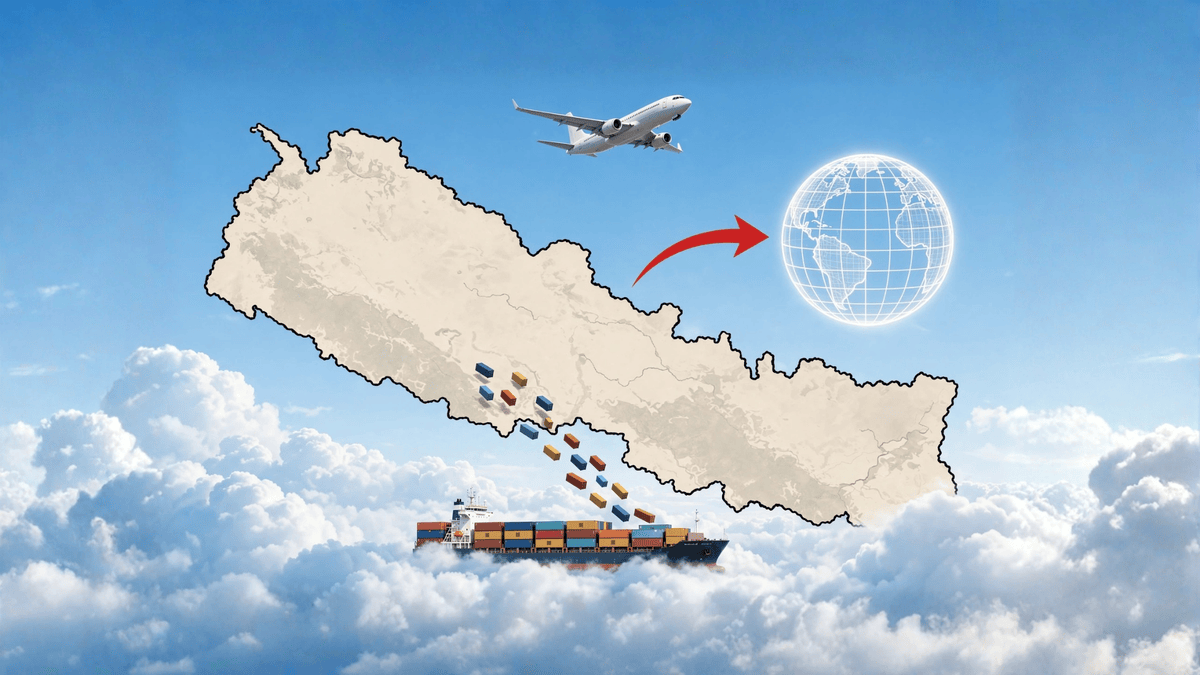
Every container bound for Nepal makes a journey most countries never have to think about. It lands at an Indian port, clears foreign customs, then travels overland for hundreds of kilometers before ever reaching Nepali soil.
Transit and logistics friction in Nepal isn’t an abstract inconvenience. It’s a measurable economic tax, paid on nearly everything the country imports or exports. Being landlocked means Nepal depends entirely on a neighboring country’s ports, roads, and rail lines just to connect with the rest of the world. When those connections run inefficiently, as they often have, the cost shows up directly in higher prices and weaker export competitiveness.
Understanding exactly how this friction works, and where genuine improvement is finally happening, matters for anyone tracking Nepal’s trade competitiveness heading into a genuinely consequential period for the country’s economy.
In this article, we’ll examine the real cost of Nepal’s landlocked geography, the persistent weaknesses in its dry port and rail infrastructure, and the significant breakthrough that just occurred.
The Basic Geography Nepal Can’t Change
Some of Nepal’s logistics friction is simply unavoidable, rooted in physical geography rather than policy failure.
According to the Asian Development Bank’s trade facilitation assessment of Nepal, the nearest seaport, Kolkata, India, sits 1,056 kilometers away, with roughly 90% of Nepal’s entire foreign trade transiting through India’s transportation system as a result. This single fact shapes nearly everything else about Nepal’s logistics reality. According to Sea Sky Cargo Service’s 2026 shipping guide, there is no direct port-to-door option for Nepal at all. Every kilogram of ocean freight must first arrive at an Indian port, primarily Kolkata or Chennai, clear Indian customs as transit cargo, and only then move inland by rail or truck toward the Nepal border.
The cost implications of this geography are well documented globally, not just in Nepal’s case. According to World Bank research on logistics performance, logistics costs amount to roughly 8% of GDP in the United States, but rise to 15% to 20% in many middle-income countries, and can reach as high as 30% of GDP in landlocked or island low-income countries. Nepal sits squarely within the category facing the steepest end of this cost burden.
What This Geography Costs in Practice
Beyond the abstract percentage figures, Nepal’s landlocked position translates into concrete, measurable delays that ripple through the entire trade process.
According to the Farsight Nepal’s analysis of the country’s export challenges, goods bound for Europe can take 35 to 40 days to arrive, due specifically to multiple handling points along the route. The same analysis notes that India itself permits only a limited number of land and sea routes for third-country trade, meaning even India’s own logistics constraints compound Nepal’s shipment timelines further.
According to the Asian Development Bank‘s assessment, roughly 50% of Nepal-bound containers are handled at Kolkata, with the remaining 50% at Haldia. Bulk cargo, meanwhile, is handled almost exclusively at Haldia, with about 90% of it subsequently moved to Nepal by rail, typically bagged rather than containerized. This split handling system, across two separate Indian ports, adds coordination complexity to nearly every significant Nepali import shipment.
Nepal’s Overwhelming Dependence on Roads
Compounding the border-crossing friction, Nepal’s domestic transport network remains heavily skewed toward road transport, limiting the efficiency gains that better multimodal integration could otherwise provide.
According to the Asian Transport Observatory’s March 2026 Nepal Transport in Review report, roads account for around 98% of Nepal’s transport energy consumption, reflecting decades of historical investment patterns and limited modal diversification. The same report states plainly that logistics performance continues to lag behind regional peers due to infrastructure gaps, customs inefficiencies, and weak multimodal integration, even as the road network itself has expanded substantially over the past two decades.
This road-dependency matters because road transport, while flexible, is typically less cost-efficient than rail for high-volume, long-distance freight. Without meaningful rail alternatives, Nepal’s importers and exporters have historically had little choice but to absorb the higher relative costs road transport imposes over long transit distances.
The Dry Port Bottleneck
Nepal’s inland clearance depots, the dry ports meant to serve as customs and storage hubs along its trade corridors, have historically compounded this friction rather than relieving it.
Birgunj ICD, Nepal’s largest and most important dry port, handles more than 20,000 TEU containers annually despite storage capacity built for a considerably smaller trade volume. Congestion caused by inadequate warehousing has led to significant cargo clearance delays, and government efforts to expand the facility by merging it with the adjacent Integrated Check Point have stalled for years over an unresolved 16-hectare land acquisition. Bhairahawa ICD, Nepal’s second-largest facility, faces its own persistent bottleneck, with average waiting times between vehicle arrival and berthing running one to two days, worsened further during the rainy season when parking and warehouse space grows even more constrained.
These aren’t new problems. They reflect years of infrastructure investment failing to keep pace with genuinely growing trade volumes, precisely the kind of structural friction that compounds Nepal’s already difficult geography.
A Genuine Breakthrough, Just Weeks Old
Against this backdrop of persistent friction, Nepal achieved something genuinely historic just weeks ago, offering a rare, concrete example of transit friction actually easing.
According to Kathmandu Post’s July 2026 reporting, the first-ever direct rail cargo service from Kolkata to Biratnagar officially began on July 18, 2026, marking only the second direct rail freight link to Nepal after the long-established Birgunj route. Officials in Kolkata flagged off the inaugural freight train, extending direct rail access to eastern Nepal’s importers for the first time in the country’s history.
This breakthrough didn’t happen overnight, and its timeline reveals something important about the nature of Nepal’s logistics friction. According to College Simplified’s detailed analysis, the physical infrastructure for the Bathnaha-Jogbani-Biratnagar rail line was actually completed and jointly inaugurated back in June 2023, under grant assistance from the Government of India. Yet, commercial operations didn’t begin until July 2026, nearly three years later. The delay wasn’t infrastructural. It was legal and administrative, requiring a revised Letter of Exchange, signed on November 13, 2025, amending the Protocol to the Nepal-India Treaty of Transit specifically to authorize direct containerized and bulk rail cargo movement to Biratnagar’s Nepal Customs Yard.
Why This Specific Change Matters So Much
The substance of this treaty amendment reveals just how narrow Nepal’s rail options had been until very recently.
According to Kathmandu Post’s reporting, previously, the Nepal-India Transit Treaty permitted rail cargo movement only to Birgunj ICD, and even then, only four specific commodities, coal, clinker, cement, and fertiliser, could be transported by rail from third countries at all. The amended protocol now allows all cargo trains, carrying any type of goods, both containerized and bulk cargo, to operate through both Biratnagar ICP and Nautanwa, near Bhairahawa, dramatically expanding Nepal’s rail-accessible trade corridors beyond the single Birgunj chokepoint that had dominated for years.
The practical savings look genuinely significant. According to Kathmandu Post, trade experts estimate that direct transportation from Visakhapatnam to Biratnagar ICP will cut logistics costs by around 15% to 20%, compared to the previous system, where cargo arriving at Birgunj had to be reloaded onto 10-to-12-ton capacity Nepali-registered trucks for onward delivery to Biratnagar, an inefficient double-handling process the new direct rail link eliminates entirely.
According to College Simplified’s analysis, this new capacity specifically benefits the Sunsari-Morang Industrial Corridor, supporting steel manufacturing, edible oil processing, cement production, textiles, and consumer goods manufacturing, sectors that depend on steady, low-cost imports of raw materials like canola grain, scrap metal, and industrial chemicals.
The Broader Lesson: Legal Friction, Not Just Physical Friction
This episode offers a genuinely important insight into Nepal’s transit and logistics friction more broadly: physical infrastructure alone doesn’t solve the problem.
The nearly three-year gap between the Bathnaha-Jogbani-Biratnagar line’s physical completion in June 2023 and its actual commercial usability in July 2026 illustrates that treaty protocols, customs authorizations, and bilateral legal frameworks can create just as much friction as inadequate roads or congested dry ports. A functioning rail line sitting unused for years, purely due to unresolved transit treaty language, represents exactly the kind of “inefficient cross-border connection” that compounds Nepal’s unavoidable geographic disadvantage with entirely avoidable administrative delay.
This matters for how Nepal approaches future infrastructure investment. Building physical connectivity, while necessary, isn’t sufficient on its own. The legal and regulatory frameworks governing how that connectivity can actually be used matter just as much, and historically, Nepal has moved considerably slower on that second front.
What Remains Unresolved
Despite this genuine breakthrough, significant transit and logistics friction remains embedded in Nepal’s trade infrastructure.
Birgunj ICD’s core congestion problem, the stalled 16-hectare land acquisition blocking its planned ICD-ICP merger, remains unresolved. Bhairahawa’s parking and cold storage limitations persist unaddressed. And while the Biratnagar rail breakthrough expands options for eastern Nepal specifically, the vast majority of Nepal’s trade still funnels through the same congested road and rail corridors that have constrained capacity for years.
Nepal’s overwhelming 98% road-dependency for transport energy consumption also hasn’t shifted meaningfully, suggesting that even with new rail options available, the broader modal balance of Nepal’s logistics system remains far from optimized.
What Would Genuinely Reduce This Friction Further
Building on the Biratnagar precedent, several concrete steps could help Nepal continue reducing transit and logistics friction going forward.
First, applying the same legal and treaty-focused approach that unlocked Biratnagar’s rail capacity to other potential corridors, rather than waiting for new physical infrastructure alone, could unlock existing but underutilized connectivity elsewhere in Nepal’s trade network.
Second, resolving Birgunj ICD’s stalled land acquisition would address Nepal’s single most consequential dry port bottleneck, given that facility’s outsized share of the country’s total import value.
Third, continuing to expand the range of commodities and cargo types eligible for rail transport, following the shift from just four permitted commodities to unrestricted cargo movement on the Biratnagar route, could extend similar cost savings to other trade corridors still operating under narrower legal permissions.
Finally, investing in genuine multimodal integration, ensuring rail, road, and dry port capacity expand in coordination rather than independently, would help Nepal avoid replicating the kind of years-long gap between physical completion and commercial usability that delayed the Biratnagar route’s benefits for so long.
Why This Trend Deserves Long-Term Tracking
Transit and logistics friction in Nepal deserves sustained attention as a structural indicator of the country’s trade competitiveness, particularly as Nepal approaches its Least Developed Country graduation.
First, tracking whether the Biratnagar rail corridor’s projected 15% to 20% cost savings materialize in practice, rather than remaining a pre-launch estimate, would confirm whether this legal breakthrough translates into genuine economic benefit for eastern Nepal’s importers and industries.
Second, monitoring whether similar treaty or protocol amendments unlock additional underutilized infrastructure elsewhere would reveal whether Nepal has learned a repeatable lesson from the Biratnagar experience, or whether that breakthrough remains an isolated case.
Third, tracking Nepal’s road-versus-rail transport energy split over time would show whether the country’s chronic overreliance on road freight is genuinely shifting, or whether new rail capacity simply adds marginal options without changing the underlying modal balance.
Conclusion
Transit and logistics friction in Nepal reflects a genuine combination of unavoidable geography and avoidable administrative delay. Being 1,056 kilometers from the nearest seaport, with 90% of trade transiting through India, imposes real costs Nepal simply cannot eliminate. However, the nearly three-year delay between the Biratnagar rail line’s physical completion and its actual commercial launch shows that legal and treaty friction has compounded this geographic disadvantage unnecessarily.
The July 2026 Kolkata-Biratnagar rail cargo launch offers genuine cause for optimism, projected to cut logistics costs 15% to 20% on that specific corridor while finally unlocking rail capacity that had physically existed, unused, for years. Yet, persistent bottlenecks at Birgunj and Bhairahawa, alongside Nepal’s continued overwhelming road dependency, confirm this friction remains far from fully resolved.
As Nepal approaches its LDC graduation and continues seeking export competitiveness, closing the gap between physical infrastructure and the legal frameworks that actually let businesses use it will matter just as much as building new roads, rail lines, and dry ports in the first place.
FAQ: Transit and Logistics Friction in Nepal
Why does Nepal face such high logistics costs?
As a landlocked country, Nepal sits 1,056 kilometers from its nearest seaport, Kolkata, with roughly 90% of its foreign trade transiting through India’s transportation system.
What is the Kolkata-Biratnagar rail cargo service?
Launched in July 2026, it’s only the second direct rail freight link to Nepal after Birgunj, expected to cut logistics costs by 15% to 20% for eastern Nepal’s trade.
Why did it take so long for the Biratnagar rail line to become operational?
The physical rail line was completed in June 2023, but commercial use required a treaty amendment, signed in November 2025, to legally authorize direct cargo movement.
What are Nepal’s main dry port bottlenecks?
Birgunj ICD faces chronic congestion from inadequate warehousing, while Bhairahawa ICD suffers from limited parking and no cold storage facilities.
How dependent is Nepal on road transport?
Very. Roads account for around 98% of Nepal’s total transport energy consumption, reflecting limited rail and multimodal infrastructure development.
How much do landlocked countries typically pay in logistics costs compared to coastal nations?
According to World Bank research, logistics costs can reach up to 30% of GDP in landlocked or island low-income countries, compared to just 8% in the United States.