Every autumn, someone on an investor Facebook group posts the same question. Should I buy before Dashain for the rally, or wait for the market to fall? Both camps sound certain. Both quote the same festival. And most years, both are partly wrong, because they are arguing about mood when the thing that actually moves is cash.
Dashain NEPSE seasonality is one of the most talked-about patterns in Nepali investing and one of the least understood. The folk version comes in two flavors. One says the market rallies before Dashain because bonuses arrive and sentiment turns festive. The other says the market softens because people sell shares to fund the festival. The honest answer is that the sentiment story is unreliable, and the part that holds up year after year has nothing to do with celebration. It has to do with where the country’s money physically goes during the two biggest festivals of the year, and what that does to the banking system that quietly funds the stock market.
This piece takes the folk belief apart and rebuilds it on a liquidity foundation. Not superstition, not a “Dashain rally” calendar trick, but the actual mechanism: money leaves bank deposits, the banking system tightens, the marginal buyer runs out of firepower, and the market drifts. Understand that chain and you will stop trading the festival on vibes.
The Dashain NEPSE seasonality myth: check the record
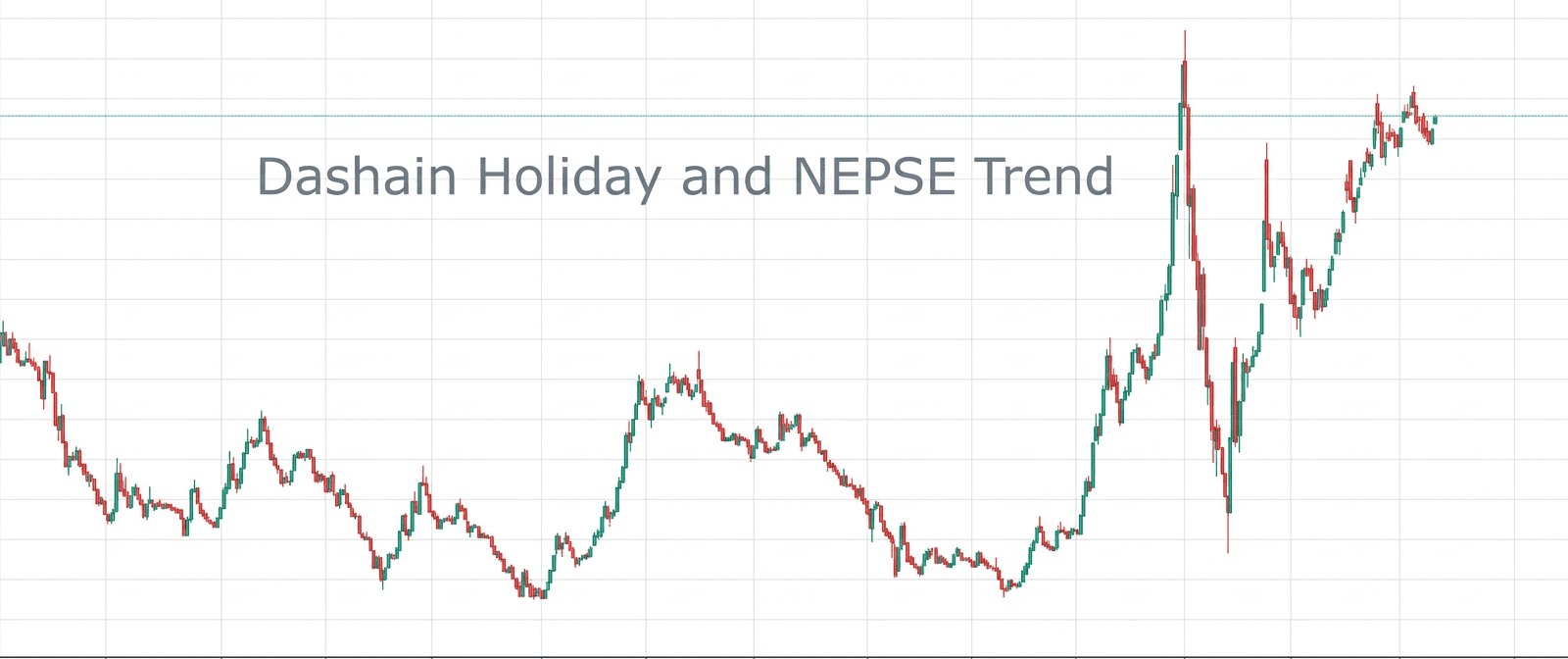
Start by killing the easy story. If there were a reliable “Dashain rally,” it would show up in the data as a strong Ashwin and Kartik, the Nepali months that carry Dashain and Tihar. It does not.
ShareSansar’s SS Pro seasonality study, published July 2, 2026 and based on monthly NEPSE history since 1997, found that the strongest month of the year by a wide margin is July (Shrawan), when the index has closed higher in 73.33 percent of years with an average gain of 6.00 percent. That strength is easy to explain, and it has nothing to do with Dashain. July is when listed companies publish fourth-quarter and annual results, dividend expectations peak, and investors reposition at the start of the new fiscal year.
Now look at the festival window. According to the same experts analysis, August and September have historically been among the weakest months, with September posting negative average returns. October carries a decent 65.52 percent probability of a positive close, but its average gain sits at only around 1 percent, far below July’s. In plain terms: the run-up to Dashain (August into September) has tended to be soft, and the festival month itself has been positive more often than not but weak in size. That is not a rally. That is a market treading water.
The sector picture says the same thing. ShareSansar’s data shows the Banking Index, the heaviest weight in NEPSE, turning negative on average in August and September before its own July strength. Development banks, finance companies, life and non-life insurers all show the same August-September dip, with non-life insurance averaging about a 5 percent September loss. When the sectors that dominate the index all sag into the festival season, the “buy before Dashain” thesis is standing on air.
So the first verdict is simple. If you are buying shares in September because you expect a festive rally, you are trading a pattern the historical record does not support. The seasonality that is real runs the other way, and it is driven by liquidity, not sentiment.
Where the money actually goes

Here is the mechanism the folklore skips. Dashain and Tihar are not just holidays. They are the largest cash-spending event in the Nepali calendar, and that spending pulls money out of the banking system.
In the weeks before Vijaya Dashami, households withdraw cash on a scale they do not touch the rest of the year. New clothes for the whole family, meat, travel to the village, gifts, dakshina handed out at tika, gambling stakes, and the Tihar shopping that follows a fortnight later. A large share of that changes hands in cash, not digital transfer, especially outside the cities. Employers pay a festival bonus, often a full extra month of salary, and much of it comes straight out as currency.
The Nepal Rastra Bank sees this every year as a spike in currency in circulation, the physical notes held by the public rather than sitting in bank vaults or deposits. NRB’s financial-position report for the festive period showed currency in circulation rising by roughly NPR 27.46 billion, as reported by NEPSE Trading. When notes leave the banking system for household wallets, bank deposits fall. And bank deposits are the raw material the whole credit system, including share-backed lending, is built on.
This is the hinge of the entire festival effect, so it is worth stating plainly. Money withdrawn for Dashain is money that stops funding loans. The stock market does not run on festive optimism. It runs, at the margin, on credit. Squeeze the credit and you squeeze the market, whatever the mood.
Why tighter deposits reach the trading floor
A stock exchange and a banking system can look like separate worlds. In Nepal they are wired together, and the wire is margin.
A meaningful slice of NEPSE turnover is funded by borrowed money: margin loans from brokers, and share-collateral loans (loans against shares) from banks and finance companies. An investor pledges a portfolio and borrows against it to buy more. That leverage is the marginal buyer, the incremental demand that pushes prices up when credit is loose. When credit tightens, that same buyer disappears first, and can be forced to become a seller.
Now connect it to the festival. As deposits drain in the run-up to Dashain, banks get protective of liquidity. Under NRB rules, a bank can lend only up to 80 percent of the sum of its core capital and deposits, and it must hold a cash reserve ratio and statutory liquid assets on top, as outlined in NRB’s liquidity framework. When deposits fall, the ceiling on lending falls with them, and loans against shares, which are discretionary and easy to pause, are among the first the bank pulls back. Interbank borrowing costs rise as banks compete for the same shrinking pool of cash. The interbank rate, the overnight rate at which banks lend to each other, is the market’s live thermometer for this; it sat around 2.75 percent in the recent surplus phase, per NRB data reported by NEPSE Trading, but historically it has spiked hard in festive crunch years.
The chain, start to finish: cash leaves deposits, banks tighten, share-backed credit gets scarcer and pricier, the leveraged buyer loses firepower, turnover thins, and the index drifts down or sideways on low volume. None of that requires a single investor to feel bearish. The selling pressure is mechanical. If you want to see the tightening in real time rather than infer it, the interbank rate and NRB’s open-market operations are the tells, and you can read the same liquidity signals inside NRB’s own policy communications, which we break down in our guide to NRB monetary policy and NEPSE.
The detail that decides how hard it bites: the liquidity regime
Here is where most festival commentary goes wrong, and where the useful call lives. The Dashain liquidity drain is a constant. Its effect on the market is not. How hard it bites depends entirely on the liquidity regime the banking system is already in when the festival arrives.
Think of it as a reservoir. In a year when the banking system is already tight, deposits scarce, credit-to-deposit ratios stretched, interbank rates elevated, the festival withdrawal hits a low reservoir and the crunch is severe. Loans against shares get called, rates jump, and the market can fall meaningfully into and just after the festival. Those are the years the “Dashain dip” believers remember.
In a year of surplus liquidity, the same withdrawal barely registers. Through much of 2026 the banking system has run flush, so flush that NRB has been absorbing money rather than injecting it, mopping up excess through deposit collection and reverse repo, with the interbank rate sitting well below the policy rate. In a regime like that, a NPR 27 billion cash outflow for Dashain is a ripple, not a flood. The banks have room to spare, share-backed credit keeps flowing, and any festival softness is mild.
That is the analytical point ShareSansar’s calendar and the folk belief both miss. Seasonality is not a fixed law you can trade blind. It is a mechanism whose strength swings with conditions. The right question before Dashain is not “does NEPSE fall around the festival,” it is “how tight is the banking system right now, and how much room does it have to absorb the withdrawal.” Answer that and you have a real read instead of a superstition.
You can check it yourself with a few free numbers before the festival: the interbank rate trend, whether NRB is injecting liquidity through repo or absorbing it through deposit collection, and the banking sector’s credit-to-deposit position. When rates are climbing and NRB is injecting, the reservoir is low and the drain will hurt. When rates are soft and NRB is absorbing, it will not. The mechanics of those bank ratios, and why the credit-to-deposit number matters so much, are worth understanding in their own right; we walk through them in banking ratios: NPL, CD and CAR.
The trap of the closed days
There is a second, smaller effect that trips up active traders, and it is purely structural. NEPSE shuts for several days during Dashain. For Dashain 2083 (2026), Ghatasthapana falls on October 11 and Vijaya Dashami (tika) on October 20, with the main Dashami-period days plus weekly closures taking the market offline for a stretch, and Tihar following in early to mid-November (the main days run roughly November 7 to 11, 2026). Confirm the exact NEPSE closure dates against the official holiday notice, which the exchange issues closer to the festival.
The trap is this. Whatever news or global move lands while NEPSE is shut gets absorbed in a single gap when it reopens, not smoothed across sessions. A leveraged position held through a multi-day closure carries gap risk you cannot manage, because you cannot trade out. Reduced screens, thin pre-festival volume, and a hard multi-day break are a poor combination for anyone running borrowed money. This is less about seasonality and more about not being trapped in an illiquid position you cannot exit. If you trade on leverage, the days before a long closure are when the leverage is least worth carrying.
So how should you actually position?
Strip out the folklore and a practical playbook remains. Treat it as a framework, not a signal to fire blindly.
First, do not buy in September on the promise of a festive rally. The historical record, per ShareSansar, shows the pre-Dashain months skewing weak, not strong. If you are buying then, buy for a company-specific reason, valuation, an earnings catalyst, a dividend you have actually verified, not for the calendar.
Second, read the liquidity regime before you read the festival. This is the whole game. If the banking system is flush and NRB is absorbing cash, the Dashain drain is noise and you can largely ignore it. If the system is tight and rates are rising, expect the festival withdrawal to pressure leveraged names and thin turnover, and size your risk down accordingly.
Third, respect the leverage cycle. The festival crunch, when it bites, hits the leveraged investor first. If you are running margin or a loan against shares, the run-up to Dashain in a tight year is the time to trim borrowing, not add to it. A forced sale into a thin, closed-heavy market is how a manageable position becomes a loss.
Fourth, remember the drain reverses. Cash withdrawn for the festival does not vanish; it flows back into deposits through November and December as spending settles and the banking system re-liquefies. If a genuine liquidity squeeze pushes good companies down into and just after the festival, the weeks after Tihar can be where the opportunity sits, not the weeks before. The reservoir refills.
The verdict
The “Dashain rally” is a story people tell because a festival is a vivid thing to pin a market on. The data does not back it. What the data and the plumbing of the banking system do back is quieter and more useful: Dashain and Tihar pull a large slug of cash out of bank deposits, that withdrawal tightens the credit that funds leveraged buying, and the effect on NEPSE ranges from invisible to painful depending entirely on how much spare liquidity the system had to begin with.
So stop asking whether to buy or sell for Dashain. Ask how tight the banks are. In a flush year, the festival is a holiday and nothing more for your portfolio. In a tight year, it is a liquidity event, and the investors who get hurt are the ones who mistook borrowed money for a festive rally. Trade the cash, not the calendar.
This is analysis, not financial advice.
Frequently Asked Questions
1. Does NEPSE usually rise before Dashain?
Not necessarily. Historical data does not show a reliable “Dashain rally.” Expert’s seasonality study found August and September have generally been among the weaker months, while October has had more positive closes but only a modest average gain.
2. Why can Dashain affect the Nepal stock market?
Dashain and Tihar increase household cash spending, causing money to move out of bank deposits and into circulation. Lower deposits can reduce the funds available for lending, including loans backed by shares, which can reduce buying power in the stock market.
3. Does the Dashain effect on NEPSE happen every year?
No. The impact depends on the banking system’s liquidity before the festival. When liquidity is already tight, the seasonal cash withdrawal can put more pressure on credit and the stock market. When liquidity is high, the same withdrawal may have a much smaller effect.
4. What should investors check before Dashain?
Investors can monitor the interbank rate, NRB liquidity operations, and the banking sector’s credit-to-deposit position. These indicators can help show whether the banking system has enough liquidity to absorb the seasonal cash withdrawal.
5. Is it risky to hold leveraged positions during Dashain?
It can be, particularly when banking liquidity is tight. NEPSE also remains closed for several days during Dashain, meaning investors cannot immediately react to market or global news. Investors using margin or share-backed loans therefore face additional gap and forced-selling risks during an extended market closure.