
Two Nepali banks can lend at the same rate, to the same kind of borrower, with the same bad-loan ratio, and still post very different profits. The difference usually sits on the other side of the balance sheet, in a line most retail investors never read: what the bank pays for its money. The CASA ratio in Nepal banks is the quickest way to see that cost. It tells you how much of a bank’s deposit base comes from current and saving accounts, the cheap money, rather than from fixed deposits the bank has to pay up for.
Here is the part the ratio guides skip. Over the past two years, almost every Nepali bank’s CASA ratio has jumped, and very little of that jump was earned. It came from a flood of liquidity and falling fixed deposit rates that made locking money away pointless for savers. If you read a high CASA ratio today as proof of a strong deposit franchise, you are reading the weather, not the bank. This piece explains what the ratio measures, why it drives margins, what has distorted it, and how to read it so that it actually tells you something.
What the CASA ratio measures
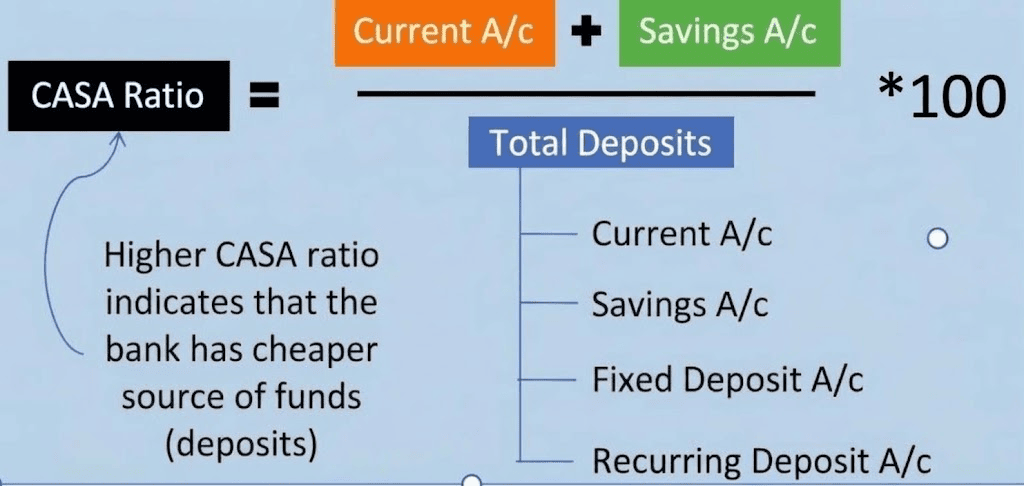
CASA stands for current account and saving account. The ratio is simple:
CASA ratio = (current deposits + saving deposits) ÷ total deposits × 100
Current accounts are mostly held by businesses for day-to-day transactions. In Nepal they typically pay little or no interest. Saving accounts are held mostly by individuals and pay a modest rate. Fixed deposits, where money is locked for a set term, pay the most. Call deposits, a category Nepali banks use heavily for institutional money that can be withdrawn at short notice, sit somewhere in between and usually carry negotiated rates.
So a bank with a CASA ratio of 60 percent funds six of every ten rupees of deposits with cheaper, non-term money. A bank at 35 percent is leaning much harder on fixed and call deposits, which cost more.
ShareSansar, working from Nepal Rastra Bank’s (NRB) monthly bank-wise data for Mangsir 2078 BS (roughly mid-December 2021), found an industry average CASA ratio of 38.66 percent at the time, with Rastriya Banijya Bank at the top at 74.18 percent and Civil Bank at the bottom at 21.87 percent. That spread, more than three to one between the best and worst funded bank, is the whole point of the ratio. Banks in the same regulated market, lending at broadly similar rates, were paying very different prices for their raw material.
Why cheap deposits decide bank margins
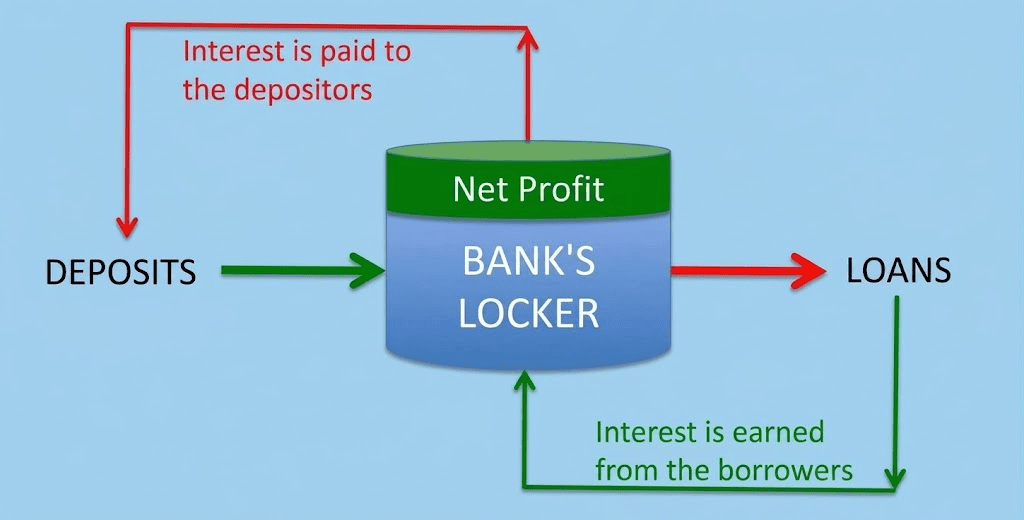
A Nepali commercial bank makes most of its money on the gap between what it earns on loans and what it pays on deposits. We cover that gap in detail in our guide to how base rate and spread work in Nepali banks. The key point for this piece is that lending rates are heavily shaped by competition and by NRB, and banks cannot simply charge more because their funding costs more. NRB has at times capped the average spread commercial banks can run. In its first-quarter review of Monetary Policy 2022/23, for example, it cut the permitted spread from 4.4 percent to 4 percent.
When the lending side is squeezed like that, the funding side is where a bank wins or loses. A bank that can raise its deposits cheaply keeps more of every loan. A bank that has to buy deposits with high fixed rates hands that margin to its depositors instead.
Cost of funds also feeds straight into the base rate. The base rate is the minimum reference lending rate each bank calculates from its own cost of funds plus operating and other costs, and most loans are priced as base rate plus a premium. A bank with a cheaper deposit mix has a lower base rate, which lets it price loans more competitively and still earn a decent spread. That advantage compounds: better borrowers go to the cheaper lender, and a cleaner loan book shows up later in return on assets. If you want to see how that flows into shareholder returns, our piece on bank ROE and ROA in Nepal walks through it.
A worked example in rupees
The numbers below are hypothetical, built to show the mechanism. They are not any real bank’s figures.
Take two banks, each with NPR 100 arba (NPR 10,000 crore) of deposits. Assume current accounts pay 0 percent, saving accounts pay 2.5 percent, and fixed deposits pay 5 percent. Ignore call deposits to keep it clean.
Bank A has a CASA ratio of 60 percent: 10 percent current, 50 percent saving, 40 percent fixed. Its blended deposit cost is (0.50 × 2.5) + (0.40 × 5) = 1.25 + 2.00 = 3.25 percent.
Bank B has a CASA ratio of 35 percent: 5 percent current, 30 percent saving, 65 percent fixed. Its blended cost is (0.30 × 2.5) + (0.65 × 5) = 0.75 + 3.25 = 4.00 percent.
The gap is 0.75 percentage points. On NPR 10,000 crore of deposits, that is NPR 75 crore a year in interest that Bank A does not pay and Bank B does. Before a single loan is judged, before any bad debt, Bank A starts the year NPR 75 crore ahead.
Now move rates. Suppose liquidity tightens and fixed deposit rates rise to 8 percent while saving rates rise to 4 percent. If both banks keep their deposit mix, Bank A’s cost becomes (0.50 × 4) + (0.40 × 8) = 5.2 percent. Bank B’s becomes (0.30 × 4) + (0.65 × 8) = 6.4 percent. The gap has widened to 1.2 percentage points, or NPR 120 crore a year. A strong CASA ratio is worth the most exactly when money gets expensive.
But that assumes the mix holds, and in Nepal it often does not. When fixed rates jump, savers move money out of saving accounts and into fixed deposits. If Bank A’s saving share drops from 50 to 35 percent and its fixed share rises to 55 percent, its cost becomes (0.35 × 4) + (0.55 × 8) = 1.4 + 4.4 = 5.8 percent. Most of its advantage over Bank B has leaked away. That leak is the single most important thing to understand about CASA in this market, and it leads directly to the current distortion.
The current distortion: CASA ratios Nepal banks did not earn

Look at what has happened to the whole system’s deposit mix. According to NRB’s Current Macroeconomic and Financial Situation report based on annual data for FY 2025/26 (2082/83 BS), published August 26, 2026, the share of saving deposits in total deposits of banks and financial institutions rose to 47.0 percent in mid-July 2026, from 36.8 percent a year earlier and 30.3 percent in mid-July 2024. Demand (current) deposits rose to 8.1 percent, from 7.1 percent and 5.8 percent. Fixed deposits collapsed to 35.3 percent, from 48.3 percent and 56.4 percent.
Add demand and saving together and you get a rough system-wide CASA ratio. It went from about 36 percent in mid-July 2024, to about 44 percent in mid-July 2025, to about 55 percent in mid-July 2026. That is nearly 20 percentage points in two years. No banking system builds that much genuine deposit franchise in two years. Something else happened.
What happened was liquidity. The same NRB report shows total deposits at banks and financial institutions grew 13.9 percent in FY 2025/26 to about NPR 8,277 arba, while private sector credit grew only 6.5 percent. Remittance inflows rose 37.1 percent in NPR terms over the year. With far more money coming in than borrowers wanted to take out, NRB spent the year absorbing excess liquidity through its standing deposit facility, deposit collection auctions, and NRB bonds. Banks had no reason to compete for fixed deposits, so they stopped paying for them. The weighted average deposit rate of commercial banks fell to 3.21 percent in mid-July 2026 from 4.19 percent a year earlier, per NRB.
Once fixed rates fall close to saving rates, many savers simply leave money in a saving account. CASA rises for good banks and bad ones alike.
That is our main argument, and it is an opinion, not a fact from any report: in 2026, a high CASA ratio on its own tells you very little about a Nepali bank’s quality. Nearly everyone has one. The ratio only becomes informative when you strip out the tide.
Cheaper deposits have not meant fatter margins
There is a second surprise in the NRB data. If deposits got so much cheaper, you would expect bank spreads to widen. They did not.
Per the same NRB report, the weighted average lending rate of commercial banks fell to 6.55 percent in mid-July 2026 from 7.85 percent a year earlier, a drop of 1.30 percentage points. The average deposit rate fell 0.98 points over the same period. So the simple gap between average lending and deposit rates narrowed, from about 3.66 points to about 3.34 points. The average base rate of commercial banks fell to 4.83 percent from 6.02 percent.
Cheap funding got passed through to borrowers, and then some. With weak credit demand, banks competed for the few good borrowers by cutting lending rates faster than their funding costs fell. A cheap deposit base is only valuable if the bank can deploy it at a decent spread. When every bank is flush, cheap money is not scarce, so it commands no premium, and money a bank cannot lend ends up parked at low yields, including with NRB.
How NRB rules blunt the CASA advantage

Two features of Nepal’s rules make the CASA advantage smaller than it looks in textbook examples from other markets.
First, Nepali saving accounts are not near-zero-cost money. NRB has capped the gap between the interest rate on individual fixed deposits and the minimum rate on saving accounts at 5 percentage points. The same provision requires institutional fixed deposits to pay at least 1 percentage point less than individual fixed deposits. The effect is that when fixed deposit rates rise, the floor under saving rates rises with them. A bank cannot sit on a big saving base paying almost nothing while fixed rates double. The cheap money gets more expensive automatically.
Second, a large share of Nepali deposits is institutional. NRB puts institutional deposits at 33.9 percent of total deposits at banks and financial institutions in mid-July 2026, down from 36.1 percent a year earlier. Institutional money is rate-sensitive and moves quickly, and some of it sits in saving and call products at negotiated rates. A bank’s headline CASA can therefore include “saving” money that behaves more like flighty wholesale funding. Who the depositors are matters more than the number itself.
How to read a bank’s CASA ratio so it tells you something
If the headline ratio is distorted, here is how to get a useful signal out of it.
Compare a bank to its peers at the same moment, not to its own past. Because the tide moves every bank, the absolute CASA number in 2026 is not comparable to 2022. What still carries information is the gap. If the sector sits near 55 percent and one bank sits at 45 percent while another sits at 65 percent, that difference reflects something real about branch networks, customer base, and transaction business.
Watch what happens when rates turn. The real test of a deposit franchise is not a flush year. It is the next tight year, when banks start fighting for fixed deposits again, as they did through 2021 and 2022. ShareSansar’s Mangsir 2078 analysis noted that most banks’ CASA ratios were already falling month on month as banks raised rates to attract term deposits. The banks whose CASA falls least when that happens have sticky customers. The banks whose CASA collapses were renting their cheap deposits from the market. Keep a note of each bank’s CASA now so you have a baseline when the cycle turns.
Look at current deposits separately. Current accounts are the stickiest and cheapest money, because businesses keep them for payments, payroll, and trade. A high current account share usually means real corporate relationships. Saving deposits can drift away with a phone app.
Check the source of the deposits. State-linked banks such as Rastriya Banijya Bank have historically shown very high CASA ratios, partly through public-sector relationships. That is a real funding edge, but not the same as winning customers in open competition.
Read CASA alongside the CD ratio and bad loans. Cheap funding that gets lent to weak borrowers is not an advantage. It is a faster way to lose money. The credit-to-deposit ratio tells you how much of the deposit base is actually deployed, and the NPL ratio tells you how well. Our explainer on NPL, CD ratio and CAR covers both. NRB puts the system-wide NPL ratio of banks and financial institutions at 5.66 percent in mid-July 2026, which is a reminder that the cost of bad loans can easily swamp any funding edge.
Where to find the numbers
You do not need a paid terminal. Each commercial bank publishes quarterly unaudited financial statements, and the notes to the statement of financial position break down deposits from customers by type: current, saving, fixed, call, and margin deposits. Add current and saving, divide by total deposits, and you have the bank’s CASA ratio. If you are new to these reports, our guide on how to read a bank’s quarterly report shows where each line sits.
For the system-wide picture, NRB’s monthly Current Macroeconomic and Financial Situation report gives the share of demand, saving, and fixed deposits, plus the institutional share, and its monthly Banking and Financial Statistics publication carries bank-wise data. That is the same NRB data ShareSansar used for its bank-by-bank CASA table in 2021.
Compare the same quarter across banks, because deposit mix moves with the calendar, especially around Asar-end. And watch for merged banks, whose ratios shift simply because two deposit bases were combined.
Is a higher CASA ratio always better?
No, and the reason is specific to how banks fund long loans. Current and saving money can be withdrawn at any time. Fixed deposits are locked for a term. A bank that funds long-term home loans or hydropower project loans almost entirely with money that can leave tomorrow is taking on maturity risk. It is cheap until the day depositors want their money back at once. A very high CASA ratio in a bank with a heavy long-term loan book deserves a second look rather than applause.
The verdict
The CASA ratio is still one of the best single signals of a Nepali bank’s funding strength, because funding cost is the part of the business management actually controls in a market where lending rates are competitive and heavily regulated. A bank that consistently raises money more cheaply than its peers has an edge that compounds through the base rate, loan quality, and return on assets.
But 2026 is the wrong year to read the ratio at face value. The system’s rough CASA share climbed about 20 points in two years on excess liquidity, not better customers, and the cheap money did not even widen margins.
So use CASA the way a careful credit analyst would. Rank banks against each other today. Look hardest at current accounts and at who the depositors are. Keep today’s numbers as a baseline. Then watch what happens when liquidity tightens and fixed deposit rates rise again, because that is the moment a real deposit franchise separates from a borrowed one. Until then, a high CASA ratio is a starting question, not an answer.
This is analysis, not financial advice.
Frequently Asked Questions
1. What is the CASA ratio in Nepalese banks?
The CASA ratio measures the percentage of a bank’s total deposits that comes from current and saving accounts. A higher CASA ratio generally means the bank has access to cheaper sources of funds compared with fixed deposits.
2. Why is a high CASA ratio important for a bank?
A higher CASA ratio can reduce a bank’s cost of funds because current and saving deposits generally cost less than fixed deposits. This can help the bank maintain its lending margins and compete more effectively on loan rates.
3. Is a higher CASA ratio always better?
No. A high CASA ratio alone does not mean a bank has a stronger deposit base. Current and saving deposits can be withdrawn more easily than fixed deposits, so investors should also consider deposit stability, loan quality, CD ratio, NPL ratio and the bank’s overall financial performance.
4. Why have CASA ratios increased among Nepali banks recently?
CASA ratios have increased partly because of high liquidity and falling fixed-deposit rates. With less incentive to lock money into fixed deposits, more money has remained in saving and current accounts, increasing the CASA ratio across the banking system.
5. How can investors use the CASA ratio to compare Nepali banks?
Investors can compare a bank’s CASA ratio with its peer banks during the same period and track how it changes when market conditions change. It is also useful to look at the share of current deposits, the type of depositors, CD ratio, NPL ratio and profitability rather than relying on CASA alone.