A bank you own announces a 20 percent bonus. The trading groups light up with congratulations, and you feel quietly clever for holding. Then book closure passes, you open your trading app, and the stock is showing NPR 500 instead of NPR 600. Your portfolio value in Meroshare looks like it just took a 17 percent hit. The bonus shares you were promised are nowhere to be seen. Someone in the group posts “manipulation,” and someone else says “don’t worry, it will recover to the old price.”
Both of them are wrong. What you just watched is the bonus share price adjustment NEPSE applies to every stock that issues bonus shares, and it is not a loss, not a manipulation, and not something that needs to “recover.” It is arithmetic. This piece walks through the formula, the timing gap that makes it feel like a loss, and the one belief that costs retail investors real money: the idea that a bonus makes you richer and that the price should climb back to where it was.
It does not, and it should not. Here is why.
The bonus share price adjustment on NEPSE, in one formula
Financial stock chart showing a downward trend with “Bonus Share” text in yellow at the top right, illustrating stock price adjustment
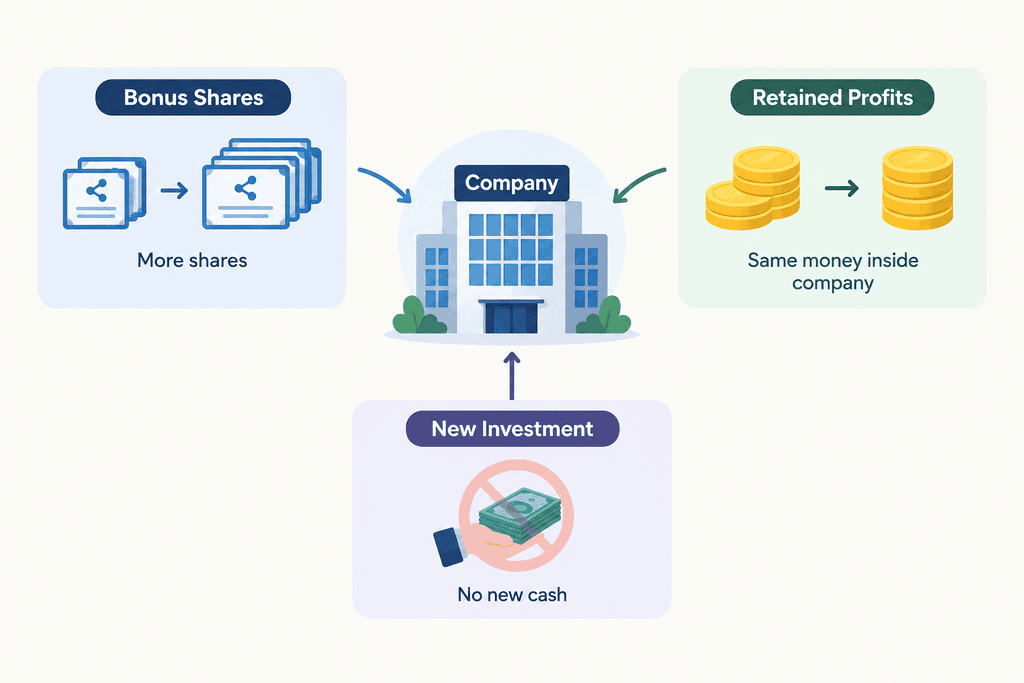
A bonus share is a share issued to existing shareholders out of the company’s own reserves. No new money enters the company. No money leaves it. The company simply moves an amount from accumulated profits into share capital and hands out new share certificates (these days, units in your demat account) to represent it.
Think about what that means for the value of the company. Before the bonus, a bank might be worth NPR 6,000 crore on the market, split across 10 crore shares. After a 20 percent bonus, it is still worth NPR 6,000 crore, because nothing about its loans, deposits, branches or profits changed overnight. It is now split across 12 crore shares instead. Each slice is smaller.
The Nepal Stock Exchange handles this by adjusting the share price right after the book closure date, the cut-off that decides who is entitled to the bonus. The formula is:
Adjusted price = Market price before book closure ÷ (1 + bonus percentage)
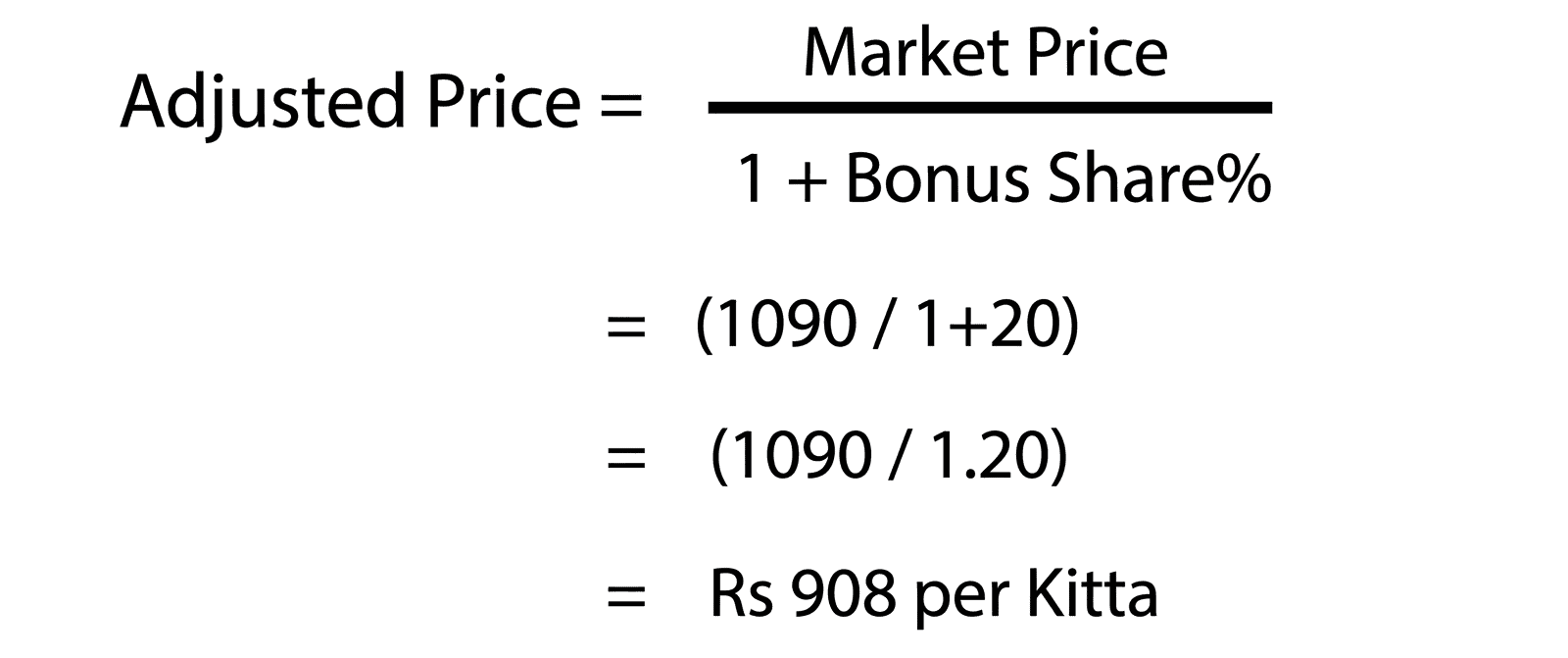
The “market price” here is the last traded price (LTP) just before book closure. ShareSansar’s own worked example uses a stock at NPR 390 issuing a 25 percent bonus: 390 divided by 1.25 gives an adjusted price of NPR 312.
That is the entire mechanism. The price drops by exactly enough to keep the company’s total market value unchanged as the share count rises. NepseKhabar and other Nepali market sites publish calculators using the same formula, so you can check any adjustment yourself.
A worked example: 100 shares become 120, and you are exactly as rich
Take a commercial bank trading at NPR 600 the day before book closure. It has declared a 20 percent bonus. You own 100 shares.
Before book closure, your holding is worth 100 × NPR 600 = NPR 60,000.
After book closure, NEPSE adjusts the price to 600 ÷ 1.20 = NPR 500. You are entitled to 20 bonus shares (20 percent of 100), so you will own 120 shares.
Your holding is now worth 120 × NPR 500 = NPR 60,000.
Not a rupee gained. Not a rupee lost. You own the same fraction of the same bank you owned yesterday, cut into more, smaller pieces.
Now look at it from the company’s side, because this is where the illusion really breaks. Say the bank earned NPR 300 crore last year on those 10 crore shares. That is earnings per share (EPS) of NPR 30. At a price of NPR 600, the stock traded at a price-to-earnings ratio of 20.
After the bonus, the same NPR 300 crore profit is spread across 12 crore shares. EPS falls to NPR 25. At the adjusted price of NPR 500, the P/E ratio is still 20. Nothing about the valuation changed. The EPS dilution and the price adjustment cancel each other out perfectly, which is precisely the point. As ICT Frame noted when NEPSE listed a batch of bonus shares in February 2026, the company’s paid-up capital rises while net worth per share and EPS are “mathematically adjusted” for the larger share count.
If you want to go deeper on how P/E works and why it matters more than the headline price, we cover it in how to use the P/E ratio on NEPSE.
Why it feels like a loss: the gap between adjustment and credit
If the math is that clean, why do so many investors panic? Because the price adjustment happens immediately. The bonus shares do not.
After the annual general meeting approves the bonus, the company has to register the shares with the Securities Board of Nepal (SEBON), get them listed on NEPSE, and then have them credited to shareholders’ demat accounts by CDS and Clearing Limited (CDSC). 2026 listing of bonus shares for Agricultural Development Bank, Shivam Cements and Asha Laghubitta describes exactly this sequence: NEPSE lists the shares first, and investors can only trade them once CDSC has credited them, which “typically takes a few additional working days” after listing. The ADBL bonus in that batch was a 3.25 percent distribution from fiscal year 2081/82 profits, and it reached the trading floor well into the following fiscal year.
So for a stretch of weeks, sometimes months, your Meroshare portfolio shows your old share count multiplied by the new, lower price. In the example above, that is 100 × NPR 500 = NPR 50,000. Your app is telling you that you lost NPR 10,000. You did not. NPR 10,000 of your value is sitting in 20 shares that exist on paper but have not yet landed in your account.
This timing gap causes two expensive mistakes.
The first is panic selling. An investor who sees a 17 percent “drop” sells in fear, often into the weakness that tends to follow a pre-bonus rally, locking in a low price for shares whose value never fell.
The second is misreading charts. On an unadjusted price chart, a bonus adjustment looks like a sharp gap down, easy to read as a “breakdown” or a stop-loss trigger. It is neither. Before you draw any conclusion from a sudden drop in a stock’s price history, check whether a book closure happened that day. If it did, you are looking at an adjustment, not a sell-off.
The myth that costs real money: “It will recover to the old price”
Nepali trading culture treats the pre-bonus price as a rightful home the stock should return to: it “will fill the gap,” it is “cheap now compared to before.” That framing is a trap.
Go back to the bank. After the adjustment, it trades at NPR 500 with EPS of NPR 25, a P/E of 20. Suppose, over the next three months, the price drifts back to NPR 600 while the bank’s profits stay exactly the same. The trading groups will celebrate the “recovery.”
But look at what you are now paying. At NPR 600 with EPS of NPR 25, the P/E is 24. The bank did not become 20 percent more valuable. Investors simply agreed to pay 20 percent more for the same rupee of earnings. That is not a recovery. It is a re-rating, and re-ratings built on a misunderstanding of arithmetic tend to unwind.
For the price to legitimately return to NPR 600 at the same P/E of 20, EPS has to climb back to NPR 30. On 12 crore shares, that means total profit has to rise from NPR 300 crore to NPR 360 crore, a 20 percent increase in actual earnings. That is the real bar. A stock that issues a 20 percent bonus needs to grow its profit by 20 percent just to stand still on a per-share basis.
Some companies clear that bar. Many do not, and this is where Nepal’s history matters. Banks, insurers and microfinance companies here have often issued bonus shares not because they had earnings to justify them but because they needed to expand paid-up capital to meet regulatory minimums. Nepal Rastra Bank’s requirement that commercial banks hold NPR 800 crore (NPR 8 arba) in paid-up capital, set in the 2015/16 monetary policy with a mid-July 2017 deadline, drove years of heavy bonus issuance across the banking sector. A bonus issued to satisfy a regulator is not a sign of surplus earning power. It is a balance sheet requirement dressed up as a gift. When EPS then shrinks with every issue, the “recovery” trade becomes a bet against arithmetic.
Our verdict is blunt. Never buy a stock after book closure because it looks “cheap compared to before the bonus.” The pre-bonus price is irrelevant. The only question is whether today’s price is reasonable relative to today’s earnings on today’s share count.
The bonus changes nothing the company does with its money
Here is the insight almost nobody in the Nepali market states plainly: the bonus decision and the retention decision are two different things, and only one of them matters for your return.
When a company earns a profit, it has two real choices. It can pay the cash out to shareholders as a cash dividend, or it can keep the cash and reinvest it. That choice, keep or pay, is what affects the company’s future value and your future return.
A bonus share is what the company does with the profit it has already decided to keep. It relabels part of the retained reserves as share capital. That relabeling moves money from one line of the balance sheet to another. It does not create earning power. A bank that keeps NPR 200 crore of profit and issues bonus shares against it has exactly the same money to lend as a bank that keeps NPR 200 crore and issues nothing. The difference is the share count and the accounting classification, not the economics.
So stop asking “how big is the bonus?” and ask two better questions. Will the company earn a good return on the profit it keeps? And is it keeping the money because it has good uses for it, or because it has to? A bank retaining profit to grow its loan book at healthy margins is making a choice. A bank retaining profit because it must meet capital norms is making no choice at all.
Neither answer shows up in the bonus percentage. Both show up in the quarterly report.
Where the bonus actually leaves you slightly poorer: tax
There is one more reason the bonus is not neutral, and it runs against the investor.
Nepal’s Income Tax Act treats the capitalization of profit into bonus shares as a distribution, the same category as a cash dividend, and it is taxed at the 5 percent dividend rate on the face value of the bonus shares (usually NPR 100 per share), not on their market value. In November 2025, SEBON’s 10th amendment to the Securities Issuance and Allotment Directive required companies to deduct and pay that tax themselves rather than chasing shareholders to deposit it.
Convenient, but the tax does not disappear. Whoever writes the check, it leaves the shareholders’ pool. On 20 bonus shares with a face value of NPR 100 each, the taxable amount is NPR 2,000, and the tax is NPR 100. Small, but real. The bonus adjustment keeps your pre-tax value constant. After tax, shareholders as a group are slightly worse off than if no bonus had been issued.
The second tax effect arrives later. Because bonus shares add to your share count without adding much to your cost, they pull down your weighted average cost per share, which increases the taxable capital gain when you eventually sell. We explain that effect in detail in why bonus shares aren’t tax-free. The short version: a bonus is taxed a little at issuance and a little more at sale.
Rights shares adjust differently, and that difference matters

Retail investors often lump bonus and rights shares together. Their adjustments work on different logic.
A rights share is an offer to buy new shares, usually at face value, in proportion to what you already hold. Unlike a bonus, fresh money enters the company. ShareSansar’s version of NEPSE’s rights adjustment formula is:
Adjusted price = (Market price + subscription price × rights percentage) ÷ (1 + rights percentage)
Example: a stock at NPR 390 offering 25 percent rights at NPR 100 per share adjusts to (390 + 25) ÷ 1.25 = NPR 332.
Now run the numbers for someone holding 100 shares. Before book closure, the holding is worth NPR 39,000. If you subscribe, you pay NPR 2,500 for 25 new shares and end up with 125 shares at NPR 332, worth NPR 41,500. That is your original NPR 39,000 plus the NPR 2,500 you paid in. You are whole.
If you do not subscribe, you still own 100 shares, but at the adjusted price of NPR 332 they are worth NPR 33,200. You are NPR 5,800 poorer. The price adjusted for new shares issued at a discount, and you did not take the discount.
That is the critical difference. A bonus adjustment leaves you whole automatically. A rights adjustment only leaves you whole if you pay up and subscribe. Ignoring a rights offer is not neutral. For the timing rules behind both, see our guide to book closure and record dates on NEPSE, including how to make sure you are on the register in time.
Does a bonus signal anything good?
To be fair, bonus shares are not meaningless. Three points count in their favor.
A company that can afford to retain profits and capitalize them is, at minimum, profitable. Bonus shares can only come from accumulated reserves, so a loss-making company cannot issue them. That is a low bar, but it is a bar.
A larger share count at a lower price can improve liquidity, which ICT Frame noted about the Asha Laghubitta listing’s effect on free float. For thinly traded companies, that has some value.
And because many investors treat bonus announcements as bullish, the announcement can support the price in the short term. That is sentiment, not value, and it tends to reverse once the adjustment lands and the book-closure chasers exit.
None of this changes the core arithmetic. On the day it happens, a bonus is value-neutral before tax and slightly negative after it.
The verdict
A bonus share is your own money cut into smaller pieces. The bonus share price adjustment on NEPSE exists to make sure you understand that, even if the trading groups do not. Your holding is worth the same the day after book closure as it was the day before, minus a small tax, and your app will tell you otherwise until CDSC credits the new shares.
The practical rules follow directly. Do not panic when the price drops after book closure; do the multiplication yourself. Do not buy a stock because it looks cheap relative to its pre-bonus price; that price no longer exists. Do not expect the stock to “recover” unless the company’s total profit grows by at least the bonus percentage. And do not let a big bonus distract you from the questions that actually decide your return: how much of its profit is the company keeping, why, and what is it earning on the money?
The investors who make money on bonus-issuing stocks are not the ones who celebrate the announcement. They are the ones who ignore it and read the earnings.
This is analysis, not financial advice.
Frequently Asked Questions
1. What happens to the share price after a bonus share is issued on NEPSE?
NEPSE adjusts the share price downward after the book closure date to account for the additional bonus shares. The adjusted price is calculated as: Adjusted Price = Market Price Before Book Closure ÷ (1 + Bonus Percentage). For example, a stock trading at NPR 600 with a 20% bonus is adjusted to NPR 500.
2. Does a bonus share make investors richer?
No. A bonus share does not create new value by itself. If you own 100 shares at NPR 600 and receive a 20% bonus, you will have 120 shares, but the adjusted price becomes NPR 500. Your total holding remains NPR 60,000 before considering taxes or subsequent price movements.
3. Why does my portfolio value fall after a bonus share adjustment?
The price is adjusted immediately after book closure, while the bonus shares may take additional time to be listed and credited to your Demat account. During this gap, your portfolio may show the lower adjusted price without showing the additional shares, making it appear as though you have suffered a loss.
4. Will a stock return to its pre-bonus price after the adjustment?
There is no automatic reason for a stock to return to its pre-bonus price. After a bonus, the company has more shares outstanding, so investors should evaluate the stock using its adjusted price, earnings and valuation. A return to the old price would require the company’s underlying earnings or valuation to support that price.
5. What is the difference between bonus shares and rights shares?
Bonus shares are issued from a company’s accumulated reserves without requiring shareholders to pay for the additional shares. Rights shares, however, are offered to existing shareholders at a specified subscription price, so investors generally need to pay to receive them. Because fresh money enters the company through a rights issue, NEPSE uses a different price-adjustment formula for rights shares.