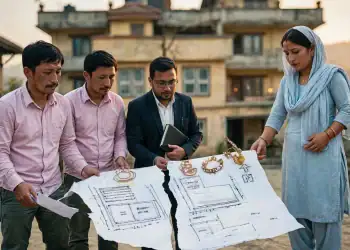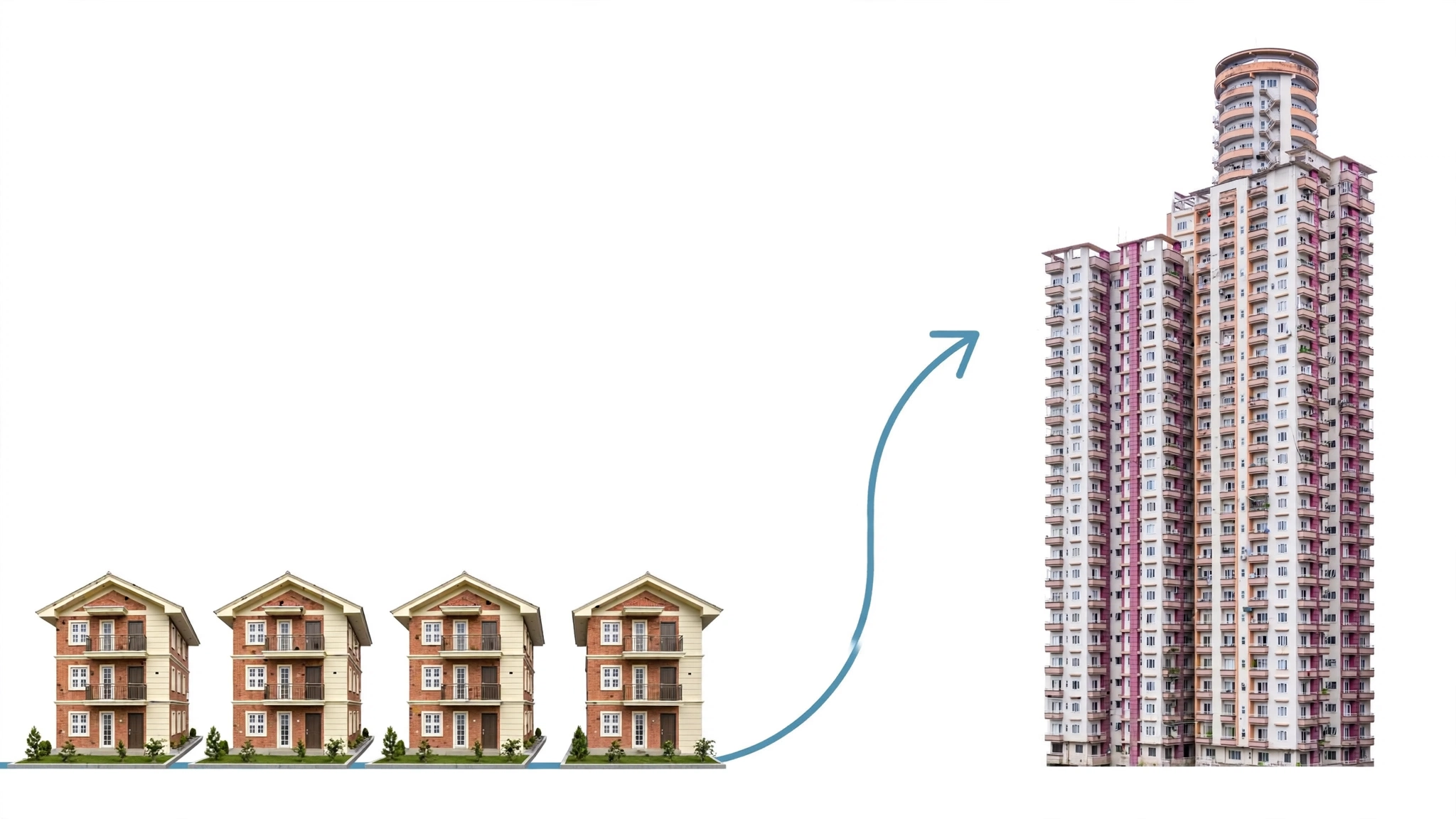
The vertical housing shift sounds simple on paper. Cities run out of land, so people move upward into apartments. In practice, this shift is messy, slow, and full of friction. Urban land keeps shrinking. Populations keep growing. Yet standalone houses remain the dream for most families, even when apartments make far more practical sense.
Why does this gap persist? The answer isn’t just personal preference. It’s a mix of weak regulation, financial hurdles, and deep-rooted cultural habits. Together, these forces slow the vertical housing shift, even in cities that clearly need it. This article unpacks each barrier, using Nepal’s fast-growing urban centers as a real, verified example.
What Is the Vertical Housing Shift?
The vertical housing shift describes the move from low-density, standalone houses to high-rise or mid-rise apartment living. It’s a natural response to urbanization. As cities grow, land becomes scarce, and building upward becomes more efficient than spreading outward.
In theory, this shift brings real benefits. Apartments use land more efficiently. They reduce urban sprawl, cut commuting time, and make services like water and electricity easier to deliver. Many cities across Asia have embraced this shift already, particularly in dense metros like Mumbai, Singapore, and Manila. Yet in cities like Kathmandu, the vertical housing shift is happening far more slowly than land pressure alone would suggest.
Regulatory Bottlenecks Holding Back the Vertical Housing Shift
Weak enforcement is the first major obstacle. Nepal’s high-rise apartment sector is governed by a patchwork of laws, including the Building Act, the National Building Code, and municipal bylaws. On paper, these rules cover structural safety, fire protection, and seismic design. In practice, compliance monitoring is thin.
Officials at the Department of Urban Development and Building Construction have openly admitted this gap. The department has issued permits to just 63 high-rise apartment projects across the Kathmandu Valley. Yet it lacks updated, reliable records on which of those projects are actually complete or occupied. Staff have cited a lack of manpower as the reason follow-up monitoring rarely happens.
This regulatory gap became especially visible after the 2015 Gorkha earthquake. A structural review of high-rise apartments in the valley raised public concern about seismic safety, open space around towers, and fire escape access. Residents in neighboring standalone houses also raised safety objections about nearby high-rises, adding further delays to new approvals.
Ownership law adds another layer of complexity. Apartment ownership in Nepal rests mainly on the Ownership of Joint Housing Act of 1997, along with its 2003 procedural rules. But unlike some countries, Nepal has no single, fully consolidated condominium law. Instead, ownership blends property law, the Civil Code, and site-specific registration processes. Developers handle common areas, shared amenities, and unit titles somewhat inconsistently. That inconsistency can create ownership disputes, which makes buyers understandably cautious.
Sewage and wastewater treatment present a further compliance issue. Nearly every high-rise applicant claims to include a treatment plant in project plans. Yet regulators say resource constraints often prevent proper follow-up, leaving actual compliance unverified. Together, these regulatory gaps slow the vertical housing shift by undermining public trust in apartment safety and legal clarity.
Financial Bottlenecks: Loans, Liquidity, and Land Economics
Money matters just as much as regulation. Financial friction shapes household decisions at every stage of the vertical housing shift, from loan approval to long-term affordability.
Recent central bank data shows a striking pattern. In the first eight months of fiscal year 2025/26, housing loan disbursements in Nepal fell 31 percent compared with fiscal year 2022/23. At the same time, the average loan size dropped by 12 percent, to roughly NPR 7.8 million. That suggests many buyers are scaling down their ambitions, choosing smaller plots in cheaper areas rather than apartments in prime locations.
Lending conditions remain tight, even when rates look attractive. Nepal Rastra Bank cut its policy rate by 50 basis points in December 2025, with inflation cooling to around 3.8 percent. Some banks now advertise promotional home loan rates near 11.49 percent for the first year. Yet banks still require 35 to 40 percent cash equity upfront, alongside strict income verification. That’s a steep barrier for many middle-income households eyeing apartment ownership.
Loan-to-value rules add further complexity. The central bank raised the loan-to-value ratio for housing loans in the Kathmandu Valley to 50 percent, up from 30 percent, specifically to spur demand. Despite this, real estate agents report that transactions remain sluggish. Falling interest rates and easier loan access haven’t translated into stronger demand, showing that affordability isn’t the only constraint at play.
Supply-side economics compound the problem. Roughly 24,000 ropani of marked residential land currently sits available in the valley, enough to cover an estimated 28 months of sales at current absorption rates. Commercial plots face an even larger backlog, worsened by a new commercial building code that cut buildable area by 15 percent. With so much land still available, developers face real pressure to price apartments competitively, yet construction costs, land prices, and financing costs make that difficult.
Notably, cash buyers now dominate the market. In 2025, cash purchases, largely funded by remittances from Nepalis working abroad, made up 62 percent of registered property deeds, up sharply from 38 percent in 2021. This shift shows that everyday mortgage-financed buyers are shrinking as a share of the market, while remittance-funded, often land-focused, purchases grow. That trend works against apartments, since land purchases remain the more culturally familiar, remittance-friendly option.
Cultural Resistance to the Vertical Housing Shift
Even where financing and regulation align, cultural habits still hold the vertical housing shift back. Owning standalone land carries deep symbolic weight in many South Asian societies, Nepal included.
Land ownership traditionally signals permanence, security, and status within a family and community. A standalone house, often built gradually over years or even decades, becomes a generational asset. Families frequently pass land down according to inheritance customs, and multi-generational households commonly expect to expand a family home over time, adding floors as children marry and grow.
Apartments disrupt this model. Shared walls, shared management committees, and limited space for future expansion don’t fit neatly into these traditions. Many buyers also worry about long-term control. With standalone houses, owners manage their own property fully. With apartments, owners share responsibility for common areas, maintenance funds, and building decisions through a management committee, a system that still feels unfamiliar and, at times, distrusted.
There’s also a perception gap around safety and quality. Despite generally solid earthquake performance during the 2015 disaster, public skepticism about high-rise structural safety persists. Combined with inconsistent regulatory follow-up, this skepticism reinforces a cultural preference for smaller, self-built homes that owners can inspect and control directly.
Lessons From Cities That Made the Shift
Some cities offer a useful contrast. Singapore, for instance, pushed the vertical housing shift decades ago through a highly centralized public housing program. Government-built apartments came with clear titles, strict maintenance standards, and predictable resale rules. That combination gave buyers confidence the private market alone often struggles to provide.
Mumbai took a different path, driven mainly by extreme land scarcity rather than policy design. Vertical housing became the default option simply because horizontal expansion ran out of room decades ago. Even there, though, older neighborhoods still show strong pockets of resistance to redevelopment, often rooted in the same ownership and inheritance concerns seen in Kathmandu.
The common thread across successful cases is trust. Buyers need confidence that titles are secure, buildings are safe, and shared management will function fairly over time. Where that trust exists, the vertical housing shift tends to accelerate quickly, sometimes within a single generation. Where it’s missing, land-based housing persists stubbornly, even under serious space constraints.
The Role of Urban Planning Policy
Zoning and land-use rules shape the vertical housing shift just as much as housing finance does. Nepal’s Land Use Regulation, introduced in recent years, initially restricted land plotting to discourage sprawling, poorly planned subdivisions. That policy aimed to nudge development toward denser, more organized housing.
In practice, though, the plotting ban created unintended friction. It disrupted a real estate sector already strained by pandemic-era slowdowns and tighter lending rules. The government later eased these restrictions, hoping to revive transactions. Still, easing land-plotting rules doesn’t automatically direct demand toward apartments. Without parallel incentives favoring vertical construction, loosened land rules can simply reinforce the status quo, more standalone plots, rather than pushing buyers toward high-rises.
A more balanced approach would pair any land-use flexibility with meaningful apartment incentives, such as faster permit processing for compliant vertical projects or reduced registration fees for first-time apartment buyers. Without that pairing, planning policy risks working against the very shift it’s meant to support.
Why These Bottlenecks Reinforce Each Other
None of these barriers operates alone. Weak regulatory enforcement fuels cultural distrust of apartment safety. That distrust then reduces demand, which discourages banks from expanding favorable financing for apartment purchases. Reduced financing options push buyers back toward smaller land plots, reinforcing the very land-based housing pattern that the vertical housing shift is supposed to replace.
This cycle explains why Nepal’s urban housing loan growth, while significant since the pandemic, still hasn’t translated into a decisive shift toward high-rise living. Real estate loans grew substantially between fiscal years 2020-21 and 2024-25, yet much of that growth reflects land and standalone housing, not apartment adoption specifically.
What Could Accelerate the Vertical Housing Shift
Progress is possible, but it requires coordinated action across all three fronts. On regulation, stronger post-approval monitoring would rebuild public trust. Clearer, unified condominium ownership law would reduce disputes and protect buyers directly.
On financing, more flexible loan-to-value terms specifically for verified, compliant apartment projects could help. Targeted incentives, like reduced equity requirements for first-time apartment buyers, would also widen access beyond cash-rich purchasers.
On culture, visible success stories matter most. As more families experience apartment living positively, safely, affordably, and with well-managed shared spaces, cultural resistance tends to soften gradually. This pattern has played out in other rapidly urbanizing Asian cities, where apartment living shifted from an unfamiliar option to a mainstream expectation within a generation.
Conclusion
The vertical housing shift isn’t failing because land pressure is weak. Land in cities like Kathmandu remains genuinely scarce, and demand for housing keeps growing. Instead, the shift stalls because regulation, financing, and culture haven’t moved together. Builders face inconsistent oversight. Buyers face steep equity requirements and cautious banks. Families face a cultural pull toward land ownership that apartments haven’t fully replaced yet. Closing these gaps, not just building more towers, is what will ultimately determine how fast the vertical housing shift takes hold.
FAQ: Vertical Housing Shift and Apartment Adoption
What is the vertical housing shift?
It’s the transition of urban populations from standalone houses to apartment or high-rise living, driven mainly by land scarcity and rising urban density.
Why do people still prefer standalone houses over apartments?
Cultural attachment to land, generational inheritance customs, and a desire for full control over property all make standalone houses more appealing, even when apartments offer practical advantages.
Are high-rise apartments in Nepal regulated for safety?
Yes, through the Building Act, National Building Code, and municipal bylaws. However, monitoring after project approval is often inconsistent, which raises public concern.
What financial barriers slow apartment adoption?
High upfront equity requirements, typically 35 to 40 percent, along with strict income verification and cautious bank lending, make apartment purchases harder for many middle-income buyers.
Is apartment ownership legally secure in Nepal?
Apartment ownership is governed mainly by the Ownership of Joint Housing Act of 1997. However, the absence of a single consolidated condominium law can create ownership and common-area disputes.
How can cities encourage a faster vertical housing shift?
Stronger regulatory enforcement, more accessible financing for verified apartment projects, and positive, visible examples of well-managed apartment living all help shift cultural attitudes over time.
Do falling interest rates alone solve the vertical housing shift problem?
No. Even with lower policy rates and easier loan access, demand for apartments has stayed weak in markets like Kathmandu, showing that regulatory trust and cultural preference matter just as much as affordability.
Why do remittance-funded buyers favor land over apartments?
Land purchases feel more familiar and lower-risk to remittance senders, since they avoid shared ownership structures and management committees that apartments require.