Nepal’s economy runs on a stubborn imbalance. Imports keep climbing, while exports struggle to catch up. In fact, the trade deficit crossed Rs 1.44 trillion in the first ten months of FY 2025/26 alone.
Understanding the export challenges from Nepal helps explain why this gap keeps widening, even as export figures technically grow.
This article breaks down the structural, logistical, and policy barriers behind that story. Along the way, you’ll see why headline growth numbers often hide a weaker underlying picture.
A Landlocked Nation Facing Real Geography
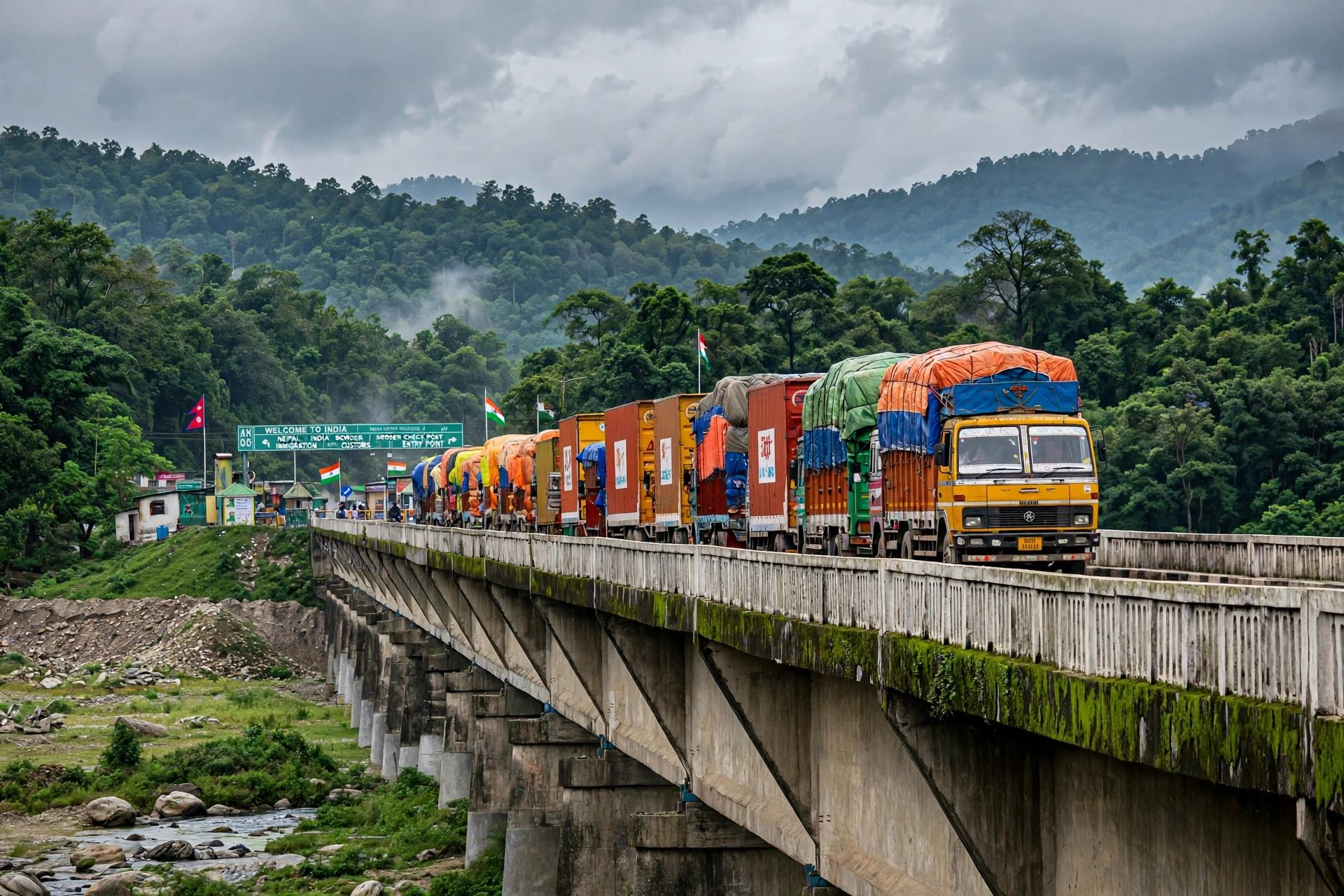
First, geography itself creates a fundamental obstacle. Nepal is landlocked, sandwiched between India and China. Consequently, every export shipment must cross a neighboring country before reaching a seaport.
Kolkata port, Nepal’s primary gateway, sits roughly 460 miles from the Nepal-India border. Even the shortest reliable road route from India into the Kathmandu Valley takes at least five hours. Many cargo trucks, however, travel a longer 175-mile route that stretches closer to seven hours.
As a result, shipping costs rise sharply compared to coastal competitors. Perishable goods also face spoilage risk during these extended transit times. Therefore, landlockedness isn’t just an inconvenience. It’s a persistent tax on nearly everything Nepal tries to sell abroad.
Overreliance on a Narrow Export Basket
Next, consider what Nepal actually exports. The list stays surprisingly narrow: woolen carpets, readymade garments, pashmina, tea, large cardamom, yarn, and increasingly, re-exported edible oil.
Recently, that basket has skewed even further. In the first seven months of FY 2025/26, total exports rose 32.2 percent year-on-year. However, this growth came almost entirely from processed soybean and palm oil shipments to India. These products rely on imported crude oil inputs, repackaged to exploit preferential tariffs under the South Asian Free Trade Area.
Consequently, analysts describe this pattern as an “arbitrage mirage.” Export figures look strong on paper, yet they add little real domestic value. Meanwhile, traditional high-value exports tell a different story entirely.
Declining Performance in Traditional Export Sectors
Indeed, several long-standing export categories have actually shrunk. Yarn exports fell 6.23 percent in one recent review period. Carpet shipments dropped 13.17 percent, while readymade garments declined 2.07 percent. Tea exports fell sharply too, down 24.10 percent year-on-year.
Iron and steel products, once a top export earner, plunged even further. Similarly, large cardamom, ginger, medicinal herbs, and essential oils all posted declines in recent fiscal periods. Since these products historically generated more domestic value than re-exported oil, their decline signals a deeper competitiveness problem, not just a temporary dip.
Heavy Dependence on India as a Trading Partner
Furthermore, Nepal’s exports lean overwhelmingly on a single market. India absorbs the vast majority of Nepali goods, particularly the recent surge in processed edible oil. When combined with China, these two neighbors account for close to 78 percent of Nepal’s total imports too.
This concentration carries real risk. Small, landlocked economies naturally trade heavily with large neighbors, and Nepal’s open border with India does bring genuine efficiency benefits. Even so, that dependence turned painful during the 2015 border blockade, when fuel and essential goods stopped moving for months. A single policy shift in Delhi, therefore, can ripple through Nepal’s entire export economy overnight.
Quality Certification and Testing Gaps
Another major barrier involves quality standards. Nepal often lacks the domestic laboratories needed to certify agricultural exports. Consequently, farmers must send products like large cardamom to India for testing and certification.
This process adds real cost and delay. Traders have reported verification costs reaching as high as USD 1,700 per shipment. Because of this, Nepal has struggled to export large cardamom directly to third-country markets, relying instead on India as an intermediary.
Additionally, India recently tightened its own standards. The Bureau of Indian Standards began requiring quality certification for raw materials used in steel utensils, not just finished goods. As a direct result, Nepali steel utensil exports to India halted for two consecutive months. This example shows how quickly a neighboring country’s regulatory shift can disrupt Nepali trade.

Weak Infrastructure and Logistics Bottlenecks
Physical infrastructure remains another persistent weak point. Nepal’s textile and garment sector, for example, suffers from weak roads, limited dry-port capacity, and transportation systems that lengthen lead times.
Because shipments often pass through multiple checkpoints and transshipment points, delivery timelines stretch far beyond what competitors offer. Buyers in fashion and textiles, in particular, prize speed and reliability. Consequently, Nepal often loses orders to countries with faster, more predictable logistics chains.
Limited access to modern technology compounds the problem. Many factories still rely on outdated equipment, which slows production and raises per-unit costs. Combined with human resource shortages, this leaves Nepali exporters struggling to compete on price and turnaround time alike.
Limited Processing and Value Addition Capacity
Similarly, Nepal exports too many raw or semi-processed goods. Large cardamom offers a clear example. Because processing units remain scarce, Nepal cannot easily convert raw cardamom into higher-value products before shipping it abroad.
This pattern repeats across sectors. Ginger, medicinal herbs, and essential oils often leave Nepal in relatively unprocessed form. As a result, other countries capture the profit margin that comes from further processing and branding. Building domestic processing capacity, therefore, remains one of Nepal’s clearest paths toward higher export earnings.
Currency, Financing, and Access to Capital
Access to finance also limits export growth. Many small and medium exporters struggle to secure affordable credit for equipment upgrades or working capital. Without financing, upgrading machinery or scaling production becomes nearly impossible.
Meanwhile, the Nepali rupee’s depreciation against the dollar cuts both ways. It technically makes exports cheaper for foreign buyers. However, it also raises the cost of imported raw materials, many of which Nepali manufacturers depend on. Consequently, currency movements alone can’t offset the deeper structural weaknesses exporters face.
Climate Change Adding New Agricultural Risk
Climate change has also emerged as a growing threat. Cardamom farmers, for instance, increasingly face erratic weather patterns and pest infestations. These disruptions raise both costs and uncertainty for growers who already operate with thin margins.
Because farmers often lack resources to adapt, climate shocks translate directly into export volume losses. Combined with weak value-chain linkages between farmers and traders, this leaves agricultural exporters especially vulnerable to seasonal disruption.
LDC Graduation: A Looming Structural Test
Perhaps the biggest looming challenge involves Nepal’s graduation from least developed country status. This transition is scheduled for November 2026, alongside Bangladesh and Laos, though Nepal has separately requested a deferral to 2030.
Graduation reflects genuine development progress. Still, it also means losing preferential trade access and duty-free market benefits that Nepali exporters currently enjoy, particularly in garments and textiles. Countries like Cambodia have already started preparing, using WTO support to master “rules of origin” requirements and invest in garment sustainability.
Nepal’s growth, meanwhile, remains largely consumption-driven, financed by remittances rather than export competitiveness. Unless the country strengthens its export base before graduation, losing these preferences could hit manufacturers hard, right when they need support most.
Political Instability and Policy Uncertainty
Finally, political disruption continues to affect trade planning. Recent civil unrest and a special election have widened Nepal’s fiscal deficit and slowed public investment. Growth projections have dipped as a result, adding uncertainty for exporters trying to plan long-term contracts.
Additionally, inconsistent policy support has historically hampered sectors like garments and carpets. Without stable, predictable trade policy, exporters find it harder to attract the investment needed for modernization and expansion.
Final Thoughts on Nepal’s Export Challenges
Ultimately, the export challenges from Nepal stem from overlapping structural issues. Landlocked geography raises costs before goods even leave the country. A narrow, India-dependent export basket limits diversification. Weak infrastructure, limited processing capacity, and certification gaps further erode competitiveness.
Meanwhile, climate risk and looming LDC graduation add fresh urgency to the problem. Addressing these challenges will require sustained investment in infrastructure, testing facilities, and value-added processing. Without that shift, Nepal’s trade deficit will likely keep widening, even as headline export numbers occasionally look strong.
Frequently Asked Questions
What are the main export challenges from Nepal?
Key challenges include landlocked geography, heavy reliance on India, weak infrastructure, limited quality certification facilities, and a narrow range of export products.
Why does Nepal have such a large trade deficit?
Nepal imports far more than it exports, including fuel, machinery, and raw materials. Meanwhile, exports remain concentrated in low-value or re-exported goods, keeping the deficit wide.
How does being landlocked affect Nepal’s exports?
Nepal relies on Kolkata port in India for most sea trade, adding significant transport time and cost. This raises shipping expenses and increases spoilage risk for perishable goods.
Why do Nepali farmers struggle with export certification?
Nepal lacks sufficient domestic testing laboratories, so farmers must send products to India for certification. This adds delays and costs that can reach USD 1,700 per shipment.
How will LDC graduation affect Nepal’s exports?
Graduating from least developed country status means losing preferential trade access and duty-free benefits, particularly for garments. This could hurt manufacturers unless Nepal strengthens competitiveness beforehand.
Which products make up most of Nepal’s exports?
Woolen carpets, readymade garments, pashmina, tea, large cardamom, yarn, and increasingly re-exported edible oil form the core of Nepal’s export basket.