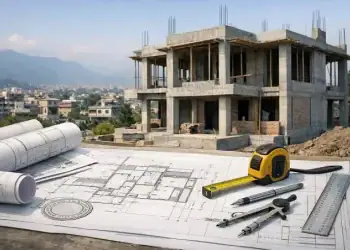
Two buyers put money down on an unfinished flat. One is in Pune, the other in Patan. Both watch the completion date slip by a year. The Pune buyer can file a complaint with a state regulator, demand monthly interest on every rupee paid, and in many cases force a refund with a tribunal order behind it. The Patan buyer writes letters, waits, and hopes the developer stays solvent. That gap is the subject here, and it has a name: India built a Real Estate (Regulation and Development) Act, and Nepal never did.
Key Takeaways
- India’s RERA, in force fully since 1 May 2017, forces developers to park 70% of money collected from buyers in a separate account spent only on that project, with withdrawals signed off by an engineer, architect, and chartered accountant.
- Any project on a plot of 500 square meters or more, or with more than eight apartments, must register with a state authority before it can be sold or advertised. Agents must register too.
- RERA prices flats on carpet area (net usable floor area), ending the older practice of charging buyers for inflated “super built-up” space.
- By mid-2025, roughly 150,000 projects and 100,000 agents had registered across India’s state authorities, and about 150,000 buyer complaints had been resolved since the law began, per an industry analysis reported by Business Standard.
- Nepal has no equivalent regulator. Real estate here runs on the National Civil Code, the Lands Act, the Registration Act, and the Joint Housing Ownership Act (2054 B.S.), none of which escrow buyer payments or guarantee refunds on delay.
- Nepal’s protection gap is not theoretical: documented episodes left apartment buyers facing losses of at least Rs 1.33 billion with no regulator mandated to pursue the developers.
What RERA actually changed
Before 2016, an Indian developer could take booking money for Tower B, spend it finishing Tower A, and leave Tower B buyers holding receipts and little else. The Real Estate (Regulation and Development) Act closed the most expensive of those loopholes. Its central mechanism is the escrow rule: 70% of the amount collected from buyers for a project must sit in a dedicated bank account and can be drawn down only for that project’s land and construction, and only after a certifying engineer, architect, and chartered accountant confirm the work matches the withdrawal. The design intent is narrow and useful. It makes it structurally harder to divert one project’s cash into another, which is how most stalled-tower stories begin. The provisions are laid out in the Government of India’s own factsheet (PIB, Ministry of Housing and Urban Affairs).
Registration is the second pillar. A project on at least 500 square meters, or with more than eight apartments, cannot legally be marketed or sold until it is registered with the state Real Estate Regulatory Authority, with approved plans, title documents, and a delivery timeline on the public record. Agents who sell those units register separately. The law also reset how buyers are billed. Flats are priced on carpet area, the net usable floor area, rather than a loosely defined super built-up figure that once let two “1,000 square foot” flats deliver very different living space.
When a developer misses the agreed handover date, the buyer gets a statutory choice: walk away with a full refund plus interest, or stay in and collect interest for every month of delay until possession. Enforcement carries teeth on paper. Altering sanctioned plans without consent can cost a promoter up to 10% of the project cost or up to three years in prison, and agents face up to a year for defying tribunal orders.
The record, with the asterisks
The scale is real. By mid-2025, around 150,000 projects and 100,000 agents had registered across India’s states, and roughly 150,000 consumer complaints had been resolved since the law’s inception, according to a Knight Frank analysis reported by Business Standard. A buyer today transacts with far more information than a buyer did in 2015.
The asterisks matter just as much, and Nepal should copy the law without copying the wishful thinking around it. RERA is a state subject, so enforcement is uneven: a complaint moves quickly in one state and stalls in another, which is why industry groups keep pushing a “One Nation, One RERA” standard. Tribunals carry backlogs, and a refund order is worth little against a developer who has already run out of cash. Compliance also raised the cost of launching a project, and smaller builders in several states slowed registrations. The honest summary is that RERA shifted the odds toward buyers without eliminating risk. For Nepal, the lesson is not that a statute is magic. It is that a law with an institution behind it beats no law at all.
What Nepal has instead
Nepal regulates land and buildings through a stack of general laws rather than a buyer-protection statute. The National Civil Code (2017) sets ownership and transaction rules, the Lands Act and the Registration Act govern title and deed registration at the Land Revenue Office, and the Joint Housing Ownership Act (2054 B.S., 1997) covers shared ownership in apartment buildings (Nepal Law Commission). Municipalities issue building permits, the environment ministry handles impact assessments, and the Department of Land Management and Archives licenses real estate businesses. What none of this does is hold a buyer’s money in trust, register a project’s delivery promise before sale, or give a buyer a fast refund when a tower stalls. The framework behind every title is covered in our explainer on Nepal’s Land Revenue Act.
The gap shows up in the record. In an episode first reported in 2011, the Department of Urban Development and Building Construction ordered Kathmandu Valley land revenue offices to stop transferring ownership to buyers of 19 developers after inspecting 85 housing and apartment projects. Thirteen of the 19 had never completed the required environmental assessment or obtained structural permits, yet had taken bookings and started building anyway. The buyers, who had already paid in full or in part, absorbed the consequences. A few years later, buyers tied to financially troubled cooperative developers stood to lose at least Rs 1.33 billion, with 468 complaints filed to a government commission that, by its own account, lacked the mandate to investigate those who had duped them (ShareSansar). These are older cases, but the structural hole they exposed, money taken before approvals, no escrow, no regulator with power to recover, has not been filled.
What a RERA for Nepal would and would not fix
A Nepali version would not need to be elaborate to help. Three mechanisms carry most of RERA’s weight. An escrow requirement would stop one project’s booking money from funding another. Mandatory pre-sale registration of apartment projects, with approved plans and a dated delivery commitment, would move the environmental and structural checks to before buyers pay rather than after. A statutory delay remedy would give buyers a defined claim instead of a civil case that outlasts the building. Agent registration is the natural fourth piece, and it connects directly to a problem Nepal already lives with, the informality of ghar jagga brokerage, where unlicensed dalals carry no accountability for what they sell.
The tradeoffs are equally real and worth saying plainly. A regulator costs money and staff Nepal would have to fund and keep honest; a rule on paper with no tribunal behind it repeats India’s weakest results, not its best ones. Escrow and compliance raise developers’ costs, and some of that lands on prices, so a law written carelessly could slow the very apartment supply Kathmandu needs. There is also a sequencing point: much of Nepal’s dispute volume comes from informal, undocumented dealing, the same pattern seen in commercial leasing, and a buyer-protection law works best alongside better documentation, not as a substitute for it. Until any of this exists, the burden stays on the buyer: verify title and permits at the Land Revenue Office before paying, insist on approved drawings, stage payments against construction milestones, and use documented listings, such as those on Basobaas, rather than word of mouth. None of that equals a regulator. It is simply what buying without one requires.
For more on Nepal’s property market and the rules that shape it, see our Real Estate coverage.
Frequently Asked Questions
What is RERA and when did it take effect?
RERA is India’s Real Estate (Regulation and Development) Act, 2016, which came into force fully on 1 May 2017. It created state-level regulatory authorities to register real estate projects and agents, protect homebuyers, and resolve disputes through dedicated tribunals.
Does Nepal have a RERA-style real estate regulator?
No. Nepal has no dedicated real estate regulatory authority or buyer-protection law. Transactions are governed by general statutes including the National Civil Code (2017), the Lands Act, the Registration Act, and the Joint Housing Ownership Act (2054 B.S.), none of which require escrow of buyer funds or guarantee refunds on delayed projects.
What is RERA’s 70% escrow rule?
Under RERA, a developer must deposit 70% of the money collected from buyers for a project into a separate bank account used only for that project’s land and construction. Withdrawals require certification from an engineer, architect, and chartered accountant confirming the work has progressed. The aim is to stop developers from diverting one project’s funds to another.
How would a RERA for Nepal protect apartment buyers?
A Nepali equivalent could require escrow of buyer payments, mandatory registration of apartment projects before sale with approved plans and delivery dates, a statutory remedy of refund or interest on delay, and licensing of agents. Together these would move safety checks to before buyers pay and give them an enforceable claim if a project stalls.
How can Nepali buyers protect themselves without a regulator?
Verify the title deed and that the project holds building and environmental approvals at the Land Revenue Office before paying, demand approved construction drawings, tie payments to construction milestones rather than paying large sums upfront, and rely on documented listings and written agreements instead of informal assurances from unlicensed brokers.