Every time Nepal’s central bank sets policy, one number never moves. The Nepali rupee stays locked to the Indian rupee, day after day, year after year.
This is the NPR-INR pegged exchange rate, and it’s arguably the single most consequential feature of Nepal’s entire monetary system. It shapes inflation, trade, remittances, and even how much control Nepal actually has over its own economy.
For decades, this peg has delivered genuine stability. However, it also comes with real trade-offs, particularly around export competitiveness and independent monetary policy. Understanding both sides matters, especially as Nepal’s foreign reserves reach record highs and the debate over the peg’s future resurfaces.
In this article, we’ll explain how the NPR-INR pegged exchange rate actually works, what benefits it provides, and where its limitations show up most clearly.
How the NPR-INR Pegged Exchange Rate Works
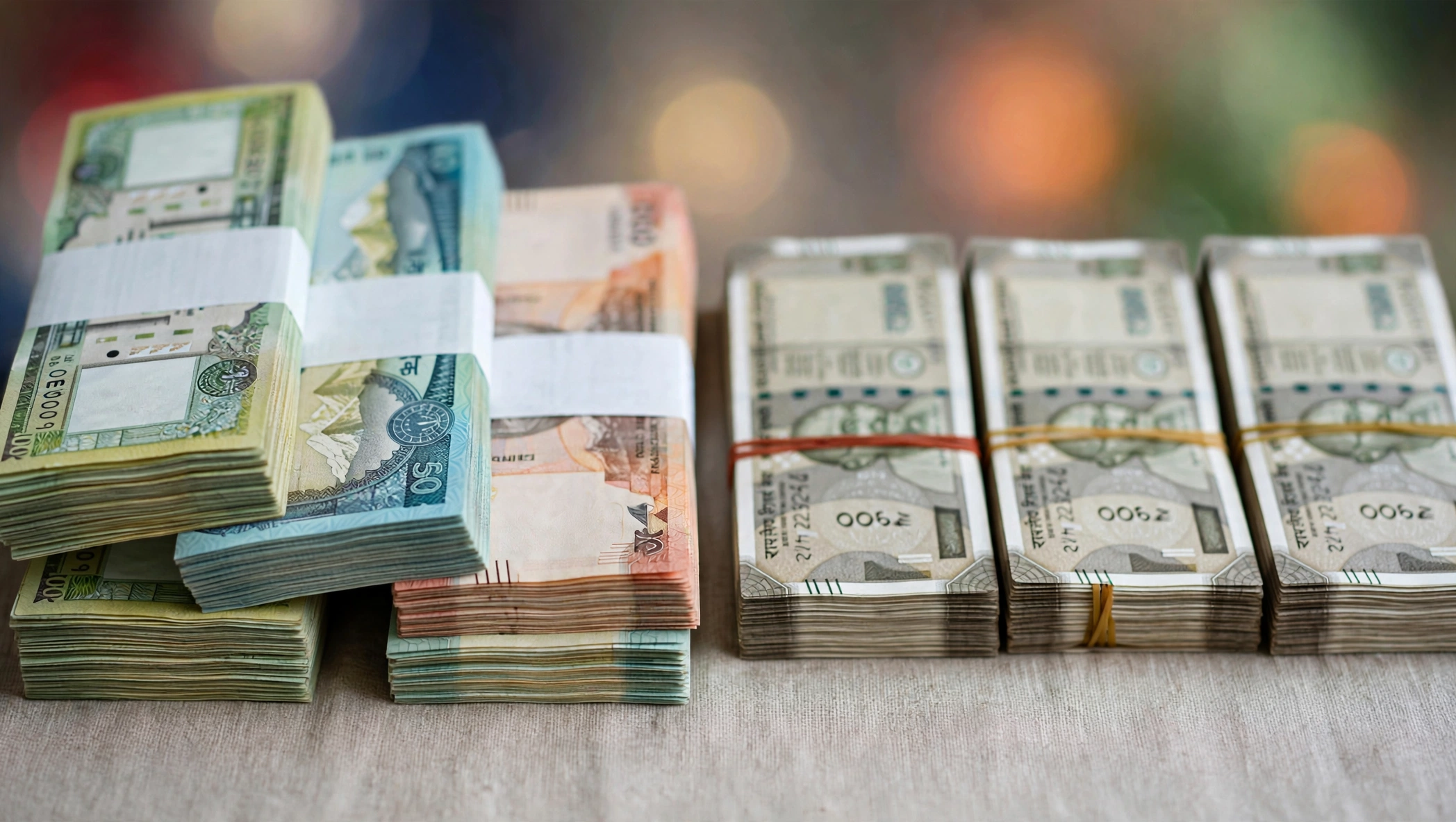
The mechanics here are refreshingly simple, at least on the surface. According to Merokalam’s 2026 exchange rate guide, the Nepali rupee is fixed to the Indian rupee at a rate of 100 INR equals 160 NPR, meaning 1 NPR equals 0.625 INR.
This fixed relationship means Nepal effectively imports its exchange rate policy from India, for everything beyond the direct NPR-INR relationship. Since India operates its own managed float against global currencies like the US dollar, Nepal’s exchange rate with the rest of the world becomes indirectly derived from India’s rate, simply multiplied by the constant peg ratio.
Nepal actually operates what economists call a dual exchange rate system. According to research published on ResearchGate, the Nepali rupee is pegged specifically to the Indian rupee, while floating freely against the US dollar and all other global currencies. This distinction matters enormously for understanding how Nepal’s currency actually behaves day to day.
A Peg with Deep Historical Roots
This arrangement didn’t appear overnight. It reflects decades of gradually formalized monetary policy, dating back much further than most people realize.
According to research from Sushil Parajuli, Nepal began pegging its currency to the Indian rupee back in 1960, aiming to build public confidence in Nepali currency and reduce the disruptive fluctuations that had undermined its domestic use during the 1950s. Before that, Nepal had experienced a genuinely flexible exchange rate with Indian currency, which caused substantial instability.
The peg was formally fixed at its current structure in 1994, according to CityPay’s 2026 currency guide, replacing what had been a somewhat more flexible arrangement. Interestingly, research published on ResearchGate notes that the specific INR-NPR rate has actually remained unchanged since February 12, 1993, even predating the 1994 formalization by about a year.
Before this final adjustment, according to Merokalam, the rate stood at 100 INR equals 155 NPR. The shift to 160 NPR reflected relative purchasing power conditions at the time. Since then, remarkably, this exact rate has held steady for over three decades.
The Stability Benefits Nepal Actually Gets
Given how long this peg has persisted, it clearly delivers something valuable. The benefits are real and well documented.
Perhaps most importantly, the peg provides genuine monetary stability and predictability for Nepal’s economy. Since Nepal and India share an open border under the 1950 Treaty of Peace and Friendship, according to Merokalam, Indian rupees have circulated alongside Nepali currency for as long as both have existed. A stable, predictable exchange rate between these two deeply intertwined economies reduces transaction friction enormously for cross-border trade, labor migration, and remittance flows.
The peg also helps anchor Nepal’s inflation indirectly through India’s monetary conditions. According to the World Bank’s April 2026 Nepal Development Update, inflation is projected to moderate in fiscal year 2028 as global commodity prices ease and inflation in India declines, which, through Nepal’s currency peg, helps contain imported inflation. This demonstrates a direct, functioning transmission channel between Indian monetary conditions and Nepal’s own price stability.
Given Nepal’s heavy trade dependence on India, this stability genuinely matters. According to Nepal News’s mid-2026 macroeconomic coverage, exports to India increased 16.1% during a recent ten-month period, while imports from India also grew substantially. A stable exchange rate removes currency risk from this enormous volume of cross-border commerce.
Why Nepal’s Reserves Look So Strong Right Now
Nepal’s current foreign exchange position looks genuinely robust, and understanding why matters for evaluating the peg’s sustainability.
According to Nepal News’s coverage of Nepal Rastra Bank’s ten-month report for fiscal year 2025/26, foreign exchange reserves reached Rs 3,704.55 billion, equivalent to 19.2 months of import cover, as of mid-May 2026. That’s dramatically above Nepal Rastra Bank’s own regulatory target of just seven months, according to NEPSE Trading’s analysis.
Earlier data points confirm this wasn’t a one-time spike. According to Sharesansar’s reporting, reserves stood at USD 22.47 billion by mid-January 2026, sufficient to cover 21.4 months of merchandise imports alone, or 18.1 months when including services imports. Notably, Indian currency specifically accounted for 22.3% of Nepal’s total foreign exchange reserves at that time.
However, a Kathmandu Post opinion piece published in April 2026 raises an important caveat. These reserves, now reaching roughly $23 billion, aren’t built on a manufacturing export boom. They’re built almost entirely on a surge in remittance inflows. This distinction matters enormously for understanding just how fragile this apparent strength might actually be.
The Export Limitation Problem
Here’s where the peg’s real cost becomes visible. By locking NPR to INR, Nepal effectively surrenders one of the most common tools countries use to boost export competitiveness, independent currency devaluation.
Nepal’s trade data illustrates just how significant this limitation has become. According to Nepal News’s explainer on Nepal’s trade deficit, total imports reached Rs 1.4905 trillion during a recent nine-month period, compared to exports of just Rs 222.94 billion. That means imports run roughly 6.7 times larger than exports, an enormous structural imbalance.
Even when exports grow faster than imports in percentage terms, the underlying gap barely narrows. According to the same analysis, exports grew 18.46% during this period, actually outpacing 13.82% import growth. Yet, because the import base starts so much larger, even slower percentage growth in imports adds more absolute value than faster export growth, keeping the trade deficit structurally wide.
More recent ten-month data confirms this pattern continuing. According to Nepal News, merchandise exports grew 14.2% to Rs 248.96 billion, while imports rose 14.8% to Rs 1,692.64 billion, widening the trade deficit by 14.9% to Rs 1,443.68 billion. The export-import ratio stood at just 14.7%, meaning Nepal’s exports cover only a small fraction of its import bill.
Crucially, terms of trade data reveals the peg’s competitiveness cost directly. According to Nepal News, the export price index rose just 3.1%, while the import price index surged 24%, causing terms of trade to deteriorate by 16.9%. Under a floating exchange rate, currency depreciation would typically help offset exactly this kind of competitiveness erosion, by making exports cheaper and imports more expensive. Under the peg, Nepal simply can’t access this adjustment mechanism.
The Monetary Independence Trade-Off
Beyond exports specifically, the peg fundamentally limits Nepal Rastra Bank’s independent monetary policy flexibility, a cost that becomes more visible during periods of economic stress.
According to Nepal News’s coverage of NRB’s eight-month report, the central bank’s reserve buffer specifically “supports currency stability under the peg with the Indian rupee, and allows the central bank flexibility in managing liquidity.” Notice the framing here. Flexibility exists specifically because reserves are strong right now, not because the peg itself grants independent policy tools.
The 2022-23 period demonstrated what happens when this buffer weakens. According to CityPay’s currency guide, Nepal faced a severe foreign exchange reserve crisis during this period, with reserves dropping to levels covering only about six months of imports. In response, Nepal Rastra Bank introduced import restrictions specifically to protect these dwindling reserves, a blunt policy tool necessitated partly by the peg’s constraints on more conventional currency adjustment.
This history illustrates the core trade-off clearly. When reserves are abundant, as they are now, the peg’s monetary independence cost feels manageable. When reserves run low, as they did in 2022-23, that same cost becomes acutely painful, forcing Nepal toward administrative import controls rather than smoother currency-based adjustment.
Should Nepal Reassess the Peg?
Given today’s unusually strong reserve position, this question has genuinely resurfaced in policy discussions.
According to the Kathmandu Post’s April 2026 opinion piece, the timing of this debate isn’t accidental. With $23 billion in reserves, enough to cover 18 months of imports, some economists are asking a pointed question. If Nepal already holds this much insurance, why continue paying the ongoing premium of lost monetary independence?
However, the same analysis acknowledges the case for reassessment isn’t simple, given real structural constraints. Nepal’s deep trade, labor migration, and remittance integration with India creates genuine risks around any sudden currency regime change. Moving away from the peg could introduce exactly the kind of volatility the system was originally designed to prevent, back in 1960.
Additionally, since these reserves rest heavily on remittances rather than a genuinely diversified, export-oriented economy, some analysts caution that Nepal’s apparent currency strength may be less durable than the headline numbers suggest.
Why This Metric Deserves Long-Term Tracking
The NPR-INR pegged exchange rate deserves sustained attention as a foundational structural indicator of Nepal’s economic policy space.
First, tracking foreign exchange reserves and import cover ratios reveals how much buffer Nepal actually maintains against the peg’s inherent monetary constraints. A shrinking buffer, as seen in 2022-23, signals rising vulnerability far more directly than headline GDP figures.
Second, monitoring the trade deficit and terms of trade trends shows exactly how much the peg’s export competitiveness limitation is costing Nepal in practice. Persistent deterioration here suggests structural, not cyclical, weakness.
Third, tracking the composition of reserve growth, remittances versus genuine export earnings, reveals whether Nepal’s currency stability rests on a durable foundation or a more fragile, migration-dependent one.
Conclusion
The NPR-INR pegged exchange rate remains one of Nepal’s most consequential, and least frequently discussed, economic policies. Since 1960, and formally since 1994, this fixed rate has delivered genuine stability for a small, landlocked economy deeply intertwined with its much larger neighbor.
Yet, this stability carries real costs. Nepal’s export competitiveness suffers under a currency it can’t independently adjust, evident in a trade deficit where imports run nearly seven times larger than exports. Meanwhile, monetary independence remains fundamentally constrained, a cost that becomes painfully visible whenever reserves run thin, as they did during the 2022-23 crisis.
With reserves currently near record highs, largely thanks to remittances rather than manufacturing or export growth, the debate over whether Nepal should reassess this decades-old peg has genuinely reopened. Whatever direction Nepal ultimately takes, the NPR-INR relationship will remain central to the country’s economic story for years to come.
FAQ: The NPR-INR Pegged Exchange Rate
What is the current NPR-INR exchange rate?
The Nepali rupee is fixed at 100 Indian rupees equals 160 Nepali rupees, a rate that has remained unchanged since 1993.
When did Nepal first peg its currency to the Indian rupee?
Nepal began pegging its currency informally in 1960, with the current fixed rate formally established in 1994.
Why does Nepal peg its currency to India instead of floating freely?
The peg provides monetary stability and predictability, given Nepal’s deep trade, remittance, and labor migration ties with India.
How does the peg limit Nepal’s export competitiveness?
Since Nepal can’t independently devalue its currency, it can’t use exchange rate adjustments to make exports cheaper, unlike countries with floating currencies.
How large is Nepal’s trade deficit under the current peg?
Nepal’s imports have recently run about 6.7 times larger than exports, reflecting a persistent structural trade imbalance.
Are Nepal’s foreign exchange reserves currently strong?
Yes. Reserves reached roughly $23 billion by mid-2026, covering around 18 to 19 months of imports, though largely driven by remittances rather than exports.