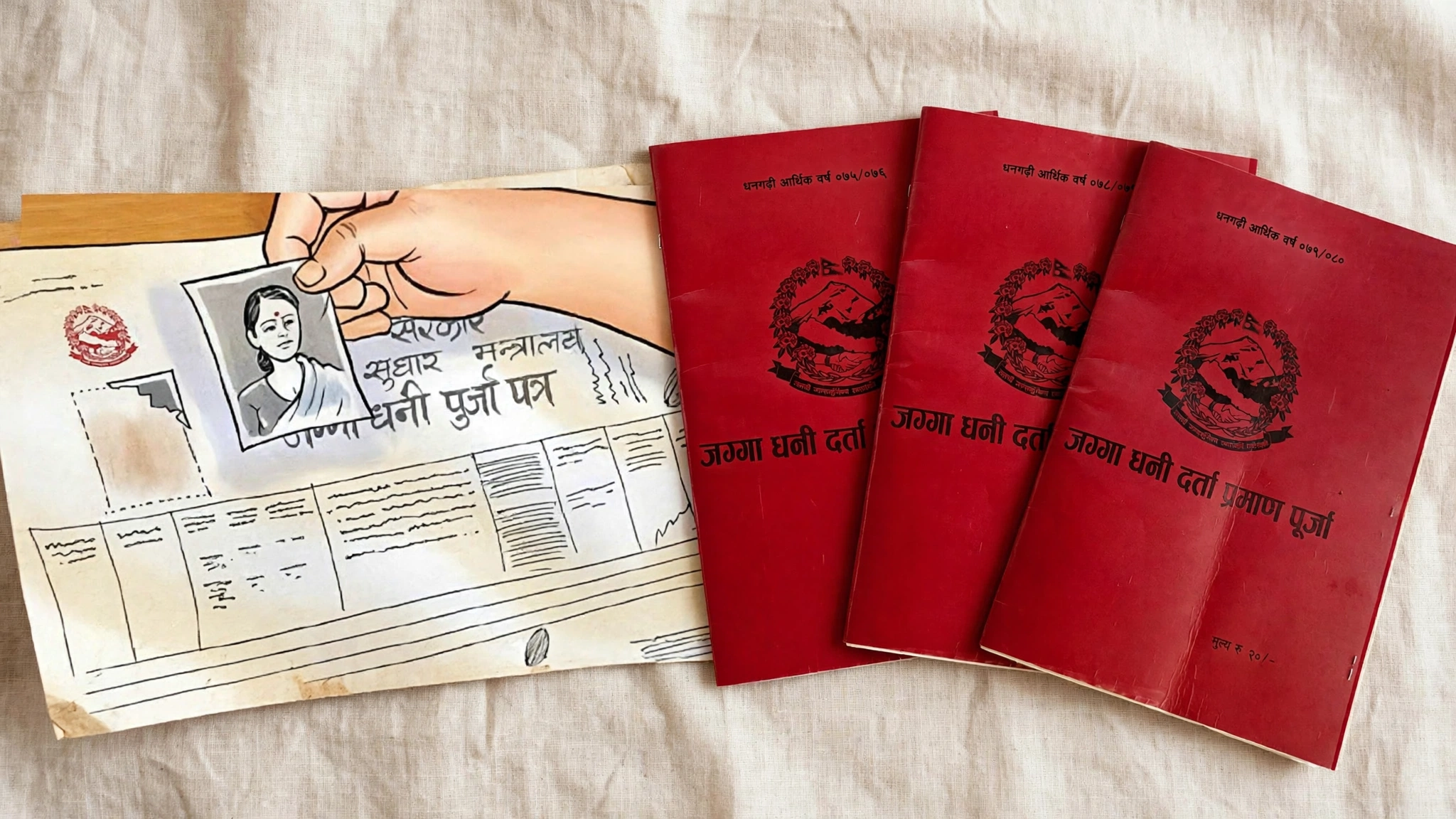
In Nepal, one small red document can decide whether a family gets a business loan, builds a house, or secures their child’s education fund. That document is the Lalpurja.
The Lalpurja land ownership system isn’t just about proving who owns a piece of land. It’s the legal foundation that makes borrowing, investing, and building wealth possible for millions of Nepalis.
However, this system now sits under real pressure. Banks have leaned so heavily on land as collateral that a stagnant property market is beginning to choke off credit across the entire economy.
In this article, we’ll explain how the Lalpurja system works, why it became Nepal’s dominant form of collateral, and what happens when that foundation starts to wobble.
What Is the Lalpurja Land Ownership System?
Lalpurja is Nepal’s official land ownership certificate. It’s issued by the District Land Revenue Office, known locally as the Malpot Karyalaya, according to S.O. Real Estate’s 2026 guide.
The name itself comes from the document’s traditional red color, since “lal” means red in Nepali. Without a valid, verified Lalpurja, there’s simply no legally recognized property ownership in Nepal. Banks won’t approve loans against unverified land. Government offices won’t process transfers. Courts won’t uphold ownership claims without it.
Legally, the system traces back to the Lands Act, 2021 (1964), according to Corporate Biz Legal’s 2025 guide. This foundational law defines a landowner as someone who has land registered in their name, subject to paying land revenue, establishing clear legal title. That definition remains the cornerstone of Nepal’s entire property rights framework today.
How the Lalpurja System Actually Works
Understanding the mechanics helps explain why this document carries so much weight.
According to Basobaas’s 2026 property registration guide, transactions must be registered at the Land Revenue Office covering the specific district where the property sits. Buyers and sellers must present the existing Lalpurja, citizenship certificates, a land parcel map, and a tax clearance certificate confirming all land taxes are paid.
Once the transaction completes, the Land Revenue Office issues a brand-new Lalpurja in the buyer’s name. This new certificate becomes the definitive legal record, according to Attorney Nepal’s overview of Nepal’s property law.
Notably, Nepal operates what’s known as a Deed System, according to Aafnai Ghar’s registration guide. This means the government serves only as a witness to the transaction, not a guarantor of the title’s accuracy. Consequently, thorough due diligence, including encumbrance searches and boundary verification against official survey maps, remains essential before any purchase.
Ownership itself can also take different forms. Individual Lalpurja covers land registered to a single person, while Joint Lalpurja, or Amsha Patta, covers land shared among multiple co-owners, most commonly family-inherited property, according to S.O. Real Estate.
Why Lalpurja Became Nepal’s “Ultimate” Collateral
Here’s where the Lalpurja system’s economic importance becomes truly clear. It’s not just a property document. It’s the backbone of Nepal’s entire lending system.
According to recent analysis from Nepalnews, roughly three-fifths of all bank loans in Nepal are secured against real estate collateral. That’s an extraordinary concentration. It means the vast majority of Nepal’s credit system depends on land values holding steady, and on Lalpurja-backed titles remaining enforceable and clear.
This dependence makes practical sense. Land is durable, immovable, and relatively easy to value compared to other assets. According to Global IME Bank’s home loan guide, securing a loan involves registering a lien, known as Rokka, directly on the borrower’s Lalpurja at the Land Revenue Office. This process, called Drishti Bandhak or mortgage without possession, lets borrowers retain use of their property while offering it as security.
Nepal’s National Civil Code, 2074, specifically Chapter 12, governs this mortgage system, according to MedhaCorpLaw’s real estate law overview. Two main mortgage types exist. Bhogbandaki allows lenders to possess and use the mortgaged property directly. Drishtibandhaki, the more common option, lets borrowers keep possession while the lender holds a registered claim.
The Numbers Behind Nepal’s Collateral Economy
Let’s look at how this plays out in practice, because the lending figures reveal just how central land has become.
According to Attorney Nepal’s 2026 analysis, mortgage interest rates have declined significantly, falling from 12.69% in December 2022 to just 7.65% by December 2025. This decline reflects broader monetary easing, and it should, in theory, make property-backed borrowing more attractive.
Loan-to-value ratios also matter here. According to industry guidance, typical home loans can reach up to 80% of assessed property value. Meanwhile, Nepal Rastra Bank guidelines require a collateral margin of 33.33% of a property’s distress value, or 50% of its fair market value, depending on the lending framework applied.
This tight linkage between land value and lending capacity works well when property markets are healthy. Unfortunately, that’s not Nepal’s current reality.
When the Foundation Starts to Crack
Nepal’s real estate market has been stagnant since a correction that began around 2022 to 2023, according to Nepalnews’s analysis of the banking sector. This stagnation is now creating serious ripple effects throughout the financial system.
Since so much bank lending sits on real estate collateral, a frozen property market makes that collateral difficult to liquidate at anything close to book value. Nepal Rastra Bank’s own Bank Supervision Report for fiscal year 2024/25 documents rising non-performing loans, driven partly by this exact dynamic.
The report also reveals deeper governance issues compounding the problem. According to Nepalnews, banks have been found disbursing loans to firms with negative net tangible assets, financing borrowers beyond their approved limits, and even accepting shares of already-troubled financial institutions as collateral for margin lending.
Perhaps most strikingly, this has created a strange paradox. By mid-June 2026, the weighted average lending rate had fallen to just 6.64%, historically low levels that would typically spark a borrowing surge. Yet, private sector credit growth for the fiscal year reached only around 6%, well short of Nepal Rastra Bank’s original 12% target. Nepal’s banks, in short, are cash-rich but borrower-starved.
Political Unrest Adds Further Strain
Compounding these structural issues, Nepal’s September 2025 political unrest has added further caution among both borrowers and lenders, according to Nepalnews’s coverage of NRB’s monetary policy for fiscal year 2026/27.
With the real estate market underpinning the majority of bank collateral already stagnant, this unrest has made financial institutions even more hesitant to extend new credit. Nepal Rastra Bank expects credit growth to gradually rebuild toward roughly 11% during fiscal year 2026/27, as these combined strains slowly ease.
Can Nepal Reduce Its Dependence on Land Collateral?
Recognizing this structural vulnerability, Nepal Rastra Bank has begun outlining reforms aimed at reducing overreliance on real estate-backed lending.
According to Nepalnews, the central bank’s prescribed remedy involves pushing banks toward project-based and character-based lending, supported by a more institutionalized individual credit-scoring system. This approach would let banks evaluate borrowers based on business viability and repayment history, rather than relying almost entirely on land value.
Additionally, reforms are underway to end unlimited personal liability on loan guarantees, according to the same analysis. This change aims to reduce the disproportionate risk currently placed on individual guarantors, many of whom pledge family land to secure loans for relatives or business partners.
However, these reforms represent a long-term direction, not a quick fix. As Nepalnews notes, they do nothing to immediately unfreeze the roughly three-fifths of existing loans already sitting on real estate collateral that currently can’t be sold anywhere near its book value.
Why Tracking This System Matters
Given how central the Lalpurja system is to Nepal’s credit economy, tracking its health deserves ongoing attention.
First, the share of bank lending secured by real estate collateral reveals systemic concentration risk. A figure as high as three-fifths signals limited diversification, leaving the entire banking sector vulnerable to property market swings.
Second, tracking land registration efficiency and dispute resolution matters too. According to Corporate Biz Legal, land disputes in Nepal go through mandatory mediation first, followed by Survey Office intervention for boundary issues, Revenue Tribunal for revenue matters, and District Court for broader disputes. Faster, more reliable resolution strengthens confidence in Lalpurja-backed collateral overall.
Third, digitization progress matters. Nepal’s Land Records Information System has already improved verification speed and reliability, according to Aafnai Ghar. Continued investment here could reduce fraud, strengthen title certainty, and ultimately support healthier, more diversified lending practices.
What Strengthening the System Could Look Like
Several practical steps could help Nepal build a more resilient version of this foundational system.
First, accelerating credit-scoring infrastructure would genuinely diversify lending beyond pure land-value dependence. This shift would help creditworthy borrowers without substantial property holdings access financing more easily.
Second, continuing to expand Nepal’s Land Records Information System would further strengthen title certainty. Digital records reduce the kind of boundary disputes and fraudulent claims that undermine confidence in the Deed System’s witness-only structure.
Third, closer monitoring of the real estate market’s recovery trajectory would help regulators anticipate collateral risk before it compounds further. Given how tightly bank health and property values are now linked, early warning signals matter enormously.
Finally, continued reform of personal guarantee practices could reduce the outsized risk currently borne by individual families whose land secures loans for broader business or community purposes.
Conclusion
The Lalpurja land ownership system remains the bedrock of property rights and credit access across Nepal. From its origins in the Lands Act, 2021, to its modern role securing roughly three-fifths of all bank lending, this humble red certificate carries extraordinary economic weight.
Yet, that same concentration now poses a genuine vulnerability. With Nepal’s real estate market stagnant since 2022-23, and non-performing loans rising, the system’s greatest strength, its reliability as collateral, has also become a structural risk worth watching closely.
Ultimately, Nepal’s path forward likely requires both preserving what makes the Lalpurja system trustworthy, and gradually reducing the economy’s outsized dependence on land as the default form of collateral. Getting that balance right will shape Nepal’s credit markets for years to come.
FAQ: The Lalpurja Land Ownership System
What is a Lalpurja in Nepal?
Lalpurja is Nepal’s official land ownership certificate, issued by the District Land Revenue Office. It serves as the definitive legal proof of who owns a specific parcel of land.
Why is the Lalpurja system important for Nepal’s economy?
It underpins Nepal’s lending system directly. Roughly three-fifths of all bank loans in Nepal are secured against real estate collateral tied to Lalpurja titles.
What law governs land ownership in Nepal?
The foundational law is the Lands Act, 2021 (1964), supported by the National Civil Code, 2074, which governs mortgages and property transfers.
How does land become collateral for a bank loan in Nepal?
Banks register a lien, called Rokka, directly on the borrower’s Lalpurja at the Land Revenue Office, securing the loan against the property’s value.
Why is Nepal’s collateral system currently under strain?
A stagnant real estate market since 2022-23 has made land collateral hard to liquidate, contributing to rising non-performing loans across Nepal’s banks.
Is Nepal trying to reduce reliance on land as collateral?
Yes. Nepal Rastra Bank is promoting project-based and character-based lending, supported by improved credit-scoring systems, to diversify away from pure land dependence.