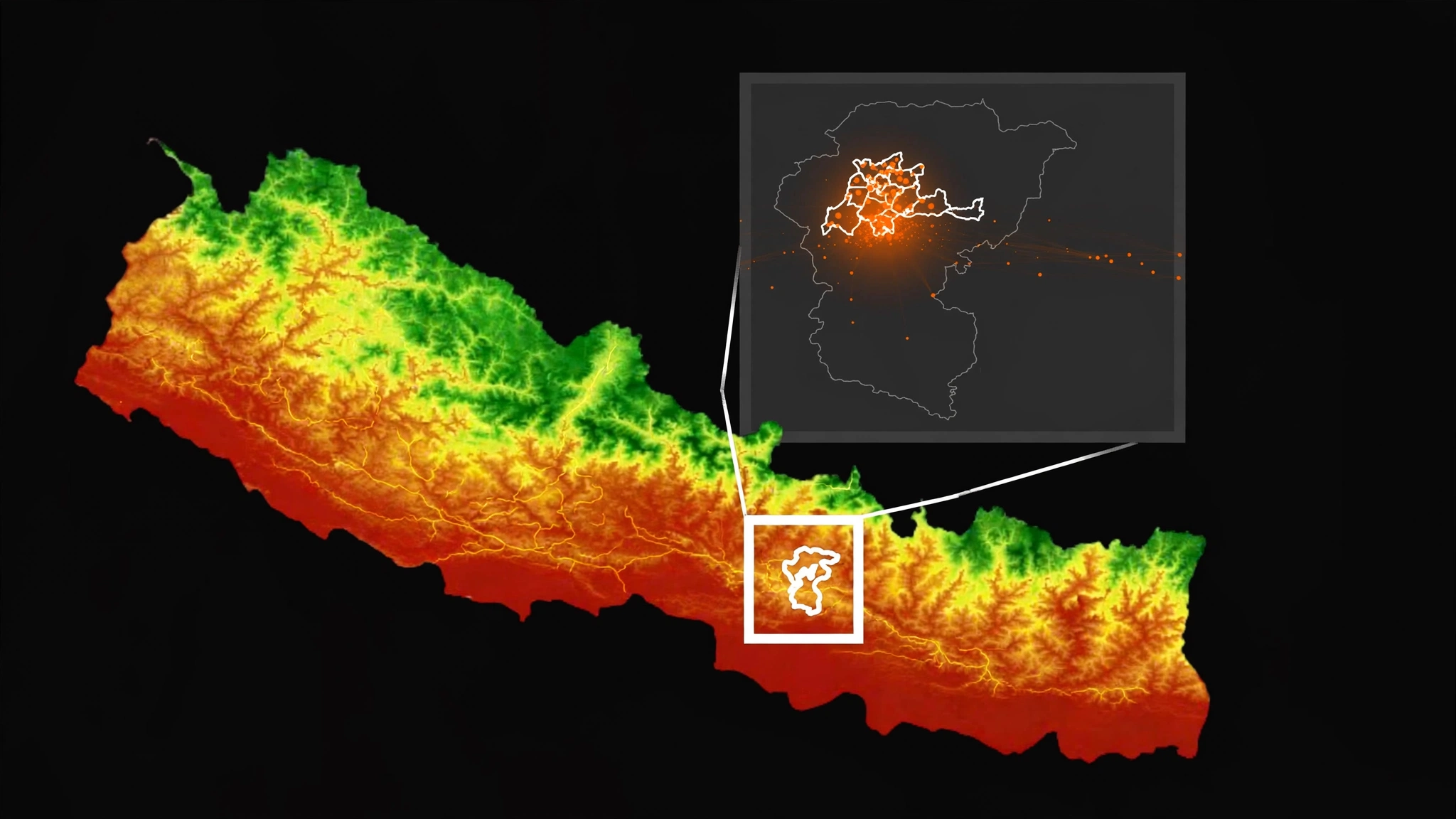
Walk into almost any Nepali startup office, and you’ll find the same story. The founders live in Kathmandu. The office sits in Kathmandu. And, most often, so does the entire user base. This is the Kathmandu Bubble bias. It’s the tendency of startups to design products exclusively for the capital’s demographic, while the rest of Nepal waits on the sidelines.
The clearest evidence of this bias sits in one simple metric: the percentage of a startup’s active user base located outside the Kathmandu Valley. For most companies, that number stays painfully low. And it explains a lot about why Nepal’s startup ecosystem struggles to scale nationally.
This article explores why the bubble forms, what data reveals about it, and how founders can start breaking out of it.
What Is the Kathmandu Bubble Bias?
The term describes a pattern, not a single company’s mistake. Startups build products, marketing, and support systems around Kathmandu Valley life. They rarely test outside it.
This happens for understandable reasons. Founders, investors, and mentors mostly live in the valley. So do most accelerators. Most accelerators operate in Kathmandu Valley, leaving rural entrepreneurs, who make up the majority of Nepal’s population, without access to resources.
The bias isn’t just about geography. It influences which problems get solved, determines pricing, and even affects the language used in apps. As a result, the majority of the country is quietly excluded from ever becoming a customer.
Why the Numbers Don’t Add Up
Here’s the uncomfortable math. Kathmandu Valley, the most developed and largest urban agglomeration in Nepal, is home to roughly 5 million people.
Nepal’s total population sits close to 29.6 million, estimated at 29,629,410 people in 2026.
Do the math, and the valley holds under 20% of the country. That leaves roughly 80% of Nepalis living entirely outside it, spread across hills, mountains, and the Terai plains.
Yet startup attention doesn’t reflect that split. Most product testing, marketing pushes, and customer support still concentrate inside the valley. The result is predictable: user bases that mirror founder location, not national demand.
The Digital Divide Behind the Bubble
Some of this gap comes from real infrastructure limits, not just founder blind spots. Internet access in Nepal is deeply uneven.
While the Kathmandu Valley reports an internet penetration rate of 79.3 percent, Karnali Province lags at just 14 percent, underscoring the gap between policy commitments and lived reality. That’s not a small gap. It’s a different digital world entirely.
Geography plays a major role, too. About 77 percent of Nepalis live in rural areas, where connectivity is either unavailable or prohibitively expensive.
Even where connections exist, quality varies wildly. One rural student described her daily reality clearly. “I have to walk 30–35 minutes just to get a proper signal. The internet is unreliable here, not indoors, not in the rain, not when the electricity goes out,” she explained.
Provincial data tells the same story from another angle. Geographically, Bagmati and Gandaki outperform, at 60 percent and 51 percent respectively, while Karnali sits at just 13 percent and Sudurpashchim at 18 percent.
For any startup relying on smooth app performance, these gaps matter enormously. A product that works flawlessly in Kathmandu can fail completely two hours outside it.
Why Startups Fall Into the Bubble
The Kathmandu bias isn’t usually intentional. It emerges from structural forces that quietly push founders toward the capital.
- Accelerator geography. Founders in Pokhara, Biratnagar, or rural mountain regions are largely excluded due to the in-person nature of most programs.
- Language barriers. Language has long been a barrier for entrepreneurs outside urban, English-speaking circles, and many programs in Kathmandu operate in English.
- Sector bias. Tech and urban-focused startups are favored, while rural agriculture, tourism, and manufacturing innovation are overlooked.
- Investor proximity. Most funders, mentors, and demo-day judges live and work in the valley, shaping which ideas get attention.
- Infrastructure cost. Expanding outside the valley means facing patchy internet, unreliable power, and higher logistics costs.
None of these forces are conspiracies. They’re just easier paths. But together, they build a wall around the capital that few startups bother to climb.
The Cost of Staying Inside the Bubble
Ignoring 80% of the population isn’t just an equity problem. It’s a business problem, too. Growth stalls once the Kathmandu market saturates.
Digital businesses face particular exposure. Local tech companies face challenges while expanding, as they are compelled to invest in digital awareness as well as focus on developing and marketing their products. That extra effort scares many founders away from trying at all.
Even sectors built on inclusion often stay concentrated. Consider Khaalisisi, a well-known waste management platform. About 30% of households in Kathmandu Valley already practice waste segregation, and Khaalisisi’s platform makes it easier for them to connect with collectors, operating primarily in Kathmandu. A genuinely national environmental problem gets a Kathmandu-sized solution.
This pattern repeats across fintech, e-commerce, health tech, and logistics. Products get built, tested, and scaled inside a bubble that represents a fifth of the country. The remaining four-fifths becomes an afterthought, if it’s considered at all.
Signs the Bubble Is Starting to Crack
It’s not all bad news. Some efforts are pushing startup culture beyond the valley, even if progress remains slow and uneven.
While growth has been exciting in the capital, cities outside the valley are also getting exposure to startup culture through seed camps and incubators starting in different parts of the country. Organizations like Antarprerana specifically target entrepreneurs beyond Kathmandu.
New AI-driven tools are also trying to close the language and access gap. An AI Mentor now provides round-the-clock, personalized guidance in Nepali, making entrepreneurship education more inclusive and accessible for founders who don’t operate comfortably in English.
Infrastructure investment is growing, too, even if unevenly distributed. Nepal Telecom has extended fiber connectivity to all 77 districts, and the Rural Telecommunications Development Fund has connected over 16,000 public sites, including schools and health facilities.
These are meaningful steps. But they remain the exception, not the rule, across Nepal’s broader startup ecosystem.
What “Outside the Valley” User Data Should Look Like
For founders serious about national reach, tracking geographic user distribution should become a core metric, not an afterthought.
Here’s what a healthier target profile might include:
- User base outside Kathmandu Valley tracked monthly, not just at launch.
- Regional breakdown across provinces like Bagmati, Gandaki, Karnali, and the Terai belt.
- Language usage data, comparing Nepali-language sessions to English-language sessions.
- Device and connectivity patterns, since rural users often rely on lower-end phones and unstable networks.
- Support ticket origin, revealing where users struggle most with onboarding.
Without this data, founders simply cannot know whether they’re building for Nepal, or just for Kathmandu wearing Nepal’s flag.
Digital Access Snapshot: Valley vs. Rest of Nepal
| Metric | Kathmandu Valley | Rural Nepal (e.g., Karnali) |
|---|---|---|
| Internet penetration | 79.3% | As low as 13–14% |
| Population share | Roughly 17% of Nepal | Roughly 83% of Nepal |
| Broadband household access | Higher, fiber-backed | Limited, unreliable |
| Startup accelerator presence | Concentrated | Minimal to none |
| Primary business language | English common | Nepali and local languages dominant |
This table makes the bubble visible. Startups optimizing purely for the left column are optimizing away most of the country.
How Founders Can Break Out of the Bubble
Escaping the Kathmandu bubble doesn’t require abandoning the capital. It requires treating it as one market among several, not the whole picture.
Practical steps matter more than good intentions. Building Nepali-language interfaces from day one helps immediately. So does designing for low-bandwidth conditions instead of assuming fast, stable Wi-Fi.
Partnering with regional incubators, rather than only Kathmandu-based accelerators, opens founders to different customer realities early. Field-testing products in Pokhara, Biratnagar, or the Terai, before scaling nationally, exposes usability gaps that valley-only testing simply cannot catch.
Above all, tracking the outside-valley user percentage from the earliest possible stage keeps teams honest. It’s much easier to correct course at 5,000 users than at 500,000.
Conclusion
The Kathmandu Bubble bias isn’t a minor blind spot. It’s a structural pattern shaping which problems Nepali startups solve, and which Nepalis they serve. With roughly 80% of the population living outside the valley, the untapped opportunity is enormous.
The percentage of a startup’s active user base located outside Kathmandu Valley is more than a vanity metric. It’s a direct measure of whether a company is truly building for Nepal, or simply building for the capital. Closing that gap won’t happen by accident. It takes intentional design, regional partnerships, and a willingness to test beyond familiar streets.
Founders who take that step early won’t just serve more Nepalis. They’ll likely build stronger, more resilient companies in the process.
FAQ: Kathmandu Bubble Bias in Nepali Startups
What does the “Kathmandu Bubble” mean in Nepal’s startup world?
It describes startups building products, marketing, and support almost entirely around Kathmandu Valley, while ignoring the rest of the country.
What percentage of Nepal’s population lives outside Kathmandu Valley?
Roughly 80% of Nepal’s population lives outside the Kathmandu Valley, which holds only about 5 million of the country’s 29.6 million people.
Why do so few startups reach users outside the valley?
Reasons include uneven internet access, English-language platforms, valley-based accelerators, and higher costs of expanding into rural markets.
How big is Nepal’s rural-urban internet gap?
Kathmandu Valley has around 79% internet penetration, while provinces like Karnali sit near just 13 to 14 percent.
Why does the outside-valley user percentage matter for startups?
It shows whether a company is genuinely serving the national market, or only a small, well-connected slice of it.
What can founders do to reach users outside Kathmandu?
They can build Nepali-language products, design for low-bandwidth conditions, and test with regional incubators before scaling nationally.
Is the Kathmandu Bubble bias improving?
Slowly. Rural incubators, AI-driven Nepali-language mentoring, and expanding fiber infrastructure are helping, but valley concentration still dominates.