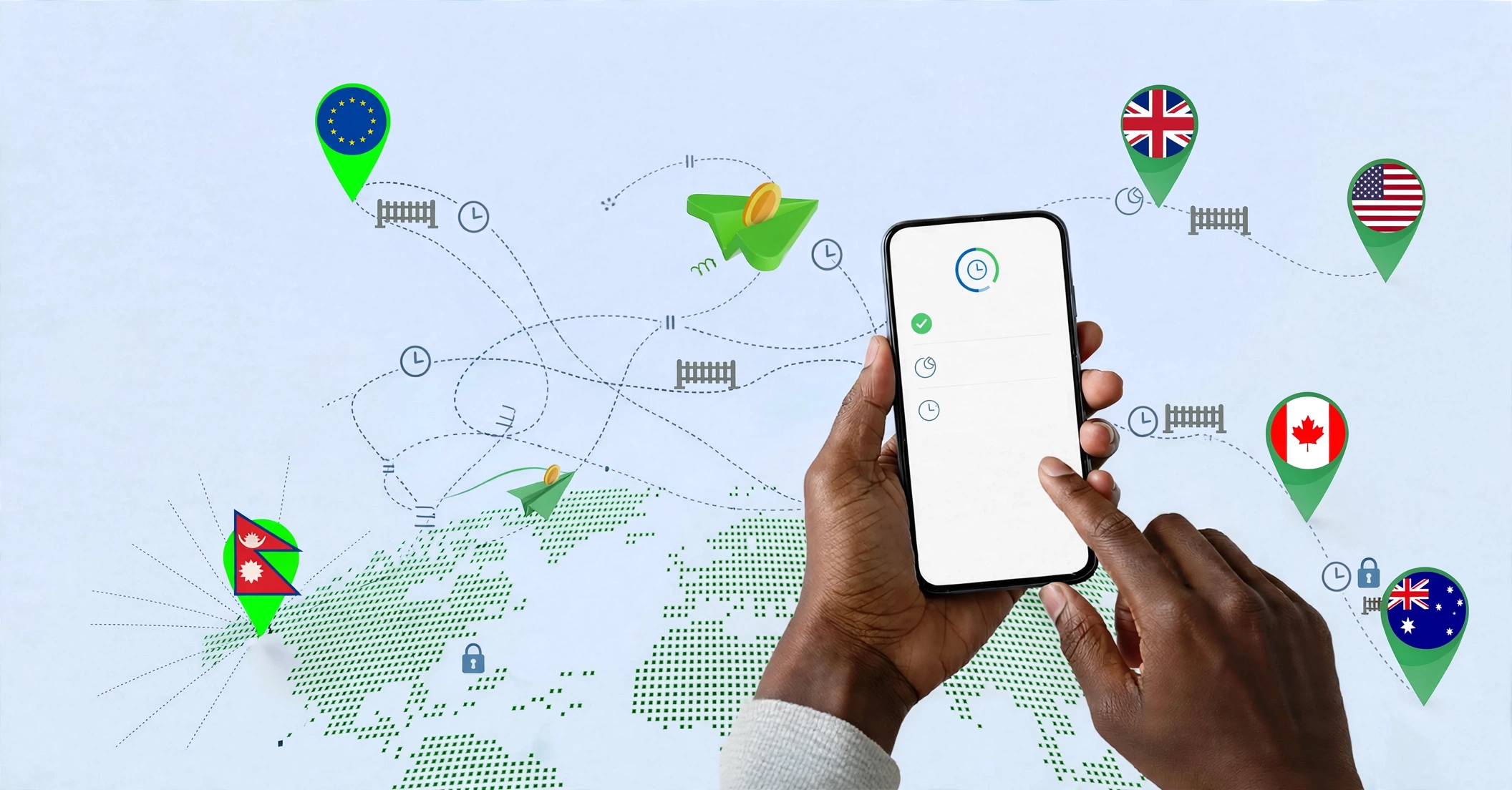
A Nepali startup wants to run a Google Ads campaign. For years, that meant applying for a special card, waiting days for approval, and hoping the year’s spending hadn’t already hit a hard $500 cap. That picture changed in April 2026, though not completely.
Cross-border payment barriers in Nepal remain a real structural constraint, built into foreign exchange rules originally designed decades ago for a very different economy. Startups trying to pay for global SaaS tools, cloud hosting, or digital advertising still run into friction, even after Nepal Rastra Bank eased some of the toughest limits this year.
This matters because these tools aren’t optional extras. They’re the basic infrastructure modern businesses run on. Understanding exactly what Nepal’s central bank rules allow today, who benefits from recent reforms, and who’s still left out, reveals a lot about the country’s evolving relationship with global digital commerce.
In this article, we’ll examine Nepal’s current cross-border payment restrictions, what changed in 2026, how these rules specifically affect startups, and what’s still missing.
The Rules Just Changed: A Tiered System Replaced the Flat $500 Cap
For years, a single flat cap defined this problem: USD 500 per person, per year, for all international online payments. That number still exists, but it’s no longer the whole story.
According to Court Marriage in Nepal’s dollar card guide, updated as of April 2026 (2083 BS), Nepal Rastra Bank significantly eased foreign exchange limits specifically for the IT sector through an update to its Unified Circular 2082. IT and ICT businesses can now obtain prepaid dollar cards with a USD 3,000 annual limit for purchasing software, cloud services, and other online services. IT companies that earn foreign currency through service exports can access up to USD 5,000 annually. Beyond that, industries can now make payments of up to USD 100,000 annually for software or technology procurement, and online earners providing technology services are permitted up to USD 25,000 annually.
Techmandu’s coverage of the same update confirms the shift was framed explicitly as recognition that “$500 worth of dollar card was seen as exceptionally inadequate to fill the modern needs of the industry.” The same report notes an additional change relevant to Nepal’s growing creator economy: YouTube, Facebook, and other social media influencers and content creators can now receive half of their earnings directly into a dollar account, rather than being converted entirely into Nepali rupees first.
Crucially, the individual personal limit of USD 500 remains unchanged for anyone outside these registered IT or export-earning categories. According to Court Marriage in Nepal, this limit is also cumulative across every dollar card a person holds, verified through a centralized NRB database, so opening cards at multiple banks doesn’t multiply the allowance.
What This Means in Practice for Different Founders
This tiered structure now creates a genuinely uneven experience depending on how a startup is classified and registered.
A registered IT or software startup, with documentation proving its business registration, can access $3,000 annually, five times the old individual cap, specifically for tools like AWS, Google Cloud, and SaaS subscriptions. If that same company earns foreign currency through service exports, it can apply for up to $5,000. A larger, established industry procuring software or technology at scale can apply for as much as $100,000 annually, a figure that would have been unimaginable under the old flat-rate system.
However, a founder in agritech, retail e-commerce, or any non-IT-classified sector, someone equally dependent on Google Ads or Meta advertising to acquire customers, remains capped at the same $500 individual limit that existed before this reform. According to Gurkha Technology’s 2026 guide, this personal-tier cap still covers Facebook, Instagram, and LinkedIn ads, Google Ads and AWS, and standard software subscriptions like Adobe Creative Cloud and Microsoft 365, the same essential toolkit every digital business needs, regardless of sector.
Getting Access Still Isn’t Simple
Even with higher limits now available to IT businesses, actually accessing them requires navigating real documentation requirements.
According to Court Marriage in Nepal’s detailed guide, the enhanced IT-sector limits require proof of business registration, and the $5,000 export-earner tier specifically requires documented foreign currency earnings. Applicants still need a valid citizenship certificate, PAN card, and completed KYC with the issuing bank, and physical dollar cards typically take three to seven working days to issue, though some banks now offer instant virtual cards through mobile banking apps.
For founders still operating under the unchanged $500 individual tier, this remains a meaningfully tight budget. A single month of meaningful Google or Meta ad spend can easily approach or exceed that figure on its own. According to Quality Computer’s January 2026 analysis, applying for any dollar card can still feel bureaucratically heavy, with documentation and approval steps that add friction for founders trying to move quickly in a competitive digital environment.
The Deeper Problem: PayPal and Stripe Still Don’t Work
Beyond spending limits, Nepal faces an even more fundamental gap. The payment platforms most global SaaS tools and ad networks expect simply don’t function normally in Nepal.
According to ThinkMove Solutions’ March 2026 analysis, Nepali users can create a PayPal account, but cannot receive or withdraw money in Nepali currency through Nepali banks. This limitation stems directly from foreign exchange restrictions and the absence of a formal regulatory partnership between PayPal and a licensed Nepali financial institution.
This remains true as of the most recent tracking available. According to Nepal Republic’s dedicated tracker on international payment gateway access, updated in March 2026, neither PayPal nor Stripe is officially available in Nepal, blocked specifically by NRB foreign exchange restrictions, the lack of a regulatory partnership, and outstanding AML and KYC compliance gaps. The same tracker notes that an NRB Deputy Governor confirmed the central bank had sought direct contact with PayPal, though no agreement has been reached.
This gap extends to receiving payments too, a critical issue for Nepal’s growing freelance and remote work economy. According to Remotify’s April 2026 analysis, PayPal doesn’t support Nepal for business payments, and Stripe isn’t an option either. Freelancers working with international clients across the US, Europe, and Australia face genuine difficulty simply getting paid, let alone paying for the tools their work requires.
The same analysis describes the resulting reality bluntly. The work is global. The payment infrastructure is not. Nepali freelancers and founders end up researching workarounds through Facebook groups, often uncertain whether a given solution might get their bank account flagged for unusual activity.
Why the New Bill Matters Alongside This Year’s Circular Changes
It’s worth being precise about what’s actually changed and what hasn’t. The $3,000 to $100,000 tiered limits described above came through an update to NRB’s Unified Circular 2082, an administrative directive, not new legislation. Separately, Nepal’s Ministry of Finance has released a full Bill to Amend and Consolidate the Laws Relating to Foreign Exchange, 2082 (2025/26) for public consultation, aiming to replace the Foreign Exchange (Regulation) Act, 1962, and the Act Restricting Investment Abroad, 1964, entirely.
According to Review Nepal’s coverage of this bill, it would end a six-decade ban on outward investment, permitting IT companies specifically to reinvest foreign earnings and allowing service providers to accept equity or stock options as remuneration from foreign clients. Returning citizens and non-resident Nepalis could maintain offshore investments if properly registered. As of the most recent reporting, the bill remains in the public consultation stage, following stakeholder feedback before it heads to the Council of Ministers and then Parliament for debate.
So the circular changes are already in effect and usable today, while the broader legislative overhaul is still working through Nepal’s legislative process. Both point in the same direction, easing restrictions for IT-classified and export-earning businesses specifically, while leaving the underlying framework’s caution toward broader outward payments largely intact.
Why Nepal Rastra Bank Maintains These Restrictions
Understanding why these barriers exist requires looking at Nepal’s broader foreign exchange management philosophy, which prioritizes reserve stability above transaction convenience.
According to Nepal News’s July 2026 analysis of Nepal’s proposed new Foreign Exchange Bill, this caution has deep roots. Nepal’s foreign exchange framework has historically been built around reserve adequacy concerns, given how import-dependent and remittance-financed the economy remains. The 2022 reserve crunch, when import restrictions and informal capital controls became de facto policy, illustrates how quickly Nepal has moved to restrict outward currency flows during periods of stress.
This same analysis reveals that Nepal’s new Foreign Exchange Regulation and Management Bill, currently under review, would actually formalize this kind of emergency power more explicitly, granting government authority to compel citizens and firms to surrender foreign exchange holdings during a declared “external sector crisis.” Notably, the bill offers no clear definition of what triggers such a crisis, leaving that determination to executive discretion.
The New Bill’s Startup-Specific Provisions
Nepal’s forthcoming foreign exchange legislation contains provisions specifically relevant to how startups might pay for international tools and services going forward.
According to Nepal News’s detailed analysis, the bill’s outward investment provisions quietly favor a narrow set of entities. Only Nepal Gazette-exempted entities, technology transfer recipients with central bank permission, and firms formally classified as information technology businesses receive a clear legal pathway to send money abroad. Every other business sector operates outside this affirmative permission structure entirely.
This creates a genuinely uneven playing field. A software startup might eventually qualify for preferential outward payment treatment under the IT business classification. A startup in agritech, manufacturing, or retail e-commerce, equally dependent on international SaaS tools and digital advertising, would not automatically receive the same consideration.
The bill does include one genuine improvement worth noting. According to the same analysis, explicit permission for hedging transactions represents real progress over the previous law’s ambiguity, since Nepali firms with foreign currency exposure had long operated in a legal gray zone regarding whether hedging instruments were even available to them. However, this permission depends entirely on procedures Nepal Rastra Bank has yet to actually prescribe, meaning the practical benefit remains theoretical until those procedures materialize.
Hundi and the Informal Workaround Problem
When formal channels prove too restrictive or slow, some businesses and individuals turn toward informal transfer networks, a practice Nepal’s new legislation treats with particular severity.
According to Nepal News’s analysis, hundi, Nepal’s traditional informal money transfer system, receives the harshest treatment in the new bill, defined broadly enough to capture any cross-border transfer or settlement happening outside recognized institutions or authorized payment instruments. Given that remittances make up close to a quarter of Nepal’s GDP, keeping currency flows within monitored, formal channels represents a genuine macroeconomic priority for regulators, not merely bureaucratic caution.
However, the same analysis notes a critical enforcement gap. Nepal’s porous land border with India means hundi has survived decades of prohibition already, and nothing in the new bill suggests additional investigative resources or technology-based tracing tools to actually shrink this informal economy, beyond restating the prohibition with clearer legal language and harsher penalties.
This matters for startups specifically because informal channels sometimes represent the path of least resistance when formal options feel too slow, too limited, or too bureaucratically demanding, even though doing so now carries meaningfully elevated legal risk under the new legislative framework.
Signs of Genuine Change on the Horizon
Despite these substantial current barriers, Nepal has begun signaling real movement toward easier cross-border digital payment access.
According to Hamro Bichar’s May 2026 reporting, Nepal is edging closer to formal recognition and regulation of international payment gateways like PayPal and Stripe, as debate continues around amendments to the Nepal Rastra Bank Act and broader digital financial reforms. Experts cited in the report suggest that easier access to international payments could open significant opportunities specifically for Nepal’s freelancers, startups, IT sector, and digital entrepreneurs.
According to ThinkMove Solutions, Nepal’s Digital Economy Framework aims to attract international payment gateways by mid-2026 to early-2027, contingent on Nepal meeting the compliance and anti-money-laundering infrastructure requirements these global platforms typically demand before entering a new market.
Interestingly, cross-border cooperation with India offers another potential path forward. According to Quality Computer’s analysis, talks are ongoing between India and Nepal to allow cross-border UPI payments, a development that could meaningfully ease at least regional cross-border transaction friction, even if it wouldn’t directly solve the broader global SaaS and advertising payment challenge.
What This Means for Nepal’s Startup Ecosystem
These cross-border payment barriers connect directly to broader challenges already facing Nepal’s startup ecosystem.
Registered IT startups now operating under the new $3,000 to $5,000 tiers have meaningfully more room to market products, test paid acquisition channels, and access premium software infrastructure than they did before April 2026. That’s a genuine improvement, and one worth acknowledging clearly. However, founders in non-IT sectors, equally dependent on the same digital tools, remain on the unchanged $500 individual cap. This adds yet another disadvantage layered on top of Nepal’s already well-documented venture capital shortage and technical talent retention challenges, just distributed unevenly rather than universally now.
The narrow IT-sector focus of both this year’s circular update and the pending Foreign Exchange Bill, while a real step forward for software-focused startups, leaves founders in other sectors facing continued uncertainty. A more coherent approach, tying outward payment permissions to export orientation or foreign currency earning potential broadly, rather than favoring one named sector, would likely serve Nepal’s diverse startup ecosystem more effectively.
What Would Genuinely Help Close This Gap
Given the scope of these barriers, several concrete steps could meaningfully ease cross-border payment friction for Nepali startups.
First, formally onboarding international payment gateways like PayPal and Stripe, as Nepal’s Digital Economy Framework already targets, would directly address the most fundamental gap, the inability to send and receive payments through platforms the rest of the world already relies on by default.
Second, now that IT businesses have a clearer, higher-limit pathway, extending an equivalent structured tier to other export-oriented or digitally native sectors, rather than leaving them on the flat $500 individual cap, would reduce the friction those founders still face when legitimate business spending exceeds that limit.
Third, extending the pending Foreign Exchange Bill’s outward payment provisions beyond the narrow IT business classification, toward a broader export-orientation or foreign-currency-earning standard, would create a more equitable playing field across Nepal’s diverse startup sectors.
Finally, ensuring the hedging procedures the new bill promises actually get published and implemented, rather than remaining a theoretical permission, would help startups with genuine foreign currency exposure manage that risk formally, rather than through informal workarounds.
Why This Trend Deserves Long-Term Tracking
Cross-border payment barriers in Nepal deserve sustained attention as a structural indicator of the country’s digital economy competitiveness.
First, tracking progress on international payment gateway recognition specifically would reveal whether Nepal’s stated mid-2026 to early-2027 timeline for platforms like PayPal and Stripe actually holds, or slips further as compliance requirements prove more complex than anticipated.
Second, monitoring how the new Foreign Exchange Bill’s implementing procedures develop, particularly around hedging permissions and business-specific dollar card limits, would show whether legislative promises translate into genuinely usable systems for founders.
Third, tracking whether informal channels like hundi actually shrink under the bill’s harsher penalty structure, or persist due to continued enforcement gaps, would indicate whether formal cross-border payment infrastructure is becoming genuinely competitive with informal alternatives.
Conclusion
Cross-border payment barriers in Nepal have genuinely eased in 2026, but they haven’t disappeared. NRB’s April 2026 update to its Unified Circular gave registered IT businesses real breathing room, raising limits from $500 to as much as $3,000, $5,000, or even $100,000 depending on classification and export earnings. That’s a substantive, usable change, not just a policy promise.
Yet the underlying structure remains uneven. Founders outside the IT classification still face the same $500 individual cap that existed before this reform. PayPal and Stripe still don’t support Nepal for business payments. And the broader Foreign Exchange Bill that would formalize hedging permissions and modernize the legal framework further remains in public consultation, not yet law. Nepali founders, IT-classified or not, will keep applying for dollar cards, tracking their annual limits carefully, and weighing informal workarounds against real legal risk until these gaps close further.
Closing this gap matters for more than convenience. It shapes whether Nepal’s startups can compete on equal footing with peers elsewhere, or whether they’ll keep running their global ambitions through a distinctly local, and distinctly limited, financial bottleneck.
FAQ: Cross-Border Payment Barriers in Nepal
How much can Nepali startups spend internationally each year?
It depends on classification. Individuals and non-IT businesses are capped at USD 500 per year, while registered IT/ICT businesses can access up to $3,000, export-earning IT firms up to $5,000, and larger industries up to $100,000 for software and technology purchases, following an April 2026 NRB update.
Does PayPal work in Nepal for businesses?
Not fully. Nepali users can create PayPal accounts but cannot receive or withdraw money in Nepali currency, and PayPal doesn’t support Nepal for business payments.
Why does Nepal Rastra Bank restrict cross-border payments so strictly?
These restrictions stem from reserve adequacy concerns, given Nepal’s import-dependent, remittance-financed economy, and past experiences like the 2022 reserve crunch.
Are any startups exempt from these outward payment restrictions?
IT-classified and export-earning businesses already benefit from higher dollar card limits following NRB’s April 2026 circular update, and Nepal’s pending Foreign Exchange Bill would give them clearer legal pathways too.
Is Nepal planning to allow PayPal and Stripe in the future?
Yes. Nepal’s Digital Economy Framework targets formal recognition of international payment gateways by mid-2026 to early-2027.
What is hundi, and why does it matter for cross-border payments?
Hundi is Nepal’s informal money transfer system. It faces harsh penalties under new legislation, though enforcement gaps mean it persists as an informal workaround.