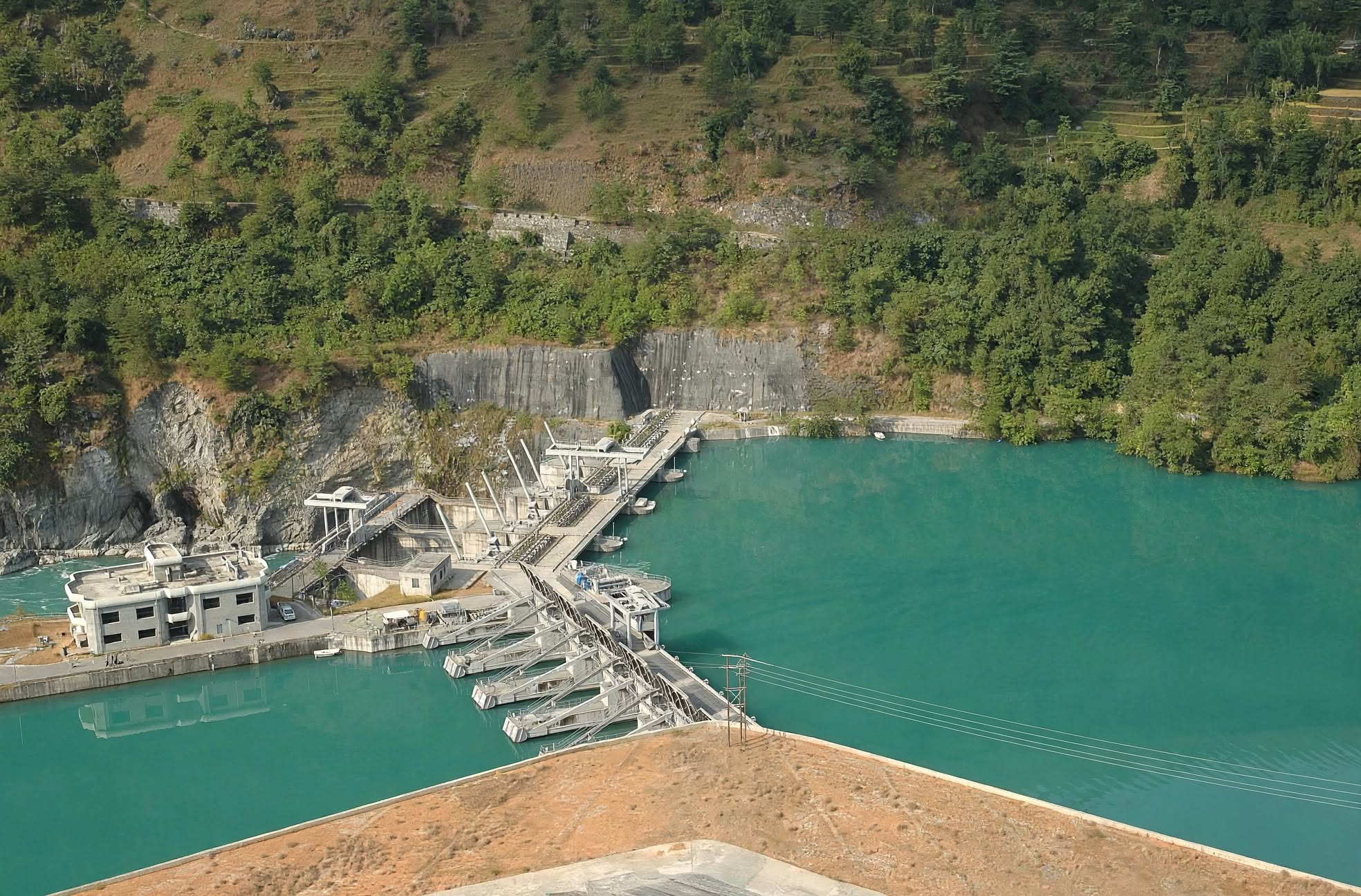
The pitch usually arrives as a single number. “This company has 200 MW in the pipeline.” It shows up in a trading group, then in a broker’s morning note, then in an AGM speech. Nobody mentions that the company sells power from 15 MW today, that 60 MW is still a tunnel being blasted through a hillside, and that the remaining 125 MW is a survey license and a feasibility study. The stock trades as if all 200 MW were already spinning.
That gap is what this piece is about. A hydropower project pipeline in Nepal is not one asset. It is a stack of very different assets at very different stages, and only the bottom layer pays anyone. The rest is a set of promises, each carrying construction risk, grid risk, hydrology risk and regulatory risk that the headline megawatt figure hides completely.
Here is the position this article takes. On NEPSE, pipeline megawatts are routinely priced as if they were operating megawatts, with a small discount for time. They deserve a large discount for probability. A plant that is not generating has no earnings, and in Nepal the date it starts generating is the single least reliable number in any hydropower prospectus.
What a hydropower project pipeline in Nepal actually contains
At the start sits the survey license, issued by the Department of Electricity Development, which lets a developer study a river. It is an option to do homework, not a power plant, and many never become one.
Next comes the generation license, which allows construction. Around the same time, the developer negotiates a power purchase agreement (PPA) with the Nepal Electricity Authority (NEA), the state utility that buys almost all of the country’s power. The PPA fixes the tariff and, critically, a required commercial operation date, usually called the RCOD. That is the date by which the plant is supposed to be selling power.
Then the company needs financial closure, meaning a consortium of banks has committed the construction loan. Without it there is no project, whatever the press release says.
Construction follows: access roads, headworks, a tunnel or canal, a penstock, a powerhouse, and a transmission link to the grid. Only after testing, and only once the grid can take the power, does the plant reach its commercial operation date (COD) and start earning.
So when a company says “pipeline,” ask the only question that matters: how many of those megawatts are past COD, how many are in physical construction with money committed, and how many are still paperwork? Three companies with identical pipeline totals can be completely different businesses.
Under construction is not “almost operating”
The most common mistake is treating under-construction capacity as nearly finished. Investors see a planned COD two years away and mentally book the revenue. Nepal’s record says that is optimistic.
Look at the country’s flagship project. Upper Tamakoshi, the 456 MW plant developed by Upper Tamakoshi Hydropower Ltd (listed on NEPSE), was first scheduled for mid-July 2016, according to the Kathmandu Post. The project office pushed its completion date back repeatedly, blaming the 2015 earthquakes, the Indian trade blockade, design changes and contractor problems on the hydro-mechanical works. The plant was inaugurated in July 2021, as Powerline reported, roughly five years late. Along the way, the Kathmandu Post reported the estimated cost rising from NPR 3,530 crore to NPR 4,200 crore, with NEA sources later telling the paper the total was likely to exceed NPR 5,000 crore.
That project had state backing. Smaller private developers do not get easier geology.
The Chilime group offers another set of examples, and these are useful because several of its subsidiaries are listed. In January 2016, Republica (republished by ShareSansar) reported that the Sanjen projects, developed by Sanjen Jalvidhyut Company, had been pushed back by at least two years. Upper Sanjen, originally due in July 2014, was revised to July 2017. Sanjen, originally due in December 2015, was revised to January 2019. An unofficial calculation put the developer’s lost revenue at NPR 495 crore, before any cost overrun. Madhya Bhotekoshi, another Chilime-linked project, was described as “bedeviled by cost overruns” in Kathmandu Post coverage as early as 2014, and in December 2024 Kantipur reported that its generation had stopped after water leaked twice during tunnel testing.
None of this is unusual. It is the base case. If your valuation assumes the planned COD, you are assuming the best outcome in a sector where the best outcome is rare.
The delay tax: how a late COD eats equity
Delays do not just postpone revenue. They transfer value away from shareholders, and the accounting makes it easy to miss.
During construction, the company is paying, or accruing, interest on its construction loan. Under NFRS, Nepal’s version of international accounting standards, borrowing costs on an asset under construction are generally capitalized. In plain terms, the interest gets added to the cost of the plant instead of appearing as an expense in the income statement. So an under-construction hydropower company can show tidy financials with small losses while its project cost quietly swells every quarter.
A worked example makes the damage visible. The numbers below are illustrative assumptions, not any real company.
Suppose a 50 MW project has a budgeted cost of NPR 900 crore, funded 70 percent by debt and 30 percent by equity. That is NPR 630 crore of loans and NPR 270 crore of shareholder money. Assume the loan carries 10 percent interest.
Each year of delay adds roughly NPR 63 crore of interest to the project cost (630 × 10 percent, before compounding). A two-year slip adds about NPR 126 crore.
Now look at who absorbs that. The plant’s capacity has not changed. Its tariff has not changed. Its future revenue is the same as before, just later. But the cost base is now around NPR 1,026 crore instead of NPR 900 crore. The extra NPR 126 crore is equal to nearly half of the original equity. Unless shareholders inject more money through a right share, the company borrows more, and the equity sits behind an even larger loan. Either way, the return on every rupee of shareholder capital falls.
This is why a two-year delay is not “the same profit, two years later.” It is less profit, permanently, spread over a bigger capital base.
The grid is part of your pipeline
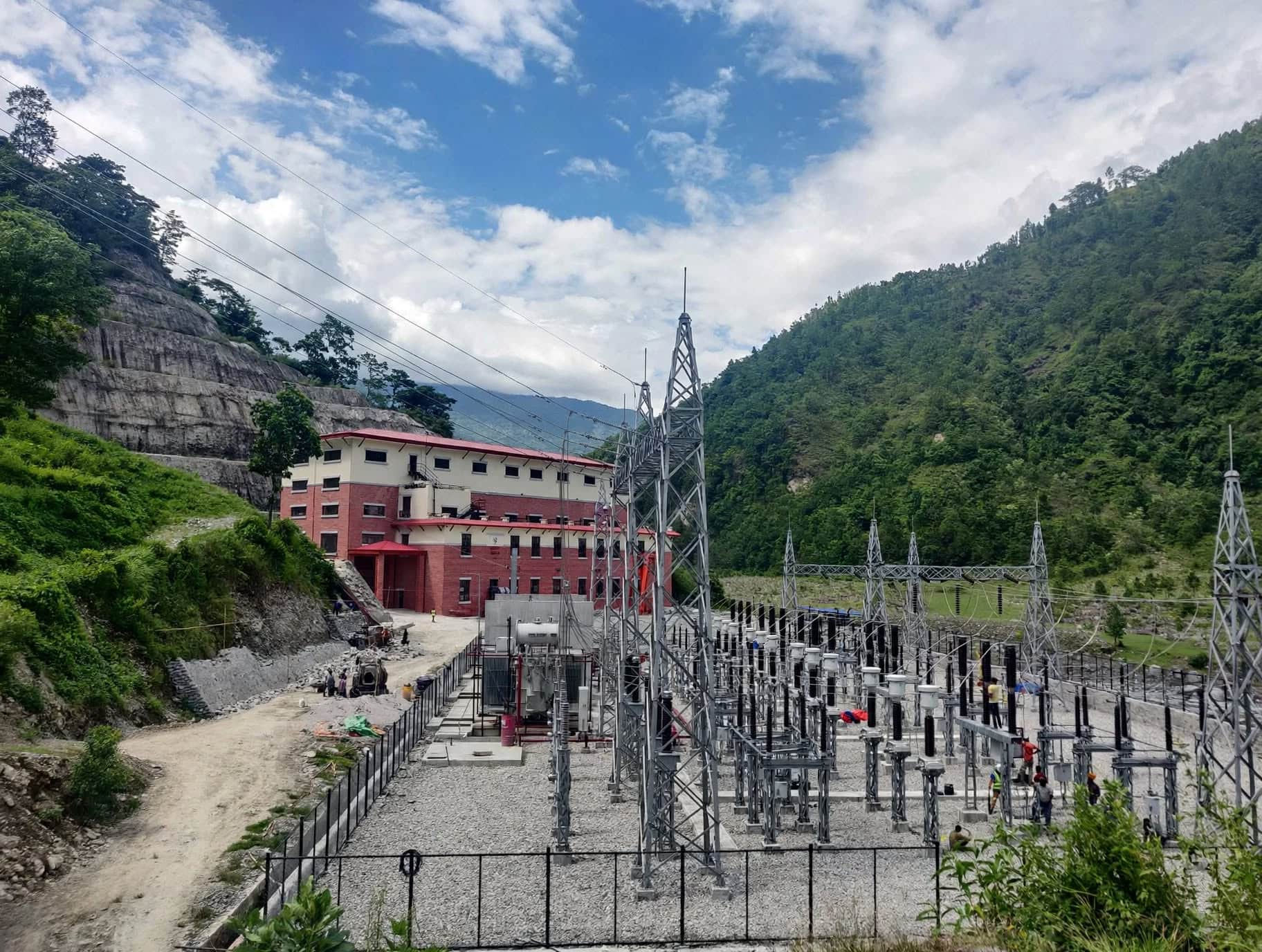
Here is the risk that surprises even experienced investors. A plant can be finished and still earn nothing, because the transmission line or substation it depends on is not ready. In most cases that infrastructure belongs to NEA, not the developer.
The Rasuwagadhi case is the clearest illustration. In May 2024, myRepublica reported that the 111 MW Rasuwagadhi Hydropower Project had successfully tested production in mid-January but could not begin commercial generation because NEA’s 220 kV Chilime Hub substation and the Chilime-Trishuli transmission line were not complete. The project chief told the paper the company was losing about NPR 27 crore a month in forgone revenue, with a further NPR 15 to 20 crore in loan principal and interest costs. Over four months, he put the revenue loss at roughly NPR 108 crore. The same report noted the delay was also holding back Upper Sanjen from connecting at full capacity.
The Sanjen story from 2016 had the same root cause. The developer said it deliberately slowed construction to match the transmission line’s delayed schedule, rather than finish a plant that would waste its power while paying interest.
NEA’s rules treat grid-caused delays more leniently, but any compensation is negotiated, slow and partial. Meanwhile the shareholder sees a finished plant, zero sales and a loan clock still running.
So when you read a pipeline, do not stop at the plant. Ask which substation it connects to, who is building that line, and whether that line is on schedule. A company with a project “90 percent complete” that depends on an unbuilt transmission corridor is not 90 percent of the way to earnings.
Nature does not read the schedule either
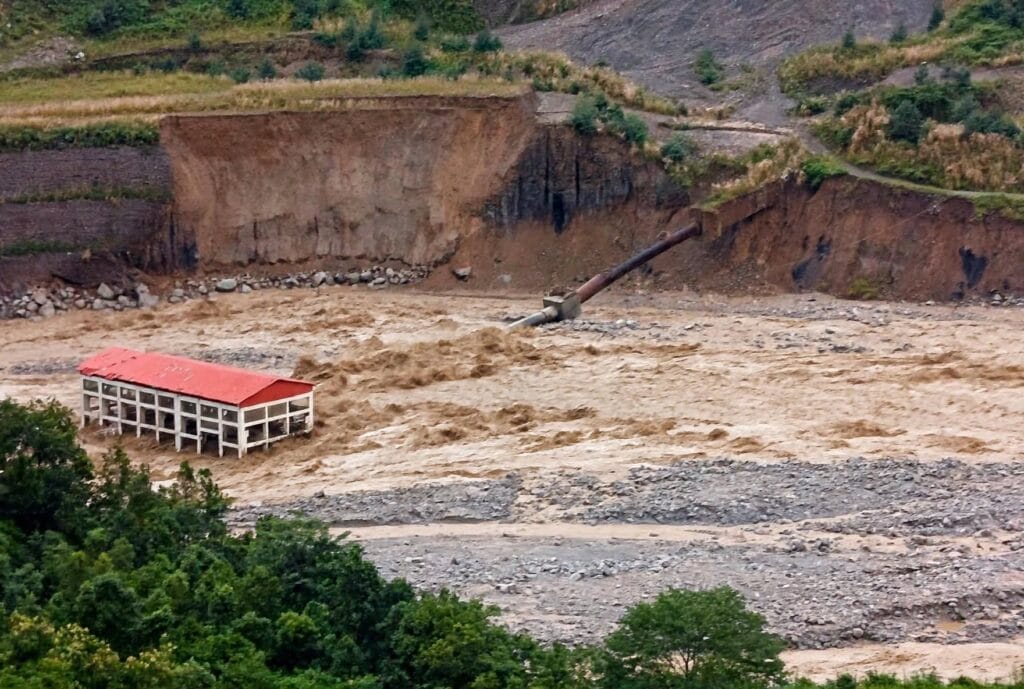
The third layer of pipeline risk is physical. Nepal’s rivers are steep, young and violent, and hydropower sits directly in their path.
In July 2025, a flood that entered Nepal from Tibet through the Lhende stream into the Bhotekoshi River damaged more than ten hydropower projects in Rasuwa and Nuwakot, according to a statement by the Independent Power Producers’ Association, Nepal (IPPAN) reported by Onlinekhabar. IPPAN said projects with roughly 250 MW of capacity were knocked offline, including Rasuwagadhi, and construction was suspended on schemes totaling more than 350 MW, including the 216 MW Upper Trishuli-1. Ekantipur separately reported damage to Rasuwagadhi’s headworks. The same river flooded again on August 26, 2026, Himal Press reported, hitting projects in the corridor once more.
An operating plant that floods loses some months of revenue and pays for repairs. An under-construction plant that floods loses schedule, which means more capitalized interest, a later COD and a higher cost base. Under-construction megawatts carry every risk operating megawatts carry, plus several that operating megawatts have already survived.
What NEA’s RCOD rules tell you
You do not have to guess how the regulator itself sorts pipeline projects. In July 2026, Ratopati reported that NEA’s board had decided to classify projects whose required commercial operation dates were at issue into four groups, based on physical progress, PPA obligations and status.
In summary, as Ratopati described it:
- Group A: RCOD not yet expired, with key obligations such as the generation license, financial closure and land acquisition met on time.
- Group B: RCOD expired, but the delay was caused by NEA (for example, a missing transmission line or substation), or the project faced unforeseen events and had achieved more than 25 percent physical progress within the RCOD period.
- Group C: RCOD not yet expired, but key obligations unmet, or less than 25 percent physical progress by the RCOD deadline. These projects face a notice of default and possible PPA cancellation.
- Group D: licenses cancelled or projects effectively abandoned.
Ratopati also reported that NEA measures physical progress by work on the main structures (headworks, tunnels, penstock alignment, powerhouse), not by paperwork or spending.
The framework tells you which projects even the buyer of the power regards as credible. A Group C project is, in NEA’s own eyes, at risk of losing its PPA. Ask the company, at the AGM if necessary, which group each project falls into.
How SEBON’s IPO gate shifts the risk onto you
The pipeline question becomes sharpest at the IPO stage, because many hydropower companies come to the public before they generate a single unit.
SEBON’s recent decisions show both versions. In February 2026 (Magh 29, 2082 BS), SEBON approved the IPO of Beni Hydropower Project, which ShareSansar reported was offering 20.80 lakh shares at NPR 100 each to fund its 18 MW Upper Solu Khola project in Solukhumbu, a project ShareSansar described as still under construction. ICRA Nepal rated the issuer BB+, which the agency defines as moderate risk of default on timely debt servicing.
In October 2026, SEBON approved the NPR 59.15 crore public issue of Him Parbat Hydropower. ShareSansar reported that the company had already completed construction and begun commercial generation in mid-2025 from its 5.5 MW Sagu Khola-1 and 20 MW Sagu Khola projects, and had a net worth above NPR 100 per share. Market commentary on NepseTrading read that approval as SEBON favoring companies that have already crossed into production.
The difference matters for you as a subscriber. An IPO from an operating company asks you to fund a business with a revenue history, however short. An IPO from an under-construction company asks you to fund the riskiest stretch of the project, the part where delays, floods and grid gaps hit hardest, at the same NPR 100 face value. The price is identical. The risk is not. Our breakdown of why hydropower IPOs dominate NEPSE covers the IPO side of this in more detail.
Valuing a pipeline: probability, not just time
If pipeline megawatts are not operating megawatts, how should you think about them? The honest answer is that you should value each stage separately and apply a probability, not just a discount rate.
Start with the operating fleet, the part you can value on cash flow. Our guide to valuing a hydropower stock on NEPSE walks through that framework, and our explainer on installed capacity versus actual generation explains why even operating megawatts overstate output.
Then handle each pipeline project on its own terms. A project in advanced construction with financial closure, a signed PPA and a grid connection that is actually being built deserves real weight, but on a delayed COD, not the planned one. A reasonable habit is to add at least a year or two to any planned COD before you model it, and to assume some cost overrun. That is an opinion, not a rule, but Nepal’s record supports it.
A licensed project without financial closure deserves much less. A survey license deserves very little, perhaps nothing.
Check the PPA terms for each project too. The tariff, escalation and whether the contract is take-or-pay or take-and-pay can change a project’s value more than its size. Our explainer on reading a hydropower PPA covers those clauses.
A quick sense check: divide market capitalization by operating megawatts only, and compare with fully operational peers. If the pipeline company trades at a much higher value per operating megawatt, you are already paying for the pipeline.
How to read a hydropower pipeline before you buy
- Split the megawatts by stage. Operating, under construction with financial closure, licensed but unfunded, and survey only. If the company will not split them clearly, treat that as information.
- Find the planned COD and RCOD for each project. Then check how many times each has been revised.
- Check physical progress, not spending. Ask for progress on headworks, tunnel and powerhouse. NEA’s 25 percent threshold is a useful floor for whether a project is real.
- Identify the grid connection. Which substation, which line, who is building it, and is it on schedule? A finished plant without evacuation earns nothing.
- Look at the balance sheet for capitalized interest. Compare the project’s carrying cost over time with its original budget. A steadily rising cost with no change in capacity is the delay tax showing up.
- Value the operating fleet first, then add the pipeline with heavy haircuts. If the stock only makes sense when you count the survey licenses, it does not make sense.
The verdict
A hydropower project pipeline in Nepal is real value and real risk at once, and the market tends to see only the first part. The headline megawatt total flattens very different assets into one flattering number.
The evidence from Nepal’s own projects is consistent. Upper Tamakoshi ran about five years late. Sanjen and Upper Sanjen slipped by years. Rasuwagadhi finished and then sat idle while waiting for a substation. A single flood in July 2025 took around 250 MW offline and froze more than 350 MW of construction. No model that trusted the planned COD would have captured any of it.
So treat operating megawatts as the business, and everything else as a set of options with expiry dates and failure rates. Pay for the pipeline only after you have checked its stage, its grid connection and its record of slipped deadlines. A company that sells power from 25 MW and shows you a credible 50 MW under construction may be a better investment than one that sells from 15 MW and talks about 200. The second one has a better story. The first one has more electricity.
This is analysis, not financial advice.
Frequently Asked Questions
What is a hydropower project pipeline?
It is the total capacity of a company’s hydropower projects at different stages, including surveys, approved projects, construction and operating plants.
What is the difference between operating and under-construction hydropower?
An operating plant generates electricity and can earn revenue. An under-construction plant has not yet started commercial generation and may face delays, additional costs and grid connection problems.
Why do hydropower project delays hurt investors?
Delays postpone revenue while loan interest and other costs continue to increase. This can reduce profits and shareholder returns.
Why is transmission infrastructure important?
A plant needs a working transmission line and substation to deliver electricity to the grid. Without them, even a completed plant may be unable to sell its power.
How should investors evaluate a hydropower company’s pipeline?
Check each project’s stage, construction progress, funding, operation deadlines, transmission connection and PPA terms. Value operating projects first and treat early-stage projects cautiously.