A loan officer in New Road slides a sheet across the desk. NPR 10 lakh, five years, EMI of NPR 21,242. The borrower does the only math most of us do in that chair: can I afford NPR 21,242 a month? Yes. Sign.
What the sheet does not say in large print is that the borrower will hand back about NPR 12.75 lakh, that NPR 2.75 lakh of it is interest, and that in the very first month nearly 40 percent of that “affordable” installment goes to the bank as interest, not toward the debt. Understanding how the EMI on a personal loan in Nepal is actually built is the difference between borrowing on purpose and borrowing by accident.
Here is this article’s position, stated up front. The monthly installment is the least useful number on a Nepali loan offer. Banks lead with it because it is the number that looks smallest. The numbers that decide what a loan really costs you are the total interest, the tenure, the premium over base rate, and the fee deducted before the money ever reaches your account. Learn to read those four, and the EMI takes care of itself.
What an EMI actually is
EMI stands for equated monthly installment. “Equated” is the key word. On a standard fixed-rate personal loan from a Nepali bank, you pay the same amount every month for the whole tenure, but what that payment is made of changes every single month.
Each installment has two parts. One part is interest on whatever principal you still owe. The other part is principal repayment, the slice that actually shrinks your debt. Because interest is charged only on the outstanding balance, and the balance is largest at the start, the interest slice is largest at the start too. As the balance falls, the interest portion shrinks and the principal portion grows. The total stays fixed. This method is called reducing balance, and it is the standard way Nepali commercial banks compute interest on term loans.
The formula looks intimidating, but it is mechanical:
EMI = P × r × (1 + r)^n ÷ [(1 + r)^n − 1]
P is the principal you borrow. r is the monthly interest rate, which is the annual rate divided by 12 and then by 100. n is the number of monthly installments. A five-year loan has 60.
Every bank’s website carries an EMI calculator, so you never need to do this by hand. What matters is what the formula leaves out: the processing fee, insurance, and what happens when a floating rate resets. Those live outside the formula, which is exactly why they get ignored.
A worked example in rupees
Take a realistic case. You borrow NPR 10 lakh for five years at a fixed 9.99 percent a year. That rate is not invented: Nepal SBI Bank’s published loan rate sheet, effective July 17, 2026 (Shrawan 1, 2083), lists 9.99 percent as its fixed rate for personal mortgage and other personal term loans of up to five years.
The EMI comes to about NPR 21,242. Over 60 months you pay roughly NPR 12,74,527 in total. Interest: about NPR 2,74,527. All figures in this section are Biznessvue calculations using the standard reducing-balance formula.
Now look at how that interest is distributed across time.
In month one, your outstanding balance is the full NPR 10 lakh. Interest for that month is about NPR 8,325. So of your NPR 21,242 installment, only about NPR 12,917 reduces the loan. Close to 39 percent of the first payment is pure interest.
By the end of year one, you have paid NPR 2,54,904 in installments. About NPR 92,600 of that was interest. Your balance has fallen to roughly NPR 8,37,700. Twelve months of payments, and you still owe more than 83 percent of what you borrowed.
At the halfway point in time, month 30, you have paid off about NPR 4,38,100 of principal, which is less than half the loan. But you have already paid about NPR 1,99,100 in interest, which is roughly 73 percent of all the interest you will ever pay on this loan.
Half the time has passed, less than half the debt is gone, and nearly three quarters of the interest bill has been collected. This is not a trick by the bank. It is what reducing-balance arithmetic does. But it has a practical consequence most borrowers learn too late: the benefit of paying a loan off early is heavily front-loaded. A prepayment in year one saves far more interest than the same prepayment in year four.
Tenure: the dial that quietly doubles your cost
When the EMI on a personal loan in Nepal feels too high, the loan officer’s standard fix is to stretch the tenure. The installment drops and the conversation ends happily. Here is what that fix actually does, on the same NPR 10 lakh at 9.99 percent (Biznessvue calculations):
A three-year tenure gives an EMI of about NPR 32,262 and total interest of about NPR 1,61,450.
A five-year tenure gives an EMI of about NPR 21,242 and total interest of about NPR 2,74,527.
A seven-year tenure gives an EMI of about NPR 16,596 and total interest of about NPR 3,94,065.
A ten-year tenure gives an EMI of about NPR 13,210 and total interest of about NPR 5,85,144.
Going from three years to ten cuts your monthly payment by about 59 percent. It also multiplies your interest bill by roughly 3.6 times. On the ten-year version you pay back NPR 15.85 lakh for NPR 10 lakh of money.
Our view is blunt: for consumption borrowing (a phone, a wedding, a bike, a holiday, consolidating credit card debt), the right tenure is the shortest one you can comfortably carry, not the longest one the bank will approve. Long tenures make sense for assets that last decades, like a house, where the cost is spread across the years you use the thing. Stretching a personal loan to ten years means you will still be paying for that wedding long after the photos have faded. If you are weighing a property purchase rather than a personal loan, the trade-offs are different, and we work through them in our home loan versus renting analysis.
Fixed or floating: what the rate sheet is really telling you
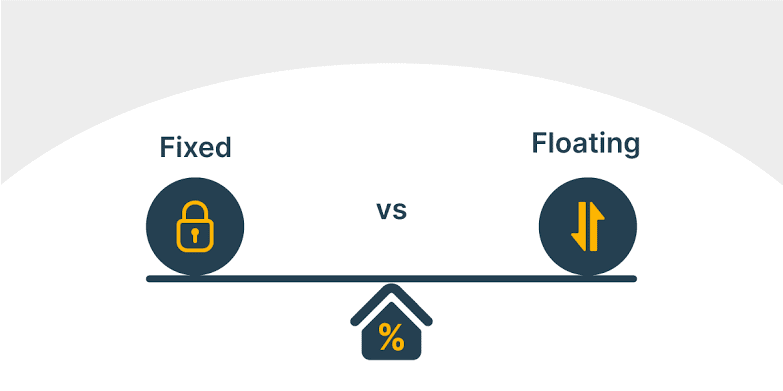
Most Nepali banks offer two kinds of pricing on personal loans, and they behave very differently over a five-year life.
A floating rate is quoted as base rate plus a premium. The base rate is the bank’s own minimum lending rate, calculated monthly under an NRB formula from its cost of funds, reserve costs and operating costs. The premium is the extra the bank charges you depending on the product and how risky it considers you. Nepal SBI Bank, for example, prices its personal loan and overdraft product at base rate plus 1 to 3 percentage points, and its published three-month average base rate applicable from Shrawan 1, 2083 was 5.21 percent, according to the bank’s July 17, 2026 rate sheet. That implies a floating personal loan rate somewhere between about 6.21 and 8.21 percent at that bank today, depending on where you land in the premium band. (We explain how the base rate and spread drive bank pricing in our piece on how Nepali banks actually make money.)
A fixed rate locks the price for a set period. It costs more today. On the same Nepal SBI sheet, fixed personal term loans start at 9.99 percent for up to five years.
So which is better? On paper, floating looks like an obvious win right now. On a NPR 10 lakh five-year loan, 8.21 percent floating gives an EMI of about NPR 20,377 and total interest of about NPR 2,22,600. That is NPR 52,000 less interest than the 9.99 percent fixed option (Biznessvue calculations).
But that comparison assumes the floating rate never moves, and it will. Base rates in Nepal are near historic lows because banks are sitting on surplus deposits and weak credit demand. NRB’s 25th monetary policy for FY 2083/84, released in July 2026, leaned toward reviving lending, for example by raising the personal overdraft ceiling to NPR 1 crore from NPR 50 lakh. If credit demand recovers and deposit rates rise, base rates follow, and so does your floating loan.
Here is what a two-point rise does. Suppose that NPR 10 lakh floating loan starts at 8.21 percent and after 12 months the rate resets to 10.21 percent. Your balance at that point is roughly NPR 8,31,300. To finish on schedule in the remaining 48 months, the EMI rises from about NPR 20,377 to about NPR 21,168. If the bank instead keeps your EMI fixed and extends the tenure, the remaining term stretches from 48 months to a little over 50. Neither is a disaster on a loan this size. Scale it to a larger loan or a bigger rate jump, and it becomes one. (Biznessvue calculations.)
The skeptical read: floating rates are cheaper because you carry the interest rate risk. That is a good bet when rates are high and likely to fall, and a weaker one when rates are near the floor, as they are now. For a short personal loan of two or three years, floating is usually fine, because there is not much time for rates to move against you. For anything longer, price the fixed option seriously, and ask the bank in writing what happens to your EMI if the base rate rises.
The costs that never appear in the EMI
The EMI formula covers interest and principal. Several other costs sit outside it, and they change the real price of the loan.
The administrative or service fee
Nepali banks charge a one-time fee when they sanction a loan, usually deducted from the disbursed amount. Nepal Bank Limited’s published schedule of charges, for example, lists an administrative fee of 0.75 percent of the approved limit on new consumer loans. On NPR 10 lakh, that is NPR 7,500.
It sounds small. But you pay interest on NPR 10 lakh while receiving only NPR 9,92,500. On the five-year, 9.99 percent example, that fee lifts the effective annual cost to roughly 10.3 percent. On a one-year loan, where the same fee is spread across far fewer months, the effective rate rises to about 11.4 percent. These are Biznessvue estimates, and they illustrate a simple rule: the shorter the loan, the more a flat upfront fee distorts the true rate.
Other charges
Secured personal loans can add valuation fees, mortgage registration costs and asset insurance. Miss an installment and most banks add penal interest on the overdue amount, and repeated delays show up with the Credit Information Bureau (CIB), which makes your next loan harder or dearer. Ask for the full list of charges before you sign, not after.
Prepayment: the clause worth reading twice
Because interest is front-loaded, paying down principal early is one of the highest-return moves available to a Nepali borrower. Whether it is cheap to do depends on the prepayment clause.
Nepal Bank Limited’s schedule of charges shows the common structure for floating-rate term loans for non-corporate borrowers: a prepayment charge of 0.75 percent of the amount prepaid within two years of disbursement, 0.375 percent between two and five years, and 0.15 percent after five years. The same schedule states that no prepayment charge applies to term loans of up to NPR 50 lakh. For fixed-rate loans, the bank’s charge depends on the timing set in the loan agreement. Other banks publish their own schedules, so read yours.
For most personal loans, which sit well below NPR 50 lakh, this means prepayment should cost you nothing at banks following that structure. Here is what it is worth. Take the NPR 10 lakh, five-year loan at 9.99 percent. After 12 months, you receive a Dashain bonus or a remittance top-up and put NPR 2 lakh against the principal. Keep the EMI unchanged, and the remaining 48 months collapse to roughly 35. Total interest saved: about NPR 82,800 (Biznessvue calculation). Alternatively, keep the original end date and your EMI drops from NPR 21,242 to about NPR 16,171.
Compare that NPR 82,800 saving with what the same NPR 2 lakh would have earned in a fixed deposit at today’s deposit rates. Paying off a loan at 9.99 percent is a guaranteed, tax-free 9.99 percent return. Very few safe instruments in Nepal pay that right now. That logic also cuts the other way: borrowing at 10 percent to buy shares in the hope of beating it is a bet, not a plan. We lay out the trade-off between guaranteed and market returns in fixed deposit versus stocks in Nepal.
One caveat. Do not prepay with money you might need next month. Draining your savings to clear a loan, then taking an expensive emergency loan three months later, is worse than not prepaying at all. Build the cushion first; our guide to building an emergency fund in Nepal covers how big it should be.
Flat rate quotes: the oldest trick in Nepali lending
Nepali commercial banks typically calculate interest on a reducing balance. But not every lender a Nepali household deals with is a bank. Some cooperatives, informal lenders and dealer-arranged schemes quote a “flat” rate, and the difference is enormous.
A flat rate charges interest on the original principal for the entire tenure, as if you never paid any of it back. A “9.99 percent flat” quote on NPR 10 lakh for five years means interest of NPR 99,900 a year for five years, NPR 4,99,500 in total. The monthly installment is about NPR 24,992.
That looks only a little higher than the bank’s NPR 21,242. It is not. The equivalent reducing-balance rate on that flat quote is about 17.3 percent a year (Biznessvue calculation). The same headline number, 9.99, hides a loan that costs nearly twice as much in interest.
The test is simple. Ask any lender: “Is this rate on a reducing balance or flat?” If they hesitate, or if they cannot show you an amortization schedule that lists interest and principal separately for every month, walk away.
How much EMI can you actually carry?
Banks will not lend you unlimited amounts, and NRB does not want them to. NRB requires banks to assess a borrower’s debt service to gross income ratio, meaning the share of your verified gross income that goes to all loan installments combined. For personal term loans and overdrafts, that ceiling is 50 percent. A loan that pushes you over the cap must be classified by the bank as a watch-list loan, which costs the bank provisioning, so most banks simply refuse.
Fifty percent is a regulatory ceiling, not a target. A household spending half its gross income on EMIs has almost no room for school fees, medical bills or a bad month. A more comfortable rule for personal borrowing is to keep all non-housing EMIs well below a fifth of take-home pay. That is our opinion, not a regulation, but it is the difference between a loan you manage and a loan that manages you.
The verdict
The EMI is real, and you have to be able to pay it. But it is a symptom of the loan, not its price. Two borrowers can carry the same NPR 21,000 monthly payment and pay wildly different amounts for their money.
So before you sign any personal loan in Nepal, ask for five things in writing. The total amount you will repay over the full tenure. The interest rate, and whether it is fixed or base rate plus premium, with the premium spelled out. Every fee deducted at disbursement. The prepayment charge, if any. And a full amortization schedule. A bank that is confident in its offer will give you all five without fuss. A bank that only wants to talk about the monthly installment is telling you something too.
This is analysis, not financial advice.
Frequently Asked Questions (FAQs)
1. What is EMI on a personal loan?
EMI is the fixed monthly payment you make toward your loan. It includes both principal and interest, but the share of interest is higher in the early months.
2. Does a lower EMI mean a cheaper loan?
Not necessarily. A lower EMI often comes with a longer tenure, which means you may pay much more interest overall. Always compare the total repayment amount, not just the monthly EMI.
3. How does loan tenure affect the total interest?
A longer tenure reduces your monthly payment but increases the total interest you pay. For example, a NPR 10 lakh loan at 9.99% costs about NPR 1.61 lakh interest over 3 years but about NPR 5.85 lakh over 10 years.
4. What is the difference between fixed and floating interest rates?
A fixed rate remains unchanged for a set period, while a floating rate can change when the bank’s base rate changes. Floating rates may be cheaper initially, but your EMI or repayment period can increase if rates rise.
5. What extra charges should I check before taking a loan?
The EMI does not include every cost of borrowing. Check for processing or administrative fees, insurance, valuation and registration costs, and late-payment charges before signing the loan agreement.
6. Can I save money by repaying my loan early?
Yes. Paying off part of the principal early can reduce the total interest you pay, especially during the early years of the loan. However, check your bank’s prepayment rules and charges before making an early payment.
7. What should I check before taking a personal loan in Nepal?
Don’t look at the EMI alone. Ask the bank for the total repayment amount, interest rate, all fees, prepayment charges, and a full amortization schedule before signing.