Here is a mistake that costs NEPSE investors real money. A hydropower company reports record electricity sales, the stock climbs, and a few quarters later the same company is posting a net loss and announcing a rights issue. Revenue was never the problem. Interest was. The number that would have warned you sat on the balance sheet the whole time, and it is the debt to equity ratio NEPSE investors check least often.
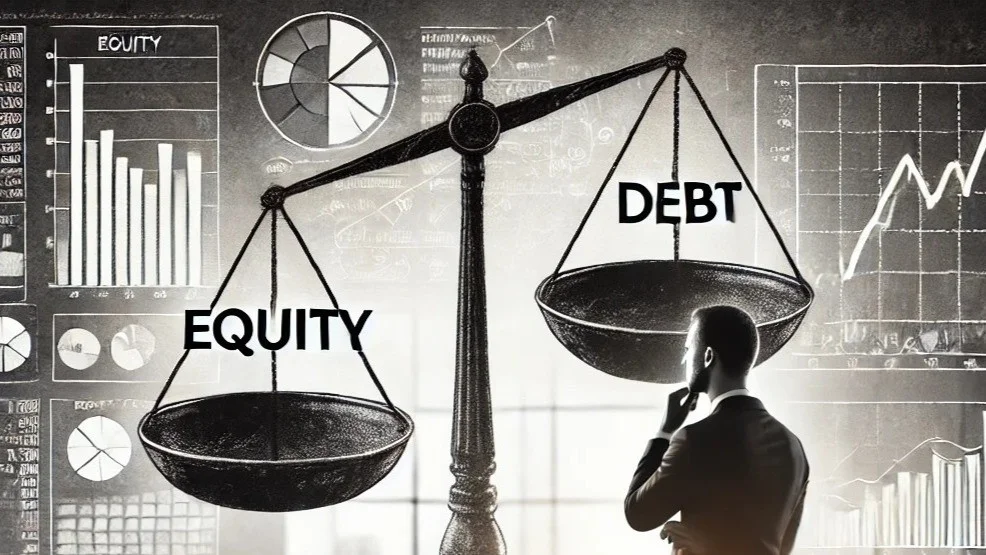
Debt-to-equity (D/E) tells you how much of a company is funded by lenders versus owners. It is the simplest leverage measure there is, and on NEPSE it matters far more for some sectors than others. For hydropower and manufacturing it can be the most important ratio you look at. For banks and insurers it is close to useless, and applying it there leads people to wrong conclusions.
Our view, stated up front: leverage is not the enemy. Almost every hydropower project in Nepal is built mostly on borrowed money, and that is fine. What kills shareholders is leverage that moves the wrong way after the project is running, and a market that stopped paying attention because interest rates fell. This piece shows you how to spot that.
What the debt to equity ratio actually measures

The formula is short.
Debt-to-equity = Total interest-bearing debt ÷ Shareholders’ equity
Debt here means borrowings that carry interest: long-term project loans, short-term working capital loans, overdrafts and any debentures the company has issued. Do not include trade payables or provisions. Those are liabilities, but they are not the kind that can force a company into default through missed interest payments.
Shareholders’ equity is paid-up capital plus reserves and retained earnings. On a Nepali quarterly report, you will usually see it split into “share capital” and “reserves and surplus” (or “retained earnings”). Add them together. If retained earnings are negative, subtract them. That detail matters more than people think, as we will see.
A quick worked example. Say a listed company has:
- Long-term bank loans: NPR 70 crore
- Short-term loans: NPR 10 crore
- Paid-up capital: NPR 30 crore
- Retained earnings: NPR 10 crore
Debt is NPR 80 crore. Equity is NPR 40 crore. D/E is 2.0, meaning lenders have put in NPR 2 for every NPR 1 from shareholders.
Now suppose the company loses NPR 15 crore over two bad years, and borrows nothing new. Debt is still NPR 80 crore. Equity drops to NPR 25 crore. D/E jumps to 3.2. The company did not take on a single rupee of new loans, yet it became far more leveraged. Losses do the borrowing for you.
Why leverage flatters returns until it does not
Debt is a multiplier. When a business earns more on its assets than it pays in interest, borrowing boosts the return to shareholders. When it earns less, borrowing magnifies the damage.
Take two identical hydropower plants, each costing NPR 100 crore and each earning NPR 12 crore a year before interest and tax. Plant A is funded entirely by equity. Plant B is funded 70:30, with NPR 70 crore of debt at 9 percent interest.
Plant A’s shareholders earn NPR 12 crore on NPR 100 crore of equity, a 12 percent return.
Plant B pays NPR 6.3 crore in interest, leaving NPR 5.7 crore. On its NPR 30 crore of equity, that is 19 percent. Leverage turned a 12 percent business into a 19 percent return for owners.
Now a bad monsoon, a transmission outage or a flood cuts operating earnings to NPR 6 crore. Plant A’s shareholders still earn 6 percent. Plant B’s earnings fall to negative NPR 0.3 crore, because the bank gets paid first, rain or no rain. Same plant, same bad year. One set of shareholders has a weak year. The other has a loss.
These numbers are illustrative, not drawn from any company. But the mechanism is exactly how Nepali hydropower earnings behave, and it is why we argue the D/E ratio deserves as much attention as the megawatt number in any hydro prospectus. For a fuller framework, see our guide to valuing a hydropower stock on NEPSE.
Hydropower: 70:30 is the norm, so read the trajectory

Nepali hydropower is built on debt by design. Bank consortium financing at a 70:30 debt-to-equity split is the standard structure you will see in loan announcements. Nepal Bank’s August 2026 loan agreement for Chitwan Energy’s Lower Thulokhola project used a 70:30 ratio, according to ShareSansar. So did the NPR 13.20 billion Sanjen Khola financing led by NIBL, and the Upper Modi A project, where NMB Bank and HIDCL committed debt against an estimated total cost of NPR 10.57 arba, also per ShareSansar. The 1,063 MW Upper Arun project, led by the Nepal Electricity Authority, is planned on the same 70:30 split, Kantipur reported in November 2025.
A 70:30 split means D/E of about 2.3 at financial close. That is high by the standards of most industries, and it is normal for Nepali hydro. So a D/E of 2 or 2.5 on a hydropower company tells you very little on its own.
What tells you a lot is the direction.
A healthy operating hydropower company should see D/E fall over time. Loans get repaid from electricity revenue, principal shrinks, and retained earnings build equity. If you line up five years of annual reports and D/E drifts from 2.3 toward 1.5 and then 1.0, the project is doing what it was financed to do.
An unhealthy one shows the opposite. D/E rises after commercial operation. That usually means one of three things: cost overruns financed with extra debt, losses eating into equity, or short-term loans being used to cover interest and repayments. Any of these is a red flag, and all three can happen at once.
A case study in rising leverage: Upper Tamakoshi

Upper Tamakoshi Hydropower (UPPER) is the clearest public example of how leverage behaves when a project runs late and over budget. It is a 456 MW plant and one of the most widely held stocks on NEPSE, which is exactly why its balance sheet is worth studying.
When ICRA Nepal assigned the company an issuer rating of [ICRANP-IR] BB in December 2022, it pointed to cost per megawatt rising from NPR 77 million to NPR 196 million, an increase of about 155 percent, according to ShareSansar’s report on the rating. ICRA also flagged the company’s “large debt and negative net value” (a reference to accumulated losses), along with liquidity issues and high gearing that could affect timely debt servicing.
The quarterly numbers showed the same story. For the first half of FY 2079/80 (ending mid-January 2023), Upper Tamakoshi reported electricity sales of Rs 4.98 arba and finance expenses of Rs 3.64 arba, according to its unaudited second-quarter report as published by ShareSansar. In plain terms, interest consumed roughly 73 percent of what the company earned from selling power. Retained earnings stood at negative Rs 3.98 arba against paid-up capital of Rs 10.59 arba. Net worth per share had fallen to Rs 62.38 from Rs 86.86 a year earlier.
That is the equity erosion effect from our worked example, playing out in a real company. Losses shrank the equity base, which pushed leverage higher without any headline about new borrowing.
The fix, predictably, came from shareholders. The company went to a 1:1 rights issue of 10.59 crore units, which it extended to its shareholders until Ashwin 22, 2080 BS (October 2023 AD), per ShareSansar. ICRA’s 2022 note had already indicated that a rights issue, along with internal cash, would fund its next project. A rights issue is equity coming in to repair a leveraged balance sheet. If you held the stock and did not subscribe, you were diluted. If you did, you paid to fix a problem the D/E ratio had been signaling for years.
Earnings stayed volatile after that. The company reported a net loss of Rs 2.57 billion for FY 2081/82, per its fourth-quarter report published on ShareSansar, a year in which flood and landslide damage halted the plant in late 2024 before full generation resumed by the end of June 2025, according to ShareSansar and The Kathmandu Post. It then posted a net profit of Rs 1.67 billion in the first quarter of FY 2082/83. That swing is what leverage does: small changes in operations produce large changes in the bottom line.
We are not making a call on UPPER stock today. The point is the pattern. Every warning sign was visible in public filings well before the rights issue arrived.
Manufacturing: watch the short-term debt
Manufacturing companies on NEPSE are few, but leverage risk works differently for them. A hydropower plant has a long-term loan with a repayment schedule tied to a power purchase agreement. A cement, steel or consumer goods maker usually leans more on short-term working capital loans that must be rolled over every year.
That creates a risk D/E alone does not capture. Two manufacturers can both show D/E of 1.5. If one has mostly long-term debt and the other has mostly short-term loans, the second is more fragile. When banks tighten credit, short-term lines get cut or repriced first. So for manufacturers, split the debt line. Check how much is due within a year, and compare that to cash and receivables.
Also watch inventory. Short-term borrowing that rises alongside unsold stock means the company is borrowing to fund a slowdown, not growth.
Banks and insurers: do not use debt-to-equity at all

This is where many NEPSE investors go wrong. A bank’s main liability is deposits. Customer deposits are, technically, money the bank owes. Run D/E on a commercial bank and you will get a number like 8 or 10, which looks alarming if you compare it with a hydro company. It means almost nothing.
Banks are built to be leveraged. The question is not how much they owe but whether they hold enough capital against the risk in their loan book. That is why Nepal Rastra Bank regulates them through the capital adequacy ratio (CAR) rather than debt-to-equity. Commercial banks in Nepal must maintain a minimum total CAR of 11 percent of risk-weighted assets, including the capital conservation buffer, and a minimum core (Tier 1) capital ratio of 8.5 percent, according to ShareSansar’s review of NRB’s Basel III requirements.
So for banks, look at CAR, non-performing loans and the credit-to-deposit ratio instead. Our explainer on NPL, CD ratio and CAR covers how to read each. The same logic applies to insurers, where policyholder liabilities dominate the balance sheet and solvency ratios, not D/E, measure strength. Microfinance and finance companies fall into the same bucket as banks.
The interest rate trap nobody is talking about
Here is the part of the D/E story that incumbents rarely write about. Low interest rates hide leverage.
When rates are high, heavily indebted companies bleed, and investors notice. When rates fall, the same debt suddenly costs less. Profits recover, dividends reappear, and the market stops asking about balance sheets.
Nepal has just been through exactly that cycle. The average base rate of commercial banks (the benchmark banks use to price loans) stood at 10.64 percent for Falgun to Baisakh 2079/80 BS (roughly February to May 2023 AD), according to ShareSansar. By Shrawan 2082 BS (July 2025 AD), the average across 20 commercial banks had fallen to 6.11 percent, down from 8.13 percent a year earlier, Beema Post reported. Most corporate loans in Nepal float off the base rate, so a leveraged company’s interest bill falls as the base rate falls.
That is roughly a 4.5 percentage point drop in about two years. On NPR 100 crore of floating-rate debt, a fall of that size would cut the annual interest bill by about NPR 4.5 crore (an illustration, since actual loan rates add a borrower-specific premium). It explains why many leveraged companies look healthier today than their balance sheets justify.
Our take is simple. Rates move in cycles. If you are buying a highly leveraged company now, you are partly buying a bet that rates stay low. Stress-test it. Ask what happens to profit if the company’s borrowing cost goes back up by 3 or 4 percentage points. If the answer is “it swings to a loss,” you are holding a rate bet dressed up as a stock pick.
How to calculate and use the debt to equity ratio on NEPSE

You do not need paid software. Here is a practical routine using the quarterly and annual reports companies publish on their websites and through NEPSE.
- Open the latest quarterly balance sheet. Find every interest-bearing borrowing line: long-term loans, short-term loans, overdrafts, debentures. Add them.
- Find share capital and reserves (or retained earnings). Add them, subtracting any negative retained earnings.
- Divide debt by equity.
- Repeat for the same quarter in each of the last three to five years. A single number tells you little. The trend tells you nearly everything.
- Check the income statement for finance costs. Compare them with operating profit (sometimes shown as “profit from operations”). This is the interest coverage ratio. If operating profit does not cover interest by a comfortable margin, high D/E is already a live problem, not a theoretical one.
- For manufacturers, separate short-term debt from long-term debt.
- Read the notes and any credit rating report. Rating agencies often spell out leverage concerns in plain language, as ICRA did for Upper Tamakoshi.
It takes about 20 minutes per stock and fits into the broader checklist in our guide on how to research a NEPSE stock.
Rough benchmarks, and why we hold them loosely
There is no official D/E threshold for listed non-financial companies in Nepal. What follows is Biznessvue’s working view, not a regulatory standard, and it should be adjusted for each company’s business model.
For operating hydropower, a D/E at or below the 70:30 financing level (around 2.3) is normal in early years. We would want to see it trending down, toward 1.5 or lower, within several years of commercial operation. D/E above financing levels on an operating plant, or rising year after year, is a warning.
For hydropower still under construction, D/E climbs as loans are drawn. That is expected. The risk there is cost overrun, so compare the current project cost estimate with the original one in the prospectus.
For manufacturing, we would treat D/E above 2 as high and look hard at how much of that debt is short-term.
For banks, insurers, microfinance and finance companies, ignore D/E. Use CAR, solvency and asset quality.
These are starting points for questions, not buy or sell signals.
The rights issue connection
One last pattern worth remembering. When a company’s D/E climbs too high, lenders get nervous and its options narrow. It can sell assets, cut dividends, or raise equity. On NEPSE, raising equity usually means a rights issue.
That makes rising leverage a rough early indicator of future rights issues. If you understand how a rights offering works (our explainer on IPO, FPO and rights shares walks through it), you will see why this matters. A rights issue priced at par to repair a balance sheet is not a gift to shareholders. It is a bill.
The verdict
Debt-to-equity is not a ratio you read once. It is one you watch. A 70:30 hydropower company is not reckless. It is typical. The companies that hurt shareholders are the ones whose leverage rises after they start producing, whose equity is being eaten by losses, and whose interest bill looks manageable only because base rates have fallen sharply since 2023.
If you own leveraged NEPSE stocks, do three things. Track D/E over five years, not one quarter. Compare finance costs with operating profit. And ask what the company looks like if rates return to where they were in 2023. The companies that pass that test are the ones worth holding through the next cycle.
This is analysis, not financial advice.
Frequently Asked Questions (FAQs)
1. What is the debt-to-equity ratio in NEPSE?
Debt-to-equity (D/E) measures how much a company relies on borrowed money compared with shareholders’ equity. It is calculated by dividing total interest-bearing debt by shareholders’ equity.
2. Is a high debt-to-equity ratio always bad?
No. A high D/E ratio can be normal in capital-intensive sectors such as hydropower. What matters more is whether the ratio is rising or falling over time and whether the company can comfortably manage its interest costs.
3. What is a normal debt-to-equity ratio for hydropower companies in Nepal?
Nepali hydropower projects commonly use around 70% debt and 30% equity, which equals a D/E ratio of about 2.3. However, investors should focus on whether D/E starts declining after the project begins generating electricity.
4. Should investors use debt-to-equity ratio for banks and insurance companies?
Not usually. D/E is not a useful measure for banks because deposits are a major part of their liabilities. For banks, investors should instead look at measures such as CAR, NPL and credit-to-deposit ratio. Insurers also require sector-specific solvency measures.
5. How can rising debt-to-equity signal a future rights issue?
If debt keeps rising while shareholders’ equity falls because of losses, a company may need to raise fresh equity to strengthen its balance sheet. On NEPSE, this can result in a rights issue, requiring existing shareholders to contribute additional capital.