Picture a saver in Pokhara who bought NPR 5 lakh of a seven-year bank debenture paying 7 percent. Two years later, a new debenture from a similar bank opens on Meroshare at 9 percent. He shrugs. His coupon has not changed, his principal is “safe,” and he plans to hold to maturity anyway. Nothing lost, he thinks.
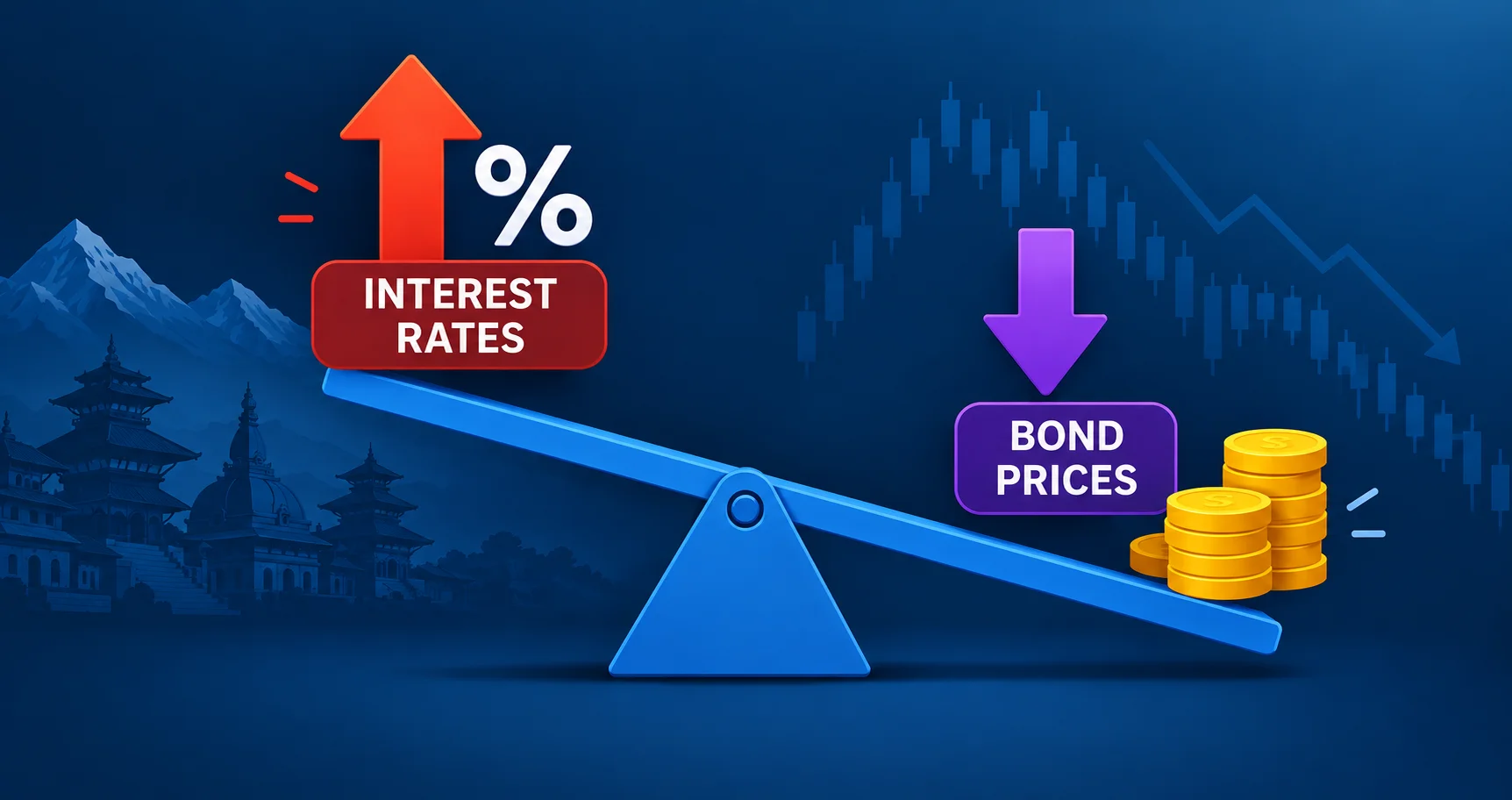
He is wrong, and the reason is the most important idea in fixed income. The link between bond prices and interest rates in Nepal works exactly as it does everywhere else: when rates rise, the market value of the bonds you already hold falls. The only difference here is that Nepal’s thin secondary market hides the loss from you. Hidden is not the same as absent. This piece explains the inverse rule in plain rupees, why it bites harder on long bonds, and why, with Nepali rates sitting near the bottom of their cycle in 2026, it matters more now than it has in years.
The inverse rule in one example
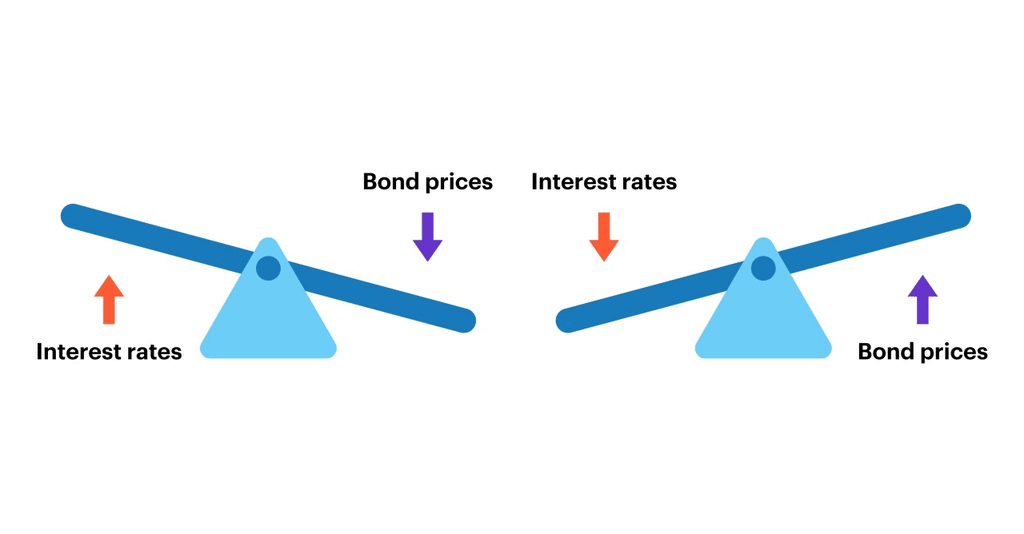
Start with the mechanics, because once you see them the rule stops being mysterious.
A bond (or debenture, the word most Nepali issuers use) is a loan. You pay NPR 1,000 today. The issuer pays you a fixed coupon every year and returns your NPR 1,000 at maturity. The coupon is fixed on the day the bond is issued. It never changes. That fixedness is the whole point of the instrument, and it is also the source of the price risk.
Suppose you own a 7 percent debenture with seven years left to run. It pays NPR 70 a year on each NPR 1,000 of face value. Now market rates rise, and new bonds of similar quality are being issued at 9 percent, paying NPR 90 a year.
Ask yourself what a buyer would pay you for your old bond. Nobody rational pays NPR 1,000 for NPR 70 a year when they can pay NPR 1,000 for NPR 90 a year down the road. To sell, you have to cut your price until your bond offers the same 9 percent return as the new one. Using a standard present-value calculation (discounting each future payment at 9 percent), that price works out to roughly NPR 899. Your “safe” bond has lost about 10 percent of its market value, and not a single coupon was missed.
Run it in reverse. If market rates fall to 5 percent, your 7 percent coupon is suddenly generous. Buyers will compete for it, and its fair price climbs to about NPR 1,116. Same bond, same issuer, same coupon. The price moved only because the going rate moved.
That is the inverse rule. The coupon is fixed, so the price is the only thing that can adjust to bring your old bond’s yield in line with the market. Rates up, price down. Rates down, price up. There is no version of a fixed-coupon bond where this does not happen.
Why the coupon and the yield are different numbers
Most confusion about bonds in Nepal comes from treating two different numbers as one.
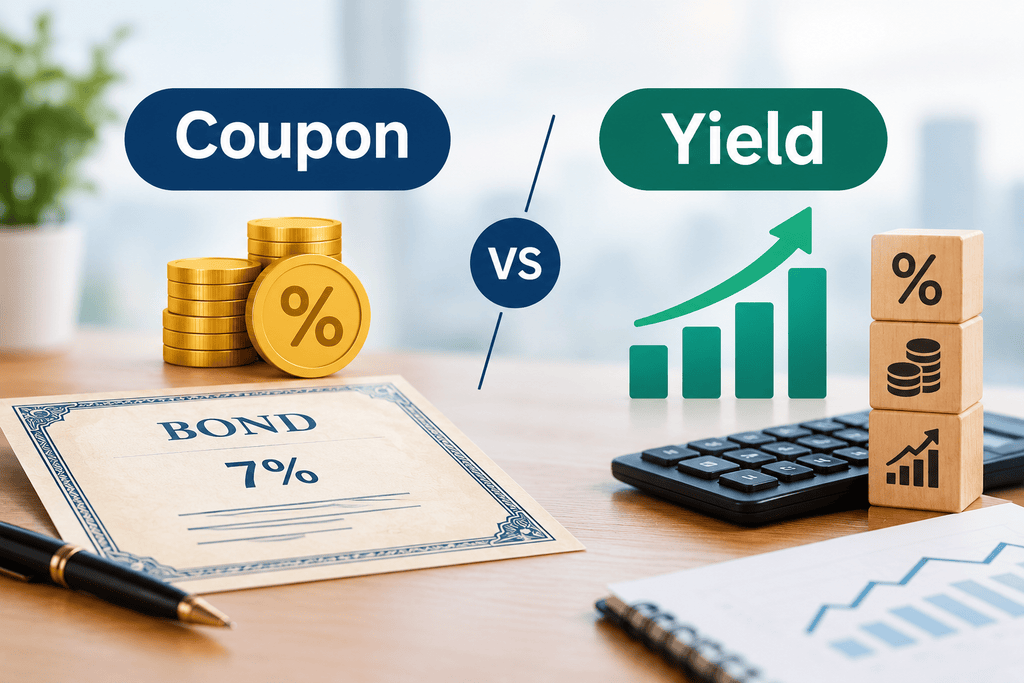
The coupon rate is printed on the bond. A name like “7% XYZ Bank Debenture” tells you the coupon, the percentage of face value paid each year. It is a contract term and it never changes.
The yield is what you actually earn if you buy the bond at today’s market price and hold it to maturity. It includes the coupons and any gain or loss between the price you paid and the NPR 1,000 you get back. If you buy that 7 percent bond at NPR 899, your yield is about 9 percent, because you collect NPR 70 a year and also pocket an extra NPR 101 at maturity. If you buy it at NPR 1,116, your yield is about 5 percent, because the NPR 116 premium you paid melts away by the time you are repaid at par.
So the coupon describes the bond. The yield describes the deal. When people say “bond prices and yields move in opposite directions,” this is what they mean. A falling price is, mathematically, a rising yield for whoever buys next.
Long bonds move more than short ones
Not every bond reacts to a rate change equally. The further away the bond’s cash flows are, the more its price swings.
Keep the same scenario, a 7 percent coupon with market rates jumping to 9 percent, and change only the years left to maturity. By the same present-value math, a bond with one year left falls to about NPR 982. With three years left, about NPR 949. Five years, about NPR 922. Seven years, about NPR 899. Ten years, about NPR 872.
The one-year bond barely flinches, because you get your NPR 1,000 back soon and can reinvest at the new higher rate. The ten-year bond takes a 13 percent hit, because you are stuck earning the old, lower coupon for a decade.
Professionals compress this into a number called duration, roughly how many percent a bond’s price moves for each 1 point change in rates. For a seven-year bond paying 7 percent, it comes out around 5.4. You do not need to calculate it. Remember the direction: the longer the bond, the bigger the swing. In Nepal, where bank debentures typically run seven to ten years and government development bonds can run much longer, most of what retail investors can buy sits at the sensitive end of this scale.
“I will just hold to maturity” is not the escape it sounds like
This is the objection almost every Nepali bondholder raises, and it deserves a straight answer.
It is true that if you hold a debenture to maturity and the issuer does not default, you get every coupon and your full NPR 1,000 back. The price dip in the middle never becomes a realized loss. For many savers that is exactly the plan, and it is a reasonable one.
But holding to maturity does not make the rate change disappear. It converts a price loss into an opportunity loss. Go back to the Pokhara saver. His NPR 5 lakh earns 7 percent while new money earns 9 percent. With five years left to run, that 2 point gap costs him around NPR 10,000 of income a year compared with someone who waited, roughly NPR 50,000 over the remaining term before compounding. By the same present-value math, the fair price of his bond has dropped to about NPR 922 per unit, so his NPR 5 lakh holding is worth roughly NPR 4.6 lakh to a buyer today. That discount is simply the market’s honest estimate of his income shortfall, paid up front. Selling crystallizes the loss. Holding spreads it out. Either way, he is poorer than he would have been had rates not risen.
And “hold to maturity” assumes nothing forces your hand. A medical bill or a child’s admission fee abroad turns the paper loss into a real one, and in Nepal a larger one than the math suggests.
Nepal’s hidden version of the inverse rule
On paper, publicly issued debentures in Nepal must be listed on NEPSE and can be traded. In practice, the secondary bond market has barely functioned for years. The Kathmandu Post reported as early as 2019 that secondary bond trading was effectively absent, and debentures remain a sideshow on an exchange that runs almost entirely on equities. SEBON’s own draft Debenture Registration and Issuance Regulation, 2026, released for comment in August 2026, frames building a functioning bond segment as a goal, not a description of today.
Here is the take that matters. Because Nepali debentures rarely trade, you almost never see their price fall when rates rise. There is rarely a fresh trade to mark your holding against, so it keeps feeling like NPR 1,000 a unit. That creates a comforting illusion that bonds here are “stable” in a way they are not elsewhere.
They are not more stable. They are less transparent. The value loss from a rate rise happens whether or not anyone prints a price. And when you do need to sell, a thin market adds a second cost on top of the rate loss: you may have to accept whatever bid the one or two interested buyers will offer, which can sit well below the fair NPR 899 of our example. In a deep market, you pay the rate loss. In Nepal’s market, you can pay the rate loss plus an illiquidity discount.
The same hidden logic applies to a five-year fixed deposit locked at a low rate. The bank never shows you a market price; the early-withdrawal penalty is the closest thing to one. Our comparison of fixed deposits versus stocks in Nepal covers that trade-off from the saver’s side.
What Nepal’s own rate cycle shows
Nepali rates have swung hard enough in the last five years to make this concrete.
In the tight-liquidity year of fiscal 2021/22, the 91-day Treasury bill rate hit about 10.66 percent and the 364-day bill about 10.19 percent, according to Nepal Rastra Bank data. By 2022/23 the 91-day rate had dropped to 6.35 percent, and by mid-June 2025 it was 2.94 percent. In NRB’s report on the macroeconomic situation for the ten months to mid-May 2026, the 91-day bill stood at 2.63 percent and the weighted average interbank rate at 2.75 percent.
Savings bond coupons followed the same arc. The Citizens Saving Bond 2084, sold between February 22 and March 14, 2023, paid 11.5 percent a year for five years, according to NRB’s issue notice. That rate is still quoted with nostalgia, while the more recent Citizen Savings Bond 2087 came in at 6.5 percent and the Foreign Employment Savings Bond 2087 at 7.5 percent, according to Public Debt Management Office issue notices. The more detailed history is in our guide to buying government bonds in Nepal as a retail investor.
Now apply the inverse rule to that history. Anyone who locked in that 11.5 percent in March 2023 holds a bond whose fair value today sits well above face value, because its coupon towers over the 6.5 percent new savers are offered. With about a year and a half left to its March 2028 maturity, the premium is modest; on a ten-year bond with the same gap, it would be large. Anyone who bought a long fixed-rate bond in the low-rate period just before the 2021/22 spike saw the opposite. The bond did not change. The timing did.
Why this matters more in 2026 than it did in 2023
This is where the rule turns from textbook to decision.
Nepali rates today are near the bottom of their cycle. NRB’s monetary policy for fiscal 2026/27 (2083/84), announced on July 7, 2026, left the policy rate at 4.25 percent, the standing deposit facility floor at 2.75 percent, and the bank rate ceiling at 5.75 percent. The same policy projects inflation around 5.5 percent and states that NRB may review its stance if inflation pressure rises, and may gradually narrow the interest rate corridor. In plain terms: rates are low, inflation is forecast to be higher than it was, and the central bank has told you it is watching.
That creates an asymmetry. With rates already low, there is limited room for them to fall, so the price upside on bonds bought today is capped. There is plenty of room for them to rise. Buying a ten-year bond at a 6.5 or 7 percent coupon near the bottom of the cycle is a bet that rates stay low for most of a decade. If they instead climb back toward the levels of 2022, a bond like that could be worth 10 to 15 percent less than you paid, and in Nepal’s market you might struggle to exit even at that price.
This is opinion, not a forecast. Nobody knows where Nepali rates will be in 2028, and NRB could hold the line for years. The point is narrower. Whatever you believe about the rate path, the price risk on a long bond bought at low yields is lopsided, and most retail buyers here do not price it at all, because they have been told the instrument is “fixed.” How NRB’s corridor, liquidity tools, and policy reviews translate into market rates is covered in our explainer on how NRB monetary policy moves NEPSE.
Reading a Nepali bond with the inverse rule in mind

You do not need a finance degree to use this. You need four habits.
First, match maturity to your real time horizon. If there is a meaningful chance you will need the money in three years, a ten-year debenture is the wrong tool no matter how attractive its coupon. Shorter maturities, or a ladder of bonds maturing in different years, limit how much a rate shock can hurt you.
Second, compare yields, not coupons. If a debenture ever trades on NEPSE at a price other than NPR 1,000, work out the yield you would earn at that price before you get excited about the coupon printed on it. A 9 percent coupon bought at a premium can yield less than a 7 percent coupon bought at a discount.
Third, watch the direction of NRB’s signals, not the level. A tilt toward tightening in the monetary policy or its mid-year review is what pushes new coupons up and existing bond values down.
Fourth, keep rate risk separate from credit risk. The inverse rule applies even to the safest government bond. Whether the issuer can repay you is a separate question. Our guide to investing in corporate bonds in Nepal walks through credit ratings, security, and the tax on coupon income.
What the planned bond market reforms would change
SEBON’s 2026 ten-year capital market blueprint lists corporate and green bonds among its planned reforms, and the draft debenture regulation would require the exchange to build separate trading platforms for publicly issued debentures, with an over-the-counter route for privately placed ones. None of this is live yet. Treat it as a plan.
If it does arrive, it will not repeal the inverse rule. It will make it visible. You will see your debenture’s value fall on screen when rates rise, just as you see a share price fall. That will feel worse and be better, because a visible price comes with a real exit and a fair bid. The risk was always there. A deeper market simply puts a number on it.
The verdict
The inverse link between bond prices and interest rates is not a technicality for foreign markets. It is the core risk of every fixed-rate instrument a Nepali saver can buy, from a bank debenture to a Citizen Savings Bond to a five-year fixed deposit. The coupon never moves, so the value has to.
Nepal’s quiet secondary market makes that risk easy to ignore, and that is the trap. A bond that never shows you a lower price has not avoided the loss. It has only postponed telling you about it. With policy rates at 4.25 percent, short-term bills under 3 percent, inflation forecast to rise, and NRB openly keeping the option to tighten, this is a poor moment to buy long-dated fixed income on the assumption that “fixed” means “safe.”
If you want bonds for income, buy them for the right reason: a maturity you can genuinely wait out, an issuer you have checked, and a clear understanding that you are locking in today’s rate for better or worse. That last part is the one most people skip, and it is the one the inverse rule is really about.
This is analysis, not financial advice.
Frequently Asked Questions
1. Why do bond prices fall when interest rates rise?
Bond coupons are fixed when the bond is issued. When new bonds offer higher interest rates, existing bonds with lower coupons become less attractive, so their market price falls to offer buyers a competitive yield.
2. What is the difference between a bond’s coupon rate and its yield?
The coupon rate is the fixed interest payment stated on the bond. Yield reflects what an investor actually earns based on the bond’s current purchase price, coupons, and eventual repayment at face value.
3. Do long-term bonds lose more value when interest rates rise?
Generally, yes. Bonds with longer maturities are more sensitive to interest-rate changes because investors are locked into their existing coupon for a longer period.
4. If I hold my bond until maturity, can I avoid losing money when rates rise?
If you hold the bond to maturity and the issuer does not default, you can still receive the scheduled coupons and face value. However, the bond can lose market value during the holding period, creating an opportunity cost if newer investments offer higher rates.
5. Why is the interest-rate risk of bonds easy to overlook in Nepal?
Nepal’s secondary bond market has historically been thin, so many debentures rarely trade at observable market prices. As a result, investors may not see the decline in their bond’s market value even though the underlying interest-rate risk still exists.