Every IPO notice in Nepal carries a line most applicants scroll straight past. “ICRA Nepal has assigned [ICRANP] IPO Grade 4.” Or “CARE-NP IPO Grade 3.” Then the applicant opens Meroshare, applies for 10 kitta, and moves on. Ask them what Grade 4 meant and many will guess it is a decent score, because four sounds better than three. It is not. On the IPO scale, Grade 4 means below average fundamentals.
That confusion is the whole problem with how credit rating agencies in Nepal are used by retail investors. The ratings exist, they are mandatory for most public issues, they are published in every prospectus, and they are almost entirely ignored. Part of that is the market’s fault. For years, nearly every IPO issued at NPR 100 per share listed above its issue price, so fundamentals felt irrelevant. Part of it is the ratings’ fault, because the symbols are confusing and the scales run in opposite directions.
This piece explains who rates what in Nepal, how to read each scale, what a grade does and does not tell you, and where it is genuinely useful. The short version of our view: a rating is a good filter and a poor signal. Use it to rule things out, never to rule things in.
Who the credit rating agencies in Nepal are

Nepal’s Securities Board (SEBON) licenses and regulates credit rating agencies under the Credit Rating Regulation 2068 BS (2011 AD). The regulation only allows agencies set up as joint ventures with a foreign rating agency. In practice, all three licensed agencies are subsidiaries of Indian rating firms.
ICRA Nepal was the first. It was incorporated in November 2011 as a subsidiary of India’s ICRA Ltd, which holds 51 percent, per The Kathmandu Post. CARE Ratings Nepal became the second agency approved by SEBON in November 2017, with Mumbai-based CARE Ratings holding a 51 percent stake, the Post reported at the time. Infomerics Credit Rating Nepal, a subsidiary of India’s Infomerics Valuation and Rating, received SEBON approval on March 20, 2022, making it the third, according to ShareSansar.
Three agencies for a market the size of NEPSE is not a lot, and it matters for one reason investors rarely consider. Competition between raters cuts both ways. It can push quality up, but in an issuer-pays model it can also push grades up, because the company being rated is the one choosing and paying the agency. That model is standard across the rating industry globally, and it is worth keeping in mind every time you read a grade.
When a rating is mandatory
Under the Credit Rating Regulation 2068, companies planning public issues of ordinary shares, rights shares, preference shares, bonds or debentures above NPR 3 crore (Rs 30 million) must get rated by a SEBON-licensed agency, as reported by ShareSansar. That covers almost every IPO, FPO and rights issue of any size, and most bank debenture issues.
The rating then goes into the offer document. That is why you see it in the prospectus, in the merchant banker’s public notice, and in the news coverage of the issue. If you want to know where to find it and what else to check in the same document, our guide to reading an IPO prospectus in Nepal walks through it section by section.
SEBON later gave the IPO grade real teeth. In January 2019, it amended the Securities Issuance and Allotment Guidelines 2074 so that a company must receive at least one notch above the lowest grade to issue an IPO. The same amendment required issues rated just one notch above the bottom to be fully underwritten. In plain terms, a Grade 5 IPO cannot come to the public, and a Grade 4 IPO needs an underwriter guaranteeing the whole issue.
The immediate effect was visible. ShareSansar reported on January 15, 2019 that the new rule blocked four hydropower companies in SEBON’s pipeline (Bhairab Kunda, Sayapatri, Unique Hydel and Eastern Hydropower) from issuing IPOs to project-affected locals because they held Grade 5 ratings, while issues already approved could proceed.
The two scales, and why they confuse people
This is the single most useful thing to understand. Nepali rating agencies use at least two very different kinds of scale, and they run in opposite directions.
The IPO grade: 1 is best, 5 is worst

The IPO grade assesses the fundamentals of an equity issue. ICRA Nepal and CARE Ratings Nepal both grade on a five-point scale, according to the agencies’ published definitions as reported by ShareSansar:
- Grade 1: strong fundamentals
- Grade 2: above average fundamentals
- Grade 3: average fundamentals
- Grade 4: below average fundamentals
- Grade 5: poor fundamentals
ICRA Nepal adds a plus sign to Grades 2, 3 and 4 to show a relatively better position within that category. So 4+ sits one notch above 4, and 3+ one notch above 3.
The same scale is used for rights issues, which is why you will see headlines about a “Grade 5 rights issue.” Several finance companies and microfinance institutions have received Grade 5 on proposed rights issues, according to ShareSansar’s coverage of ICRA Nepal and CARE Ratings Nepal gradings.
The issuer and debt rating: AAA is best, D is worst

Issuer ratings and debt ratings work like the international letter scale. CARE Ratings Nepal rates issuers from CARE-NP AAA (Is) at the top to CARE-NP D (Is) at the bottom, per its published rating symbols. ICRA Nepal uses [ICRANP-IR] for issuer ratings and [ICRANP] L for long-term debt, so a bank’s debenture program might be rated [ICRANP] LA while the bank itself carries [ICRANP-IR] A.
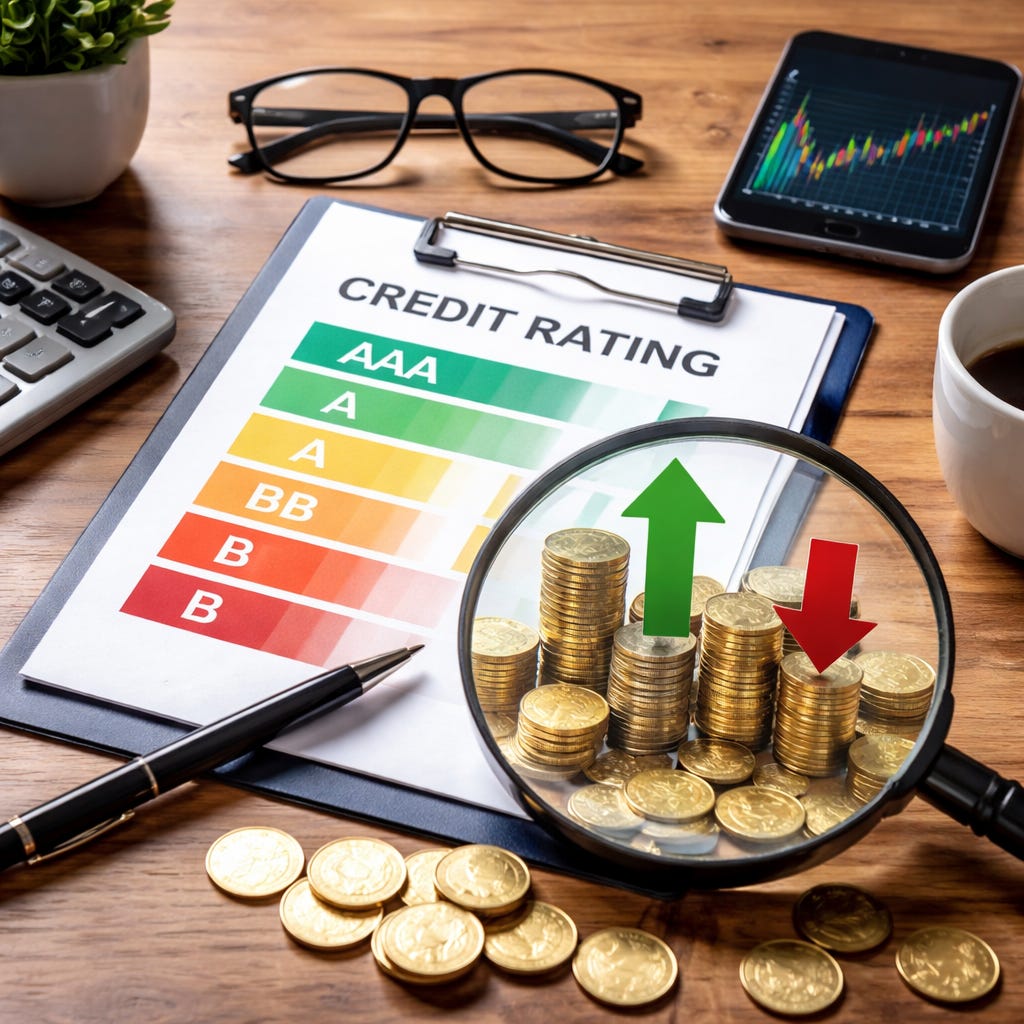
On CARE’s definitions, AAA carries the lowest credit risk and the highest degree of safety for timely servicing of financial obligations. AA means very low credit risk. A means low credit risk and an “adequate” degree of safety. BBB means moderate credit risk. Below that, BB, B, C and D describe progressively higher risk, with D at the bottom of the scale.
So here is the trap. On the IPO scale, a lower number is better. On the letter scale, more A’s are better. A reader who has absorbed “A is good” from debt ratings then sees “Grade 4” on an IPO and has no reference point at all. The agencies are not doing anything wrong here. But the market has never been taught to read the two scales separately, and the prospectus rarely explains it.
A third scale most investors never see
ICRA Nepal also rates mutual fund managers, not funds, on a Fund Management Quality scale from AMC Quality 1 (highest assurance) to AMC Quality 5 (poor). In April 2026, ICRA Nepal upgraded NMB Capital to [ICRANP] AMC Quality 2+, which ShareSansar described as the highest fund management rating in the industry at the time. That tells you something on its own. No Nepali fund manager was at the top of the scale. If you invest through funds, the manager’s rating is worth a look before you commit, alongside the points in our mutual funds explainer.
What an IPO grade does not tell you

This is where the retail reading usually goes wrong.
An IPO grade is not a recommendation to buy, sell or hold, and it is not a comment on the price or valuation of the shares. ICRA Nepal states this explicitly in its grading releases. The grade looks at the business: the project or operations, the promoters and management, financial position, industry risk and so on. It does not tell you whether NPR 100 per share, or NPR 400 per share in a premium issue, is a fair price.
That distinction was easy to ignore when almost everything was issued at par. If you pay NPR 100 for a share and the market prices it at NPR 250 on listing day, the grade did not seem to matter. But look at why the listing pop happened. It was driven by scarce supply, heavy oversubscription and tiny allotments, not by the company’s fundamentals. We explain those mechanics in our piece on how IPO allotment works in Nepal. The pop tells you about demand for the lottery ticket. The grade tells you about the thing you hold after the excitement fades.
ShareSansar made a similar observation back in January 2019. Applicants told it they ignored poor ratings because any IPO would “surely” double after listing, and it noted that this belief had started to break down as some stocks fell below par. That is the lesson in one line. Listing day and year five are different investments. The grade is about year five.
It is also a snapshot. Ratings are reviewed periodically, and they can be upgraded, downgraded, reaffirmed or withdrawn. ShareSansar’s archive is full of “reaffirms” and “withdraws” headlines. A Grade 3 at IPO says nothing about what the company became three years later, and an IPO grade is tied to that specific issue. For a listed company, the more current signal is its issuer rating, if it has one, plus its latest financials.
A worked example: two hydropower IPOs
The figures below are hypothetical and exist only to show how to use a grade. They are not any real company.
Say two hydropower IPOs open in the same month, both at NPR 100 per share. Company A holds IPO Grade 3+. Company B holds Grade 4.
Most retail applicants will apply to both, because the minimum application is small and the expected listing gain looks free. Suppose you apply for 10 kitta in each, NPR 1,000 per application, and get allotted in both.
Now run the long view. Company A’s grade tells you the rater saw average fundamentals, slightly better than the middle of that band. Company B’s grade tells you the rater saw below average fundamentals, and under SEBON’s 2019 amendment, B’s issue needed full underwriting to come to market at all. In other words, B is close to the floor of what the regulator allows to be sold to you.
On listing day, both might trade at NPR 200 or more. The grade will not predict that. But if you are deciding which of the two to keep after listing, or whether to add more shares in the secondary market, the grades are a starting point for a question: why did the rater land where it did? For a hydropower company, the answer usually sits in the rating rationale. Look for delays in construction, cost overruns, weak hydrology data, a power purchase agreement with unfavorable terms, or high debt relative to project size. Our guide to valuing a hydropower stock covers what those factors do to earnings.
The grade is not the analysis. It is the rater telling you where to look.
Where ratings are genuinely useful
Our view is that credit ratings in Nepal are more useful for debt than for equity, and more useful as negative filters than positive ones.
For bonds and debentures
When you buy a bank debenture, you are lending money and waiting for interest and principal. The question a debt rating answers, how likely you are to be paid on time, is exactly the question you care about. A debenture rated [ICRANP] LA or CARE-NP A carries low credit risk on the agency’s definition. One rated BBB carries moderate risk. That gap should show up in the coupon you are offered. If two banks offer similar coupons on debentures with very different ratings, the lower-rated one is paying you too little for the extra risk.
Ratings also expose something about the Nepali banking sector that the headline numbers hide. Many well-known commercial banks sit in the A or BBB bands on the local scale rather than at AAA, based on ratings ShareSansar has reported for banks including Sanima, Machhapuchchhre, Kumari and Prabhu. For example, ShareSansar reported in June 2023 that ICRA Nepal assigned Agriculture Development Bank an issuer rating of [ICRANP-IR] A. The local scale is relative to other Nepali entities, so an A is not weak. But it is a reminder that the raters do not see Nepali banks as risk-free, whatever their dividend history.
For IPO and rights issues
For equity, the rating works best as a floor. A Grade 5 on a rights issue is a clear statement from an independent analyst that the fundamentals are poor. That does not always mean you should skip the rights. Sometimes subscribing protects you from dilution. But it should make you ask why the company needs fresh capital, and whether the new money is going into growth or filling a hole.
A Grade 4 or 4+ on an IPO should push you to read the rating rationale before you treat the issue as a free listing gain. A Grade 1 or 2 is a stronger starting point, but it still says nothing about price. In a premium or book-built issue, where the price is set above par, that gap matters more. Fundamentals can be strong and the price can still be too high.
The limits, stated plainly
Three things keep ratings from being more useful than they are.
First, the issuer pays. That is not unique to Nepal and it does not mean ratings are bought. But it does mean the rater has a commercial relationship with the company it grades, and investors should weight the grade accordingly. This is opinion, and it is the same view many investors hold about ratings in every market.
Second, the rationale matters more than the symbol, and very few investors read it. The agencies publish rating rationales that explain the strengths and weaknesses they weighed. That document is where the value is. A symbol compresses a multi-page argument into a single number, and a single number can hide a great deal.
Third, grades are relative, and the floor has moved. Since SEBON barred the lowest IPO grade in 2019, Grade 4 is effectively the lowest grade you will see on an IPO that reaches the public. Reading Grade 4 as “just below average” understates it. It is the bottom of what is permitted to be sold to you.
How to use a rating in five minutes
Before you apply to any IPO or rights issue, or buy a bond or debenture, do this:
- Find the rating in the prospectus or public notice, and note which agency issued it and when.
- Identify which scale you are reading: numbered IPO grade (1 best, 5 worst) or letter issuer or debt rating (AAA best, D worst).
- For an IPO, note where the grade sits relative to the effective floor. Grade 4 and 4+ deserve more scrutiny, not less.
- Open the rating rationale on the agency’s website and read the key weaknesses section. That is where the useful information is.
- For bonds, compare the rating against the coupon. A lower rating should come with a higher yield. If it does not, you are not being paid for the risk.
The verdict
Credit ratings in Nepal are underused because they were, for a long time, irrelevant to what most retail investors were doing: buying lottery tickets at NPR 100 and selling on listing day. As more issues come at a premium, as SEBON’s capital market blueprint plans a deeper market for corporate and green bonds, and as retail investors hold stocks for longer, that will stop being true.
The rating is not a buy signal. It never was. It is an independent analyst telling you, in compressed form, what could go wrong. The investors who get the most out of it will be the ones who skip the symbol and read the reasoning underneath.
This is analysis, not financial advice.
Frequently Asked Questions (FAQs)
1. What does an IPO Grade mean in Nepal?
An IPO Grade reflects the fundamental strength of a company or project issuing shares. The scale runs from Grade 1 to Grade 5, where Grade 1 indicates strong fundamentals and Grade 5 indicates poor fundamentals. A lower number is therefore better.
2. Is IPO Grade 4 better than Grade 3?
No. On Nepal’s IPO grading scale, Grade 3 means average fundamentals, while Grade 4 means below-average fundamentals. Grade 1 is the strongest and Grade 5 is the weakest.
3. Does a high IPO grade mean I should buy the shares?
No. An IPO grade is not a buy, sell, or hold recommendation, and it does not indicate whether the IPO price is fair. It evaluates factors such as the company’s business, management, financial position, project risks, and industry conditions.
4. How is an IPO rating different from a bond or debt rating?
IPO ratings use a 1–5 scale, where 1 is best, while issuer and debt ratings generally use a AAA-to-D scale, where AAA is best and D is the weakest. Investors should identify which rating scale they are reading before interpreting the grade.
5. How should investors use credit ratings when evaluating an IPO or bond?
Investors should treat the rating as a starting point rather than a final investment decision. Check the rating agency and date, identify the correct scale, read the rating rationale and key weaknesses, and for bonds compare the rating with the coupon or yield.