The first time most people try to buy shares in Nepal, they hit a wall of acronyms. Demat. DP. CDSC. Meroshare. TMS. ASBA. The forms ask for things you have never heard of, and the bank counter explains it in thirty seconds flat. So people sign where they are told, pay what they are told, and walk out with logins they do not understand. Then a year later their account is blocked, an IPO application bounces, or the name on the share certificate does not match the name on the bank account, and nobody told them why.
This guide is the practical on-ramp to open a demat account in Nepal and link it to Meroshare. But it is not a click-by-click that you could get anywhere. The goal is that by the end you understand what each piece is, why it exists, what it actually costs you every single year, and where beginners quietly trip up. Get the setup right once and you rarely think about it again. Get it wrong and you pay for it in blocked accounts and missed allotments.
The plumbing, before the steps
Before you fill in a single form, it helps to know who holds what.
A demat account (short for “dematerialized”) is where your shares live in electronic form instead of paper certificates. The account itself sits at the CDSC, the CDS and Clearing Limited, which is Nepal’s central depository. Think of CDSC as the master ledger for the entire market. Every share you own is recorded there against a unique number called a Beneficial Owner (BO) ID, a 16-digit code that is effectively your share account number. According to CDSC, you can even hold a demat account with a zero balance, and you can open more than one in the same name with different participants if you ever need to.
You do not walk into CDSC to open the account, though. You go through a DP, a Depository Participant. A DP is your custodian, the licensed intermediary that maintains your demat account on CDSC’s system on your behalf. In Nepal, DPs are banks and financial institutions, commercial banks, development banks, and finance companies, along with brokers and merchant bankers that hold a DP license. The DP is the human-facing front desk for the depository. When you “open a demat account,” you are really opening it at a DP.
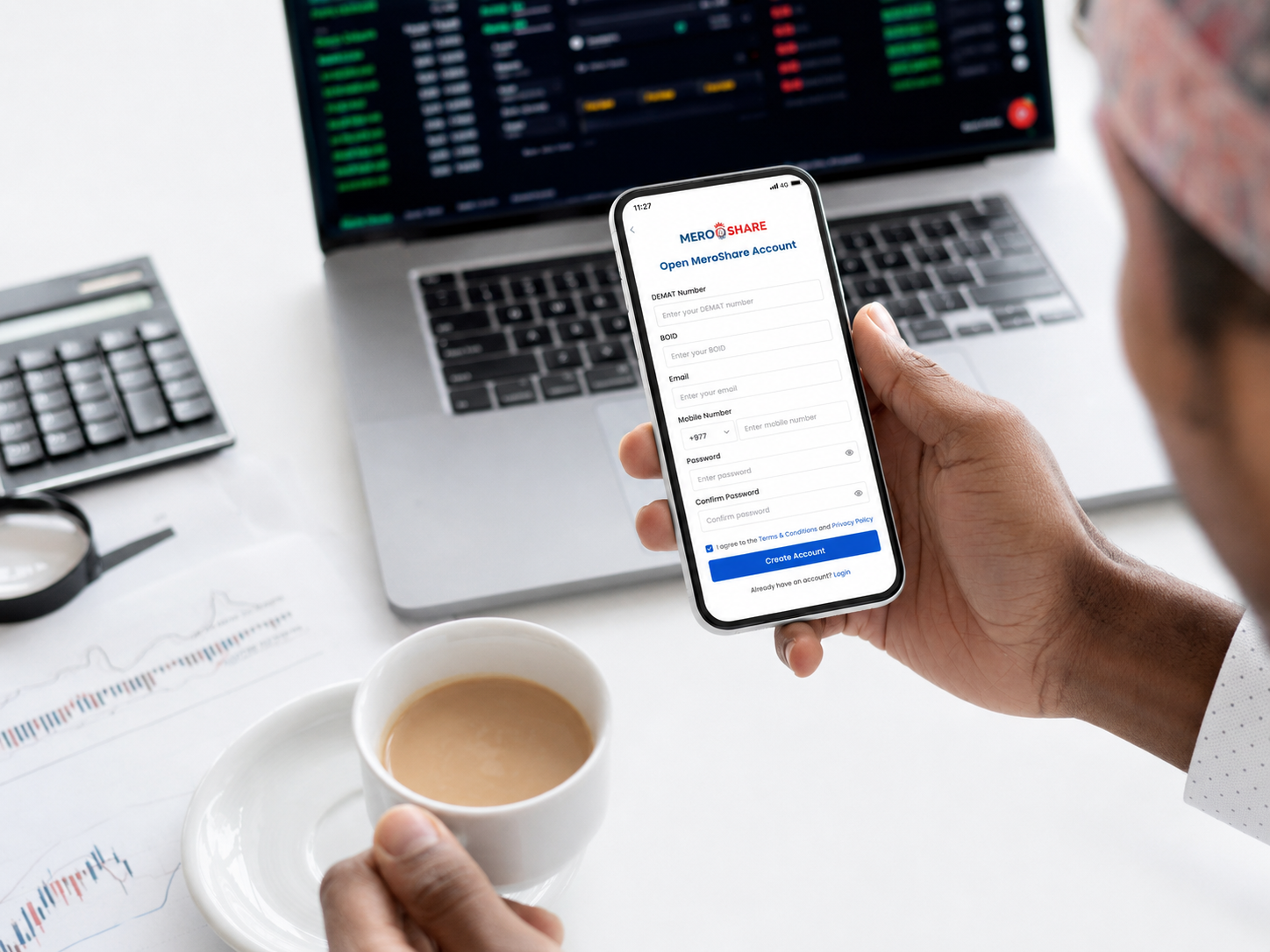
Then there is Meroshare, the online portal run by CDSC. This is the part you will log into most. Meroshare is where you apply for IPOs and FPOs, see your holdings, track corporate actions like bonus shares and dividends, and transfer shares you have sold. It does not let you buy and sell on the open market. That is a separate system.
That separate system is TMS, the Trading Management System. TMS is the online platform of your stockbroker, where you actually place buy and sell orders on the NEPSE secondary market. You get TMS credentials only after you open a trading account with a licensed broker, which is a step beyond the demat account itself. Many beginners conflate the two. They are not the same. Meroshare is your record book and IPO gateway; TMS is your trading desk.
The last piece is ASBA, Application Supported by Blocked Amount. When you apply for an IPO through Meroshare, the money is not pulled out of your bank account immediately. It is blocked in your account through your bank’s ASBA service and only deducted if shares are actually allotted to you. If you get nothing, the block is released. This is why your demat and Meroshare accounts have to be linked to a bank account that supports ASBA and why the bank you choose matters more than people assume.
For how the actual share lottery works once you apply, our explainer on how IPO allotment works in Nepal goes deeper than we will here.
What you need before you start
Keep the paperwork ready so you are not making a second trip. Most DPs ask for:
- A copy of your citizenship certificate (Nagarikta) or passport for those without citizenship. NRNs and foreign nationals follow a separate route, covered briefly below.
- Two recent passport-size photographs.
- Your bank account details, ideally a bank that is also a DP or at least supports ASBA, so the linkage is clean.
- A working mobile number and email, because Meroshare and IPO alerts run through both.
- For minors, the guardian’s documents and the birth certificate or citizenship of the guardian.
That is the core list. Individual DPs may ask for a little more, but if you arrive with these, you will almost always get through.
The steps, in order
Here is the sequence that actually gets you from nothing to a working, IPO-ready setup.
Step 1: Choose your DP, and do not choose it on price alone. This is the decision people rush and later regret. Every DP charges roughly the same headline fees, so the few rupees of difference are not the point. What matters is whether the DP is also a bank where you hold an account that supports ASBA, how responsive their DP desk is when something breaks, and whether they process renewals and corrections quickly. A demat account at a bank where you already bank and which has a functioning online renewal system is worth far more than one that is twenty rupees cheaper. More on this below, because it is the single most common rookie mistake.
Step 2: Fill in the demat (BO) account form at the DP. You can do this at a branch or, with many DPs now, online. The form asks for your personal details exactly as they appear on your citizenship, your bank account number, and a nominee. Fill the name field with extreme care. The name on your demat account must match the name on your bank account and, later, your IPO applications. A mismatch here is the quiet killer of IPO allotments.
Step 3: Submit documents and pay the opening fee. The DP verifies your KYC (Know Your Customer, the identity and address checks every financial account requires) and submits your details to the CDSC. You will be charged a one-time demat account opening fee. Industry sources put this at around NPR 150 set at the DP level, though some DPs run promotions that waive it.
Step 4: Receive your BO ID. Once CDSC processes the account, you get your 16-digit Beneficial Owner ID. This is the number that identifies you across the whole system. Keep it somewhere safe. You will need it for Meroshare registration and for every IPO you apply to.
Step 5: Register for Meroshare. With the demat account live, you register on the Meroshare portal. You will need your BO ID and your DP’s identifier, and you will set a username and password. Crucially, Meroshare also asks you to set a transaction PIN, a four-digit code you enter to confirm IPO applications and share transfers. Forget this PIN and you cannot apply for anything, so write it down. There is a small Meroshare registration charge, commonly cited at around NPR 50.
Step 6: Link the bank account for ASBA. Inside Meroshare, under your bank settings, you confirm the bank account that will fund your IPO applications. This is the account where money gets blocked when you apply. If this bank does not support ASBA, or the account details are wrong, your applications will fail. Confirm it once, properly.
Step 7 (separate and optional but eventually necessary): Open a broker trading account for TMS. If you only want to apply for IPOs, you can stop at Meroshare. But the moment you want to buy or sell on the secondary market, you must open a trading account with a licensed NEPSE broker, who gives you a TMS login and a separate client (CRN) reference for settlement. This is a distinct process from the demat account, and it can be done at the same time or later.
Done properly, this whole chain takes anywhere from a day to a week depending on how fast your DP and CDSC process the account.
The fees nobody warns you about
The opening fee is the cheap part. The cost that catches people out is the annual one.
Your demat account is not a one-time purchase. It carries an annual maintenance charge (AMC) that you have to pay every Nepali fiscal year, and Meroshare has its own annual renewal fee on top. Multiple DP fee schedules put the demat AMC in the region of NPR 100 per year and the Meroshare renewal at roughly NPR 50 per year, so a typical investor is looking at somewhere around NPR 150 to NPR 200 a year just to keep the lights on before any transaction or trading costs.
The amount is small. The consequence of forgetting is nothing. The renewal is tied to the Nepali fiscal year, with the practical deadline falling around the end of Asar (mid-July). Miss it and your demat account can be blocked, which means you cannot apply for IPOs and, depending on the situation, cannot transfer shares you have sold. People discover this at the worst possible moment, usually when a hot IPO opens and their account suddenly will not let them apply. Set a calendar reminder for Asar. Pay both the demat and Meroshare renewals together. Many banks now let you renew online through eSewa, Khalti or connectIPS, and reactivation typically takes up to a day or two while the DP updates CDSC’s system.
There are other charges further down the line, transaction fees on share transfers, and pledge charges if you lock shares as loan collateral, but for a beginner the two that matter are the opening fee once and the annual renewals forever.
The mistakes that cost beginners
A few errors show up again and again, and all of them are avoidable.
The most damaging is a name mismatch. Your demat account name, your bank account name, and your IPO application all have to line up. If your citizenship reads one spelling, your bank account another, and Meroshare a third, allotments and transfers can be rejected even when you did everything else right. Fix this at the source by entering your name exactly as it appears on your citizenship, everywhere.
The second is letting KYC expire. KYC is not always permanent. DPs and CDSC periodically require you to update your KYC details, and an out-of-date KYC can freeze your ability to transact. If a renewal payment goes through but your account still will not apply for an IPO, an expired KYC is a likely culprit. Update it when your DP asks, not when you are blocked.
The third is choosing a DP on price alone, which we flagged earlier and will say plainly now. The headline fees barely differ. What differs is service, the responsiveness of the DP desk when a transfer hangs, whether renewals can be done online, and whether the DP is the same bank that holds your ASBA account. A clean, well-run DP at your own bank saves you hours and missed deadlines. A cheap DP that does not answer the phone in mid-July does not.
The fourth, smaller but common, is losing the transaction PIN or login. Treat your Meroshare PIN with the same care as a bank PIN. Recovering it is possible but slow, and slow is expensive when an IPO closes in three days.
A note for NRNs and the diaspora
Non-resident Nepalis can invest in NEPSE, but the account-opening path runs through specific NRN-designated bank accounts and additional documentation, and it has historically been more cumbersome than the resident process. If you are abroad, do not assume the standard demat steps apply unchanged. We cover the route and its friction points in our guide on how NRNs can invest in NEPSE.
The verdict
Opening a demat and Meroshare account is genuinely easy. That is precisely why people do it carelessly and pay later. The setup is not where the market punishes you; the maintenance is. Treat the BO ID, the transaction PIN, and the name fields as things to get exactly right the first time. Pick a DP for its service and its bank linkage, not its fee. Then put one recurring reminder in your calendar for Asar to pay both renewals, and you have removed the two failure points that block most beginners.
The accounts are the on-ramp, not the destination. Once you are set up, the harder and more useful skill is reading the market itself, starting with learning how to read the NEPSE floor sheet. Get the plumbing right once, then spend your attention where it actually pays off.
This is analysis, not financial advice.