A friend of mine lost his job in the second week of Shrawan. Nothing dramatic, the company just ran out of runway. He had, on paper, more money than most of his colleagues. The problem was where it sat. About NPR 8 lakh of it was in shares, bought near the top, now worth maybe NPR 5 lakh. Another chunk was locked in a two-year fixed deposit he could not break without forfeiting most of the interest. His actual spendable cash, the money he could touch that week to pay rent and buy groceries, was under NPR 40,000. He was, by the only definition that matters in a crisis, broke.
That is the gap this article is about. Almost everything written for Nepali investors is about growing money: which IPO to apply for, which hydropower stock is cheap, whether to do SIP. Almost nothing is written about the boring layer underneath all of that, the cash you keep precisely so you never have to sell a good investment at a bad time. An emergency fund in Nepal is that layer, and getting it right is more foundational than any stock pick you will ever make. Build the cash cushion first. Everything else sits on top of it.
This piece takes a clear position, because hedging would waste your time. Your emergency fund does not belong in the stock market, and it mostly does not belong in a mutual fund either. It belongs in the dullest, most liquid instruments Nepal offers, arranged so you can reach the money in days and so a single bank failure cannot wipe it out. Here is how to size it and where to put it.
What an emergency fund actually is (and is not)
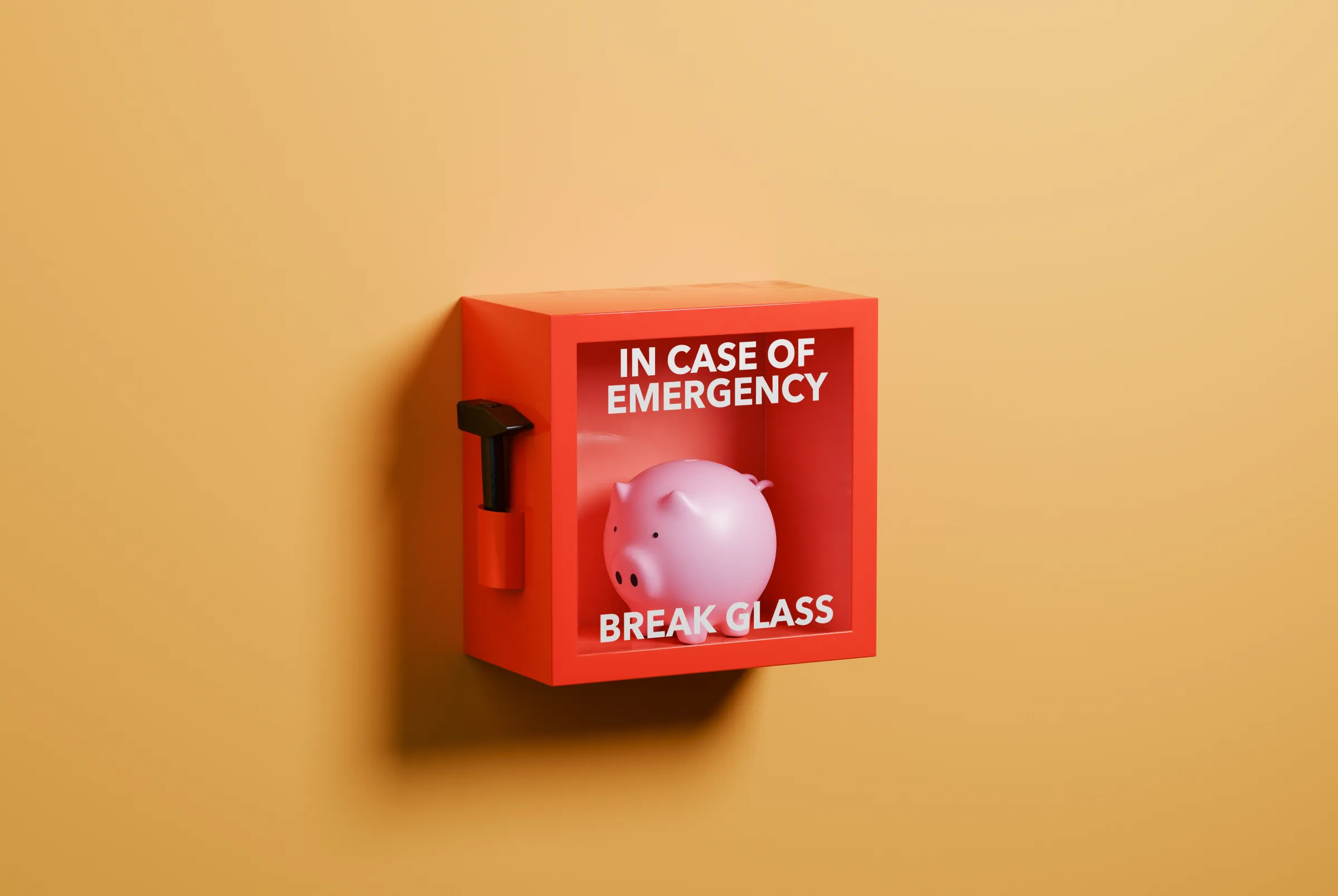
An emergency fund is money set aside for genuine shocks: job loss, a medical bill, an urgent trip home, a sudden repair. Two features define it. It must be safe, meaning its rupee value does not fall while you are not looking. And it must be liquid, meaning you can convert it to spendable cash quickly, without a penalty large enough to make you hesitate in the moment you need it.
Notice what those two requirements rule out. They rule out anything whose price swings, because a fund that is worth NPR 5 lakh in a calm month and NPR 3 lakh in a panic is not a cushion, it is another risk. They rule out anything you cannot access for months. This is why the goal is not return. The job of this money is to be boring and available, not to grow. If you find yourself trying to make your emergency fund “work harder,” you have misunderstood its purpose. Its return is the disaster it lets you survive without selling your real investments at the bottom, the exact mistake my friend was forced into.
How much: the honest Nepali number
The global rule of thumb is three to six months of expenses. That is a reasonable starting frame, but importing it into Nepal without adjustment is lazy. Nepal’s conditions push the sensible number toward the higher end, and past it for many households.
Start with the base. Add up what you actually spend in a month to live: rent, food, utilities, school fees, loan EMIs, transport, medicine. Not what you earn, what you spend. Multiply that by the number of months you want covered. If you spend NPR 60,000 a month, three months is NPR 1,80,000 and six months is NPR 3,60,000.
Now adjust for the country you live in. Three factors argue for more, not less. First, income stability. A permanent government or bank employee with a predictable salary can sit nearer three months. A contractor, a small-business owner, a remittance-dependent household, or anyone in tourism or construction where income arrives in lumps should think six months or more, because their income can stop for a whole season, not a fortnight. Second, the safety net. Nepal has no unemployment insurance to speak of. The Social Security Fund covers contributors for specific benefits, but it is not a cushion you can draw on the week you lose your job. If the state will not catch you, your own cash has to. Third, dependents and health exposure. Out-of-pocket medical costs are high and health insurance coverage is thin, so a single hospitalization can eat months of expenses in days.
My position: for most working Nepalis with irregular income or dependents, six months is the floor, not the ceiling. The three-month figure is for the minority with a genuinely stable paycheck and few dependents. If that sounds like a lot of idle cash, it is, and that discomfort is exactly why so few people hold enough. The discomfort is the price of not being my friend in Shrawan.
The ranking: where to keep it, by access
Now the core of it. Rank the options by how fast you can get the cash and how safe the rupee value is, and the right structure falls out almost on its own.
Tier one: an ordinary savings account
This is the base of the pyramid and it is not optional. A savings account at a commercial bank is the most liquid rupee instrument you have. You can withdraw at an ATM, move money by mobile banking, and access it on any day including, through digital channels, holidays. The rupee value never falls.
The cost is return. Savings rates in Nepal are low and, in the current environment of ample banking liquidity, have drifted lower. Through 2026 most commercial banks have offered savings rates in roughly the 4.30 to 5.25 percent band, with no NRB-imposed floor this year, and some accounts pay far less: Nepal Bank Limited’s normal savings account, for example, was set around 2.76 percent effective March 15, 2026, according to its published deposit rate framework. Interest is also taxed at source as a final withholding, so treat the headline rate as a ceiling on what actually reaches you, not your take-home.
That low return is fine. The savings account is not where the fund earns, it is where the fund waits. Keep enough here to cover roughly one month of expenses, the money you might need this week, and push the rest into tier two.
Tier two: a short fixed deposit ladder
A fixed deposit (FD) pays more than a savings account in exchange for locking your money for a term. As of Shrawan 2083 (July 2026), the highest one-year FD rates among commercial banks sat around 4.55 percent (Nabil and Prabhu, per rate trackers compiled by pricenepal.com and bankratenepal.com), with most large banks clustered between roughly 3.85 and 4.55 percent. Development banks pay more, with some, like Karnali, quoted as high as 8.50 percent for Asar 2083, though a smaller institution carries more credit risk, which matters more than usual for money you cannot afford to lose.
The obvious objection to an FD for an emergency fund is the lock-in. Break it early and you forfeit a large slice of the interest, so a “one-year FD” can feel useless in a true emergency. The fix is a ladder. Instead of one NPR 3 lakh deposit for one year, split it into three or four smaller deposits maturing at staggered intervals, say every three months. Something is always coming due soon, so you rarely have to break a deposit at a penalty, and you still earn close to the FD rate on most of the money. A ladder converts a locked instrument into a semi-liquid one. It is the single most useful trick in this article, and almost nobody does it. Because the FD versus cash trade-off swings with the interest rate cycle, our companion piece on fixed deposit vs stocks in Nepal is worth reading alongside this one.
Tier three: liquid and money market mutual funds, with a caveat
In a developed market, this is where the emergency fund actually lives: in a money market fund that holds short-term government paper and bank deposits, pays close to the policy rate, and can be redeemed in a day or two with almost no price risk. Nepal is not there yet, and this is the honest catch most listicles skip.
Nepal now has open-end mutual funds that allow you to buy and redeem units at the daily net asset value, such as the NIBL Sahabhagita Fund and Nabil Investment’s NI 31, rather than the older closed-end funds that trade on NEPSE at a discount. Open-end structure gives you the liquidity an emergency fund needs. The problem is what these funds hold. Most Nepali open-end funds still carry meaningful equity exposure, which means their NAV moves with the stock market. A fund that can fall 15 percent when NEPSE falls is not a safe place for emergency cash, however easy it is to redeem. A true money market or pure debt fund, holding only short-term deposits and bonds, is the instrument you would want here, and the category is only just emerging in Nepal rather than being widely available. Until a genuinely low-volatility debt fund is on offer, treat mutual funds as a place for investment money, not emergency money. If you want to understand why the fund label alone tells you little, read our explainer on how mutual funds work in Nepal.
What does not belong here at all
Shares. Not blue chips, not “safe” bank stocks, not the hydropower company everyone swears by. Equities are the opposite of an emergency fund: their price can halve, and it tends to halve in exactly the wide crises, a downturn, a liquidity squeeze, when you are most likely to also lose your income. NEPSE fell by roughly half between its 2021 peak and 2023. Anyone whose emergency fund was in shares over that stretch watched their cushion deflate precisely as the economy tightened. Gold and land have the same disqualifying flaw for this purpose, price risk and, for land, no liquidity at all. These are fine as investments. They are disqualified as emergency cash by definition.
The rule almost everyone ignores: the NPR 5 lakh guarantee
Here is a piece of the puzzle that changes how you spread the money, and it is genuinely under-discussed. Bank deposits in Nepal are insured, but only up to a limit.
The Deposit and Credit Guarantee Fund (DCGF), the state body that guarantees deposits, covers up to NPR 5 lakh per natural-person depositor per member bank or financial institution, applied to your combined savings and fixed deposits at that institution, per the DCGF’s own published guarantee terms. If a bank fails, that is the amount the guarantee is designed to make good. Anything above NPR 5 lakh at a single bank sits outside the guarantee.
For most people building a three-to-six-month fund, this matters. If your emergency fund is NPR 8 lakh and it all sits at one bank, NPR 3 lakh of it is, strictly, unguaranteed. Nepali commercial banks failing outright is rare, and NRB has generally engineered mergers rather than let depositors take losses, so treat this as prudence, not panic. But the fix costs nothing. Split a large fund across two or three banks so no single institution holds more than NPR 5 lakh of your guaranteed money. You lose nothing by doing this, and you remove tail risk from the one pot of money that exists to protect you from tail risk. Spreading across banks also pairs naturally with the FD ladder, since you are opening deposits at more than one institution anyway.
Putting it together: a worked structure
Take a household spending NPR 60,000 a month that has decided on a six-month fund, so NPR 3,60,000. A sensible structure looks like this. Keep about one month, roughly NPR 60,000, in a savings account for instant access. Ladder the remaining NPR 3,00,000 across three or four fixed deposits maturing every few months, so cash keeps freeing up without early-break penalties. Split those deposits across two banks so neither holds more than NPR 5 lakh, which here is easily satisfied. Skip mutual funds and shares for this money entirely until a low-volatility debt fund genuinely exists.
The blended return on that structure will be modest, likely in the mid-single digits before tax, and lower after the withholding on interest. That is the correct outcome. You are buying certainty and access, and you are paying for them in forgone return. The mistake is not accepting a low return on your emergency fund. The mistake is reaching for return here and discovering, in the week you lose your job, that your safety net has a hole in it.
The verdict
An emergency fund is the least glamorous money you will ever hold and the most important. In Nepal, where the state safety net is thin, incomes are often irregular, and a hospital bill can arrive with no warning, six months of expenses is a sensible floor for most households, not the cautious extreme. Keep the first month in a savings account, ladder the rest into short fixed deposits, and split the total across banks so no more than NPR 5 lakh of guaranteed money sits at any one of them. Keep it out of shares, out of gold, out of land, and, for now, out of equity-heavy mutual funds.
Once that cushion is built and boring and fully funded, you have earned the right to take risk with everything above it. Not before. If you are only now working out how much you can afford to invest at all, start with our guide to how much money you need to start investing in NEPSE, and note the order: the emergency fund comes first.
This is analysis, not financial advice.